

IEC | INDONESIA EXPORT CENTER
Natural Goodness from Indonesia to the World
Understanding Customs Classification for Edible Swiftlet Bird’s Nest
Correct customs classification is an important step in international edible bird’s nest trade.
Importers and exporters need to determine how the actual product should be classified under the applicable customs tariff system.
Indonesia Export Center (IEC) facilitates inquiries involving potential Indonesian edible swiftlet bird’s nest suppliers.
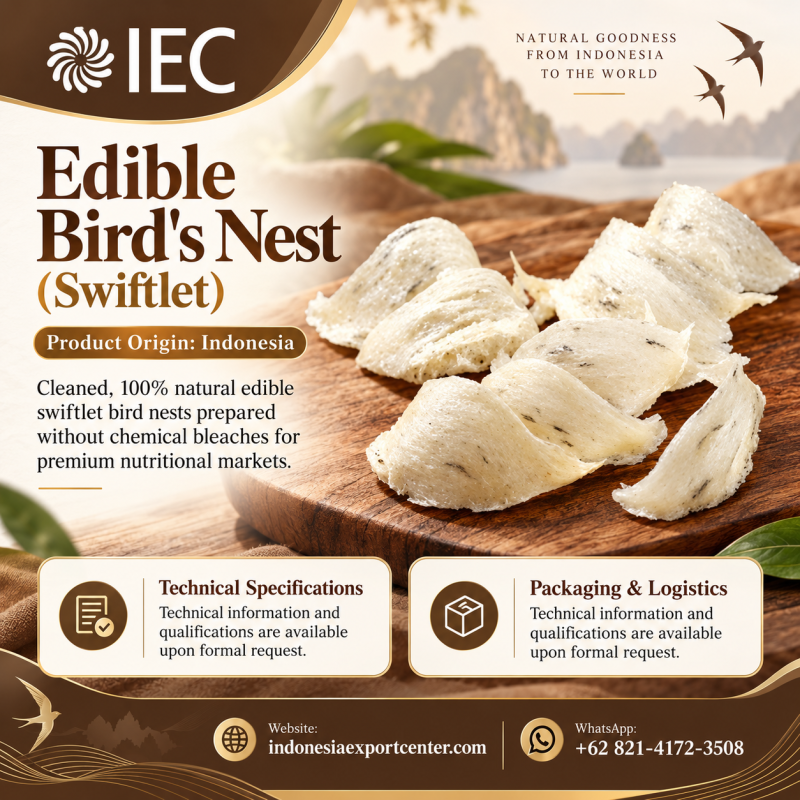
The IEC brochure identifies the product as cleaned edible swiftlet nests originating from Indonesia.
No specific HS code is assigned in this article because the correct classification must be verified for the actual product and relevant jurisdiction.
What Is an HS Code?
The Harmonized System is an international framework used to classify traded goods.
Countries may apply additional national tariff subdivisions and classification rules.
The correct classification may influence:
- Customs duties.
- Import restrictions.
- Statistical reporting.
- Documentary requirements.
- Preferential tariff treatment.
- Regulatory controls.
- Customs declarations.
Why Product Description Matters
A customs specialist should know exactly what is being imported.
Relevant information includes:
- Product identity.
- Animal source.
- Processing status.
- Composition.
- Physical form.
- Intended use.
- Packaging.
- Whether the material is a raw ingredient or prepared food product.
An incomplete product description may lead to classification errors.
Raw vs Cleaned vs Further-Processed Products
Different product presentations may require separate classification analysis.
For example, buyers should distinguish:
- Raw edible bird’s nest.
- Cleaned edible bird’s nest.
- Further-processed bird’s nest material.
- Prepared food products containing bird’s nest.
- Beverages containing bird’s nest.
These categories should not automatically be assigned the same code.
Step 1 – Prepare a Technical Product Description
Include:
- Commercial name.
- Scientific source information where available.
- Composition.
- Processing steps.
- Physical form.
- Intended use.
- Packaging.
- Country of origin.
Step 2 – Research the Applicable Tariff Schedule
Consult the official tariff schedule for the importing country.
Review:
- Relevant headings.
- Legal section notes.
- Chapter notes.
- Subheading descriptions.
- Applicable interpretive rules.
- National tariff subdivisions.
Step 3 – Consult a Qualified Customs Specialist
A customs broker or trade classification professional may help evaluate the product description and applicable tariff provisions.
However, professional advice should be based on the actual material.
Step 4 – Consider an Official Customs Ruling
Where available, importers may request an advance or binding classification ruling from the competent customs authority.
The process, validity, and legal effect depend on the jurisdiction.
Step 5 – Verify Import Restrictions
Customs classification does not replace food safety or animal-origin import controls.
The importer should separately verify:
- Import eligibility.
- Sanitary requirements.
- Health certificates.
- Import permits.
- Establishment approvals.
- Laboratory testing.
- Border inspection.
Step 6 – Review Customs Valuation
Customs valuation may depend on:
- Transaction value.
- Freight.
- Insurance.
- Relevant adjustments.
- Applicable valuation rules.
- Supporting commercial documents.
The applicable customs valuation method should be confirmed.
Step 7 – Review Country-of-Origin Documentation
Origin may affect:
- Tariff treatment.
- Trade agreement eligibility.
- Documentary requirements.
- Origin marking.
An origin statement alone does not necessarily establish entitlement to preferential duty treatment.
Step 8 – Align Commercial Documents
Ensure consistency between:
Product Specification → Invoice → Packing List → Certificate → Transport Document → Customs Declaration
Material inconsistencies may create questions during clearance.
Customs Classification Checklist
| Item | Buyer Action |
|---|---|
| Product Description | Confirm |
| Processing Status | Document |
| Composition | Verify |
| HS Heading | Research |
| National Tariff Code | Confirm |
| Customs Ruling | Consider |
| Import Restrictions | Check |
| Customs Value | Verify |
| Country of Origin | Document |
| Certificates | Confirm |
| Duty and Tax Treatment | Verify |
Common Classification Mistakes
Using a Code Without Reviewing the Product
A code used by another importer may not apply to the actual material.
Copying a Supplier’s Code Without Verification
The importer should independently review classification.
Confusing Raw Material and Finished Food
Processing can affect classification.
Assuming Export and Import Codes Are Identical at Every Digit
National tariff subdivisions can differ.
Ignoring Regulatory Controls
Correct tariff classification does not guarantee that the product may be imported.
Customs Documentation Request Template
Subject: Edible Bird’s Nest Customs Classification Information Request
Company: [Name]
Destination Country: [Country]
Product: Edible Swiftlet Bird’s Nest
Product Form: [Details]
Processing Status: [Details]
Composition: [Details]
Intended Use: [Details]
Packaging: [Details]
Required Technical Description: [Details]
Required Origin Documentation: [Details]
Commercial Quantity: [KG]
Destination Port: [Port]
Please provide available product identity, processing, composition, origin, and shipment information to support independent customs classification research.
Frequently Asked Questions
What is the HS code for edible bird’s nest?
The appropriate code must be determined using the actual product description and applicable tariff schedule.
Can IEC guarantee a particular customs classification?
No.
Does cleaning affect classification?
Processing status may be relevant and should be reviewed.
Is an HS code the same as an import permit?
No.
Can customs authorities provide an official classification ruling?
Some jurisdictions offer such procedures.
Does a correct HS code guarantee customs clearance?
No.
Request Edible Bird’s Nest Customs Documentation
Need technical product information to support customs classification and import planning?
Contact IEC with your destination country, product form, processing status, and documentation requirements.
REQUEST BIRD’S NEST CUSTOMS PRODUCT INFORMATION
IEC | INDONESIA EXPORT CENTER
Website: https://indonesiaexportcenter.com/
WhatsApp: +62 821-4172-3508
Related Resources
Edible Bird’s Nest Export Requirements Indonesia
Importing Indonesian Bird’s Nest: Buyer Checklist
Bird’s Nest Sanitary and Veterinary Documents
