

IEC | INDONESIA EXPORT CENTER
Natural Goodness from Indonesia to the World
A Practical Import Checklist for Indonesian Edible Swiftlet Bird’s Nest
Importing Indonesian edible bird’s nest requires a structured procurement process.
A buyer must consider product identity, supplier legitimacy, import eligibility, laboratory testing, documentation, shipping, customs clearance, and receiving quality control.
Indonesia Export Center (IEC) facilitates inquiries involving potential Indonesian edible swiftlet bird’s nest suppliers.
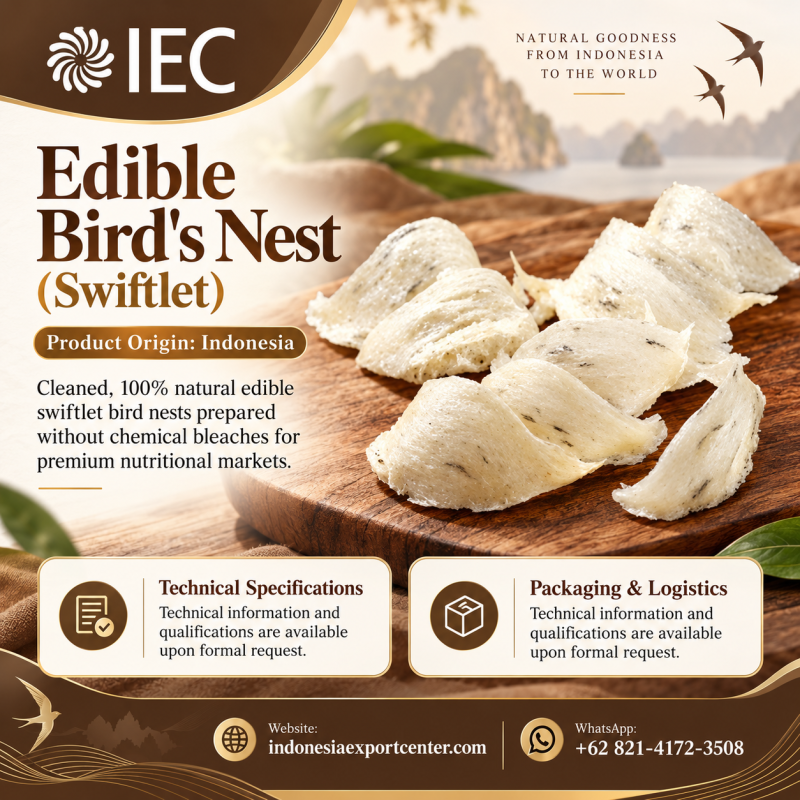
The IEC brochure describes cleaned, natural edible swiftlet nests originating from Indonesia and prepared without chemical bleaches.
The availability of specific grades, samples, prices, MOQ, export documents, and approved suppliers must be confirmed.
Phase 1 – Before Contacting Suppliers
1. Identify Your Destination Market
Confirm the country where the product will be imported.
2. Check Whether Import Is Permitted
Contact the relevant competent authority or qualified import specialist.
3. Identify the Product Category
Determine whether the proposed material is raw, cleaned, processed, or part of a finished food product.
4. Verify Importer Eligibility
Confirm whether your company requires:
- Food business registration.
- Importer registration.
- Import permit.
- Animal-origin product authorization.
- Other market-specific approvals.
5. Research Customs Classification
Determine the correct HS or national tariff classification.
Do not rely on an unverified supplier code.
Phase 2 – Product Specification
6. Define Product Form
Choose the required form:
- Whole nests.
- Broken pieces.
- Strips.
- Fragments.
- Other defined product forms.
Availability is subject to confirmation.
7. Define Quality Requirements
Specify:
- Grade.
- Appearance.
- Cleaning status.
- Moisture.
- Foreign matter.
- Nitrite.
- Microbiological criteria.
- Heavy metal criteria.
- Packaging.
- Traceability.
8. Establish Test Methods
Identify the required analytical methods and acceptance limits.
9. Define Packaging
Specify packaging materials, net weight, labels, and protection requirements.
Phase 3 – Supplier Due Diligence
10. Verify Legal Identity
Confirm the legal seller and relevant business details.
11. Identify the Processing Establishment
Determine who prepares and packs the product.
12. Check Establishment Eligibility
Verify destination-specific approvals where required.
13. Review Source Information
Request origin and traceability records.
14. Review Quality Systems
Ask about hygiene, inspection, testing, and nonconformity procedures.
Phase 4 – Samples and Testing
15. Confirm Sample Import Rules
Samples may also require regulatory authorization.
16. Request a Representative Sample
Where available and permitted, request a sample suitable for evaluation.
17. Conduct Visual Inspection
Assess form, appearance, cleanliness, and packaging.
18. Conduct Laboratory Testing
Arrange the relevant tests through an appropriate laboratory.
19. Approve the Specification
Document acceptance criteria before commercial ordering.
Phase 5 – Commercial Negotiation
20. Request a Written Quotation
Include:
- Product.
- Grade.
- Quantity.
- Price.
- Currency.
- Packaging.
- Delivery term.
- Destination.
- Lead time.
- Payment.
- Documentation.
21. Compare Total Landed Cost
Consider freight, insurance, duties, taxes, testing, inspection, clearance, and inland delivery.
22. Agree on Incoterms
Use the correct Incoterms rule and named place.
23. Review Payment Terms
Assess commercial risk and payment security.
24. Establish a Purchase Contract
Define quality, documentation, inspection, claims, and responsibilities.
Phase 6 – Before Shipment
25. Confirm Production or Processing Lot
Ensure the material is identifiable.
26. Review Laboratory Documents
Check test results and lot matching.
27. Review Official Certificates
Confirm the required health, sanitary, or veterinary documents.
28. Inspect Packaging
Check labels, seals, carton condition, and product protection.
29. Verify Shipping Documents
Ensure consistency across the invoice, packing list, transport document, and certificates.
30. Confirm Import Clearance Readiness
The importer or customs broker should verify that the shipment can be presented for entry.
Phase 7 – Arrival and Customs Clearance
31. Submit Required Documents
Follow destination-country procedures.
32. Complete Required Inspections
Authorities may require documentary, identity, or physical checks.
33. Pay Applicable Duties and Taxes
Confirm the correct tariff treatment and valuation.
34. Obtain Required Release
Do not distribute or use the product before the necessary regulatory and customs releases.
Phase 8 – Receiving and Inventory Control
35. Inspect Physical Condition
Check for damage, moisture exposure, and packaging defects.
36. Verify Quantity
Compare delivered material with the purchase order.
37. Match Lot Numbers
Connect the received goods to quality documents.
38. Apply Receiving Quality Control
Follow the company’s approved procedures.
39. Store Under Verified Conditions
Use supplier-supported storage instructions.
40. Maintain Records
Retain documents needed for traceability, complaints, and recall readiness.
Import Documentation Checklist
| Document | Requirement |
|---|---|
| Commercial Invoice | Generally relevant |
| Packing List | Generally relevant |
| Transport Document | Generally relevant |
| Certificate of Origin | If applicable |
| Health Certificate | If required |
| Sanitary/Veterinary Certificate | If required |
| Import Permit | If required |
| Laboratory Report | As required |
| Product Specification | Buyer requirement |
| Facility Approval Evidence | If required |
| Customs Classification | Verify |
| Other Official Documents | Destination-specific |
Common Import Mistakes
- Paying before verifying eligibility.
- Assuming every supplier is export-approved.
- Accepting vague product descriptions.
- Using an incorrect customs code.
- Ignoring laboratory requirements.
- Accepting unrelated COAs.
- Failing to verify official certificates.
- Overlooking storage requirements.
- Assuming sample import rules equal commercial import rules.
- Neglecting the final receiving inspection.
Importer RFQ Template
Subject: Indonesian Edible Bird’s Nest Import Inquiry
Company: [Name]
Destination Country: [Country]
Importer Registration: [If Relevant]
Product Form: [Details]
Required Grade: [Details]
Cleaning Requirements: [Details]
Technical Specifications: [Details]
Required Laboratory Tests: [Details]
Trial Quantity: [KG]
Commercial Quantity: [KG]
Destination Port: [Port]
Preferred Incoterm: [Term]
Required Health or Sanitary Documents: [Details]
Required Establishment Approvals: [Details]
Target Shipment Period: [Dates]
Please provide available supplier information, product specifications, export eligibility documentation, sample feasibility, and quotation details.
Frequently Asked Questions
Can first-time importers buy directly from Indonesia?
They may explore sourcing, but must first establish legal import eligibility and suitable supplier arrangements.
Are samples automatically permitted?
No.
Is the supplier responsible for all import permits?
Responsibilities depend on applicable law and the commercial agreement.
Can IEC guarantee customs clearance?
No.
Is the correct HS code universal across all countries?
National tariff classification and interpretation must be verified.
Should quality testing happen before shipment?
The appropriate testing and inspection arrangements should be agreed in advance.
Request Indonesian Bird’s Nest Import Assistance
Preparing your first or next edible bird’s nest import from Indonesia?
Contact IEC with your destination market, required product specifications, quantity, and import documentation checklist.
REQUEST BIRD’S NEST IMPORT SPECIFICATIONS & QUOTATION
IEC | INDONESIA EXPORT CENTER
Website: https://indonesiaexportcenter.com/
WhatsApp: +62 821-4172-3508
Related Resources
Edible Bird’s Nest Export Requirements Indonesia
Edible Bird’s Nest HS Code and Customs Questions
Bird’s Nest Sanitary and Veterinary Documents
