

IEC | INDONESIA EXPORT CENTER
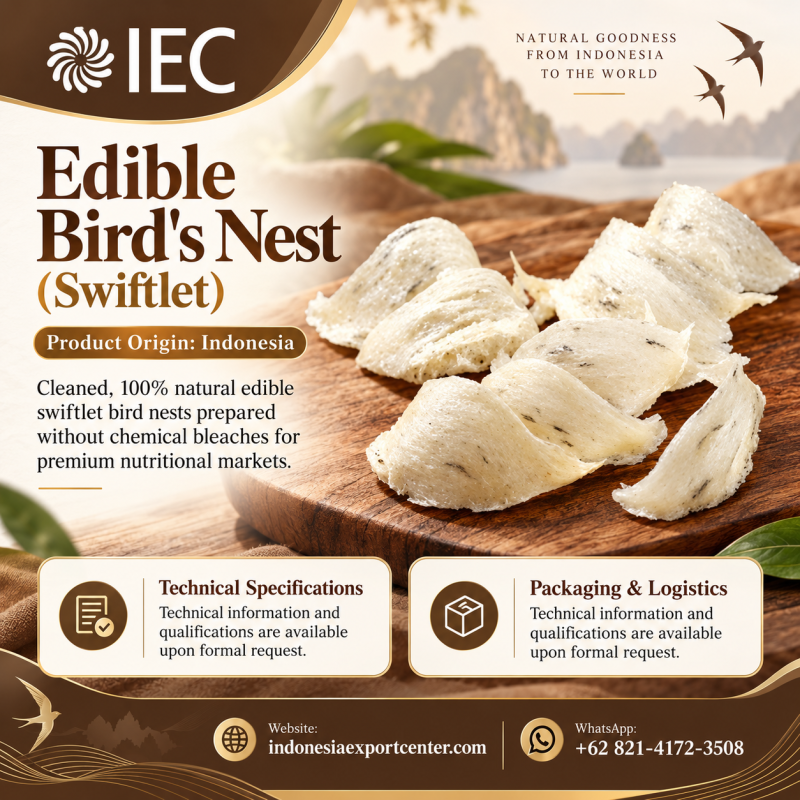
Natural Goodness from Indonesia to the World
Understanding Indonesian Edible Bird’s Nest Export Requirements
Exporting edible swiftlet bird’s nest from Indonesia requires more than finding a supplier and arranging international freight.
Because the product is intended for human consumption and originates from an animal source, exporters and importers may need to comply with specific Indonesian and destination-country requirements.
Indonesia Export Center (IEC) facilitates B2B sourcing inquiries involving potential Indonesian edible bird’s nest suppliers.
The IEC brochure describes cleaned edible swiftlet bird’s nest originating from Indonesia.
The brochure does not establish that any particular supplier, processing establishment, or shipment has obtained the approvals required for export to a specific country.
Regulations and administrative procedures can change. Current requirements must be verified with the relevant authorities before a transaction proceeds.
Why Export Compliance Matters
A shipment may face delays, rejection, or other regulatory consequences if:
- The exporting entity lacks required registration.
- The product is not eligible for the destination market.
- The processing facility is not approved where required.
- A necessary health certificate is missing.
- Laboratory results do not meet applicable standards.
- Documents contain inconsistent information.
- The product is incorrectly classified.
- The importer lacks required authorization.
Step 1 – Identify the Product
Begin with an accurate product description.
Confirm:
- Edible swiftlet bird’s nest.
- Product form.
- Processing status.
- Species information where required.
- Country of origin.
- Intended use.
- Packaging.
- Destination country.
The requirements for cleaned nests may differ from those for raw or further-processed products.
Step 2 – Verify the Indonesian Exporting Entity
The exporter should verify its current business registration and any additional permissions applicable to the product and transaction.
The buyer should establish:
- Legal seller.
- Exporter of record.
- Processing establishment.
- Product owner.
- Shipping party.
- Responsible documentation party.
IEC’s sourcing role should not be confused with a confirmed exporter-of-record role.
Step 3 – Identify Relevant Indonesian Authorities
Depending on the product and current rules, exporters may need to consult competent Indonesian authorities responsible for:
- Customs and export declarations.
- Quarantine and animal-origin product controls.
- Food safety and relevant product oversight.
- Trade licensing.
- Other applicable sectoral requirements.
For example, the Indonesian Customs authority and relevant quarantine authorities may be involved in determining applicable procedures.
The exact authority, permit, certificate, and administrative pathway should be confirmed for the transaction.
Step 4 – Check Destination-Country Eligibility
Before negotiating shipment terms, determine whether the destination country permits imports of the proposed product.
Questions include:
- Is Indonesia an eligible origin?
- Is the product category permitted?
- Must the processing establishment be approved?
- Must the source be registered?
- Is a bilateral sanitary arrangement relevant?
- Is an official certificate required?
- Are specific laboratory tests required?
- Does the importer need prior authorization?
Do not assume that eligibility in one destination establishes eligibility in another.
Step 5 – Verify Processing Establishment Requirements
Certain markets may require processing facilities to meet specified conditions.
Possible requirements include:
- Establishment registration.
- Official approval.
- Hygiene controls.
- Traceability.
- Laboratory testing.
- Inspection.
- Documentation.
- Market-specific eligibility.
A supplier’s general business licence does not necessarily establish destination-specific export approval.
Step 6 – Determine Product Testing Requirements
Depending on applicable rules, testing may address:
- Nitrite.
- Relevant microorganisms.
- Heavy metals.
- Moisture.
- Other chemical or physical hazards.
The correct panel, methods, limits, and laboratory qualifications must be confirmed.
Step 7 – Prepare Commercial Documents
Potential commercial documents include:
- Commercial invoice.
- Packing list.
- Sales contract.
- Transport document.
- Product specification.
- Certificate of origin where applicable.
The final document list depends on the shipment and destination.
Step 8 – Prepare Regulatory Documents
Depending on applicable requirements, documents may include:
- Health certificate.
- Sanitary or veterinary documentation.
- Quarantine documentation.
- Establishment approval evidence.
- Laboratory reports.
- Export permits.
- Import authorization.
- Other official declarations.
Not all documents apply to every transaction.
Step 9 – Verify Customs Classification
The exporter and importer should confirm the correct customs classification.
No HS code is assigned in this article.
The final classification should reflect the actual product and relevant tariff rules.
Step 10 – Review Packaging and Labelling
Packaging and labels may need to address:
- Product identity.
- Country of origin.
- Net weight.
- Lot number.
- Processing establishment information.
- Date marking.
- Storage instructions.
- Destination-language requirements.
- Other mandatory information.
Step 11 – Arrange Inspection and Shipment
Before dispatch, review:
- Product specifications.
- Lot identification.
- Packaging.
- Laboratory documentation.
- Certificates.
- Quantity.
- Freight booking.
- Destination clearance requirements.
- Insurance where appropriate.
Step 12 – Confirm Import Clearance Responsibilities
The contract should clarify which party is responsible for:
- Export formalities.
- Freight.
- Insurance.
- Import permits.
- Customs clearance.
- Duties and taxes.
- Inspection.
- Storage charges.
- Delivery.
Incoterms do not replace regulatory compliance obligations.
Export Compliance Checklist
| Requirement | Responsible Party | Status |
|---|---|---|
| Product Identity | Buyer/Supplier | Verify |
| Exporter Registration | Exporter | Verify |
| Processing Facility Eligibility | Supplier/Exporter | Verify |
| Destination Eligibility | Importer | Verify |
| Required Permits | Relevant Party | Verify |
| Laboratory Tests | Agreed Party | Verify |
| Health Certificates | Relevant Authority | Verify |
| Customs Classification | Customs Specialist | Verify |
| Commercial Documents | Seller/Exporter | Verify |
| Freight Arrangements | Agreed Party | Verify |
Export Inquiry Template
Subject: Indonesian Edible Bird’s Nest Export Eligibility Inquiry
Company: [Name]
Destination Country: [Country]
Product Form: [Details]
Processing Status: [Details]
Required Quantity: [KG]
Required Facility Approvals: [Details]
Required Health Certificates: [Details]
Required Laboratory Tests: [Details]
Required Export Documents: [Details]
Destination Port: [Port]
Preferred Incoterm: [Term]
Please advise whether suitable supplier information and export eligibility documentation can be reviewed for the proposed destination.
Frequently Asked Questions
Can Indonesian edible bird’s nest be exported to every country?
No automatic eligibility can be assumed.
Does every supplier have the same export permissions?
No.
Is a health certificate always required?
Requirements depend on the destination and applicable rules.
Can IEC guarantee export approval?
No.
Are export regulations fixed permanently?
No. They may change.
Should buyers verify destination eligibility before ordering?
Yes.
Request Indonesian Edible Bird’s Nest Export Information
Planning an international purchase of Indonesian edible swiftlet bird’s nest?
Contact IEC with your destination country, product requirements, quantity, and regulatory documentation checklist.
REQUEST BIRD’S NEST EXPORT DOCUMENTATION & QUOTATION
IEC | INDONESIA EXPORT CENTER
Website: https://indonesiaexportcenter.com/
WhatsApp: +62 821-4172-3508
Related Resources
Edible Bird’s Nest for Importers
Importing Indonesian Bird’s Nest: Buyer Checklist
Bird’s Nest Sanitary and Veterinary Documents
