

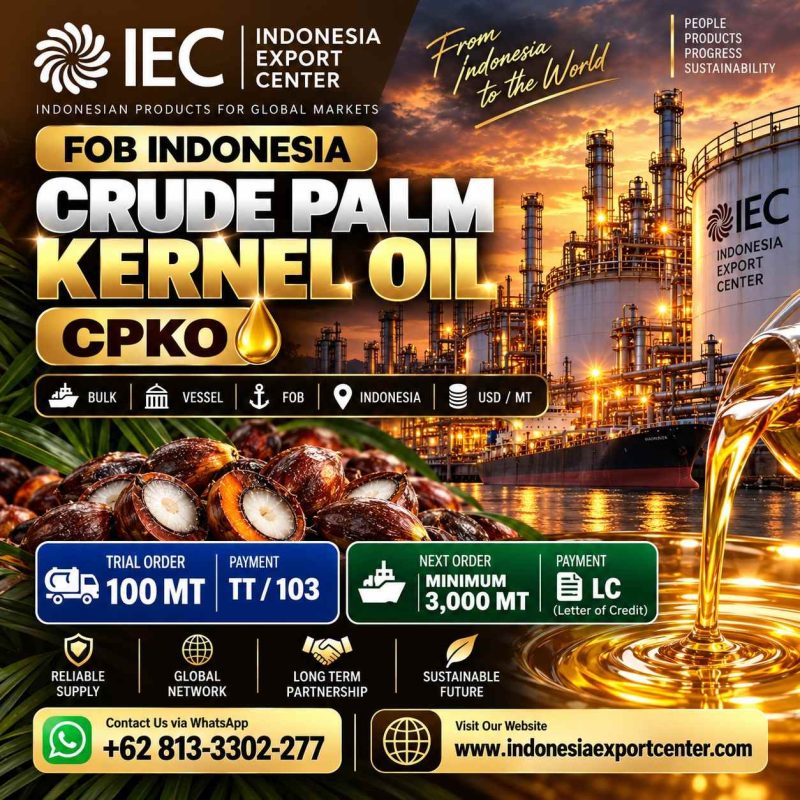
Verify Crude Palm Kernel Oil Quality Before Confirming Commercial Purchases
International Crude Palm Kernel Oil procurement requires careful attention to product specifications, representative sampling, laboratory testing, cargo quantity verification, and commercial acceptance criteria.
Indonesia Export Center (IEC) facilitates Indonesian CPKO sourcing inquiries for refineries, oleochemical manufacturers, industrial soap producers, commodity traders, and international importers.
A Certificate of Analysis and independent inspection may provide important information when evaluating a supplier or commercial shipment.
However, these documents must be understood according to their actual scope, sampling arrangements, testing methods, and contractual significance.
This guide explains how international buyers can establish an appropriate CPKO quality verification framework.
Indicative CPKO Technical Specifications
| Parameter | Indicative Reference |
|---|---|
| Product | Crude Palm Kernel Oil |
| Origin | Indonesia |
| Grade | Crude Industrial Feedstock |
| FFA as Lauric Acid | Maximum 5.0% |
| Moisture and Impurities | Maximum 0.5% |
| Iodine Value | Approximately 16–19 |
| Lauric Acid | Approximately 45–52% of Total Fatty Acids |
| Reference Trade Term | FOB Indonesia |
| Reference HS Code | 1513.21 |
These values are preliminary references and do not represent an actual tested shipment.
Final acceptance criteria must be established in the commercial contract.
What Is a CPKO Certificate of Analysis?
A Certificate of Analysis is a document reporting analytical results for an identified material sample or production batch.
A CPKO COA may include product identification, batch number, sample information, testing date, analytical methods, measured results, specification limits, laboratory details, and authorization information.
The document helps buyers evaluate whether the tested material meets agreed technical requirements.
However, the reliability of the COA depends on the authenticity of the document and the representativeness of the tested sample.
Supplier COA Versus Independent Inspection
| Evaluation Area | Supplier COA | Independent Inspection |
|---|---|---|
| Issuing Party | Supplier or Supplier-Arranged Laboratory | Agreed Independent Organization |
| Main Purpose | Report Product Analysis | Verify Agreed Inspection Scope |
| Sampling | Supplier or Agreed Procedure | According to Inspection Instructions |
| Quantity Verification | Not Necessarily Included | May Be Included |
| Loading Supervision | Not Necessarily Included | May Be Included |
| Commercial Significance | According to Contract | According to Contract |
Independent inspection does not automatically replace supplier documentation.
Both may be required depending on the transaction.
Representative COA Versus Shipment-Specific COA
A representative COA may provide information about a previously tested batch or typical supplier quality.
It may be useful during preliminary supplier qualification.
A shipment-specific COA should relate to the identified commercial cargo or batch according to agreed sampling procedures.
Buyers should avoid treating a historical representative COA as proof that a future shipment meets contractual requirements.
Main Parameters to Include in CPKO Inspection
Free Fatty Acids
FFA should be reported using the agreed fatty acid basis.
For the reference CPKO profile, FFA is expressed as lauric acid.
Moisture and Impurities
The parties should establish whether moisture and impurities are reported separately or as a combined result.
Iodine Value
The iodine value should be measured using an agreed analytical method.
Fatty Acid Composition
Buyers may request a detailed fatty acid profile, particularly where the oil is intended for oleochemical processing.
Additional Parameters
Depending on the intended application, additional testing may include peroxide value, saponification value, color, unsaponifiable matter, trace metals, phosphorus, or other contaminants.
The availability of specific tests should be confirmed with the selected laboratory.
Establishing Analytical Methods
Commercial specifications should identify appropriate analytical methods where necessary.
Recognized methods may be selected from relevant AOCS, ISO, or other accepted analytical standards.
The parties should agree on the exact method and applicable edition.
Different analytical methods or reporting conventions may produce results that are not directly comparable.
Representative Sampling for Bulk CPKO
Bulk liquid cargo sampling requires procedures appropriate to the selected cargo and storage arrangement.
Potential sampling locations may include supplier storage tanks, transfer lines, loading points, or vessel cargo tanks.
The appropriate procedure should be established by qualified inspection personnel.
The parties should agree on sampling timing, sample identification, sample retention, sealing, laboratory submission, and chain of custody.
A poorly identified or nonrepresentative sample may undermine the value of laboratory results.
Sample Retention and Claims Management
Retained samples may assist in resolving quality disputes where contractually agreed.
The parties should establish:
- Number of retained samples.
- Sample identification.
- Sealing and custody arrangements.
- Storage conditions.
- Retention period.
- Authorized testing organizations.
- Procedures for opening retained samples.
- Dispute resolution arrangements.
Actual requirements depend on the commercial contract and product characteristics.
Independent Laboratory Selection
International buyers may request laboratory testing through an agreed independent organization.
Potential evaluation criteria include technical competence, experience with vegetable oils, availability of required test methods, turnaround time, reporting procedures, and relevant accreditation.
Where accreditation is required, buyers should verify that the specific analytical method falls within the laboratory’s accredited scope.
Accreditation should not be assumed solely from the organization’s name.
Third-Party Inspection Provider Selection
Buyers may propose internationally recognized or locally qualified inspection organizations.
Companies such as SGS, Intertek, Bureau Veritas, or other suitable surveyors may be considered according to availability and buyer preference.
IEC does not claim a formal partnership, exclusive arrangement, or confirmed service availability with any named inspection organization.
The actual provider, scope, costs, and schedule must be agreed separately.
Quantity Verification for Bulk CPKO
Quality inspection and quantity inspection are distinct activities.
Bulk cargo quantity may be established using agreed calibrated weighing systems, tank measurements, or other accepted measurement procedures.
The appropriate method depends on the selected shipment format and available infrastructure.
The contract should identify:
| Quantity Parameter | Required Agreement |
|---|---|
| Contract Quantity | Metric Tons |
| Permitted Tolerance | Agreed Percentage or Weight |
| Measurement Method | Contractually Accepted Procedure |
| Weight Basis | Net Product Weight |
| Quantity Certificate | Required or Not Required |
| Final Invoicing Basis | Agreed Quantity Measurement |
| Discrepancy Procedure | Contractual Claims Process |
Quantity tolerance should not be confused with quality tolerance.
Illustrative Quantity Tolerance Calculation
For a hypothetical contract quantity of 1,000 MT with an agreed tolerance of plus or minus 5%:
- Lower permitted quantity: 950 MT.
- Upper permitted quantity: 1,050 MT.
This example is provided for mathematical illustration only.
No standard 5% tolerance is automatically offered by IEC or any supplier.
The actual tolerance must be agreed in writing.
Tank Cleanliness and Cargo Compatibility
Bulk oil transportation may require suitable cargo tanks and transfer equipment.
Inspection arrangements may include relevant tank cleanliness checks, previous cargo information where required, equipment compatibility, and review of loading conditions.
The exact inspection scope depends on the cargo format, carrier requirements, and commercial contract.
A general quality COA does not establish tank cleanliness.
Loading Supervision
Buyers may request loading supervision where commercially appropriate.
Potential inspection activities include verification of cargo identification, observation of agreed sampling, quantity measurement review, recording of relevant loading information, and documentation of observed discrepancies.
The inspection organization should operate according to the agreed scope.
Loading supervision does not automatically guarantee the condition of cargo after transportation.
Pre-Shipment Versus Destination Inspection
Pre-shipment inspection evaluates agreed cargo conditions before or during shipment.
Destination inspection may assess cargo condition upon arrival.
The contract should identify which results govern commercial acceptance and how discrepancies are handled.
Transportation, storage, sampling differences, and analytical variation may affect comparisons between loading and destination results.
Inspection Costs and Responsibilities
Inspection costs may be allocated to the buyer, seller, or shared according to the commercial agreement.
The parties should identify who appoints the inspection provider, who pays the fees, who receives the reports, and whether additional testing requires separate authorization.
Incoterms alone do not resolve every inspection-related responsibility.
Contractual Quality Acceptance Clauses
A CPKO purchasing contract should identify the agreed technical specifications and quality acceptance process.
Important provisions may include:
- Maximum FFA.
- Moisture and impurity limits.
- Iodine value range.
- Additional analytical requirements.
- Sampling procedures.
- Testing methods.
- Inspection organization.
- Quality tolerance where agreed.
- Rejection criteria.
- Price adjustment provisions where agreed.
- Claims deadlines.
- Dispute resolution procedures.
The parties should avoid relying on vague descriptions such as standard quality or export quality without measurable acceptance criteria.
Illustrative CPKO Inspection Checklist
| Inspection Item | Status |
|---|---|
| Supplier Identity Verified | Pending Confirmation |
| Product Specification Agreed | Pending Confirmation |
| Batch Identification Available | Pending Confirmation |
| Sampling Method Agreed | Pending Confirmation |
| FFA Tested | Pending Confirmation |
| Moisture and Impurities Tested | Pending Confirmation |
| Iodine Value Tested | Pending Confirmation |
| Fatty Acid Profile Reviewed | Pending Confirmation |
| Quantity Measurement Verified | Pending Confirmation |
| Inspection Report Received | Pending Confirmation |
| Commercial Acceptance Completed | Pending Confirmation |
This checklist is an example, not a completed inspection record.
Frequently Asked Questions
Is a supplier COA sufficient for commercial acceptance?
It depends on the agreed contract and the relationship between the COA and the commercial cargo.
Can I request third-party inspection?
Yes. Independent inspection requirements may be included in the RFQ.
Does IEC have an official partnership with SGS or Intertek?
No such partnership is established by the reference information.
Can the buyer appoint an independent surveyor?
This may be negotiated with the contracting supplier.
Can inspection verify both quality and quantity?
Yes, where both activities are included in the agreed scope.
Who pays inspection expenses?
Cost allocation depends on the commercial agreement.
Can a historical COA guarantee future shipment quality?
No. Future cargo requires appropriate verification.
Can I request destination inspection?
Destination inspection arrangements may be discussed as part of the contract.
Related CPKO Quality Resources
- Crude Palm Kernel Oil Specifications and COA
- Crude Palm Kernel Oil Supplier Indonesia
- CPKO Bulk Shipping Options
- CPKO Export Documents
- CPKO RFQ Template
Discuss Your CPKO Inspection and COA Requirements
Indonesia Export Center welcomes technical inquiries from international industrial buyers, quality assurance departments, procurement teams, and commodity importers.
Submit your required analytical parameters, inspection scope, preferred surveyor, cargo quantity, and shipment requirements.
Indonesia Export Center (IEC)
CPKO Quality Verification | COA and Inspection Inquiries | International Industrial Procurement
Website: https://indonesiaexportcenter.com/
WhatsApp: +62 813-3302-277
Contact IEC today to discuss supplier-specific CPKO documentation and independent inspection requirements.
All testing, inspection services, quality acceptance criteria, and commercial conditions are subject to verification and written agreement.
