

INDONESIA EXPORT CENTER (IEC)
B2B Coconut Sugar Sourcing for Korean Food Manufacturers, Importers and Ingredient Distributors
Source Indonesian Coconut Sugar for South Korea
Are you searching for a coconut sugar supplier South Korea importers can contact for commercial sourcing?
Indonesia Export Center (IEC) facilitates inquiries for Indonesian coconut sugar granules for Korean food manufacturers, ingredient distributors, importers, and specialty food businesses.
Coconut sugar is made from coconut palm sap and may be evaluated for selected food and beverage applications.
However, importing coconut sugar into South Korea requires attention to food safety, product classification, ingredient requirements, documentation, testing, and labelling.
IEC helps buyers communicate their technical and commercial requirements to potential Indonesian suppliers.
Potential Applications in South Korea
Korean food businesses may consider coconut sugar for:
- Coffee and tea products.
- Instant beverage mixes.
- Bakery products.
- Snack manufacturing.
- Breakfast cereals.
- Specialty confectionery.
- Retail sweeteners.
- Selected processed foods.
Manufacturers should verify suitability through formulation trials.
IEC Coconut Sugar Product Reference
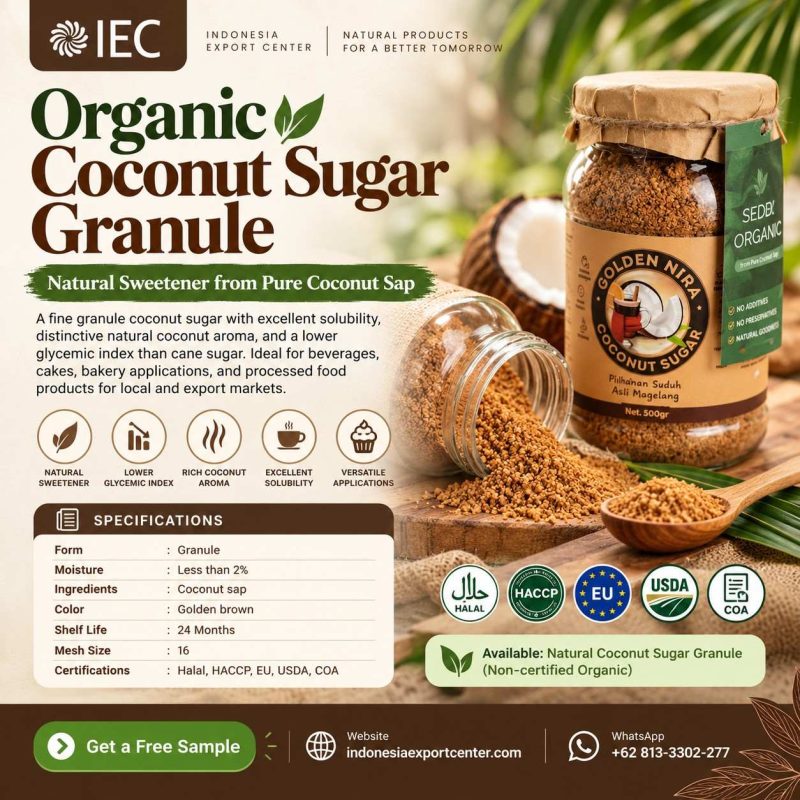
| Parameter | Flyer Information |
|---|---|
| Product | Organic Coconut Sugar Granule |
| Ingredient | Coconut Sap |
| Form | Granule |
| Moisture | Less than 2% |
| Mesh | 16 |
| Colour | Golden Brown |
| Shelf Life | 24 Months |
| Certification References | Halal, HACCP, EU, USDA |
The flyer also mentions natural coconut sugar granules.
All specifications require supplier verification.
South Korean Food Import Compliance
South Korean food imports are subject to applicable national requirements.
The Ministry of Food and Drug Safety, or MFDS, is an important authority for imported food compliance.
Importers should determine the applicable procedures for the specific coconut sugar product.
Potential requirements may include:
- Importer registration or reporting obligations.
- Overseas manufacturing facility information.
- Imported food declarations.
- Product standards.
- Relevant testing.
- Inspection.
- Labelling.
- Traceability.
Official resource: https://www.mfds.go.kr/eng/
Food Ingredient Classification
Buyers should verify how the actual coconut sugar product is classified under applicable Korean food regulations.
Product composition, processing, and intended use may influence the requirements.
A product description used in a promotional flyer should not replace official classification.
Quality Testing
Korean buyers may request:
- Moisture analysis.
- Particle-size information.
- Microbiological testing.
- Relevant contaminant testing.
- Foreign matter inspection.
- Ingredient composition.
- Product traceability.
The testing program should be agreed before purchase.
Certificate of Analysis
A COA should identify the relevant sample or lot.
Buyers should review the test methods, results, dates, and laboratory information.
A COA from an unrelated lot should not automatically be accepted as evidence for the shipment.
Korean Food Labelling
Finished retail products may require Korean-language labelling and other information under applicable rules.
Potential requirements include:
- Product name.
- Ingredient declaration.
- Net quantity.
- Nutrition information.
- Date marking.
- Storage instructions.
- Importer identification.
- Country-of-origin information.
- Other required declarations.
The importer should verify the specific requirements before packaging approval.
Organic Coconut Sugar for South Korea
The IEC flyer references USDA and EU organic certification.
However, these references do not automatically establish the right to market coconut sugar as organic in South Korea.
Buyers should check the applicable Korean organic certification, recognition, import, and labelling arrangements.
Halal and HACCP Documentation
The flyer also references Halal and HACCP.
These documents may be relevant to certain buyer requirements but must be verified separately.
Neither should be treated as automatic proof of full Korean import compliance.
Packaging and Storage
Korean importers may request bulk packaging with appropriate moisture protection.
Packaging should support:
- Product integrity.
- Lot traceability.
- Warehouse handling.
- Container transport.
- Quality preservation.
Supplier packaging formats require confirmation.
Commercial Purchasing Considerations
Buyers should establish:
- Product variant.
- Required specifications.
- Initial quantity.
- Monthly demand.
- Packaging.
- Certification requirements.
- Sample needs.
- MOQ.
- Lead time.
- Shipping terms.
Import Documentation
Depending on the transaction, relevant documents may include:
- Commercial invoice.
- Packing list.
- Transport document.
- Product specification.
- COA.
- Applicable certification records.
- Customs documentation.
- Other records required by Korean authorities.
South Korea Coconut Sugar RFQ Template
Subject: Indonesian Coconut Sugar Import Inquiry – South Korea
Company: [Name]
Country: South Korea
Application: [Details]
Product Variant: [Organic / Natural]
Initial Quantity: [KG or MT]
Monthly Demand: [Quantity]
Required Mesh: [Specification]
Maximum Moisture: [Specification]
Required Testing: [Details]
Required Certifications: [Details]
Packaging: [Details]
Destination Port: [Port]
Preferred Incoterm: [Term]
Please provide current specifications, COA, manufacturing information, certification details, sample feasibility, MOQ, lead time, and export quotation.
Frequently Asked Questions
Can South Korean companies import coconut sugar from Indonesia?
Potentially, subject to applicable Korean import requirements.
Which authority regulates imported food?
The MFDS is an important relevant authority.
Does coconut sugar need product testing?
Testing requirements depend on applicable regulations and buyer specifications.
Is USDA Organic automatically recognized in South Korea?
Buyers must verify the applicable recognition arrangements.
Does the IEC flyer provide a current COA?
It references COA, but a current report should be requested.
Can Korean buyers request bulk packaging?
Yes, subject to supplier capability.
Is MOQ confirmed?
No.
Can IEC facilitate export inquiries?
Yes.
Request Coconut Sugar Export Quotation for South Korea
Looking for Indonesian coconut sugar for Korean food manufacturing or ingredient distribution?
Contact IEC with your specifications, required quantity, packaging, destination, and compliance documentation needs.
REQUEST SOUTH KOREA COCONUT SUGAR EXPORT QUOTATION
INDONESIA EXPORT CENTER (IEC)
Website: https://indonesiaexportcenter.com/
WhatsApp: +62 813-3302-277
Korean import requirements, specifications, certification status, prices, MOQ, samples, and shipment arrangements require verification.
Related Resources
How to Import Coconut Sugar from Indonesia
Coconut Sugar COA and Quality Testing
Bulk Coconut Sugar Packaging Options
