

INDONESIA EXPORT CENTER (IEC)
B2B Coconut Sugar Sourcing for Japanese Food Manufacturers, Ingredient Importers and Specialty Food Distributors
Indonesian Coconut Sugar for Japanese Importers
Are you searching for a coconut sugar supplier Japan importers can approach for food ingredient sourcing?
Indonesia Export Center (IEC) facilitates sourcing inquiries for Indonesian coconut sugar granules for Japanese food manufacturers, ingredient distributors, specialty food businesses, and trading companies.
Japanese buyers may require detailed product specifications, reliable analytical documentation, consistent quality, and clear shipment procedures.
Before importing coconut sugar, buyers should also confirm the applicable Japanese food safety and customs requirements.
IEC supports the sourcing inquiry process by helping buyers define the information required from potential Indonesian suppliers.
Coconut Sugar Product Overview
Coconut sugar is produced from coconut palm sap.
It may be evaluated for selected food and beverage applications.
Potential uses include:
- Bakery products.
- Coffee and tea.
- Beverage powders.
- Breakfast cereals.
- Snack products.
- Desserts.
- Specialty confectionery.
- Retail sweeteners.
The actual performance of the ingredient should be tested in the intended product.
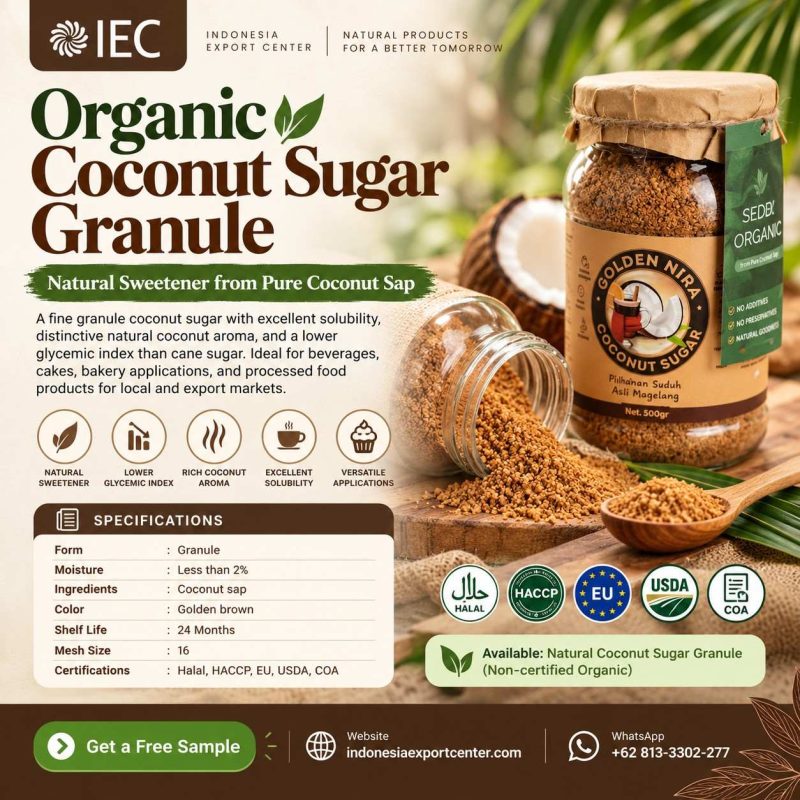
IEC Coconut Sugar Reference Specifications
| Parameter | Promotional Information |
|---|---|
| Product | Organic Coconut Sugar Granule |
| Ingredient | Coconut Sap |
| Form | Granule |
| Moisture | Less than 2% |
| Mesh Size | 16 |
| Colour | Golden Brown |
| Shelf Life | 24 Months |
| Certification References | USDA, EU, Halal, HACCP |
The flyer also identifies a natural coconut sugar variant.
Current specifications require supplier confirmation.
Japanese Food Import Requirements
Japanese food imports may be subject to requirements under the Food Sanitation Act and other applicable legislation.
Importers should confirm relevant procedures with the competent Japanese authorities.
Depending on the product, requirements may involve:
- Food import notification.
- Ingredient and additive compliance.
- Product safety.
- Relevant testing.
- Import inspection.
- Food labelling.
- Customs clearance.
Official information is available through Japan’s Ministry of Health, Labour and Welfare:
https://www.mhlw.go.jp/english/
Technical Product Evaluation
Japanese buyers may require detailed analytical information.
Potential parameters include:
- Moisture.
- Particle-size distribution.
- Colour.
- Aroma.
- Microbiological criteria.
- Relevant contaminants.
- Foreign matter.
- Product identity.
- Lot traceability.
The buyer should establish acceptable limits before approving the supplier.
Understanding Mesh Size
The IEC flyer identifies mesh size 16.
However, a single mesh designation does not necessarily describe the full particle-size distribution.
Buyers may request a sieve analysis identifying the relevant retained and passing fractions.
The test method and sieve standard should be specified.
Moisture and Product Stability
The flyer reports moisture below 2%.
Buyers should request current moisture results and confirm the analytical method.
Storage stability also depends on packaging and environmental conditions.
Certificate of Analysis
A current COA may include:
- Product name.
- Lot identification.
- Test date.
- Analytical methods.
- Results.
- Laboratory information.
- Specification limits.
Buyers should verify that the COA corresponds to the relevant sample or shipment.
Japanese Food Labelling
Finished retail products may require Japanese-language labelling.
Potential information includes:
- Product designation.
- Ingredients.
- Net quantity.
- Nutrition information.
- Date marking.
- Storage conditions.
- Responsible business information.
- Other applicable declarations.
The importer should review the requirements for the actual product and sales channel.
Organic Coconut Sugar and JAS
Japan has its own organic regulatory framework, including Organic JAS requirements.
USDA or EU organic references do not automatically establish eligibility to use the Organic JAS mark.
Buyers intending to market coconut sugar as organic in Japan should verify the applicable certification and import arrangements.
Packaging Requirements
Japanese importers may require:
- Consistent bag weights.
- Appropriate moisture barriers.
- Clear lot identification.
- Packaging integrity.
- Accurate documentation.
- Suitable handling and storage arrangements.
Actual supplier packaging capabilities require confirmation.
Supplier Quality Approval
A structured approval process may include:
- Supplier identification.
- Product specification review.
- Sample request.
- Analytical testing.
- Food safety assessment.
- Certification review.
- Packaging approval.
- Commercial quotation.
- Pre-shipment inspection.
- Delivery evaluation.
Commercial and Logistics Planning
Japanese buyers should request confirmation of:
- MOQ.
- Available capacity.
- Lead time.
- Loading port.
- Destination port.
- Incoterm.
- Payment terms.
- Documentation.
- Shipment schedule.
Japan Coconut Sugar RFQ Template
Subject: Indonesian Coconut Sugar Supply Inquiry – Japan
Company: [Name]
Country: Japan
Application: [Details]
Product Variant: [Organic / Natural]
Initial Quantity: [KG or MT]
Monthly Demand: [Quantity]
Required Moisture: [Specification]
Particle Size: [Specification]
Microbiological Requirements: [Details]
Required Certifications: [Details]
Packaging: [Details]
Destination Port: [Port]
Preferred Incoterm: [Term]
Please provide current specifications, COA, test methods, certification information, sample feasibility, MOQ, lead time, and export quotation.
Frequently Asked Questions
Can Japanese companies import coconut sugar from Indonesia?
Potentially, subject to applicable Japanese requirements.
Is a COA important?
Yes, it can support technical evaluation.
Does mesh 16 guarantee a uniform particle size?
No. A full particle-size analysis may be needed.
Is USDA Organic automatically equivalent to Organic JAS?
No.
Can Japanese buyers request laboratory samples?
Sample feasibility must be confirmed.
Is the 24-month shelf life guaranteed?
Supporting evidence should be reviewed.
Can IEC arrange supplier inquiries?
Yes.
Are prices and MOQ available?
A current supplier quotation is required.
Request Coconut Sugar Export Quotation for Japan
Looking for Indonesian coconut sugar for Japanese food manufacturing or ingredient distribution?
Contact IEC with your technical specifications, quantity, certification requirements, and destination.
REQUEST JAPAN COCONUT SUGAR EXPORT QUOTATION
INDONESIA EXPORT CENTER (IEC)
Website: https://indonesiaexportcenter.com/
WhatsApp: +62 813-3302-277
Japanese import eligibility, Organic JAS requirements, technical specifications, prices, MOQ, samples, and supply availability require verification.
Related Resources
Low Moisture Coconut Sugar Granules
Coconut Sugar COA and Quality Testing
