

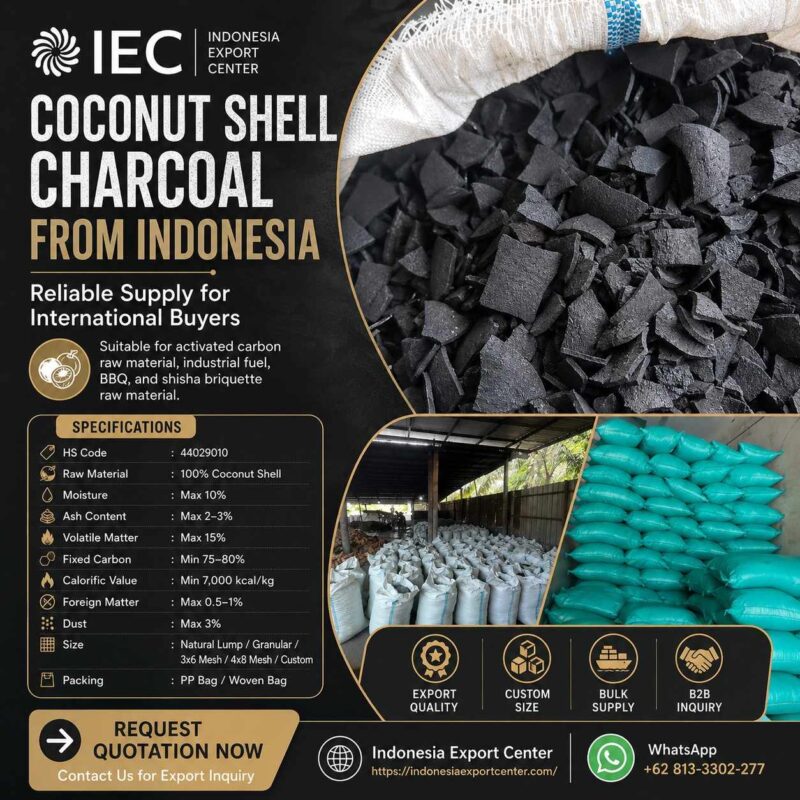
IEC | INDONESIA EXPORT CENTER
COCONUT SHELL CHARCOAL FROM INDONESIA
Reliable Supply for International Buyers
Planning to import coconut shell charcoal from Indonesia and need to understand the required coconut shell charcoal export documents?
Indonesia Export Center (IEC) facilitates international B2B sourcing inquiries for Indonesian coconut shell charcoal, helping importers and procurement teams communicate product specifications, document requirements, inspection preferences, and shipment conditions to potential supply partners.
For international charcoal shipments, documentation is a critical part of successful export preparation and import clearance.
Importers may need to review the commercial invoice, packing list, bill of lading, customs classification, certificate of origin, laboratory results, inspection reports, and transport safety documentation.
However, the exact documents required for a shipment depend on the product, destination country, customs procedures, Incoterms, carrier requirements, and commercial agreement.
A document used for raw coconut shell charcoal may not be appropriate for finished activated carbon or manufactured BBQ and shisha charcoal briquettes.
This guide explains the principal export documents, how they relate to one another, and what international buyers should verify before shipping raw coconut shell charcoal from Indonesia.
Export Quality • Custom Size • Bulk Supply • B2B Inquiry
Request Coconut Shell Charcoal Export Quotation:
https://wa.me/628133302277
What Documents Are Needed to Export Coconut Shell Charcoal from Indonesia?
A typical international shipment may involve several categories of documentation.
Commercial Documents
- Commercial invoice
- Packing list
- Sales contract or purchase order
- Payment-related documents, where applicable
Transport Documents
- Bill of lading
- Booking or shipping instructions
- Cargo transport safety documents, where required
Customs and Origin Documents
- Indonesian export customs declaration
- Destination import customs declaration
- HS classification information
- Certificate of origin, where required or requested
Quality Documents
- Certificate of Analysis
- Laboratory test reports
- Inspection certificates, where agreed
- Sampling records, where relevant
Important: This is a practical checklist, not a universal or exhaustive mandatory document list.
Why Export Documentation Matters
Accurate documentation supports customs clearance, cargo identification, payment, and shipment traceability.
Potential Benefits
- Clear product identification
- Consistent shipment quantities
- Customs classification support
- Importer and exporter identification
- Quality verification
- Freight coordination
- Insurance and claims support
- Reduced documentation discrepancies
Buyer Recommendation
Agree on the required documents before confirming the purchase order.
Raw Coconut Shell Charcoal vs. Finished Charcoal Products
Different charcoal products may have different customs classifications and regulatory requirements.
Raw Coconut Shell Charcoal
Carbonized coconut shell material that may be supplied as natural lumps or processed into granular or mesh sizes.
Finished Activated Carbon
A processed product with different technical characteristics and potentially different customs classification.
Finished BBQ and Shisha Briquettes
Manufactured charcoal products that may contain binders or other ingredients and have defined shapes and performance specifications.
Important Clarification
IEC’s supplied technical reference describes raw coconut shell charcoal.
It does not establish specifications or documentation for finished activated carbon or finished briquettes.
IEC Raw Coconut Shell Charcoal Specifications
| Parameter | Specification |
|---|---|
| HS Code | 44029010 |
| Raw Material | 100% Coconut Shell |
| Moisture | Max 10% |
| Ash Content | Max 2–3% |
| Volatile Matter | Max 15% |
| Fixed Carbon | Min 75–80% |
| Calorific Value | Min 7,000 kcal/kg |
| Foreign Matter | Max 0.5–1% |
| Dust | Max 3% |
| Size | Natural Lump / Granular / 3×6 Mesh / 4×8 Mesh / Custom |
| Packing | PP Bag / Woven Bag |
Specification note: Ash, fixed carbon, and foreign matter values are grade-dependent ranges of limits.
The exact grade, test methods, and acceptance criteria must be agreed.
The supplied HS code is a reference and must be verified against the actual product and applicable customs tariff.
HS Code Review for Coconut Shell Charcoal
HS classification is one of the first documentation checks.
IEC’s supplied raw charcoal reference is:
HS Code: 44029010
Why HS Classification Matters
It may affect:
- Customs declarations
- Import duty calculations
- Statistical reporting
- Trade measures
- Required permits
- Product-specific controls
Important Clarification
The HS system uses internationally harmonized six-digit headings, while countries may apply additional national digits.
The supplied eight-digit reference should not automatically be used as the destination country’s tariff code.
HS Code Verification Before Export
Importers should verify classification using the actual product description.
Recommended Information
- Raw material
- Carbonization or processing
- Product form
- Binder or additive content, if any
- Intended use
- Product composition
- Applicable tariff rules
Buyer Recommendation
Confirm the classification with qualified customs advisers and the relevant authorities.
Indonesian Export Customs Declaration
An Indonesian export shipment generally involves an export customs declaration under applicable Indonesian customs procedures.
The declaration is commonly known as Pemberitahuan Ekspor Barang (PEB).
Important Information
- Exporter identity
- Goods description
- Customs classification
- Quantity
- Value
- Destination
- Shipment details
Important Clarification
Filing procedures, exemptions, supporting documents, and other requirements depend on current Indonesian regulations and the transaction.
Exporter of Record Verification
The exporter of record is the party legally responsible for relevant export customs obligations.
Buyer Considerations
- Exporter identity
- Business registration
- Customs eligibility
- Export documentation
- Contractual responsibilities
- Bank details
Important Clarification
IEC operates as a sourcing and export facilitation intermediary and is not automatically the exporter of record.
The actual exporting party must be identified for each transaction.
Commercial Invoice for Coconut Shell Charcoal
The commercial invoice is a principal trade document.
It identifies the goods, parties, quantities, values, and commercial terms.
Recommended Invoice Information
- Invoice number
- Invoice date
- Seller or exporter details
- Buyer details
- Product description
- Quantity
- Unit price
- Total value
- Currency
- Incoterm
- Named port or place
- Country of origin
- Payment terms
Buyer Recommendation
Check that the invoice matches the purchase order and shipment details.
Commercial Invoice Product Description
A product description should be accurate and sufficiently specific.
Illustrative Description
Raw Coconut Shell Charcoal – 100% Coconut Shell – Natural Lump – Packed in PP Bags
This is an example only.
Buyer Recommendation
Use the actual product grade, size, packaging, and applicable customs description.
Commercial Invoice Template
| Field | Example Entry |
|---|---|
| Invoice Number | [Invoice Number] |
| Date | [Date] |
| Seller | [Contractual Seller] |
| Buyer | [Importer] |
| Product | Raw Coconut Shell Charcoal |
| Grade | [Agreed Grade] |
| Size | [Natural Lump / Granular / Mesh] |
| Quantity | [Metric Tons] |
| Unit Price | [Currency / MT] |
| Total Value | [Amount] |
| Incoterm | [FOB / CFR / CIF / FCA / Other] |
| Named Port | [Port] |
| Origin | Indonesia |
Important Clarification
This is a document preparation example, not an issued commercial invoice.
Packing List for Coconut Shell Charcoal
The packing list describes the physical shipment.
Recommended Packing List Information
- Seller or exporter
- Buyer
- Product description
- Number of bags
- Net weight
- Gross weight
- Packaging type
- Container number, when available
- Seal number, when available
- Shipping marks
- Lot identification, where applicable
Buyer Recommendation
Ensure the packing list reflects the actual loaded cargo.
Net Weight vs. Gross Weight
Net Weight
The weight of the charcoal excluding packaging.
Gross Weight
The weight of the charcoal plus packaging.
Why This Matters
Different documents may report different weight categories.
Buyer Recommendation
Use consistent units and clearly identify net and gross weights.
Bag Count and Packing List Calculation
Bag count can be estimated from net shipment weight and bag weight.
Hypothetical Example
Assume:
- Net shipment weight: 20,000 kg
- Net weight per bag: 25 kg
Calculation:
20,000 ÷ 25 = 800 bags
This is an illustrative calculation.
It does not establish a confirmed packaging configuration or container loading capacity.
PP Bag and Woven Bag Documentation
IEC’s supplied raw charcoal reference includes:
- PP bags
- Woven bags
Packaging Information to Record
- Bag type
- Net weight
- Bag count
- Gross weight
- Product grade
- Lot number
- Shipping marks
Important Clarification
No specific bag weight has been confirmed.
Shipping Marks and Cargo Identification
Shipping marks may help identify cargo during handling and delivery.
Potential Marking Information
- Product name
- Consignee
- Destination
- Lot number
- Bag or package number
- Net weight
- Gross weight
- Handling instructions
Buyer Recommendation
Agree on shipping marks before packaging and loading.
Bill of Lading for Coconut Shell Charcoal
The bill of lading is a transport document used in maritime shipping.
Its legal functions depend on its form and the carriage arrangement.
Important Information to Check
- Shipper
- Consignee
- Notify party
- Vessel or voyage details
- Port of loading
- Port of discharge
- Cargo description
- Container number
- Seal number
- Package count
- Weight
- Freight notation
Buyer Recommendation
Review the bill of lading draft before final issuance.
Original Bill of Lading vs. Other Release Arrangements
Different shipping arrangements may involve:
- Negotiable original bills of lading
- Sea waybills
- Electronic transport records, where supported
- Other carrier-approved release procedures
Important Clarification
The appropriate document depends on the commercial agreement, carrier arrangements, and payment method.
Certificate of Origin for Coconut Shell Charcoal
A Certificate of Origin (CO) may be requested for customs or commercial purposes.
It provides information about the origin of goods.
Potential Uses
- Origin verification
- Customs documentation
- Buyer requirements
- Trade agreement claims, where applicable
- Commercial recordkeeping
Important Clarification
A Certificate of Origin does not automatically establish eligibility for preferential tariffs.
Non-Preferential vs. Preferential Certificate of Origin
Non-Preferential Certificate of Origin
May be used to certify origin for general customs or commercial purposes.
Preferential Certificate of Origin
May support preferential tariff treatment where an applicable trade agreement exists and all relevant origin and documentary requirements are met.
Buyer Recommendation
Verify the destination country’s requirements and the applicable origin rules.
Indonesian Certificate of Origin Procedures
Indonesia has official procedures for issuing certificates of origin, commonly associated with Surat Keterangan Asal (SKA).
Important Considerations
- Product origin
- Exporter eligibility
- Applicable origin rules
- Supporting documents
- Destination requirements
- Issuance procedures
Important Clarification
The correct certificate type and issuing process depend on the transaction and current regulations.
Certificate of Analysis for Coconut Shell Charcoal
A Certificate of Analysis (COA) may provide laboratory results for a specific sample or batch.
Potential Test Parameters
- Moisture
- Ash
- Volatile matter
- Fixed carbon
- Calorific value
- Foreign matter
- Dust
- Particle size
Buyer Recommendation
Request a COA that identifies the tested material and relevant methods.
Laboratory Test Report vs. Certificate of Analysis
These terms may be used differently by laboratories and suppliers.
Important Information
- Laboratory identity
- Sample ID
- Test date
- Test methods
- Results
- Units
- Reporting basis
- Lot or batch reference
Important Clarification
A historical test report does not guarantee the quality of future shipments.
Moisture Testing Documentation
IEC’s raw charcoal moisture reference is:
Maximum 10%
Buyer Considerations
- Sampling method
- Test method
- Reporting basis
- Inspection point
- Acceptance limit
Buyer Recommendation
Agree on whether results will be evaluated at origin, destination, or another defined point.
Ash Content Testing Documentation
IEC’s raw charcoal ash reference is:
Maximum 2–3%, depending on grade
Buyer Considerations
- Exact maximum limit
- Test method
- Sample preparation
- Reporting basis
- Batch identification
Buyer Recommendation
Avoid accepting a vague ash range without selecting the contractual grade.
Fixed Carbon Testing Documentation
IEC’s raw charcoal fixed carbon reference is:
Minimum 75–80%, depending on grade
Buyer Considerations
- Analytical method
- Reporting basis
- Moisture
- Ash
- Volatile matter
- Laboratory reporting
Buyer Recommendation
Compare results only when analytical bases are consistent.
Particle Size and Mesh Test Reports
IEC’s supplied size reference includes:
- Natural lump
- Granular
- 3×6 mesh
- 4×8 mesh
- Custom size
Buyer Considerations
- Sieve standard
- Oversize percentage
- Undersize percentage
- Dust
- Particle-size distribution
Important Clarification
The applicable mesh standard and tolerance must be agreed.
Inspection Certificate for Charcoal Exports
Some buyers may request an independent inspection certificate.
Potential Inspection Scope
- Quantity
- Packaging
- Product identity
- Quality parameters
- Sampling
- Container condition
- Loading supervision
Important Clarification
An inspection certificate is not automatically mandatory for every shipment.
Requirements depend on the buyer, destination, contract, and applicable regulations.
Pre-Shipment Inspection
Pre-shipment inspection may be used to verify goods before dispatch.
Suggested Inspection Workflow
- Identify the shipment lot.
- Confirm the specification.
- Agree on the sampling procedure.
- Conduct visual inspection.
- Collect samples.
- Perform required testing.
- Check packaging.
- Verify quantities.
- Review loading arrangements.
- Issue the agreed report.
Buyer Recommendation
Specify inspection responsibilities and acceptance criteria in the purchase agreement.
Third-Party Inspection Requirements
International buyers may appoint an independent inspection provider.
Important Considerations
- Inspector competence
- Inspection scope
- Sampling plan
- Laboratory methods
- Reporting requirements
- Cost allocation
- Timing
Important Clarification
No specific inspection company or service arrangement is guaranteed by IEC.
Container Loading Inspection
Loading inspection may help document shipment condition.
Potential Checks
- Container identification
- Container condition
- Packaging
- Bag count
- Weight records
- Cargo securing
- Seal number
- Photographic records
Important Clarification
Loading must also comply with applicable transport safety and carrier requirements.
Container Number and Seal Number
Container and seal information should be consistent across relevant shipping records.
Buyer Recommendation
Check the container number and seal number against:
- Packing list
- Shipping instructions
- Bill of lading
- Loading report
- Other applicable documents
Verified Gross Mass
Containerized maritime shipments are subject to applicable Verified Gross Mass (VGM) requirements under SOLAS.
Important Considerations
- Verified container gross mass
- Responsible shipper
- Approved weighing method
- Submission procedures
- Carrier deadlines
Buyer Recommendation
Confirm the party responsible for VGM submission before loading.
Maritime Transport Safety Documentation
Charcoal can present self-heating and fire hazards.
Important Safety Considerations
- Cargo classification
- Applicable testing
- Packaging
- Container suitability
- Documentation
- Carrier acceptance
- Handling procedures
Important Clarification
The current International Maritime Dangerous Goods (IMDG) Code and carrier requirements must be checked for the actual cargo.
Charcoal should not automatically be declared unrestricted general cargo.
Dangerous Goods Declaration and Related Documents
Depending on classification and applicable transport requirements, a charcoal shipment may require dangerous goods documentation.
Potential Documentation
- Dangerous goods declaration
- Classification information
- Applicable test evidence
- Packaging information
- Emergency information
- Carrier-required documents
Important Clarification
The exact documentation depends on the cargo’s verified classification and current transport rules.
Safety Data Sheet for Charcoal
A Safety Data Sheet (SDS) may be requested by buyers, carriers, or other parties.
Important Considerations
- Product identification
- Composition
- Hazards
- Handling
- Storage
- Transport classification
- Emergency measures
Important Clarification
An SDS does not by itself determine the correct maritime transport classification.
Carrier Acceptance Documentation
Carriers may require information about the charcoal cargo before accepting a booking.
Potential Requirements
- Product description
- Cargo classification
- Test reports
- Packaging
- Container information
- Shipping instructions
Buyer Recommendation
Confirm carrier acceptance before finalizing shipment arrangements.
Export Permits and Product-Specific Controls
Depending on current regulations and product classification, additional permits or controls may apply.
Buyer Considerations
- Indonesian export restrictions
- Destination import controls
- Product classification
- Licensing
- Inspection requirements
Important Clarification
No blanket statement is made that all coconut shell charcoal shipments are permit-free.
Destination Country Import Documentation
Importers should verify the requirements of their destination country.
Potential Requirements
- Importer registration
- Customs declaration
- Correct tariff classification
- Commercial invoice
- Packing list
- Transport document
- Certificate of origin
- Product compliance documentation
- Applicable permits
Buyer Recommendation
Confirm destination requirements with a qualified customs representative.
Import Duties and Taxes
Duties and taxes depend on the importing country.
Important Factors
- Customs classification
- Country of origin
- Customs value
- Trade agreement eligibility
- Current tariff measures
Important Clarification
IEC has not supplied destination-specific duty rates.
Incoterms and Document Responsibilities
Document responsibilities may vary according to the agreed Incoterm and contract.
FOB
The seller generally handles export clearance and delivers the goods on board the nominated vessel at the named shipment port.
CFR
The seller arranges carriage to the named destination port, while risk generally transfers when the goods are on board at origin.
CIF
The seller arranges carriage and the required cargo insurance to the named destination port, while risk generally transfers when the goods are on board at origin.
FCA
The seller delivers the goods to the carrier or another nominated person at the agreed place, according to the rule.
Buyer Recommendation
Specify the named place or port and Incoterms edition in the contract.
Documentary Letter of Credit Requirements
Some buyers may use letters of credit.
Important Documents to Review
- Commercial invoice
- Packing list
- Bill of lading
- Insurance documents, where required
- Certificate of origin, where required
- Inspection certificate, where required
Buyer Recommendation
Ensure the letter of credit’s documentary conditions are practical and consistent with the sales contract.
Common Export Documentation Errors
Common problems include:
- Incorrect product description.
- Inconsistent quantities.
- Net and gross weight confusion.
- Incorrect consignee details.
- Mismatched container numbers.
- Mismatched seal numbers.
- Incorrect destination port.
- Unverified HS classification.
- Missing origin documentation.
- Laboratory reports unrelated to the shipment lot.
- Incorrect Incoterm wording.
- Incomplete transport safety documentation.
Buyer Recommendation
Conduct a document consistency review before shipment.
Cross-Checking the Commercial Invoice and Packing List
The commercial invoice and packing list should describe the same shipment.
Key Comparison Points
- Product name
- Quantity
- Packaging
- Net weight
- Gross weight
- Buyer
- Seller
- Shipment references
Important Clarification
Different documents may serve different purposes, but shared information should be consistent.
Cross-Checking the Packing List and Bill of Lading
Important Fields
- Cargo description
- Package count
- Container number
- Seal number
- Weight
- Port of loading
- Port of discharge
Buyer Recommendation
Resolve discrepancies before final transport document issuance.
Cross-Checking the COA and Purchase Specification
Laboratory results should be compared with the agreed acceptance criteria.
Important Parameters
- Moisture
- Ash
- Fixed carbon
- Volatile matter
- Calorific value
- Size
- Dust
- Foreign matter
Buyer Recommendation
Verify sample identity and reporting basis before accepting results.
Document Control and Version Management
International shipments may involve revised invoices, packing lists, and shipping instructions.
Recommended Practices
- Use document version numbers.
- Record issue dates.
- Identify responsible parties.
- Retain approved copies.
- Confirm changes with relevant parties.
- Avoid using superseded documents.
Buyer Recommendation
Maintain a single approved document set for the shipment.
Document Checklist Before Shipment
| Document | Status to Confirm | Responsible Party |
|---|---|---|
| Purchase order / contract | Approved | Buyer and seller |
| Commercial invoice | Prepared and checked | Contractual seller |
| Packing list | Prepared and checked | Shipping party |
| Export customs declaration | Filed as applicable | Exporter or authorized agent |
| HS classification | Verified | Relevant customs parties |
| Certificate of origin | Obtained if required | Eligible issuing process |
| Laboratory report / COA | Verified if required | Supplier / laboratory |
| Inspection report | Issued if agreed | Inspector |
| Cargo classification documents | Verified | Responsible shipping parties |
| Carrier acceptance | Confirmed | Booking parties |
| VGM | Submitted as applicable | Responsible shipper |
| Bill of lading | Checked and issued | Carrier or agent |
| Insurance document | Obtained if required | Responsible party |
| Import documentation | Prepared | Importer or customs agent |
Important Clarification
Responsibilities may vary under the contract and applicable laws.
Document Checklist After Shipment
After departure, importers should verify that the necessary documents have been received.
Important Items
- Final invoice
- Final packing list
- Transport document
- Insurance certificate, where applicable
- Certificate of origin, where required
- Inspection and laboratory documents, where agreed
- Other destination-specific documents
Buyer Recommendation
Confirm document release procedures and customs clearance readiness.
IEC’s Role in Export Documentation Coordination
Indonesia Export Center operates as a sourcing and export facilitation intermediary.
IEC can receive international buyer inquiries and facilitate discussions about potential Indonesian coconut shell charcoal supply arrangements and document requirements.
IEC is not represented as a confirmed manufacturer, contractual seller, or exporter of record.
The actual exporter, importer, customs agents, laboratories, carriers, and contractual parties remain responsible for their respective legal and commercial obligations.
How to Request Coconut Shell Charcoal Export Documentation Information
Step 1 – Identify the Product
Specify raw coconut shell charcoal and its intended application.
Step 2 – Confirm the Destination
Provide the destination country and port.
Step 3 – Define Technical Requirements
State moisture, ash, fixed carbon, size, and other acceptance criteria.
Step 4 – Confirm Quantity and Packaging
Provide the purchasing volume and packaging requirements.
Step 5 – Identify Required Documents
List customs, origin, inspection, laboratory, and shipping documents.
Step 6 – Confirm the Incoterm
Specify FOB, CFR, CIF, FCA, or another agreed term.
Step 7 – Submit the Inquiry
Send the complete requirements to IEC.
Coconut Shell Charcoal Export Documents RFQ Template
Subject: RFQ – Raw Coconut Shell Charcoal and Export Documentation
Dear Indonesia Export Center Team,
We are interested in sourcing raw coconut shell charcoal from Indonesia.
Please advise whether suitable supply arrangements are available and confirm the documentation that can be provided for the proposed shipment.
Company Name: [Company Name]
Country: [Country]
Business Activity: [Importer / Trader / Manufacturer / Distributor]
Contact Person: [Name]
Product: Raw Coconut Shell Charcoal
Intended Application: [Activated Carbon / Industrial Fuel / Briquette Feedstock / Other]
Required Grade: [Grade]
Maximum Moisture: [Percentage]
Maximum Ash: [Percentage]
Maximum Volatile Matter: [Percentage]
Minimum Fixed Carbon: [Percentage]
Minimum Calorific Value: [kcal/kg]
Maximum Foreign Matter: [Percentage]
Maximum Dust: [Percentage]
Required Size: [Natural Lump / Granular / 3×6 Mesh / 4×8 Mesh / Custom]
Packaging: [PP Bag / Woven Bag]
Net Weight per Bag: [kg]
Required Quantity: [Metric Tons]
Destination Country: [Country]
Destination Port: [Port]
Preferred Indonesian Loading Port: [Port / Please Advise]
Preferred Incoterm: [FOB / CFR / CIF / FCA / Other]
Expected Shipment Date: [Date]
Required Documents: [List]
Certificate of Origin Requirement: [Details]
Laboratory Documentation: [Details]
Inspection Requirements: [Details]
Payment Method: [Details]
Please provide:
- Available raw charcoal grades
- Technical specifications
- MOQ
- Commercial quotation
- Available packaging
- Exporter of record details
- Applicable HS classification information
- Commercial invoice arrangements
- Packing list arrangements
- Bill of lading arrangements
- Certificate of origin availability
- Laboratory documentation
- Pre-shipment inspection options
- Cargo classification and transport safety documentation
- Carrier acceptance requirements
- Shipment schedule
- Contracting and payment terms
We look forward to receiving your quotation and documentation information.
Best regards,
[Your Name]
[Company Name]
[Contact Information]
Send Your Coconut Shell Charcoal Export Inquiry via WhatsApp:
https://wa.me/628133302277
Frequently Asked Questions About Coconut Shell Charcoal Export Documents
What are the main documents for exporting coconut shell charcoal?
Common documents include a commercial invoice, packing list, transport document, export customs declaration, and additional origin, quality, inspection, or transport safety documents where required.
Is a commercial invoice required?
A commercial invoice is a principal document used in international trade and customs procedures.
What is included in a packing list?
A packing list commonly identifies the product, packages, net and gross weights, and relevant shipment details.
What is a bill of lading?
A bill of lading is a maritime transport document whose functions depend on its form and carriage arrangement.
Is a Certificate of Origin always mandatory?
Not necessarily. Requirements depend on the destination, customs rules, trade arrangements, and commercial agreement.
What is the difference between a preferential and non-preferential Certificate of Origin?
A preferential certificate may support a tariff preference under an applicable trade agreement, while a non-preferential certificate provides origin information without automatically establishing preferential treatment.
What is IEC’s supplied raw charcoal HS code?
The supplied reference is 44029010, subject to verification for the actual product and customs jurisdiction.
Can the same HS code be used for finished briquettes?
Not automatically. Classification must be verified for the actual finished product.
What is PEB in Indonesia?
PEB stands for Pemberitahuan Ekspor Barang, an Indonesian export customs declaration.
Is a Certificate of Analysis mandatory?
Not automatically for every transaction. Requirements depend on the contract, destination, and applicable rules.
Can buyers request laboratory testing?
Yes. Buyers may specify test methods, sampling, and acceptance criteria in the RFQ.
What is a pre-shipment inspection certificate?
It is a document that may record the results of an agreed inspection before shipment.
Is independent inspection mandatory?
Not automatically. It depends on the contract and applicable requirements.
What is VGM?
Verified Gross Mass is the verified gross weight of a packed container required under applicable SOLAS rules.
Does charcoal require dangerous goods documentation?
It may, depending on its verified transport classification and applicable IMDG Code requirements.
Is an SDS sufficient to establish cargo classification?
No. Classification must be determined under the applicable transport rules.
Does IEC act as the exporter of record?
IEC is presented as a sourcing and export facilitation intermediary, not automatically the exporter of record.
Can documents differ for FOB and CIF shipments?
Yes. The responsibilities for carriage, insurance, and certain documents differ under the applicable trade terms and contract.
Are import permits always required?
Not necessarily. Requirements depend on the destination country, product, and current regulations.
Can IEC guarantee all export documents for every destination?
No. Document availability and requirements must be confirmed for each shipment.
How can buyers request documentation details?
Contact IEC through WhatsApp at +62 813-3302-277 with the product specifications, destination, quantity, shipment terms, and required document list.
Request Coconut Shell Charcoal Export Quotation and Documentation Information
Looking for Indonesian coconut shell charcoal sourcing opportunities with clear export documentation requirements?
Indonesia Export Center (IEC) welcomes B2B inquiries from activated carbon manufacturers, industrial buyers, commodity traders, charcoal processors, customs coordinators, and international procurement teams.
Product: Raw Coconut Shell Charcoal
Origin: Indonesia
Technical Reference: Moisture • Ash • Fixed Carbon • Volatile Matter • Calorific Value • Foreign Matter • Dust
Size Options to Inquire About: Natural Lump • Granular • 3×6 Mesh • 4×8 Mesh • Custom
Packaging Reference: PP Bag • Woven Bag
Documentation Topics: Commercial Invoice • Packing List • Bill of Lading • Certificate of Origin • Customs Classification • COA • Inspection
Shipment Planning: FOB • CFR • CIF • FCA • Export Clearance • Cargo Safety
Target Market: International B2B Buyers
Contact IEC to discuss potential supplier availability, product specifications, export documentation, inspection requirements, packaging, MOQ, and shipment arrangements.
Indonesia Export Center (IEC)
Website: https://indonesiaexportcenter.com/
WhatsApp: +62 813-3302-277
Request Quotation via WhatsApp:
https://wa.me/628133302277
Please include your company name, country, required charcoal grade, technical specifications, quantity, packaging, destination port, preferred Incoterm, and the documents required by your customs or procurement team.
