

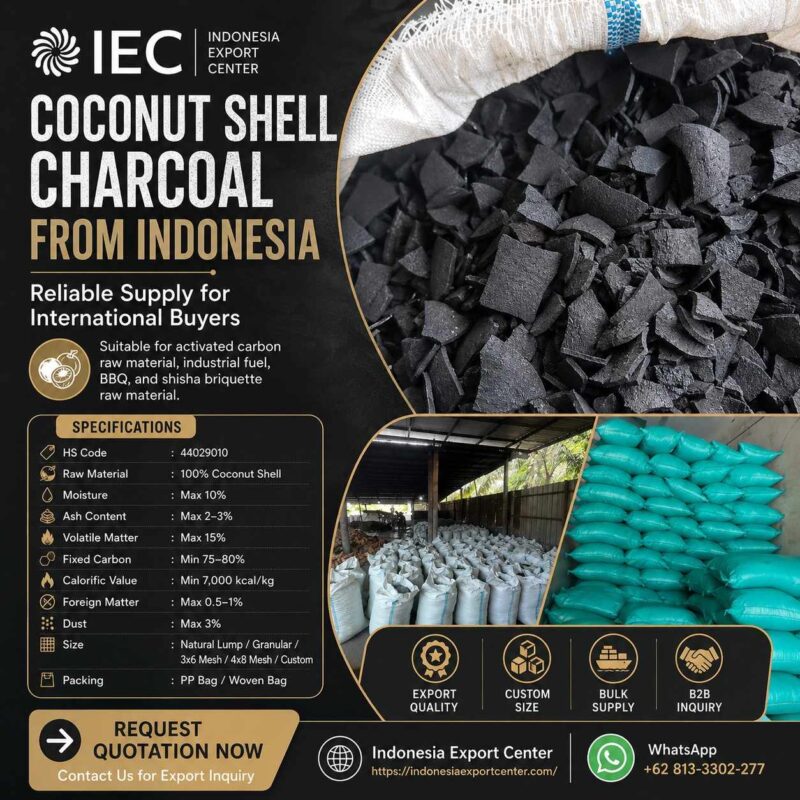
IEC | INDONESIA EXPORT CENTER
COCONUT SHELL CHARCOAL FROM INDONESIA
Reliable Supply for International Buyers
Planning to import raw coconut shell charcoal from Indonesia and need a clear explanation of coconut shell charcoal CIF shipping?
Indonesia Export Center (IEC) facilitates B2B sourcing inquiries for Indonesian coconut shell charcoal, helping international buyers communicate their required specifications, purchasing volumes, destination ports, and preferred shipment terms to potential supply partners.
For procurement teams, CIF quotations can simplify the comparison of product value, ocean freight, and cargo insurance within a single commercial offer.
However, CIF does not mean that the seller bears all risks and costs until the charcoal reaches the buyer’s warehouse.
Under CIF – Cost, Insurance and Freight, Incoterms 2020, the seller arranges and pays for carriage to the named destination port and obtains the contractually required cargo insurance. Risk generally transfers to the buyer when the goods are on board the vessel at the port of shipment.
Understanding this distinction is essential when comparing CIF quotations, reviewing insurance coverage, arranging customs clearance, and calculating total landed cost.
IEC’s supplied product reference covers raw coconut shell charcoal suitable for evaluation as activated carbon feedstock, industrial fuel, and raw material for further processing.
Export Quality • Custom Size • Bulk Supply • B2B Inquiry
Request Coconut Shell Charcoal CIF Quotation:
https://wa.me/628133302277
What Is CIF Shipping for Coconut Shell Charcoal?
CIF stands for Cost, Insurance and Freight.
It is an Incoterms rule for sea and inland waterway transport.
Under CIF Incoterms 2020, the seller generally:
- Supplies goods conforming to the contract.
- Handles export clearance.
- Delivers the goods on board the vessel at the shipment port.
- Contracts and pays for carriage to the named destination port.
- Obtains the cargo insurance required under the CIF rule.
- Provides the agreed shipping and insurance documentation.
The buyer generally handles import clearance, applicable import duties and taxes, and destination obligations allocated to the buyer.
Important: CIF’s named destination port identifies where the seller pays for carriage, not where risk transfers.
Why International Buyers Request CIF Quotations
A CIF quotation may help procurement teams evaluate product costs together with arranged ocean freight and insurance.
Potential Advantages
- A combined product, freight, and insurance quotation
- Reduced need to arrange main ocean carriage independently
- A named destination port for pricing
- A basis for comparing shipping-inclusive offers
- Seller-arranged minimum cargo insurance under the rule
Important Clarification
CIF is not automatically the least expensive or most suitable option. Buyers should compare freight arrangements, insurance coverage, destination charges, and total landed cost.
Who Uses CIF Coconut Shell Charcoal Shipping?
Potential buyers include:
- Activated carbon manufacturers
- Industrial charcoal processors
- Bulk commodity traders
- Charcoal distributors
- Briquette manufacturers
- International procurement teams
- Industrial fuel importers
Each buyer should establish the product specifications and shipment requirements before requesting pricing.
Raw Coconut Shell Charcoal for CIF Export
IEC’s raw charcoal reference describes material produced from 100% coconut shell.
Potential applications include:
- Activated carbon manufacturing feedstock
- Industrial fuel
- Charcoal processing
- BBQ briquette raw material
- Shisha briquette raw material
Raw coconut shell charcoal is not the same as finished activated carbon or finished BBQ and shisha briquettes.
IEC Raw Coconut Shell Charcoal Specifications
| Parameter | Specification |
|---|---|
| HS Code | 44029010 |
| Raw Material | 100% Coconut Shell |
| Moisture | Max 10% |
| Ash Content | Max 2–3% |
| Volatile Matter | Max 15% |
| Fixed Carbon | Min 75–80% |
| Calorific Value | Min 7,000 kcal/kg |
| Foreign Matter | Max 0.5–1% |
| Dust | Max 3% |
| Size | Natural Lump / Granular / 3×6 Mesh / 4×8 Mesh / Custom |
| Packing | PP Bag / Woven Bag |
Specification note: Ash, fixed carbon, and foreign matter limits are grade-dependent ranges. The exact applicable acceptance limits, analytical methods, and available grade must be confirmed.
The supplied HS code is a reference for raw coconut shell charcoal; destination classification must be independently verified.
CIF Quotation Structure for Coconut Shell Charcoal
A complete CIF quotation should identify both the goods and the shipping assumptions.
| Quotation Element | Required Information |
|---|---|
| Product | Raw coconut shell charcoal |
| Origin | Indonesia |
| Grade | Agreed specification |
| Size | Lump / granular / mesh / custom |
| Packaging | PP bag / woven bag |
| Quantity | Metric tons |
| Currency | Usually quoted as agreed |
| CIF unit price | Price per metric ton |
| Total CIF value | Unit price × quantity |
| Loading port | Named Indonesian port |
| Destination port | Named international port |
| Incoterm | CIF [Destination Port], Incoterms 2020 |
| Freight assumptions | Route, shipment type and validity |
| Insurance | Coverage, insured amount and documentation |
| Shipment period | Agreed date or window |
| Inspection | Agreed scope and method |
| Payment | Agreed terms |
| Quotation validity | Expiry date |
This table is a quotation template, not a confirmed IEC commercial offer.
What Is Included in a CIF Price?
The CIF price generally reflects the goods, the seller’s costs of fulfilling the delivery and export obligations, contracted ocean carriage to the named destination port, and required cargo insurance.
Typical Components
- Product value
- Agreed packaging
- Origin inland transport
- Export clearance
- Origin handling and delivery
- Ocean freight
- Contractually required cargo insurance
The exact cost components and local charge allocation depend on the shipment, carriage contract, and sales agreement.
What Is Not Automatically Included in CIF?
CIF does not automatically cover every cost after the vessel reaches the destination port.
Potential Buyer Costs
- Import customs clearance
- Import duties
- Import VAT or other taxes
- Destination terminal charges, where allocated to the buyer
- Storage
- Demurrage or detention
- Customs inspections
- Inland transportation
- Warehouse delivery
Buyer recommendation: Ask for a clear destination-charge breakdown before accepting a CIF offer.
CIF Pricing Formula
For quotation analysis, buyers may use a simplified commercial calculation:
Estimated CIF Value = FOB-Equivalent Goods and Origin Value + Ocean Freight + Cargo Insurance
This is a procurement comparison model, not a substitute for the actual contract’s cost allocation.
Hypothetical Example
Assume:
| Component | Illustrative Amount |
|---|---|
| Goods and origin costs | USD 10,000 |
| Ocean freight | USD 1,500 |
| Cargo insurance premium | USD 100 |
| Total estimated CIF value | USD 11,600 |
For a hypothetical 20-metric-ton shipment:
USD 11,600 ÷ 20 MT = USD 580 per MT
All figures are illustrative. They are not current market rates, verified freight costs, or an IEC quotation.
CIF Price per Metric Ton vs. Total Shipment Value
Procurement teams should distinguish the unit quotation from the total invoice value.
Unit Price
The CIF price per metric ton.
Total CIF Value
The CIF unit price multiplied by the contracted metric tonnage.
Buyer Recommendation
Confirm whether the contract quantity is based on net charcoal weight and how weight differences will be handled.
Why CIF Prices Differ Between Destination Ports
Ocean freight and shipment arrangements vary by destination.
Pricing Factors
- Destination country
- Destination port
- Carrier service
- Shipment timing
- Container type
- Freight availability
- Cargo classification
- Routing and transshipment
- Insurance arrangements
A CIF price for one port should not be assumed valid for another.
Naming the Destination Port Correctly
CIF quotations should name a specific destination port.
Illustrative Contract Wording
CIF Port Klang, Malaysia – Incoterms 2020
or
CIF Nhava Sheva, India – Incoterms 2020
These are examples of contractual wording, not confirmed IEC shipping routes or available freight services.
CIF Port of Shipment vs. Destination Port
Both ports matter, but they serve different purposes.
Port of Shipment
The location where the goods are delivered on board the vessel and where risk generally transfers.
Destination Port
The named port to which the seller arranges and pays for carriage.
Buyer Recommendation
Require both ports to be stated in the quotation and shipment documents.
The Most Important CIF Rule: Risk Transfers at Origin
One of the most common misunderstandings is assuming that CIF risk transfers when the vessel arrives.
It does not.
Under CIF Incoterms 2020, risk generally transfers when the goods are delivered on board the vessel at the shipment port.
The seller still pays for carriage and the required insurance to the destination port.
Freight payment and risk transfer occur at different points.
Why Cargo Insurance Matters Under CIF
CIF requires the seller to obtain cargo insurance for the buyer’s benefit in accordance with the rule.
Insurance is particularly important because the buyer generally bears transit risk after the goods are on board.
Buyer Considerations
- Insured party or beneficiary
- Insured amount
- Covered risks
- Exclusions
- Claims procedure
- Insurance documentation
- Shipment route
- Cargo description
Minimum Insurance Coverage Under CIF Incoterms 2020
Under CIF Incoterms 2020, the seller generally must obtain insurance meeting at least the minimum coverage contemplated by Institute Cargo Clauses (C), or similar appropriate clauses, unless the parties agree otherwise.
The insurance must generally cover at least 110% of the contract price in the contract currency, subject to the applicable rule and agreed terms.
Important Clarification
Minimum CIF insurance does not mean all cargo damage, deterioration, delay, or losses are covered.
Buyers should review the actual policy and exclusions.
CIF Insurance vs. All-Risks Coverage
Minimum CIF coverage can be narrower than buyers expect.
Potential Issues to Review
- Self-heating or spontaneous combustion exclusions
- Inherent vice
- Insufficient packaging
- Delay
- Moisture damage
- Cargo deterioration
- War or strike-related risks
- Deductibles
Buyer Recommendation
Request the insurance terms before shipment and discuss broader coverage where appropriate.
Broader coverage must be expressly arranged and may involve additional cost.
Cargo Insurance and Charcoal Self-Heating Risk
Charcoal may present self-heating and fire hazards.
Insurance arrangements should be evaluated in light of the cargo’s actual characteristics, classification, and shipping conditions.
Important Considerations
- Accurate cargo declaration
- Relevant testing
- Proper packaging
- Applicable transport classification
- Carrier acceptance
- Policy exclusions
Insurance does not replace safe transport practices or regulatory compliance.
Insurance Certificate and Policy Documents
Buyers should confirm what insurance document will be provided.
Information to Review
- Insurer
- Policy or certificate number
- Insured value
- Currency
- Cargo description
- Voyage
- Covered risks
- Exclusions
- Claims contact
Buyer Recommendation
Ensure the document supports the buyer’s contractual and banking requirements.
CIF Insurance Claim Preparation
If a shipment suffers damage or loss, the buyer may need supporting evidence.
Potential Documents
- Insurance certificate
- Bill of lading
- Commercial invoice
- Packing list
- Survey report
- Delivery records
- Photographs
- Carrier correspondence
The applicable claim procedure depends on the insurance contract.
FOB vs. CFR vs. CIF for Coconut Shell Charcoal
| Term | Seller Arranges Main Carriage | Seller Must Obtain Cargo Insurance Under the Rule | Risk Generally Transfers |
|---|---|---|---|
| FOB | No | No | On board at origin |
| CFR | Yes | No | On board at origin |
| CIF | Yes | Yes, required minimum coverage | On board at origin |
Buyer Recommendation
Compare terms based on total costs, operational control, and insurance protection rather than unit price alone.
CIF vs. CIP for Containerized Charcoal
CIF applies to sea and inland waterway transport and uses an on-board delivery point.
For containerized shipments handed to a carrier before vessel loading, CIP – Carriage and Insurance Paid To may sometimes better reflect the physical handover arrangement.
Under CIP Incoterms 2020, the seller contracts for carriage and insurance to the named destination, while risk generally transfers when goods are handed to the carrier at the agreed delivery point.
CIP also normally requires a higher level of insurance coverage than CIF, unless otherwise agreed.
Buyer Recommendation
Discuss the actual cargo handover and appropriate Incoterm with the contracting seller and logistics providers.
Indonesian Loading Ports for CIF Shipments
Potential Indonesian export ports may include:
- Tanjung Priok, Jakarta
- Tanjung Perak, Surabaya
- Tanjung Emas, Semarang
- Belawan, North Sumatra
- Other suitable ports
These are illustrative options.
IEC has not confirmed a specific loading port, available route, or shipment schedule.
How the Loading Port Affects CIF Pricing
The origin port may influence:
- Inland transportation costs
- Export handling
- Vessel service availability
- Transshipment requirements
- Freight charges
- Shipment scheduling
Buyer Recommendation
Request the named loading port even when purchasing under CIF terms.
Direct Shipping vs. Transshipment
Some international routes may involve transshipment.
Buyer Considerations
- Total transit time
- Intermediate handling
- Carrier arrangements
- Documentation
- Insurance coverage
- Cargo classification
- Delivery schedule
Important Clarification
No direct shipping route or guaranteed transit time is claimed.
Container Shipping for Raw Coconut Shell Charcoal
Container planning should be based on the actual cargo and packaging.
Important Variables
- Net charcoal weight
- Gross shipment weight
- Bag dimensions
- Container payload
- Cargo volume
- Palletization
- Weight distribution
- Cargo securing
- Applicable transport restrictions
IEC has not supplied verified container loading quantities.
20ft vs. 40ft Container Planning
Buyers may evaluate different container types.
Important Considerations
- Payload
- Cargo volume
- Bag configuration
- Handling
- Freight cost
- Carrier acceptance
- Safety requirements
Buyer Recommendation
Request a shipment-specific loading plan rather than assuming a standard metric-ton capacity.
PP Bag and Woven Bag Packaging
IEC’s supplied raw charcoal reference includes:
- PP bags
- Woven bags
Packaging Details to Confirm
- Net weight per bag
- Bag material
- Bag strength
- Closure
- Lot identification
- Gross weight
- Loading arrangement
No specific bag weight has been confirmed.
Packaging and CIF Freight Calculations
Packaging affects shipment dimensions and gross weight.
Buyer Considerations
- Bag dimensions
- Packaging weight
- Stacking efficiency
- Pallet requirements
- Handling
- Cargo protection
Buyer Recommendation
Provide packaging specifications before requesting a final CIF freight quotation.
Net Weight and Gross Weight in CIF Documents
Net Weight
The weight of the charcoal excluding packaging.
Gross Weight
The weight of the charcoal plus packaging.
Buyer Recommendation
Ensure the quotation, packing list, and shipping instructions use consistent quantity definitions.
Quality Inspection Before Shipment
Quality inspection helps verify whether the cargo meets the agreed specifications.
Potential Inspection Areas
- Raw material
- Moisture
- Ash
- Fixed carbon
- Volatile matter
- Calorific value
- Particle size
- Dust
- Foreign matter
- Packaging
- Quantity
Buyer Recommendation
Agree on inspection procedures before confirming the order.
Certificate of Analysis for CIF Charcoal Shipments
A Certificate of Analysis may document results for an identified sample or lot.
Recommended Details
- Product description
- Sample identification
- Batch number
- Laboratory identity
- Test date
- Test methods
- Results
- Reporting basis
A historical COA should not be treated as a guarantee of future shipment compliance.
Pre-Shipment Inspection and Risk Transfer
Inspection and risk transfer are separate contractual issues.
Important Considerations
- Inspection timing
- Sampling location
- Acceptance criteria
- Shipment readiness
- Cargo loading
- Claims procedures
Buyer Recommendation
Specify the relationship between inspection acceptance, payment, and shipment obligations in the contract.
Maritime Safety and the IMDG Code
Charcoal can present self-heating and fire hazards during ocean transport.
Important Safety Areas
- Cargo classification
- Applicable testing
- Packaging
- Container suitability
- Documentation
- Carrier acceptance
- Handling procedures
The current International Maritime Dangerous Goods (IMDG) Code and carrier requirements must be checked for the actual shipment.
Do not assume coconut shell charcoal is unrestricted general cargo.
Why Cargo Classification Affects CIF Freight
Cargo classification may influence:
- Carrier acceptance
- Freight pricing
- Packaging requirements
- Container preparation
- Documentation
- Routing
- Insurance terms
Buyer Recommendation
Confirm cargo classification before treating a freight estimate as final.
Shipping Documents Under CIF
Documents commonly discussed include:
- Commercial invoice
- Packing list
- Bill of lading
- Insurance certificate or policy
- Certificate of origin, where applicable
- Export customs documentation
- Laboratory reports, where required
- Inspection reports, where agreed
- Transport safety documentation, where required
The final document list depends on the transaction and destination.
Bill of Lading Requirements
The bill of lading should be checked against the commercial agreement.
Important Information
- Shipper
- Consignee
- Notify party
- Port of loading
- Port of discharge
- Cargo description
- Container details
- Weight
- Freight information
- Document release terms
Buyer Recommendation
Agree on the required transport documents before shipment.
Certificate of Origin
Some importers may require a certificate of origin for customs or commercial purposes.
Important Clarification
Availability, issuing procedures, and destination requirements must be confirmed.
A certificate of origin does not automatically establish preferential tariff eligibility.
Customs Classification for Coconut Shell Charcoal
IEC’s supplied raw charcoal HS reference is:
44029010
Important Clarification
The importing country may apply a different tariff subdivision or additional classification rules.
Finished briquettes and activated carbon should not automatically be classified using the raw charcoal reference.
Import Duties and Taxes Under CIF
CIF pricing does not automatically include import duties and taxes.
Potential Destination Charges
- Customs duties
- Import VAT or equivalent taxes
- Customs brokerage
- Port handling
- Storage
- Inland delivery
Buyer Recommendation
Confirm destination costs with a qualified customs broker.
CIF Value vs. Total Landed Cost
The CIF value is not necessarily the final cost of importing charcoal.
Simplified Formula
Estimated Landed Cost = CIF Value + Applicable Import Duties + Taxes + Destination Charges + Inland Delivery + Other Applicable Costs
Important Clarification
The customs valuation method and treatment of individual charges depend on destination regulations.
Hypothetical CIF Landed-Cost Example
Assume the following illustrative figures:
| Cost Component | Example Amount |
|---|---|
| CIF shipment value | USD 11,600 |
| Import duties and taxes | USD 1,200 |
| Destination handling | USD 350 |
| Inland delivery | USD 450 |
| Estimated landed cost | USD 13,600 |
For a hypothetical 20-metric-ton shipment:
USD 13,600 ÷ 20 MT = USD 680 per MT
These figures are purely illustrative and are not actual customs rates or IEC commercial offers.
CIF Quotation Validity and Freight Volatility
Freight and insurance conditions can change.
Important Quotation Details
- Issue date
- Validity period
- Shipment window
- Destination port
- Currency
- Freight assumptions
- Insurance conditions
- Quantity
- Applicable surcharges
Buyer Recommendation
Request reconfirmation when quotation validity expires.
Currency and Exchange Rate Considerations
International procurement teams should confirm the quotation currency.
Important Factors
- Contract currency
- Payment currency
- Exchange rate exposure
- Bank charges
- Payment timing
Buyer Recommendation
Compare offers using consistent currency assumptions.
CIF Payment Terms
Payment terms should be agreed with the contractual seller.
Buyer Considerations
- Deposit requirements
- Balance payment
- Bank details
- Document presentation
- Insurance documentation
- Inspection conditions
- Dispute resolution
Buyer Recommendation
Verify the contractual counterparty and payment instructions before transferring funds.
CIF and Letters of Credit
Some buyers may use documentary letters of credit.
Important Considerations
- Required bill of lading
- Insurance document
- Commercial invoice
- Packing list
- Shipment deadline
- Document presentation period
- Consistency of shipment details
Buyer Recommendation
Agree on document requirements before issuing a letter of credit.
Common CIF Quotation Mistakes
Procurement teams should avoid:
- Treating CIF as delivered-to-warehouse pricing.
- Assuming risk transfers at destination.
- Ignoring insurance exclusions.
- Failing to name the destination port.
- Omitting the loading port.
- Comparing different charcoal grades.
- Ignoring destination terminal charges.
- Assuming freight estimates are fixed indefinitely.
- Overlooking cargo classification.
- Failing to verify import duties and taxes.
CIF Supplier Comparison Checklist
| Evaluation Item | Offer A | Offer B |
|---|---|---|
| Product grade | To confirm | To confirm |
| Moisture | To confirm | To confirm |
| Ash | To confirm | To confirm |
| Fixed carbon | To confirm | To confirm |
| Particle size | To confirm | To confirm |
| Packaging | To confirm | To confirm |
| Quantity | To confirm | To confirm |
| Loading port | To confirm | To confirm |
| Destination port | To confirm | To confirm |
| CIF unit price | To quote | To quote |
| Insurance terms | To review | To review |
| Shipment period | To confirm | To confirm |
| Destination charges | To clarify | To clarify |
| Cargo classification | To verify | To verify |
Buyer Recommendation
Compare CIF quotations only after aligning product specifications, shipping assumptions, and insurance requirements.
IEC’s Role in CIF Coconut Shell Charcoal Sourcing
Indonesia Export Center operates as a sourcing and export facilitation intermediary.
IEC can receive international buyer inquiries and facilitate discussions about potential Indonesian coconut shell charcoal supply arrangements.
IEC is not represented as a confirmed manufacturer, contractual seller, or exporter of record.
Product availability, CIF prices, loading ports, freight, insurance arrangements, MOQ, shipping schedules, and contractual terms require confirmation with the relevant supplier.
How to Request a CIF Coconut Shell Charcoal Quotation
Step 1 – Define the Product
Specify raw coconut shell charcoal and its intended industrial application.
Step 2 – Provide Technical Specifications
State moisture, ash, fixed carbon, volatile matter, calorific value, foreign matter, dust, and size.
Step 3 – Confirm Quantity
Provide the required metric tonnage and expected purchasing frequency.
Step 4 – Specify Packaging
State PP bag or woven bag preferences and requested net weight per bag.
Step 5 – Name the Destination Port
Provide the exact international destination port.
Step 6 – Define Insurance Requirements
State whether minimum CIF coverage is acceptable or broader insurance is required.
Step 7 – Confirm Inspection and Documentation
Provide laboratory, inspection, and shipping document requirements.
Step 8 – Submit the RFQ
Send the inquiry through IEC’s WhatsApp contact.
Coconut Shell Charcoal CIF Shipping RFQ Template
Subject: RFQ – Raw Coconut Shell Charcoal CIF Shipping
Dear Indonesia Export Center Team,
We are interested in sourcing raw coconut shell charcoal from Indonesia under CIF shipment terms.
Please advise whether suitable supply arrangements are available for the following requirements.
Company Name: [Company Name]
Country: [Country]
Business Activity: [Importer / Trader / Manufacturer / Distributor]
Contact Person: [Name]
Product: Raw Coconut Shell Charcoal
Intended Application: [Activated Carbon / Industrial Fuel / Briquette Feedstock / Other]
Required Grade: [Grade]
Maximum Moisture: [Percentage]
Maximum Ash: [Percentage]
Maximum Volatile Matter: [Percentage]
Minimum Fixed Carbon: [Percentage]
Minimum Calorific Value: [kcal/kg]
Maximum Foreign Matter: [Percentage]
Maximum Dust: [Percentage]
Required Size: [Natural Lump / Granular / 3×6 Mesh / 4×8 Mesh / Custom]
Mesh Standard / Size Tolerance: [Details]
Packaging: [PP Bag / Woven Bag]
Net Weight per Bag: [kg]
Required Quantity: [Metric Tons]
Expected Repeat Orders: [Frequency]
Preferred Indonesian Loading Port: [Port / Please Advise]
Destination Port: [Port, Country]
Preferred Incoterm: CIF [Named Destination Port], Incoterms 2020
Insurance Requirements: [Minimum CIF Coverage / Broader Coverage Requested]
Container Preference: [20ft / 40ft / Please Advise]
Required Laboratory Documentation: [Details]
Pre-Shipment Inspection: [Requirements]
Target Shipment Date: [Date]
Preferred Payment Terms: [Details]
Please provide:
- Available charcoal grades
- Technical specifications
- Laboratory documentation
- Available particle sizes
- MOQ
- CIF price per metric ton
- Total CIF shipment value
- Named Indonesian loading port
- Destination port
- Ocean freight assumptions
- Cargo insurance coverage and insured value
- Insurance exclusions and documentation
- Packaging options
- Proposed container loading quantity
- Production and shipment lead time
- Export documentation
- Pre-shipment inspection options
- Applicable cargo classification and transport safety requirements
- Quotation validity
- Contracting and payment terms
We look forward to receiving your quotation.
Best regards,
[Your Name]
[Company Name]
[Contact Information]
Send Your CIF Coconut Shell Charcoal RFQ via WhatsApp:
https://wa.me/628133302277
Frequently Asked Questions About Coconut Shell Charcoal CIF Shipping
What does CIF mean in charcoal exports?
CIF means Cost, Insurance and Freight. The seller arranges and pays for carriage to the named destination port and obtains the insurance required by the CIF rule.
Does CIF mean the seller carries risk until destination?
No. Risk generally transfers when the goods are on board the vessel at the port of shipment.
Does CIF include ocean freight?
Yes. The seller contracts and pays for carriage to the named destination port under CIF.
Does CIF include cargo insurance?
Yes. CIF requires the seller to obtain the contractually required insurance.
Does CIF include all-risks insurance?
Not automatically. CIF Incoterms 2020 generally requires minimum coverage consistent with Institute Cargo Clauses (C), unless otherwise agreed.
What is the minimum insured amount under CIF?
Under CIF Incoterms 2020, the required insurance generally covers at least 110% of the contract price, subject to the rule and agreed terms.
Does CIF include import duties?
No. Import duties are generally the buyer’s responsibility.
Does CIF include destination terminal charges?
Not necessarily. Allocation depends on the carriage contract and agreed commercial terms.
Does CIF include delivery to the buyer’s warehouse?
No. CIF names a destination port, not a warehouse delivery obligation.
Is CIF suitable for containerized charcoal?
It can be used, but CIP may be more suitable when the container is handed to a carrier before loading on board.
Can buyers request broader insurance coverage?
Yes. Additional coverage can be discussed and expressly agreed.
Does IEC have a fixed CIF price?
No confirmed fixed CIF price has been supplied.
Can IEC provide CIF quotations for different countries?
International buyers may submit destination-specific inquiries, subject to supplier and freight availability.
What charcoal sizes can buyers inquire about?
IEC’s raw charcoal reference includes natural lump, granular, 3×6 mesh, 4×8 mesh, and custom sizes, subject to availability.
What packaging is referenced?
PP bags and woven bags.
What is the MOQ for CIF shipments?
No fixed MOQ has been supplied.
Can buyers request 20ft or 40ft containers?
Buyers may specify container preferences, but actual loading quantities require confirmation.
Can buyers request pre-shipment inspection?
Inspection requirements may be included in commercial discussions.
Is the supplied HS code valid in every destination country?
No. Import classification must be verified for the actual product and destination.
Is coconut shell charcoal unrestricted general cargo?
Not automatically. Applicable IMDG Code classification and carrier requirements must be verified.
How can buyers request a CIF quotation?
Contact IEC through WhatsApp at +62 813-3302-277 with the required product specifications, quantity, packaging, destination port, insurance requirements, and target shipment date.
Request Coconut Shell Charcoal CIF Shipping Quotation
Looking for Indonesian coconut shell charcoal sourcing opportunities under CIF shipment terms?
Indonesia Export Center (IEC) welcomes B2B inquiries from activated carbon manufacturers, industrial buyers, commodity traders, charcoal processors, and international procurement teams.
Product: Raw Coconut Shell Charcoal
Origin: Indonesia
Trade Term Inquiry: CIF [Named Destination Port] – Incoterms 2020
Alternative Terms: FOB • CFR • FCA • CIP, subject to agreement
Technical Requirements: Moisture • Ash • Fixed Carbon • Volatile Matter • Calorific Value • Foreign Matter • Dust
Size Options to Inquire About: Natural Lump • Granular • 3×6 Mesh • 4×8 Mesh • Custom
Packaging Reference: PP Bag • Woven Bag
CIF Planning: Ocean Freight • Cargo Insurance • Destination Port • Shipment Documents • Cargo Safety
Target Market: International B2B Buyers
Contact IEC to discuss potential supplier availability, technical specifications, CIF quotation assumptions, freight, insurance, packaging, MOQ, inspection, and shipment terms.
Indonesia Export Center (IEC)
Website: https://indonesiaexportcenter.com/
WhatsApp: +62 813-3302-277
Request CIF Quotation via WhatsApp:
https://wa.me/628133302277
Please include your company name, country, required charcoal grade, technical specifications, size, quantity, packaging preference, destination port, insurance requirements, and expected shipment date.
