

IEC | INDONESIA EXPORT CENTER
COCONUT SHELL CHARCOAL FROM INDONESIA
Reliable Supply for International Buyers
Planning a bulk shipment and need reliable information about coconut shell charcoal container loading from Indonesia?
Indonesia Export Center (IEC) facilitates B2B sourcing and export inquiries for Indonesian coconut shell charcoal, helping international buyers coordinate product requirements, packaging preferences, shipping quantities, and container planning discussions with potential supply partners.
For shipping managers and logistics procurement teams, container loading is more than a question of how many metric tons fit inside a 20-foot or 40-foot container.
A suitable loading plan must consider the charcoal’s bulk density, particle size, bag dimensions, packaging weight, container payload, cargo distribution, handling conditions, and applicable maritime safety requirements.
Charcoal can present self-heating and fire hazards during transportation. Consequently, the actual cargo classification, testing, packaging, and carrier acceptance requirements must be established before loading.
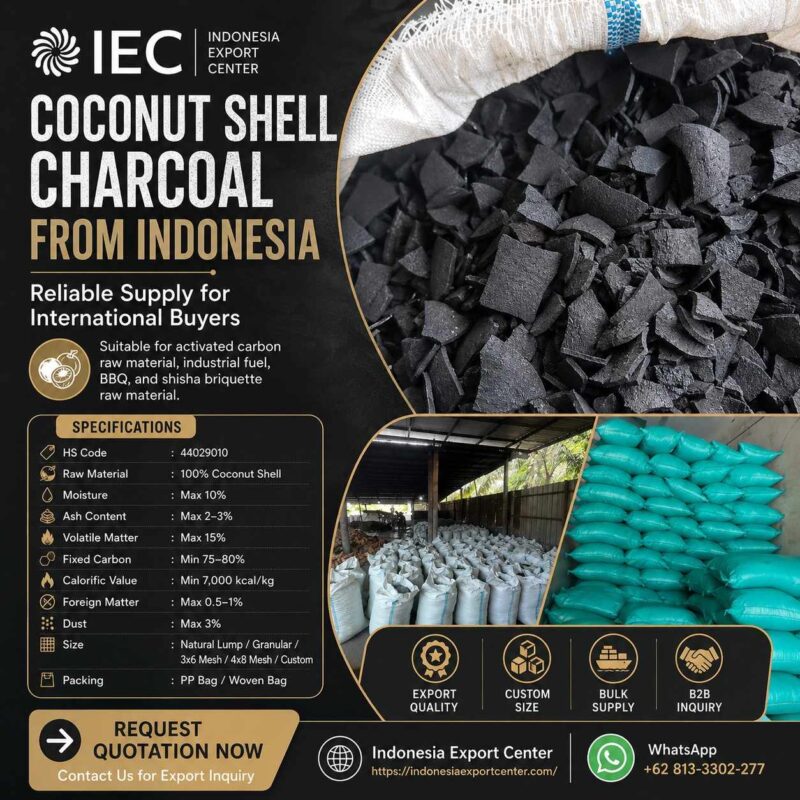
IEC’s supplied technical reference covers raw coconut shell charcoal, available for sourcing inquiries in natural lump, granular, mesh, or custom size configurations.
Export Quality • Custom Size • Bulk Supply • B2B Inquiry
Request Coconut Shell Charcoal Container Quotation:
https://wa.me/628133302277
Coconut Shell Charcoal Container Loading from Indonesia
Container loading refers to the preparation, placement, securing, and documentation of cargo inside a shipping container.
For raw coconut shell charcoal, loading arrangements depend on the physical characteristics of the product and the requirements of the shipment.
Key Loading Variables
- Charcoal grade
- Particle size
- Bulk density
- Moisture
- Bag dimensions
- Net and gross weight
- Container type
- Cargo securing
- Maritime transport classification
- Carrier requirements
Important Clarification
IEC has not supplied a verified fixed loading capacity for 20ft or 40ft containers.
Actual loading quantities must be calculated and confirmed for each shipment.
Why Container Loading Planning Matters
A loading plan helps buyers evaluate freight costs, shipment efficiency, handling requirements, and cargo safety.
Important Objectives
- Stay within container payload limits
- Use available space appropriately
- Protect packaging
- Maintain cargo stability
- Support accurate weight declarations
- Meet applicable transport safety requirements
- Prepare consistent shipping documents
Buyer Recommendation
Request a shipment-specific loading plan rather than relying on a generic charcoal container capacity.
Raw Coconut Shell Charcoal for Container Shipping
IEC’s supplied raw charcoal reference describes material produced from 100% coconut shell.
Potential applications include:
- Activated carbon feedstock
- Industrial fuel
- Charcoal processing
- BBQ briquette raw material
- Shisha briquette raw material
Important Clarification
Raw coconut shell charcoal is different from finished activated carbon and manufactured BBQ or shisha briquettes.
Their density, packaging, and loading requirements may differ.
IEC Raw Coconut Shell Charcoal Specifications
| Parameter | Specification |
|---|---|
| HS Code | 44029010 |
| Raw Material | 100% Coconut Shell |
| Moisture | Max 10% |
| Ash Content | Max 2–3% |
| Volatile Matter | Max 15% |
| Fixed Carbon | Min 75–80% |
| Calorific Value | Min 7,000 kcal/kg |
| Foreign Matter | Max 0.5–1% |
| Dust | Max 3% |
| Size | Natural Lump / Granular / 3×6 Mesh / 4×8 Mesh / Custom |
| Packing | PP Bag / Woven Bag |
Specification note: Ash, fixed carbon, and foreign matter values represent grade-dependent ranges of limits.
Exact acceptance criteria, laboratory methods, and available grades require confirmation.
The supplied HS code must be verified for the actual product and destination.
20ft Container Loading for Coconut Shell Charcoal
A 20-foot container may be considered for certain bulk charcoal shipments.
Important Planning Factors
- Internal dimensions
- Maximum payload
- Container tare weight
- Bag dimensions
- Cargo volume
- Gross shipment weight
- Weight distribution
- Transport safety requirements
Buyer Recommendation
Confirm the container’s actual specifications and carrier restrictions.
No fixed 20ft loading quantity is guaranteed.
40ft Container Loading for Coconut Shell Charcoal
A 40-foot container may provide greater internal volume than a 20-foot container.
However, larger volume does not automatically mean proportionally higher allowable cargo weight.
Important Planning Factors
- Container payload
- Cargo bulk density
- Bag stacking
- Packaging
- Weight distribution
- Road weight restrictions
- Carrier requirements
Buyer Recommendation
Compare usable volume and permitted weight rather than assuming a 40ft container carries twice the charcoal weight of a 20ft container.
20ft vs. 40ft Container Comparison
| Factor | 20ft Container | 40ft Container |
|---|---|---|
| Internal volume | Lower | Higher |
| Maximum payload | Container-specific | Container-specific |
| Suitability | Depends on cargo and shipment | Depends on cargo and shipment |
| Bag count | Requires calculation | Requires calculation |
| Loading method | Must be planned | Must be planned |
| Cargo safety | Must be verified | Must be verified |
| Carrier acceptance | Required | Required |
Important Clarification
No universal coconut shell charcoal tonnage should be assumed for either container type.
Understanding Charcoal Bulk Density
Bulk density is the mass of a material divided by the total volume it occupies, including the spaces between particles.
Formula
Bulk Density (kg/m³) = Material Mass (kg) ÷ Occupied Bulk Volume (m³)
Why Bulk Density Matters
It influences:
- Container space utilization
- Bag filling
- Cargo volume
- Loading calculations
- Freight planning
Important Clarification
IEC has not supplied a verified bulk density value for the offered charcoal.
Bulk Density vs. Particle Density
These measurements are different.
Bulk Density
Includes void spaces between charcoal pieces.
Particle Density
Relates to the density of the charcoal material or individual particles under a defined measurement method.
Buyer Recommendation
Use the correct density measurement when calculating container loading.
Why Natural Lump and Granular Charcoal Load Differently
Particle shape and size distribution influence packing behavior.
Natural Lump Charcoal
Irregular pieces may leave substantial spaces between particles.
Granular Charcoal
Smaller particles may occupy spaces differently.
Important Clarification
The actual difference depends on size distribution, particle shape, settling, and packaging.
How Mesh Size Affects Packing Density
IEC’s supplied size reference includes:
- 3×6 mesh
- 4×8 mesh
- Custom sizes
Important Factors
- Particle-size distribution
- Shape
- Fines
- Screening
- Bag filling
- Settling during handling
Buyer Recommendation
Request a measured bulk density and sieve analysis for the actual grade.
Moisture and Shipment Weight
Moisture contributes to the measured weight of charcoal.
IEC’s supplied raw charcoal reference includes a maximum moisture value of 10%.
Illustrative Example
For 1,000 kg of charcoal:
- At 5% moisture, dry material is approximately 950 kg.
- At 10% moisture, dry material is approximately 900 kg.
This calculation assumes moisture percentages are measured on the same wet-mass basis.
Buyer Recommendation
Specify moisture acceptance limits and the applicable test method.
Packaging Density and Bag Filling
Packaging density affects how efficiently bags can be arranged.
Important Variables
- Charcoal bulk density
- Bag dimensions
- Bag material
- Net weight
- Filling method
- Settling
- Bag deformation
Buyer Recommendation
Request actual filled-bag measurements rather than relying only on nominal bag size.
PP Bag Packaging
IEC’s supplied raw charcoal reference includes PP bags.
Buyer Considerations
- Material specification
- Bag dimensions
- Closure
- Net weight
- Strength
- Handling
- Applicable transport requirements
Important Clarification
No specific PP bag weight or configuration has been confirmed.
Woven Bag Packaging
Woven bags are also included in IEC’s raw charcoal packaging reference.
Buyer Considerations
- Fabric strength
- Bag dimensions
- Closure
- Product containment
- Dust control
- Stacking
- Handling
Important Clarification
Packaging suitability must be assessed for the actual cargo and applicable transport rules.
Illustrative Bag Weight Options
Buyers may request different bag weights.
Example Buyer Requests
- 10 kg
- 20 kg
- 25 kg
- 30 kg
- 50 kg
These are illustrative requested weights, not confirmed available configurations.
Calculating the Number of Bags
Formula
Number of Bags = Total Net Charcoal Weight ÷ Net Weight per Bag
Hypothetical Example
Assume:
- Total charcoal net weight: 20,000 kg
- Net weight per bag: 25 kg
Calculation:
20,000 ÷ 25 = 800 bags
This is an arithmetic illustration, not a confirmed loading capacity.
Calculating Total Gross Cargo Weight
Gross cargo weight includes the charcoal and packaging.
Formula
Gross Cargo Weight = Net Charcoal Weight + Packaging Weight + Other Included Cargo Materials
Hypothetical Example
Assume:
- Net charcoal weight: 20,000 kg
- Total packaging and other included materials: 300 kg
Calculation:
20,000 + 300 = 20,300 kg
These figures are illustrative only.
Calculating Approximate Cargo Volume
Cargo volume may be estimated using measured bulk density.
Formula
Estimated Bulk Volume (m³) = Charcoal Mass (kg) ÷ Bulk Density (kg/m³)
Hypothetical Example
Assume:
- Charcoal mass: 10,000 kg
- Measured bulk density: 400 kg/m³
Calculation:
10,000 ÷ 400 = 25 m³
The 400 kg/m³ figure is a hypothetical calculation input, not a verified IEC product density.
Important Clarification
Actual packaged volume may be greater because of bags, void spaces, stacking inefficiencies, and handling requirements.
Why Container Volume Is Not Fully Usable
The theoretical internal volume of a container is not necessarily the usable cargo volume.
Potential Limitations
- Packaging dimensions
- Stacking pattern
- Door clearance
- Cargo securing
- Pallets
- Weight distribution
- Transport safety requirements
Buyer Recommendation
Use a practical loading layout rather than theoretical volume alone.
Container Payload and Gross Weight Limits
Container loading must respect applicable weight limits.
Important Measurements
- Container tare weight
- Cargo gross weight
- Maximum gross mass
- Payload rating
- Road transport restrictions
Buyer Recommendation
Confirm the actual container data and route-specific restrictions.
Container Tare Weight
Tare weight is the weight of the empty container.
Why It Matters
The loaded container’s total gross mass includes:
- Empty container weight
- Charcoal
- Packaging
- Pallets or securing materials
Buyer Recommendation
Use the actual container tare weight for shipment calculations.
Container Maximum Gross Mass
Every container has a maximum permissible gross mass.
Important Clarification
This limit must not be exceeded.
Other transport restrictions may impose lower operational limits.
Weight Distribution Inside the Container
Cargo should be arranged to maintain appropriate weight distribution.
Important Considerations
- Concentrated loads
- Floor loading limits
- Stacking pattern
- Container stability
- Cargo movement
- Road transport limits
Buyer Recommendation
Follow approved cargo packing and securing procedures.
Floor Loading vs. Palletized Loading
Floor Loading
Bags are arranged directly on the container floor where permitted and suitable.
Palletized Loading
Bags are arranged on pallets for handling and storage.
Buyer Considerations
- Handling equipment
- Packaging
- Cargo securing
- Container space
- Destination unloading
- Applicable transport requirements
Important Clarification
Neither method is automatically suitable for every charcoal shipment.
Palletization and Container Space
Pallets may affect loading efficiency.
Important Variables
- Pallet dimensions
- Pallet weight
- Bag stacking
- Overall height
- Cargo securing
- Destination handling
Buyer Recommendation
Request a pallet layout if palletization is required.
Cargo Securing and Movement Prevention
Cargo movement during transport can damage packaging or create safety hazards.
Important Considerations
- Load distribution
- Blocking
- Bracing
- Suitable securing materials
- Bag stability
- Container condition
Buyer Recommendation
Use cargo securing practices appropriate to the shipment and relevant transport rules.
The CTU Code and Safe Packing
The IMO/ILO/UNECE Code of Practice for Packing of Cargo Transport Units (CTU Code) provides guidance on packing cargo transport units.
Relevant Topics
- Packing planning
- Weight distribution
- Cargo securing
- Container inspection
- Packing responsibilities
Buyer Recommendation
Use applicable CTU Code guidance together with binding transport requirements and carrier instructions.
Container Condition Inspection
The container should be inspected before loading.
Potential Checks
- Structural condition
- Floor condition
- Doors
- Seals
- Cleanliness
- Moisture or water ingress
- Suitability for the cargo
- Applicable safety requirements
Buyer Recommendation
Document the inspection before stuffing.
Moisture Protection During Container Shipping
Moisture can affect charcoal quality and packaging.
Important Considerations
- Container condition
- Cargo moisture
- Humidity
- Condensation
- Packaging
- Transit duration
- Destination climate
Buyer Recommendation
Assess moisture protection measures without compromising applicable cargo safety requirements.
Container Condensation and Cargo Sweat
Temperature changes may contribute to condensation during maritime transport.
Potential Consequences
- Damp packaging
- Product moisture changes
- Label damage
- Handling issues
Buyer Recommendation
Review packaging and container conditions for the planned route.
Charcoal Self-Heating and Fire Risk
Charcoal can present self-heating and fire hazards during transport.
Important Factors
- Cargo characteristics
- Production and cooling history
- Storage
- Packaging
- Shipment conditions
- Applicable classification
Important Clarification
IEC does not claim that all raw coconut shell charcoal can be shipped as unrestricted general cargo.
IMDG Code Classification for Coconut Shell Charcoal
The current International Maritime Dangerous Goods (IMDG) Code and applicable carrier requirements must be checked for the actual shipment.
Important Considerations
- Cargo classification
- Applicable testing
- Packaging
- Marking and labeling
- Documentation
- Container preparation
- Carrier acceptance
Buyer Recommendation
Confirm classification and required evidence before booking and loading.
Why Transport Classification Affects Container Loading
Transport classification may influence:
- Container acceptance
- Packaging requirements
- Cargo documentation
- Loading arrangements
- Carrier procedures
- Freight pricing
- Shipment timing
Important Clarification
A generic loading calculation is not a substitute for a compliant transport plan.
Safety Data Sheet and Supporting Documents
An SDS may be requested for charcoal shipments.
Important Information
- Product identification
- Composition
- Hazards
- Handling
- Storage
- Transport information
Important Clarification
An SDS alone does not establish the correct IMDG classification.
Carrier Acceptance Before Loading
Shipping lines may require cargo information before confirming a booking.
Potential Information
- Product description
- Cargo classification
- Test documentation
- Packaging
- Container type
- Origin
- Destination
- Shipment weight
Buyer Recommendation
Obtain carrier acceptance before finalizing loading arrangements.
Verified Gross Mass (VGM)
Containerized maritime shipments are subject to applicable Verified Gross Mass requirements under SOLAS.
Important Considerations
- Verified container gross mass
- Responsible shipper
- Approved weighing method
- Submission deadlines
- Carrier procedures
Buyer Recommendation
Confirm VGM responsibilities before shipment.
Container Loading Report
A loading report may help document the shipment.
Potential Information
- Loading date
- Container number
- Seal number
- Product
- Bag count
- Net weight
- Gross weight
- Packaging
- Loading photographs
- Inspection observations
Buyer Recommendation
Agree on the required report format before loading.
Container Number and Seal Number
Container and seal numbers support shipment identification.
Buyer Recommendation
Cross-check these details against:
- Loading report
- Packing list
- Shipping instructions
- Bill of lading
- Other applicable documents
Packing List for Container Shipments
The packing list should reflect the actual cargo.
Recommended Information
- Product description
- Bag count
- Net weight
- Gross weight
- Packaging type
- Container number
- Seal number
- Lot identification
- Shipping marks
Buyer Recommendation
Verify packing list accuracy after loading.
Commercial Invoice and Shipment Quantity
The commercial invoice should match the contractual goods and quantities.
Important Fields
- Product
- Grade
- Quantity
- Unit price
- Total value
- Incoterm
- Named port or place
- Buyer and seller
Buyer Recommendation
Resolve inconsistencies before issuing final documents.
Bill of Lading and Container Details
The bill of lading may include:
- Shipper
- Consignee
- Notify party
- Port of loading
- Port of discharge
- Container number
- Seal number
- Cargo description
- Weight
- Package count
Buyer Recommendation
Review the draft bill of lading before final issuance.
Pre-Shipment Inspection for Container Loading
Buyers may request independent inspection.
Potential Inspection Scope
- Product identity
- Quantity
- Packaging
- Container condition
- Sampling
- Quality testing
- Loading supervision
- Seal verification
Important Clarification
Inspection services and availability require confirmation.
Quality Sampling Before Loading
Representative sampling may help assess the actual shipment.
Suggested Process
- Identify the shipment lot.
- Agree on the sampling method.
- Collect representative samples.
- Preserve sample identity.
- Conduct agreed tests.
- Compare results with acceptance limits.
- Document the findings.
Buyer Recommendation
Define acceptance criteria in the purchase agreement.
Container Loading for Natural Lump Charcoal
Natural lump charcoal may require specific handling because of irregular particle size.
Important Considerations
- Lump breakage
- Dust generation
- Bag filling
- Bulk density
- Stacking
- Packaging protection
Buyer Recommendation
Request representative packing measurements and loading information.
Container Loading for Granular Charcoal
Granular charcoal may have different packing behavior.
Important Considerations
- Particle-size distribution
- Bulk density
- Dust
- Bag filling
- Leakage
- Packaging strength
Buyer Recommendation
Confirm actual packed density and bag configuration.
Container Loading for 3×6 and 4×8 Mesh
Mesh products may require additional attention to particle-size consistency.
Important Considerations
- Sieve standard
- Oversize and undersize material
- Dust
- Bag filling
- Packaging containment
- Handling losses
Buyer Recommendation
Include the mesh specification and particle-size acceptance criteria in the purchase order.
FOB Container Loading Responsibilities
Under FOB Incoterms 2020, the seller delivers the goods on board the buyer-nominated vessel at the named port of shipment.
Risk transfers when the goods are on board.
Important Clarification
For containerized cargo handed to a carrier before vessel loading, FCA may better reflect the delivery point.
FCA for Containerized Charcoal
Under FCA Incoterms 2020, delivery occurs when the goods are handed over according to the rule at the agreed place.
Buyer Recommendation
Discuss the physical container handover point before selecting the Incoterm.
CFR and CIF Container Shipments
Under CFR and CIF, the seller arranges and pays for carriage to the named destination port.
Under CIF, the seller also obtains the required cargo insurance.
Important Clarification
Risk generally transfers when the goods are on board at origin under both terms.
Container Freight Cost Considerations
Freight costs may depend on:
- Origin port
- Destination port
- Container type
- Cargo classification
- Carrier availability
- Shipment timing
- Route
- Applicable surcharges
Important Clarification
IEC has not supplied current freight rates.
Freight Cost per Metric Ton
Shipping managers may calculate freight cost per metric ton.
Formula
Freight Cost per MT = Total Freight Cost ÷ Net Charcoal Weight in MT
Hypothetical Example
Assume:
- Ocean freight: USD 2,000
- Net cargo weight: 20 MT
Calculation:
USD 2,000 ÷ 20 = USD 100 per MT
These figures are illustrative, not actual IEC freight rates.
Why Loading Efficiency Affects Landed Cost
Lower loading efficiency may increase freight cost per unit of product.
Important Factors
- Bulk density
- Packaging
- Container utilization
- Weight limits
- Cargo safety requirements
Buyer Recommendation
Evaluate both freight cost and compliant loading capacity.
Common Container Loading Mistakes
Shipping managers should avoid:
- Assuming a fixed charcoal tonnage per container.
- Ignoring bulk density.
- Using nominal rather than measured bag dimensions.
- Confusing net and gross weight.
- Exceeding container payload limits.
- Ignoring weight distribution.
- Overlooking cargo securing.
- Failing to inspect the container.
- Assuming charcoal is unrestricted general cargo.
- Omitting VGM and shipping document checks.
Container Loading Planning Checklist
| Planning Item | Information to Confirm |
|---|---|
| Product | Raw coconut shell charcoal |
| Grade | Agreed specification |
| Size | Lump / granular / mesh / custom |
| Bulk density | Measured value |
| Packaging | PP bag / woven bag |
| Net weight per bag | Confirmed value |
| Filled bag dimensions | Measured dimensions |
| Bag count | Calculated and verified |
| Total net weight | Confirmed |
| Total gross weight | Confirmed |
| Container type | 20ft / 40ft / other |
| Container payload | Actual container rating |
| Loading method | Approved arrangement |
| Cargo securing | Confirmed |
| Transport classification | Verified |
| Carrier acceptance | Confirmed |
| VGM | Submitted as required |
| Inspection | Agreed |
| Documentation | Checked |
IEC’s Role in Container Loading Coordination
Indonesia Export Center operates as a sourcing and export facilitation intermediary.
IEC can receive international buyer inquiries and facilitate discussions about potential Indonesian coconut shell charcoal sourcing and shipment arrangements.
IEC is not represented as a confirmed manufacturer, contractual seller, or exporter of record.
Product availability, measured bulk density, packaging dimensions, container loading quantities, cargo classification, carrier acceptance, and shipment terms require confirmation with the relevant parties.
How to Request a Container Loading Quotation
Step 1 – Define the Product
Specify raw coconut shell charcoal and the intended application.
Step 2 – Confirm the Grade and Size
State moisture, ash, fixed carbon, and particle-size requirements.
Step 3 – Provide Packaging Requirements
Specify PP bags or woven bags and preferred net weight per bag.
Step 4 – Identify Container Preferences
State 20ft, 40ft, or request a recommendation based on actual loading data.
Step 5 – Confirm the Destination
Provide the destination country and port.
Step 6 – Define Inspection and Safety Requirements
State required laboratory reports, loading inspection, and cargo documentation.
Step 7 – Confirm Commercial Terms
Specify FOB, FCA, CFR, CIF, or another agreed term.
Step 8 – Submit the Inquiry
Send the complete requirements to IEC.
Coconut Shell Charcoal Container Loading RFQ Template
Subject: RFQ – Raw Coconut Shell Charcoal Container Loading from Indonesia
Dear Indonesia Export Center Team,
We are interested in sourcing raw coconut shell charcoal from Indonesia and require product and container loading information.
Please advise whether suitable supply arrangements are available for the following requirements.
Company Name: [Company Name]
Country: [Country]
Business Activity: [Importer / Trader / Manufacturer / Distributor]
Contact Person: [Name]
Product: Raw Coconut Shell Charcoal
Intended Application: [Activated Carbon / Industrial Fuel / Briquette Feedstock / Other]
Required Grade: [Grade]
Maximum Moisture: [Percentage]
Maximum Ash: [Percentage]
Maximum Volatile Matter: [Percentage]
Minimum Fixed Carbon: [Percentage]
Minimum Calorific Value: [kcal/kg]
Maximum Foreign Matter: [Percentage]
Maximum Dust: [Percentage]
Required Size: [Natural Lump / Granular / 3×6 Mesh / 4×8 Mesh / Custom]
Mesh Standard / Size Tolerance: [Details]
Packaging: [PP Bag / Woven Bag]
Net Weight per Bag: [kg]
Required Quantity: [Metric Tons]
Preferred Container: [20ft / 40ft / Please Advise]
Palletization: [Required / Not Required / Please Advise]
Destination Country: [Country]
Destination Port: [Port]
Preferred Indonesian Loading Port: [Port / Please Advise]
Preferred Incoterm: [FOB / FCA / CFR / CIF / Other]
Required Laboratory Documentation: [Details]
Loading Inspection: [Requirements]
Target Shipment Date: [Date]
Please provide:
- Available charcoal grades
- Technical specifications
- Measured bulk density, if available
- Available packaging configurations
- Net weight per bag
- Filled bag dimensions
- Proposed bag count
- Proposed net and gross shipment weights
- Recommended container type
- Shipment-specific loading plan
- Applicable container payload considerations
- Cargo securing arrangements
- Cargo classification and required transport safety documentation
- Carrier acceptance requirements
- VGM arrangements
- Inspection options
- Export documentation
- MOQ
- Commercial quotation
- Shipment lead time and payment terms
We look forward to receiving your quotation and loading information.
Best regards,
[Your Name]
[Company Name]
[Contact Information]
Send Your Container Loading RFQ via WhatsApp:
https://wa.me/628133302277
Frequently Asked Questions About Coconut Shell Charcoal Container Loading
How many tons of coconut shell charcoal fit in a 20ft container?
There is no confirmed universal loading quantity. Actual capacity depends on bulk density, packaging, container payload, and transport safety requirements.
How many tons fit in a 40ft container?
The quantity must be calculated for the actual product, packaging, and container.
Does a 40ft container carry twice the weight of a 20ft container?
Not necessarily. Container payload limits and cargo density may prevent proportional weight increases.
What is bulk density?
Bulk density is the mass of material divided by the total bulk volume it occupies, including spaces between particles.
Does IEC provide a fixed bulk density?
No verified bulk density value has been supplied.
Does particle size affect loading?
Yes. Particle size and shape influence packing behavior and bulk density.
Can natural lump charcoal be shipped in containers?
Container shipment may be considered, subject to cargo classification, packaging, carrier acceptance, and other applicable requirements.
Can granular charcoal be shipped in containers?
Container shipment may be considered, subject to the same relevant checks.
What packaging does IEC reference?
PP bags and woven bags.
Can buyers request 25kg bags?
Buyers may request that configuration, subject to availability.
How is bag count calculated?
Divide total net charcoal weight by net weight per bag.
What is the difference between net and gross weight?
Net weight excludes packaging, while gross cargo weight includes packaging and other included cargo materials.
Is palletization required?
It depends on the shipment, packaging, handling, and applicable transport requirements.
What is VGM?
Verified Gross Mass is the verified gross mass of a packed container required under applicable SOLAS rules.
Is charcoal unrestricted general cargo?
Not automatically. Applicable IMDG Code classification and carrier requirements must be verified.
Does an SDS prove the cargo is non-dangerous?
No. An SDS alone does not establish the correct maritime transport classification.
Can buyers request container loading inspection?
Yes. Inspection requirements may be included in commercial discussions.
Does IEC guarantee a specific container loading capacity?
No. Loading capacity must be verified for each shipment.
Can buyers request FOB or CIF quotations?
Yes. Buyers may submit preferred shipment terms, subject to supplier and logistics arrangements.
How can buyers request loading information?
Contact IEC through WhatsApp at +62 813-3302-277 with the product grade, size, packaging, quantity, destination, and container preferences.
Request Coconut Shell Charcoal Container Loading Quotation
Planning a bulk coconut shell charcoal shipment from Indonesia?
Indonesia Export Center (IEC) welcomes B2B inquiries from shipping managers, freight forwarders, activated carbon manufacturers, industrial buyers, commodity traders, and international importers.
Product: Raw Coconut Shell Charcoal
Origin: Indonesia
Technical Reference: Moisture • Ash • Fixed Carbon • Volatile Matter • Calorific Value • Foreign Matter • Dust
Size Options to Inquire About: Natural Lump • Granular • 3×6 Mesh • 4×8 Mesh • Custom
Packaging Reference: PP Bag • Woven Bag
Container Planning: 20ft • 40ft • Bulk Density • Bag Count • Net/Gross Weight • Cargo Securing
Shipment Safety: Cargo Classification • IMDG Code • Carrier Acceptance • VGM • Inspection
Trade Terms: FOB • FCA • CFR • CIF, subject to agreement
Target Market: International B2B Buyers
Contact IEC to discuss potential supplier availability, measured product characteristics, packaging, container loading plans, inspection, shipment safety, and quotations.
Indonesia Export Center (IEC)
Website: https://indonesiaexportcenter.com/
WhatsApp: +62 813-3302-277
Request Quotation via WhatsApp:
https://wa.me/628133302277
Please include your company name, country, required charcoal grade, size, purchasing quantity, packaging preference, container type, destination port, and expected shipment date.
