

INDONESIA EXPORT CENTER (IEC)
Wholesale Coconut Blossom Nectar Sourcing for International Food Distributors and Specialty Ingredient Traders
Coconut Nectar Syrup Wholesale Opportunities for Distributors
Are you searching for coconut nectar syrup distributors sourcing opportunities or looking to expand your wholesale sweetener portfolio?
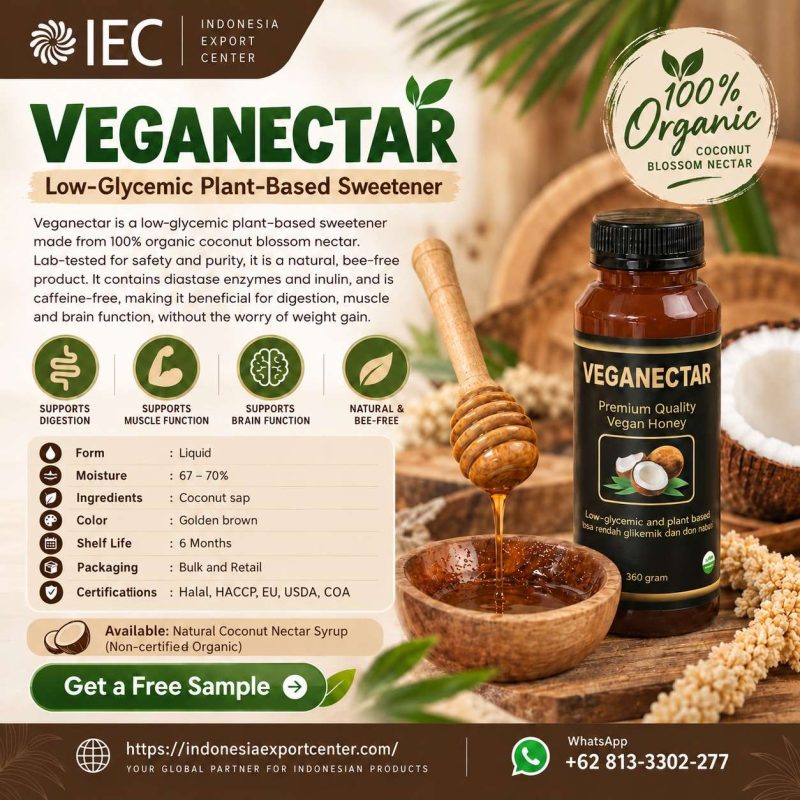
Indonesia Export Center (IEC) facilitates sourcing inquiries for Indonesian coconut blossom nectar syrup, including VEGANECTAR, a product introduced in IEC promotional material as a plant-based liquid sweetener.
Distributors may evaluate coconut nectar syrup for resale to food manufacturers, beverage companies, specialty retailers, hospitality suppliers, and other commercial customers.
However, a successful distribution program requires more than a product quotation.
Wholesale buyers should assess product consistency, packaging, certification, inventory turnover, shelf life, territory arrangements, pricing, and recurring supply feasibility.
This guide explains how distributors can evaluate Indonesian coconut nectar syrup as a potential addition to their product portfolio.
What Is Coconut Nectar Syrup?
Coconut nectar syrup is a liquid sweetening ingredient derived from coconut palm sap.
The IEC promotional material describes VEGANECTAR as a golden-brown liquid coconut blossom nectar product.
Potential customers may include:
- Food manufacturers.
- Beverage companies.
- Specialty ingredient retailers.
- Vegan food brands.
- Bakeries.
- Foodservice businesses.
- Private-label brands.
- Wholesale ingredient traders.
The suitability of the product depends on each customer’s requirements.
VEGANECTAR Reference Product Information
| Parameter | Promotional Description |
|---|---|
| Product Name | VEGANECTAR |
| Product Type | Coconut Blossom Nectar Syrup |
| Ingredient Claim | 100% Organic Coconut Blossom Nectar |
| Source | Coconut Sap |
| Form | Liquid |
| Moisture | 67–70% |
| Colour | Golden Brown |
| Shelf Life | 6 Months |
| Packaging | Bulk and Retail |
| Certification References | Halal, HACCP, EU, USDA |
| Alternative Variant | Natural Coconut Nectar Syrup |
The information is based on promotional material and requires supplier verification.
Why Distributors May Consider Coconut Nectar
Coconut nectar syrup may provide a product category for distributors serving businesses interested in plant-derived liquid sweeteners.
Potential commercial opportunities include:
Ingredient Portfolio Expansion
Distributors may add coconut nectar alongside other food ingredients.
Specialty Food Channels
The product may be relevant to retailers offering specialty sweeteners.
Plant-Based Food Manufacturers
Manufacturers may evaluate coconut nectar for selected formulations.
Foodservice Distribution
Hospitality suppliers may investigate commercial liquid sweetener formats.
Beverage Ingredient Distribution
Beverage companies may evaluate coconut nectar for selected recipes.
Each market opportunity requires customer demand validation.
Choosing the Right Product Variant
The IEC flyer references two product categories.
VEGANECTAR Organic Coconut Blossom Nectar: Marketed as organic, subject to certification verification.
Natural Coconut Nectar Syrup: Described as a non-certified organic alternative.
Distributors should not combine these variants under one organic claim.
Separate specifications, certificates, and product identities should be maintained.
Bulk vs Retail Distribution
Distributors may operate through different channels.
Bulk Ingredient Distribution
Bulk customers may require:
- Larger commercial quantities.
- Technical specifications.
- COA.
- Food safety documentation.
- Suitable industrial packaging.
- Recurring delivery arrangements.
Retail Product Distribution
Retail customers may require:
- Consumer packaging.
- Accurate labelling.
- Barcodes.
- Shelf-life information.
- Country-of-origin details.
- Packaging artwork approval.
- Applicable certification marks.
The flyer references bulk and retail formats, but exact packaging capabilities require confirmation.
Resale Packaging Considerations
Distributors should verify whether the product is supplied in manufacturer-branded packaging or whether alternative packaging arrangements are possible.
Questions to ask include:
- What pack sizes are available?
- Is VEGANECTAR-branded packaging available?
- Can labels be adapted for the destination market?
- Who owns the packaging artwork?
- Who is responsible for regulatory label approval?
- Are barcodes provided?
- What is the minimum order for each packaging format?
- Can batches be traced through distribution?
- What storage conditions apply?
- What is the remaining shelf life at dispatch?
Distributor Territory Arrangements
Some distributors may be interested in exclusive or non-exclusive territory arrangements.
However, the IEC flyer does not confirm any available exclusivity rights.
Buyers should request written clarification of:
- Brand ownership.
- Authorized distributor status.
- Geographic territory.
- Sales channels.
- Exclusivity.
- Minimum purchasing commitments.
- Marketing responsibilities.
- Contract duration.
- Termination provisions.
No territory rights should be assumed without a signed agreement.
Recurring Supply Planning
Distributors should estimate demand based on realistic customer purchasing patterns.
Important considerations include:
- Initial stock.
- Monthly sales forecast.
- Reorder frequency.
- Production lead time.
- Freight transit.
- Customs clearance.
- Warehouse handling.
- Shelf-life management.
- Safety stock.
Because the promotional shelf life is six months, distributors should carefully assess inventory turnover.
Shelf-Life Management
The IEC flyer states a six-month shelf life for VEGANECTAR.
Distributors should verify the conditions under which this shelf life applies.
Important questions include:
- What is the manufacturing date?
- What is the expiry date?
- What is the remaining shelf life at shipment?
- What storage temperature is required?
- Is refrigeration necessary?
- How should opened containers be handled?
- What shelf-life evidence is available?
- What are the appropriate warehouse conditions?
The flyer does not answer all these questions.
Warehouse and Handling Requirements
Liquid sweetener distribution requires appropriate storage and handling procedures.
Potential considerations include:
- Packaging integrity.
- Temperature control where specified.
- Hygiene.
- Lot segregation.
- Stock rotation.
- Spill prevention.
- Product traceability.
- Damaged goods handling.
- Recall procedures.
Warehouse procedures should follow the supplier’s validated storage instructions.
Product Quality Documentation
Distributors may request:
- Product specification.
- Ingredient declaration.
- COA.
- Microbiological results.
- Shelf-life evidence.
- Organic certification where claimed.
- Halal documentation where relevant.
- HACCP-related evidence.
- Packaging specifications.
- Traceability information.
These documents may also be required by downstream customers.
Certification Verification
The IEC promotional material references USDA, EU, Halal, and HACCP.
Distributors should verify the relevant certificates before making marketing claims.
Organic and halal claims may have different requirements across countries.
HACCP documentation should be reviewed in relation to the actual manufacturing operation.
Marketing Coconut Nectar Responsibly
Distributors should avoid unsupported health claims.
The flyer includes low-glycemic and other health-related statements, but these require scientific and regulatory substantiation.
Coconut nectar should not automatically be promoted as:
- Sugar-free.
- Suitable for diabetes.
- A weight-loss ingredient.
- Medically beneficial.
- Chemically identical to honey.
Marketing can instead focus on verified product identity, origin, flavour, physical format, and application suitability.
Wholesale Price Evaluation
Distributors should calculate commercial viability using total landed cost.
Potential costs include:
- Product purchase price.
- Packaging.
- International freight.
- Insurance.
- Import duties.
- Taxes.
- Customs brokerage.
- Warehouse handling.
- Domestic transportation.
- Marketing.
- Product testing.
- Inventory losses.
A distributor should also consider customer payment terms and inventory turnover.
MOQ and Order Frequency
The supplier’s MOQ may vary according to product variant, packaging, and commercial arrangements.
No verified MOQ is provided in the flyer.
Distributors should request confirmation of:
- Initial order minimum.
- Reorder minimum.
- Mixed-pack feasibility.
- Production lead time.
- Available capacity.
- Repeat-order arrangements.
Supplier Approval Checklist
| Evaluation Area | Distributor Question |
|---|---|
| Manufacturer | Who produces the syrup? |
| Brand | Who owns VEGANECTAR? |
| Product | Is the specification current? |
| Quality | Is a relevant COA available? |
| Organic | Is certification verified? |
| Packaging | Which formats are available? |
| Shelf Life | What evidence supports six months? |
| MOQ | What is the confirmed minimum? |
| Capacity | Can repeat orders be supported? |
| Territory | Are distribution rights available? |
| Freight | Which delivery terms can be quoted? |
| Documentation | Can import requirements be met? |
Distributor Onboarding Process
A practical distribution sourcing process may include:
Stage 1 – Product Review
Review the product profile and intended sales channels.
Stage 2 – Supplier Verification
Confirm manufacturer identity and brand authorization.
Stage 3 – Technical Approval
Review specifications, samples, and available quality documents.
Stage 4 – Regulatory Review
Confirm destination-market requirements.
Stage 5 – Commercial Evaluation
Request pricing, MOQ, packaging, and lead time.
Stage 6 – Trial Order
Consider a suitable initial order if commercially feasible.
Stage 7 – Performance Review
Evaluate product quality, customer response, delivery reliability, and inventory turnover.
Stage 8 – Recurring Supply
Negotiate future orders based on verified supplier capability.
Distributor RFQ Template
Subject: Coconut Nectar Syrup Distribution Inquiry – Indonesia
Company Name: [Company]
Country: [Country]
Business Type: [Ingredient Distributor / Retail Distributor / Wholesaler]
Product: VEGANECTAR Coconut Blossom Nectar Syrup
Variant: [Organic / Natural]
Distribution Channels: [Details]
Initial Quantity: [KG or MT]
Monthly Forecast: [Quantity]
Preferred Packaging: [Bulk / Retail]
Required Certifications: [Details]
Destination Port: [Port]
Preferred Incoterm: [Term]
Territory Inquiry: [Exclusive / Non-Exclusive / No Preference]
Please provide current product specifications, manufacturer and brand authorization information, certification evidence, packaging options, sample feasibility, MOQ, capacity, lead time, and wholesale quotation.
Frequently Asked Questions
Can distributors source VEGANECTAR from Indonesia?
They may submit a sourcing inquiry, subject to supplier feasibility.
Is VEGANECTAR available in bulk and retail formats?
Both formats are referenced in the flyer; exact options require confirmation.
Can distributors request exclusive territory rights?
They may inquire, but exclusivity is not confirmed.
Is the product certified organic?
The flyer references organic certification, but current evidence is required.
Can distributors sell the natural variant as organic?
Not without appropriate certification.
What is the reported shelf life?
Six months for VEGANECTAR, subject to verification.
Can distributors request branded packaging?
They may inquire about available VEGANECTAR packaging.
Is private-label packaging available?
Capability must be confirmed.
What is the MOQ?
Supplier confirmation is required.
Can recurring orders be arranged?
Potentially, subject to verified supplier capacity and commercial agreement.
Does IEC guarantee distribution rights?
No.
Can IEC facilitate wholesale quotations?
Yes, IEC facilitates sourcing inquiries.
Discuss Coconut Nectar Syrup Distribution Opportunities
Looking to expand your ingredient or specialty food distribution portfolio with Indonesian coconut nectar syrup?
Contact Indonesia Export Center with your company profile, target market, purchasing forecast, packaging requirements, and certification needs.
DISCUSS COCONUT NECTAR DISTRIBUTION OPTIONS
INDONESIA EXPORT CENTER (IEC)
Website: https://indonesiaexportcenter.com/
WhatsApp: +62 813-3302-277
Supplier capacity, brand authorization, distribution rights, certification, specifications, packaging, MOQ, prices, samples, and shipment arrangements require verification.
Related Resources
VEGANECTAR Coconut Nectar Syrup Wholesale
Bulk Coconut Nectar Syrup Supplier Indonesia
Coconut Nectar for Food Ingredient Importers
Natural Coconut Nectar Syrup Wholesale
