

INDONESIA EXPORT CENTER (IEC)
B2B Sourcing Support for International Food Ingredient Importers and Procurement Teams
Import Coconut Nectar Syrup from Indonesia
Are you evaluating coconut nectar for food importers as part of your ingredient sourcing portfolio?
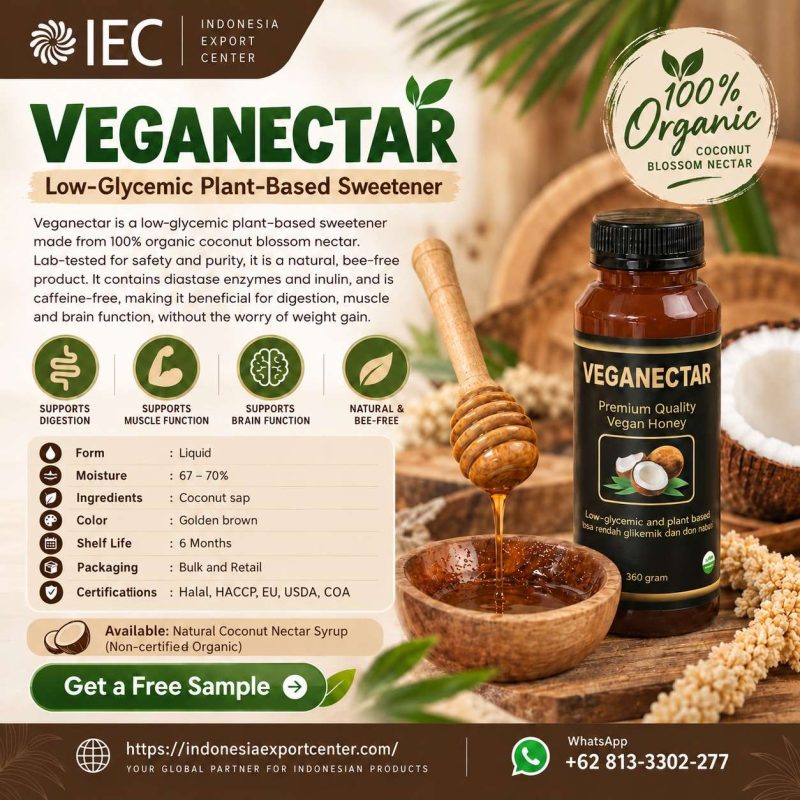
Indonesia Export Center (IEC) facilitates sourcing inquiries for Indonesian coconut blossom nectar syrup, including the VEGANECTAR product described in IEC promotional material.
Food ingredient importers need to consider more than product availability. They must evaluate supplier identity, technical specifications, food safety documentation, import eligibility, packaging, shipment terms, and commercial reliability.
This guide provides a practical procurement framework for businesses considering coconut nectar syrup imports from Indonesia.
Understanding the Product
Coconut nectar syrup is a liquid sweetening ingredient derived from coconut palm sap.
The IEC flyer describes VEGANECTAR as a golden-brown liquid product positioned for bulk and retail applications.
The product may be evaluated for:
- Beverage manufacturing.
- Bakery applications.
- Dessert products.
- Specialty foods.
- Plant-based formulations.
- Ingredient distribution.
The final suitability depends on product-specific testing.
VEGANECTAR Reference Information
| Parameter | Flyer Information |
|---|---|
| Product | VEGANECTAR |
| Source | Coconut Sap |
| Ingredient Claim | Organic Coconut Blossom Nectar |
| Form | Liquid |
| Moisture | 67–70% |
| Colour | Golden Brown |
| Shelf Life | 6 Months |
| Packaging | Bulk and Retail |
| Certification References | Halal, HACCP, EU, USDA |
| Alternative | Natural Coconut Nectar Syrup |
The values are promotional references, not independently verified shipment specifications.
Step 1: Define the Import Requirement
The importer should identify:
- Destination country.
- Product application.
- Organic or natural variant.
- Technical requirements.
- Initial order quantity.
- Expected annual demand.
- Packaging.
- Certification requirements.
- Delivery terms.
- Target arrival date.
A detailed inquiry allows suppliers to assess feasibility.
Step 2: Verify the Manufacturer
Importers should request the identity of the actual manufacturing company.
Potential checks include:
- Legal registration.
- Facility address.
- Manufacturing role.
- Product authorization.
- Quality management.
- Traceability.
- Export experience.
- Commercial references where available.
IEC facilitates inquiries and should not automatically be assumed to be the manufacturer.
Step 3: Request Product Specifications
A product specification should identify the agreed characteristics.
For liquid coconut nectar, relevant parameters may include:
- Ingredient composition.
- Moisture.
- Brix.
- pH.
- Water activity.
- Viscosity.
- Colour.
- Microbiological criteria.
- Packaging.
- Storage conditions.
- Shelf life.
The flyer does not provide all these values.
Step 4: Request a Certificate of Analysis
A COA may provide analytical results for a specific sample or lot.
Importers should verify:
- Product identity.
- Lot number.
- Sampling information.
- Test date.
- Test methods.
- Laboratory identity.
- Results.
- Specification limits.
A generic COA should not automatically be accepted for every shipment.
Step 5: Review Food Safety Documentation
Depending on the destination and buyer requirements, relevant records may include:
- Food safety management evidence.
- Manufacturing hygiene information.
- Microbiological test results.
- Contaminant testing.
- Ingredient declarations.
- Traceability.
- Shelf-life validation.
Step 6: Verify Organic Claims
The flyer describes VEGANECTAR as organic.
Importers should confirm the current certificate holder, product scope, validity, and applicable destination-market import procedures.
Organic certification requirements may differ between countries.
Step 7: Check Import Eligibility
Before shipping, the importer should confirm:
- Product classification.
- Applicable food regulations.
- Import permissions or notifications.
- Customs requirements.
- Labelling.
- Certification.
- Inspection.
- Documentation.
Import eligibility should not be assumed.
Step 8: Evaluate Samples
Samples may be evaluated for:
- Colour.
- Aroma.
- Sweetness.
- Viscosity.
- Soluble solids.
- Microbiological quality.
- Application performance.
The sample should be traceable to the supplier and product.
Step 9: Confirm Packaging
Liquid products require suitable packaging.
Importers should request:
- Available formats.
- Food-contact suitability.
- Closure information.
- Outer packaging.
- Lot coding.
- Storage requirements.
- Transport compatibility.
Step 10: Confirm MOQ and Capacity
The buyer should request the supplier’s minimum order quantity and available production capacity.
No verified MOQ or capacity is provided in the flyer.
Step 11: Agree Incoterms
Importers should agree on the appropriate Incoterm and named location.
FOB, CIF, FCA, or CIP may be considered depending on the transport arrangement.
Risk transfer and cost responsibilities should be understood before signing.
Step 12: Review Export and Import Documents
Potential documents include:
- Commercial invoice.
- Packing list.
- Transport document.
- Product specification.
- COA.
- Certificate of origin where applicable.
- Organic documentation where required.
- Halal documentation where required.
- Customs records.
- Other destination-specific documents.
Step 13: Calculate Landed Cost
The importer should estimate:
- Product price.
- Packaging.
- Freight.
- Insurance.
- Duties.
- Taxes.
- Customs clearance.
- Destination handling.
- Warehousing.
- Local delivery.
Step 14: Plan Shelf-Life Management
The flyer reports a six-month shelf life.
Importers should verify remaining shelf life at shipment and arrival.
This is particularly important for international distribution involving long transport and warehouse periods.
Step 15: Establish a Supplier Approval Process
A structured approval process may include:
- Preliminary supplier screening.
- Documentation review.
- Sample evaluation.
- Regulatory assessment.
- Commercial quotation.
- Quality agreement.
- Shipment planning.
- Pre-shipment checks.
- Receipt inspection.
- Supplier performance review.
Importer Due Diligence Checklist
| Category | Required Review |
|---|---|
| Manufacturer | Verified identity |
| Product | Approved specification |
| COA | Relevant lot evidence |
| Food Safety | Appropriate documentation |
| Organic | Current certification if claimed |
| Import Eligibility | Destination requirements |
| Packaging | Suitable liquid packaging |
| Shelf Life | Validated storage and expiry |
| MOQ | Confirmed |
| Capacity | Confirmed |
| Shipping | Agreed Incoterm |
| Payment | Agreed contractual terms |
Coconut Nectar Import RFQ Template
Subject: Coconut Nectar Syrup Import Inquiry – Indonesia
Company: [Name]
Destination Country: [Country]
Business Type: [Ingredient Importer / Distributor / Manufacturer]
Product: Coconut Blossom Nectar Syrup
Variant: [Organic / Natural]
Initial Quantity: [KG or MT]
Annual Forecast: [Quantity]
Required Specifications: [Details]
Required Certifications: [Details]
Packaging: [Details]
Destination Port: [Port]
Preferred Incoterm: [Term]
Please provide manufacturer information, current specifications, COA, certification documents, sample feasibility, MOQ, capacity, lead time, packaging options, and export quotation.
Frequently Asked Questions
Can coconut nectar syrup be imported from Indonesia?
Potentially, subject to destination-market requirements.
Does IEC manufacture coconut nectar?
IEC facilitates sourcing inquiries; the manufacturer must be confirmed.
Is VEGANECTAR certified organic?
The flyer references organic status, but current evidence is required.
What is the reported shelf life?
Six months, subject to verification.
What technical documents should importers request?
At minimum, relevant product specifications and available quality evidence.
Can importers request laboratory samples?
Sample feasibility must be confirmed.
Is the product available in bulk?
The flyer references bulk packaging, subject to confirmation.
Can IEC provide export quotations?
IEC facilitates supplier quotation inquiries.
Discuss Coconut Nectar Import Supply Options
Looking for Indonesian coconut nectar syrup for your ingredient import business?
Contact IEC with your specifications, destination, purchasing volume, and documentation requirements.
DISCUSS COCONUT NECTAR SUPPLY OPTIONS
INDONESIA EXPORT CENTER (IEC)
Website: https://indonesiaexportcenter.com/
WhatsApp: +62 813-3302-277
Supplier feasibility, product specifications, certification, import eligibility, samples, MOQ, prices, and shipment arrangements require verification.
Related Resources
Coconut Blossom Syrup Exporter Indonesia
Bulk Coconut Nectar Syrup Supplier
VEGANECTAR Coconut Nectar Syrup Wholesale
