

INDONESIA EXPORT CENTER (IEC)
Plant-Based Coconut Blossom Nectar for Food Processing, Ingredient Development and International B2B Procurement
Coconut Nectar Sourcing for Food Manufacturing Companies
Food manufacturers continuously evaluate ingredients based on functionality, consistency, safety, processing performance, and commercial feasibility. For companies exploring plant-derived liquid sweeteners, coconut blossom nectar from Indonesia may be an ingredient worth assessing.
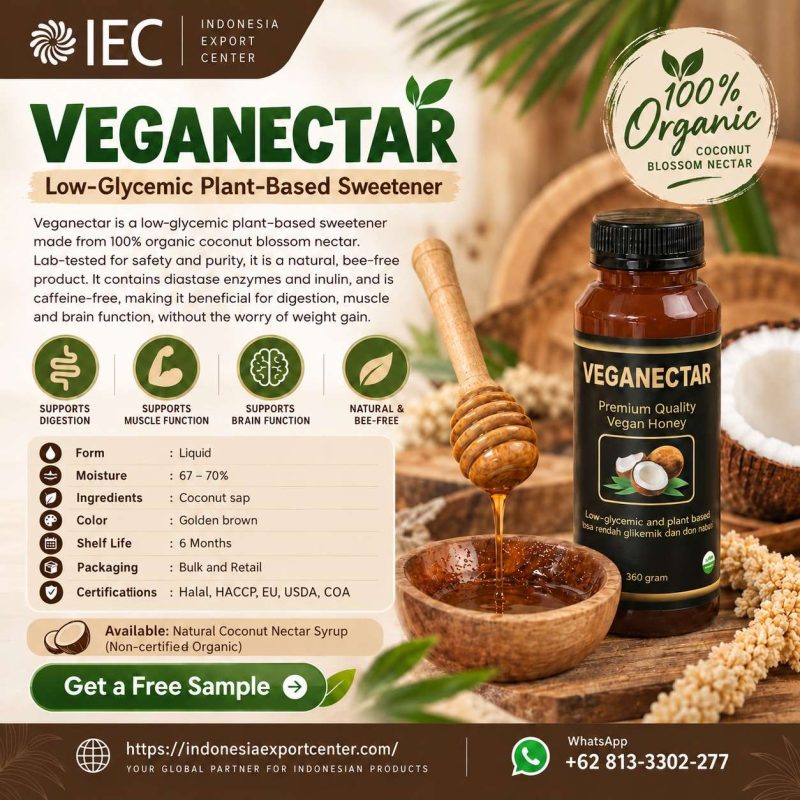
Indonesia Export Center (IEC) facilitates sourcing inquiries for Indonesian coconut nectar syrup, including VEGANECTAR, a liquid coconut blossom nectar product introduced in IEC promotional material.
Coconut nectar may be considered for selected processed foods, sauces, bakery products, confectionery fillings, desserts, snack products, and specialty food formulations. However, manufacturers must establish whether the ingredient performs adequately in their specific production processes.
A successful industrial ingredient purchase requires more than a supplier’s product description. Manufacturers need reliable specifications, laboratory documentation, representative samples, suitable packaging, and verified production capacity.
IEC helps connect international procurement inquiries with the information needed to evaluate possible Indonesian supply arrangements.
What Is Coconut Blossom Nectar?
Coconut blossom nectar is a liquid sweetening ingredient derived from coconut palm sap.
It differs from granulated coconut sugar in its physical form, water content, handling requirements, and behaviour during manufacturing.
Liquid coconut nectar may influence the overall moisture balance of a formulation, meaning a manufacturer should not automatically substitute it for granulated sugar, honey, glucose syrup, or another sweetener at an identical weight.
Instead, formulation specialists should compare the ingredients using appropriate analytical and application-specific criteria.
Introducing VEGANECTAR Coconut Blossom Nectar
The IEC product flyer describes VEGANECTAR as a plant-based liquid sweetener made from coconut blossom nectar.
Its promotional positioning includes a coconut sap origin, golden-brown appearance, and bee-free characteristics.
The flyer also describes the product as organic and references several certifications. These claims require verification through current supplier documentation.
Reference Product Specifications
| Parameter | Information from Promotional Material |
|---|---|
| Product Name | VEGANECTAR |
| Category | Coconut Blossom Nectar Syrup |
| Ingredient Claim | 100% Organic Coconut Blossom Nectar |
| Source | Coconut Sap |
| Form | Liquid |
| Moisture | 67–70% |
| Colour | Golden Brown |
| Shelf Life | 6 Months |
| Packaging | Bulk and Retail |
| Certification References | Halal, HACCP, EU, USDA |
| Quality Document Reference | COA |
| Alternative Variant | Natural Coconut Nectar Syrup |
The listed details are promotional references and should not be treated as guaranteed specifications for every shipment.
Ingredient Functionality in Industrial Food Processing
The functionality of a sweetening ingredient depends on more than its sweetness.
Sweetness Contribution
Coconut nectar may contribute sweetness to a finished formulation. However, its sweetness intensity should be measured against the manufacturer’s current ingredient.
A formulation trial can establish the dosage needed to achieve a target sensory profile.
Moisture Contribution
The reported VEGANECTAR moisture range of 67–70% is particularly relevant.
Adding liquid coconut nectar introduces water into a formulation, potentially affecting texture, solids content, processing time, and finished-product stability.
Colour Development
The product is described as golden brown.
Its colour may influence light-coloured products, fillings, sauces, and other formulations.
Colour changes during heating should be evaluated experimentally.
Flavour and Aroma
Coconut nectar may have a characteristic sensory profile.
Manufacturers should determine whether the flavour complements the intended product.
Texture and Viscosity
Liquid sweeteners can influence texture, flow, and mouthfeel.
The actual viscosity of VEGANECTAR is not supplied in the flyer and should be requested if relevant.
Processing Compatibility
Manufacturers should evaluate the ingredient under actual production conditions, including mixing, heating, cooling, filling, and storage.
Potential Food Manufacturing Applications
Bakery and Dessert Manufacturing
Coconut nectar may be evaluated in selected cake batters, fillings, dessert sauces, and glazes.
Sweet Sauces and Condiments
Food processors may investigate coconut nectar for flavour, sweetness, and colour contributions.
Snack Manufacturing
Snack producers may assess coconut nectar in coatings, fillings, and selected binding systems.
Plant-Based Foods
Manufacturers developing plant-based products may evaluate coconut nectar as a liquid sweetener.
Specialty Food Products
The ingredient may be considered for products requiring a distinctive sweetening profile.
Every application should be tested before commercial adoption.
Industrial Technical Specifications to Request
A comprehensive product specification may include:
- Ingredient composition.
- Moisture content.
- Total soluble solids or Brix.
- pH.
- Water activity.
- Viscosity at a specified temperature.
- Colour.
- Sugar composition.
- Microbiological criteria.
- Relevant contaminant limits.
- Shelf-life conditions.
- Packaging specifications.
The IEC flyer does not provide all these parameters.
Why Brix and Water Activity Matter
Moisture content alone does not describe the complete behaviour of a liquid sweetener.
Brix can help characterize soluble solids, although it should be interpreted according to the analytical method and product composition.
Water activity is relevant to microbial growth potential and product stability.
Both should be evaluated where necessary.
Food Safety and Supplier Qualification
Manufacturers should request appropriate documentation, potentially including:
- Current product specification.
- Batch-specific COA.
- Ingredient declaration.
- Relevant microbiological test results.
- Shelf-life evidence.
- Traceability records.
- Food safety management documentation.
- Organic certification where claimed.
- Halal certification where required.
HACCP documentation should be evaluated for the actual manufacturing operation.
Sample Evaluation and Trial Batch Process
A structured industrial trial may involve:
Stage 1: Documentation review. Confirm product identity and available specifications.
Stage 2: Laboratory evaluation. Measure relevant physical, chemical, and microbiological properties.
Stage 3: Bench formulation. Compare coconut nectar with the current sweetener.
Stage 4: Pilot production. Test mixing, processing, filling, and packaging.
Stage 5: Sensory assessment. Evaluate flavour, sweetness, appearance, and texture.
Stage 6: Stability assessment. Study finished-product behaviour under appropriate conditions.
Stage 7: Commercial approval. Agree specifications and quality requirements.
Organic and Natural Coconut Nectar Options
The flyer references an organic VEGANECTAR product and a natural non-certified organic alternative.
Manufacturers should request separate specifications for each variant.
The natural variant should not be marketed as certified organic without appropriate evidence.
Bulk Supply and Packaging
The IEC promotional material references bulk and retail packaging.
Industrial buyers should confirm:
- Available container sizes.
- Food-contact suitability.
- Sealing systems.
- Product handling.
- Lot coding.
- Transport requirements.
- Storage conditions.
- Minimum order quantity.
- Production lead time.
Cost Evaluation for Manufacturers
The true cost of a liquid sweetener depends on more than price per kilogram.
Manufacturers may need to evaluate:
- Ingredient dosage.
- Water contribution.
- Solids contribution.
- Production yield.
- Processing time.
- Packaging requirements.
- Freight.
- Shelf life.
- Quality testing.
- Finished-product performance.
A supplier quotation should be compared using a consistent technical basis.
Coconut Nectar Manufacturing RFQ Template
Subject: Coconut Nectar Syrup for Food Manufacturing – B2B Inquiry
Company: [Company Name]
Country: [Country]
Application: [Food Product]
Preferred Variant: [Organic / Natural]
Initial Quantity: [KG or MT]
Monthly Consumption: [Quantity]
Required Specifications: [Details]
Required Certifications: [Details]
Packaging: [Details]
Destination Port: [Port]
Preferred Incoterm: [Term]
Please provide current specifications, ingredient declaration, COA, sample feasibility, packaging options, MOQ, lead time, and export quotation.
Frequently Asked Questions
Is coconut nectar suitable for industrial food manufacturing?
It may be evaluated for selected applications, subject to formulation and quality testing.
What is VEGANECTAR’s reported moisture content?
67–70%, according to the promotional flyer.
Can coconut nectar directly replace granulated sugar?
Not without adjusting and testing the formulation.
Is a Brix specification available?
It must be requested from the supplier.
Can manufacturers request trial samples?
Sample feasibility requires confirmation.
Is VEGANECTAR organic-certified?
The flyer references organic certification, but current evidence must be verified.
Are bulk quantities available?
Bulk packaging is referenced, but supplier capacity and MOQ require confirmation.
Can IEC facilitate international procurement inquiries?
Yes, IEC facilitates sourcing inquiries and supplier communication.
Discuss Coconut Nectar Supply Options
Looking for Indonesian coconut nectar syrup for food manufacturing?
Contact IEC with your technical requirements, application, expected purchasing volume, and destination.
DISCUSS FOOD MANUFACTURING SUPPLY OPTIONS
INDONESIA EXPORT CENTER (IEC)
Website: https://indonesiaexportcenter.com/
WhatsApp: +62 813-3302-277
Product specifications, certification, sample availability, MOQ, capacity, pricing, and shipping arrangements require supplier verification.
Related Resources
Coconut Blossom Nectar Supplier Indonesia
Bulk Coconut Nectar Syrup Supplier
Coconut Nectar for Food Ingredient Importers
