

INDONESIA EXPORT CENTER (IEC)
Indonesian Coconut Nectar Syrup Sourcing for Beverage Producers, Drink Brands and Ingredient Developers
Coconut Nectar Syrup for Beverage Production
Beverage manufacturers require sweetening ingredients that perform consistently in their finished products. Sweetness, solubility, flavour, colour, microbiological quality, and storage stability can all influence whether a liquid sweetener is suitable for commercial production.
For businesses exploring coconut-derived sweeteners, coconut nectar for beverage manufacturers may offer an ingredient option worth evaluating.
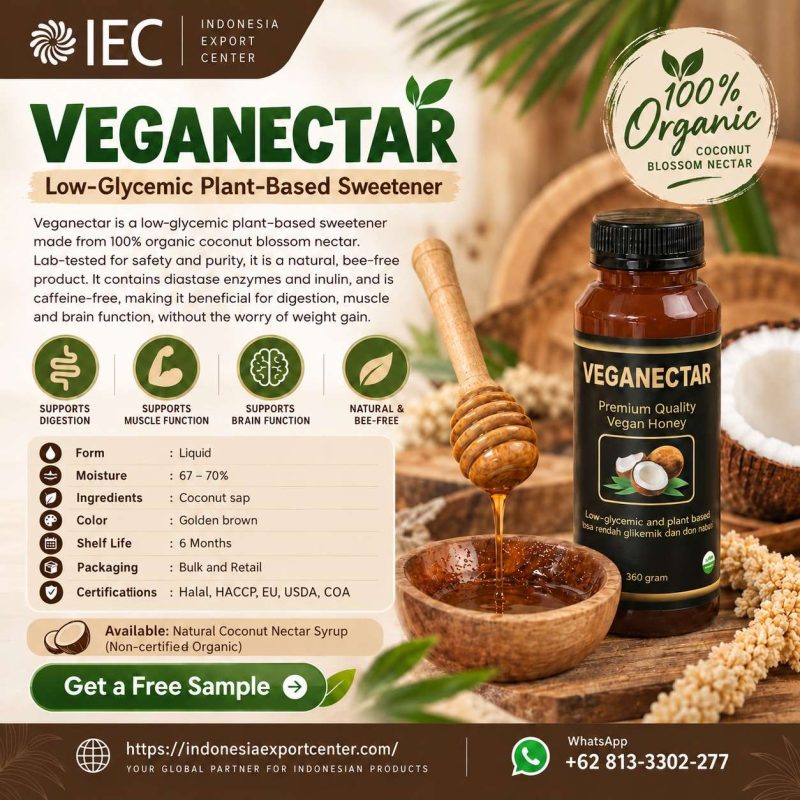
Indonesia Export Center (IEC) facilitates sourcing inquiries for Indonesian coconut blossom nectar syrup, including VEGANECTAR, a product described in promotional material as a golden-brown, plant-based liquid sweetener.
The product may be considered for selected coffee drinks, tea beverages, specialty drink concentrates, plant-based beverages, and foodservice drink formulations.
However, every beverage application requires appropriate testing. The supplier’s promotional information does not establish performance in all beverage systems.
What Is Coconut Blossom Nectar Syrup?
Coconut blossom nectar syrup is derived from coconut palm sap and supplied in liquid form.
Unlike granulated coconut sugar, a liquid sweetener contributes water to a beverage formulation and may behave differently during mixing, heating, filtration, and storage.
Manufacturers should compare coconut nectar with their current sweetener using product-specific data rather than assuming equivalent sweetness or processing performance.
VEGANECTAR Reference Product Information
| Parameter | Promotional Information |
|---|---|
| Brand | VEGANECTAR |
| Product | Organic Coconut Blossom Nectar |
| Source | Coconut Sap |
| Form | Liquid |
| Colour | Golden Brown |
| Moisture | 67–70% |
| Shelf Life | 6 Months |
| Packaging | Bulk and Retail |
| Certification References | Halal, HACCP, EU, USDA |
| Alternative | Natural Coconut Nectar Syrup |
These details require current supplier verification.
Why Beverage Manufacturers Evaluate Coconut Nectar
Plant-Based Ingredient Positioning
Coconut nectar is derived from a plant source. It may be relevant to brands developing plant-based beverage concepts.
Formal vegan claims should still be supported by ingredient and processing information.
Liquid Ingredient Handling
A liquid format may suit certain manufacturing systems already designed for liquid ingredient dosing.
Actual viscosity, pumping performance, and handling conditions must be confirmed.
Distinctive Flavour Profile
Coconut nectar may contribute a characteristic taste and aroma.
Manufacturers should test whether this profile complements coffee, tea, cocoa, fruit, or other beverage ingredients.
Specialty Product Development
Coconut nectar may be evaluated as part of a differentiated ingredient strategy for selected premium or specialty drinks.
Beverage Applications to Evaluate
Coffee-Based Beverages
Coffee manufacturers may investigate coconut nectar in ready-to-drink coffee, coffee concentrates, and café beverages.
Important evaluation criteria include flavour balance, colour, sweetness, and storage stability.
Tea Beverages
Tea brands may test coconut nectar in hot and cold tea formulations.
Its flavour and colour contribution should be assessed against the intended tea profile.
Plant-Based Milk Alternatives
Manufacturers may evaluate coconut nectar in selected oat, soy, almond, or other plant-based beverage formulations.
Compatibility, sedimentation, and stability require testing.
Cocoa and Chocolate Drinks
Coconut nectar may be evaluated for sweetness and flavour in cocoa-based beverages.
Specialty Drink Concentrates
Concentrate manufacturers may assess coconut nectar for blending behaviour, soluble solids, and product stability.
Foodservice Beverage Syrups
Commercial beverage suppliers may consider coconut nectar in selected drink recipes.
Solubility and Mixing Evaluation
A liquid sweetener may appear convenient for beverage formulation, but mixing performance must still be tested.
Manufacturers should assess:
- Mixing time.
- Temperature dependence.
- Uniformity.
- Sediment formation.
- Compatibility with other ingredients.
- Filtration behaviour.
- Final beverage appearance.
The flyer does not provide verified dissolution or sedimentation data.
Sweetness and Dosage Trials
Coconut nectar should not automatically replace another sweetener at the same weight.
A trial program can compare:
- Sweetness intensity.
- Sweetness onset.
- Aftertaste.
- Flavour interaction.
- Solids contribution.
- Water contribution.
- Cost per finished beverage.
The final dosage should be determined experimentally.
Understanding Moisture and Brix
VEGANECTAR’s promotional moisture range is 67–70%.
For beverage manufacturing, buyers may also need Brix or total soluble solids data.
Moisture content and Brix are not interchangeable specifications without appropriate analytical interpretation.
The supplier should provide current test results where available.
Colour Impact in Beverages
The product is described as golden brown.
Manufacturers should evaluate colour effects in:
- Clear drinks.
- Light-coloured beverages.
- Coffee.
- Tea.
- Cocoa drinks.
- Beverage concentrates.
Colour may be desirable in some formulations and unsuitable in others.
Beverage Stability Testing
Finished beverage stability may be affected by multiple factors.
Recommended evaluations may include:
- pH.
- Microbiological quality.
- Sedimentation.
- Colour changes.
- Flavour changes.
- Packaging interaction.
- Storage temperature.
- Shelf-life performance.
No finished-beverage stability guarantee is established by the coconut nectar flyer.
Microbiological and Food Safety Requirements
Beverage manufacturers should request appropriate food safety documentation.
Potential requirements include:
- Product specification.
- COA.
- Microbiological test results.
- Ingredient declaration.
- Traceability.
- Shelf-life evidence.
- Food safety management records.
The exact testing requirements depend on the beverage and destination market.
Organic and Natural Variants
The flyer references VEGANECTAR as organic and also mentions a natural non-certified organic variant.
Buyers should verify organic certification before using organic claims.
The natural variant requires its own specifications and documentation.
Beverage Application Trial Checklist
| Evaluation | Buyer Question |
|---|---|
| Sweetness | Does the dosage achieve the desired taste? |
| Flavour | Does the nectar complement the beverage? |
| Colour | Is the finished appearance acceptable? |
| Mixing | Does the ingredient disperse uniformly? |
| Sediment | Does sediment develop during storage? |
| pH | Is the ingredient compatible with the formulation? |
| Microbiology | Are safety criteria met? |
| Packaging | Is the finished beverage stable? |
| Cost | Is the formulation commercially feasible? |
Bulk Supply Considerations
Beverage manufacturers may request:
- Industrial packaging options.
- Current technical specifications.
- Sample feasibility.
- MOQ.
- Production lead time.
- Supply capacity.
- Export quotation.
- Shipping arrangements.
The supplier must confirm these details.
Beverage Manufacturer RFQ Template
Subject: Coconut Nectar Syrup for Beverage Manufacturing
Company: [Company Name]
Country: [Country]
Beverage Category: [Coffee / Tea / Plant-Based / Other]
Product: VEGANECTAR Coconut Blossom Nectar
Variant: [Organic / Natural]
Initial Quantity: [KG or MT]
Monthly Requirement: [Quantity]
Required Brix: [Specification]
Required pH: [Specification]
Packaging: [Details]
Certifications: [Details]
Destination Port: [Port]
Please provide current specifications, COA, sample feasibility, available packaging, MOQ, lead time, and export quotation.
Frequently Asked Questions
Can coconut nectar be used in coffee beverages?
It may be evaluated through flavour and stability trials.
Can it be used in tea?
Potentially, subject to formulation testing.
Is VEGANECTAR a liquid product?
Yes, according to the flyer.
What moisture content is reported?
67–70%.
Is coconut nectar completely soluble in every beverage?
No such performance guarantee is provided.
Can coconut nectar replace conventional syrup directly?
A substitution ratio must be established through trials.
Is VEGANECTAR certified organic?
The promotional material references organic status, but current evidence is required.
Can manufacturers request samples?
Sample feasibility must be confirmed.
Discuss Coconut Nectar Supply for Beverage Manufacturing
Contact IEC to explore Indonesian coconut nectar sourcing for your beverage production requirements.
DISCUSS BEVERAGE INGREDIENT SUPPLY
INDONESIA EXPORT CENTER (IEC)
Website: https://indonesiaexportcenter.com/
WhatsApp: +62 813-3302-277
All technical specifications, certifications, samples, packaging, MOQ, pricing, and delivery arrangements require confirmation.
Related Resources
Coconut Nectar for Food Manufacturers
Liquid Coconut Sap Sweetener from Indonesia
VEGANECTAR Coconut Nectar Syrup Wholesale
