

INDONESIA EXPORT CENTER
Botanical Extraction | Process Verification | Residual Solvent Testing | Industrial Sourcing
Understanding Cinnamon Oleoresin Extraction Methods
Cinnamon oleoresin extraction methods influence the composition, physical characteristics, and quality requirements of the resulting botanical ingredient.
For industrial buyers, the extraction process is an important part of supplier qualification.
A commercial description such as “natural cinnamon oleoresin” does not provide sufficient information about the botanical raw material, processing solvent, extraction conditions, or finished composition.
Indonesia Export Center (IEC) facilitates inquiries with potential Indonesian suppliers and processors to help international buyers obtain relevant technical and manufacturing information.
IEC does not claim to operate extraction facilities or guarantee the availability of a specific extraction technology.
REQUEST CINNAMON OLEORESIN EXTRACTION AND MANUFACTURING INFORMATION
What Is Cinnamon Oleoresin Extraction?
Cinnamon oleoresin extraction involves recovering selected constituents from cinnamon botanical material using an appropriate extraction process.
The resulting preparation may contain volatile aromatic compounds and less volatile constituents.
Its composition depends on the source material and processing conditions.
Botanical Raw Material Selection
The first stage of technical evaluation is botanical identity.
Buyers should confirm the scientific name, plant part, raw material origin, and relevant handling procedures.
Indonesia is associated with Cinnamomum burmannii, but the actual species used in a commercial product must be verified.
General Production Workflow
A typical process may involve the following stages, depending on the manufacturer:
- Raw material sourcing and identification.
- Cleaning and preparation.
- Size reduction where appropriate.
- Extraction using a selected process.
- Separation of extracted material.
- Solvent removal or recovery where applicable.
- Filtration or further processing.
- Product standardization or formulation where applicable.
- Quality testing.
- Packaging and storage.
This is an illustrative workflow, not a verified description of any particular supplier’s facility.
Solvent Extraction
Solvent extraction is one approach used to recover selected constituents from botanical materials.
The chosen solvent and operating conditions can affect the resulting composition.
The supplier should disclose the extraction solvent sufficiently to support technical and regulatory assessment.
Ethanol-Based Extraction
Ethanol may be used in certain botanical extraction processes.
However, an ethanol-based process does not automatically establish food-use suitability or compliance.
The actual product must be evaluated for composition, residual solvents, and applicable requirements.
Other Organic Solvent Processes
Different solvents may be used depending on the intended extract and manufacturing process.
Buyers should assess whether the process and resulting ingredient are appropriate for their application.
No particular solvent should be assumed without supplier disclosure.
Supercritical Carbon Dioxide Extraction
Supercritical carbon dioxide extraction is another technology that may be used for certain botanical ingredients.
Its suitability depends on the equipment, raw material, and target composition.
A CO2 extract should not automatically be treated as chemically identical to a conventional solvent-derived oleoresin.
The availability of cinnamon CO2 extract from a particular Indonesian supplier requires confirmation.
Extraction Method Comparison
| Factor | Solvent Extraction | Supercritical CO2 Extraction |
|---|---|---|
| Extraction Medium | Selected solvent | Carbon dioxide under suitable conditions |
| Chemical Selectivity | Depends on solvent and process | Depends on process conditions |
| Product Composition | Process-dependent | Process-dependent |
| Residual Solvent Considerations | Relevant to solvent used | Requires process-specific review |
| Equipment Requirements | Process-specific | Specialized pressure equipment |
| Commercial Availability | Supplier confirmation required | Supplier confirmation required |
| Food-Use Suitability | Must be assessed | Must be assessed |
| Cost | Supplier-specific | Supplier-specific |
Neither method is automatically superior for every application.
How Extraction Influences Chemical Composition
Different extraction processes may recover different proportions of botanical constituents.
For cinnamon-derived ingredients, the resulting concentrations of cinnamaldehyde, eugenol, coumarin, and other compounds should be established through analytical testing.
Preliminary Chemical References
| Compound | Unverified Commercial Reference |
|---|---|
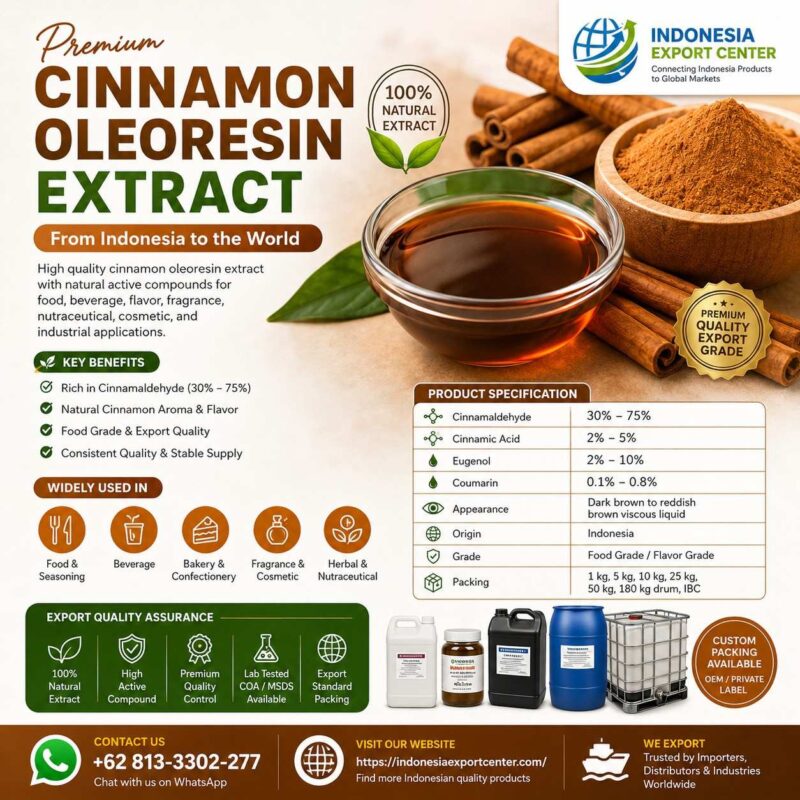
| Cinnamaldehyde | 30–75% |
| Cinnamic Acid | 2–5% |
| Eugenol | 2–10% |
| Coumarin | 0.1–0.8% |
These values do not represent verified results for any particular extraction process.
Residual Solvent Testing
Residual solvent analysis may be necessary when relevant solvents are used during production.
The testing plan should reflect the actual process, intended application, and destination-market requirements.
Process Controls and Batch Consistency
Manufacturers may need to control raw material identity, extraction conditions, solvent recovery, filtration, blending, and packaging.
Buyers should request evidence supporting the supplier’s quality system and batch consistency.
Supplier Audit Questions
| Audit Area | Questions for the Supplier |
|---|---|
| Botanical Identity | Which species and plant part are used? |
| Raw Material Origin | Where is the cinnamon sourced? |
| Extraction Process | Which technology is used? |
| Solvent | Which solvent is used and how is it controlled? |
| Manufacturing Site | Where does extraction take place? |
| Chemical Analysis | Which constituents are measured? |
| Residual Solvents | Which tests and limits apply? |
| Quality Control | How are batches released? |
| Traceability | Can raw materials be linked to finished lots? |
| Packaging | Which containers are compatible? |
| Shelf Life | What stability evidence is available? |
| Certifications | Which claims are supported by current certificates? |
Required Technical Documents
Buyers may request a manufacturing process summary, botanical declaration, TDS, batch COA, extraction solvent statement, relevant residual solvent results, and applicable quality documentation.
Confidential process details may be subject to commercial agreements.
Sample Qualification
A representative sample should be tested against the buyer’s specification.
Where relevant, testing may include chemical composition, solubility, viscosity, sensory profile, and stability.
Packaging, MOQ and Lead Time
The preliminary brief proposes 1 kg, 5 kg, 10 kg, 25 kg, 50 kg, 180 kg drums, and IBCs.
Actual packaging availability, MOQ, production capacity, and lead time require supplier confirmation.
Frequently Asked Questions
Which extraction method is best for cinnamon oleoresin?
The answer depends on the target composition, application, quality requirements, and manufacturing capabilities.
Does solvent extraction always leave unsafe residues?
No such conclusion can be made without product-specific process information and testing.
Is CO2 extract the same as conventional oleoresin?
Not necessarily. Composition can differ.
Does a natural extraction process guarantee food safety?
No. Product-specific assessment is required.
Can IEC verify a supplier’s extraction method?
IEC can request documentation and facilitate verification discussions, but independent confirmation may be necessary.
Can buyers request a specific extraction method?
IEC can communicate the requirement for supplier feasibility review.
Request Cinnamon Oleoresin Extraction and Supplier Information
IEC welcomes inquiries from ingredient procurement teams, food manufacturers, flavor houses, R&D laboratories, and supplier audit teams.
REQUEST EXTRACTION DETAILS, TDS, COA, SAMPLE AND SUPPLIER QUOTATION
INDONESIA EXPORT CENTER
Connecting Indonesian Products to Global Markets
Website: https://indonesiaexportcenter.com/
WhatsApp: +62 813-3302-277
Related Pages
