![Indonesia Export Center [IEC]](https://indonesiaexportcenter.com/wp-content/uploads/2023/07/logo-no-background.svg)
![Indonesia Export Center [IEC]](https://indonesiaexportcenter.com/wp-content/uploads/2023/07/svgviewer-output.svg)
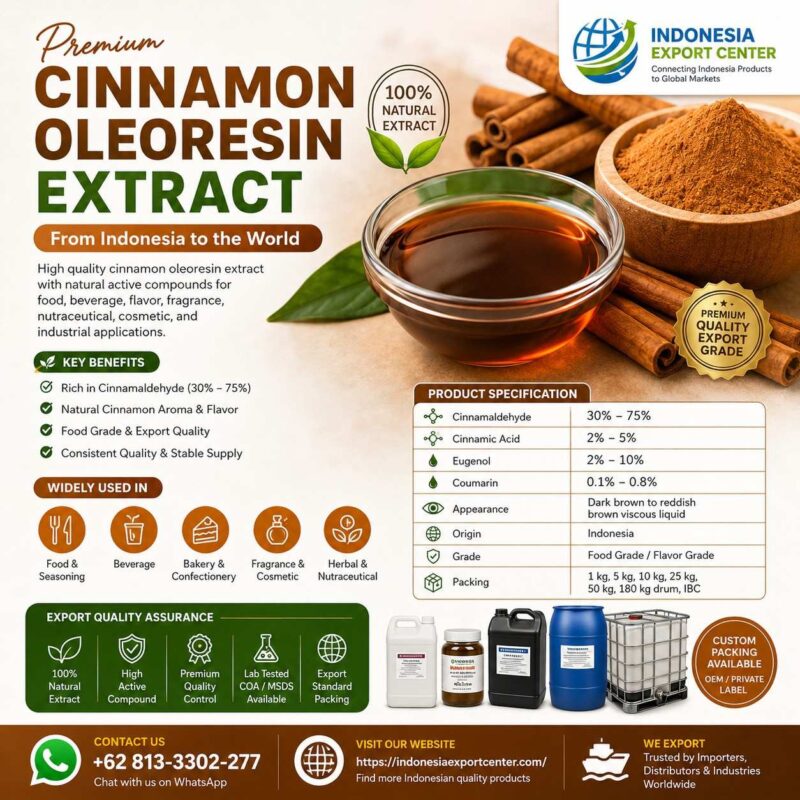
Cinnamon oleoresin is a concentrated natural ingredient used by food manufacturers, flavor houses, seasoning producers, fragrance formulators, and other industrial buyers. Because the product is concentrated, aromatic, and often viscous, its packaging and shipment require more attention than ordinary cinnamon powder.
International buyers should not evaluate cinnamon oleoresin solely by price per kilogram. Packaging compatibility, product concentration, batch size, quality documentation, transport classification, and destination-country regulations can significantly affect the total landed cost.
This guide explains the main factors buyers should consider when requesting cinnamon oleoresin samples, pilot quantities, and commercial shipments from Indonesia.
Understanding the Product Before Selecting Packaging
Before discussing packaging or minimum order quantity, the buyer and supplier must confirm the exact product form.
Cinnamon oleoresin may be supplied as:
- A concentrated viscous liquid or paste
- An oil-soluble formulation
- A water-dispersible formulation
- A standardized oleoresin with a specified volatile-oil content
- A carrier-based liquid formulation
- A spray-dried or encapsulated powder
These forms do not necessarily require the same container, storage conditions, or transport procedure. A concentrated oil-soluble oleoresin may require a different packaging system from a water-dispersible product or spray-dried cinnamon extract.
The quotation should therefore identify the botanical source, plant part, extraction method, solvent or carrier system, volatile-oil specification, solubility, and intended application.
For the United States, 21 CFR 182.20 lists solvent-free oleoresins and natural extractives from several cinnamon and cassia sources among substances generally recognized as safe for their intended use. FDA regulations also recognize oleoresins derived from spices and plant materials within the definition of natural flavoring. However, compliance still depends on the composition, manufacturing process, intended use, and applicable labeling requirements of the specific product.
Recommended Packaging for Cinnamon Oleoresin
The most suitable packaging depends on order size, viscosity, chemical compatibility, destination, and whether the shipment is transported by courier, air freight, less-than-container load, or full-container load.
Sample Packaging
Product-development samples are generally packed in small, tightly sealed containers. Depending on the formulation, these may include:
- Amber glass bottles
- Coated aluminum bottles
- Food-grade HDPE bottles
- Small food-grade jerry cans
Sample containers should be leak-resistant, tamper-evident, and clearly identified with the product name and batch number. They should also be placed inside secondary leak-proof packaging with sufficient protective material.
Samples should represent the same specification intended for the commercial order. A buyer should avoid approving an unstandardized laboratory sample when the commercial shipment will be produced using a different concentration, carrier, or extraction process.
Small and Medium Commercial Packaging
For pilot and medium-volume orders, food-grade HDPE cans, jerry cans, pails, or drums are frequently used. Commercial supplier offerings show cinnamon oleoresin packaging examples of 1 kg, 5 kg, and 25 kg or larger in HDPE cans and drums. These sizes are commercial examples rather than mandatory industry standards.
A practical commercial packaging configuration may include:
- 5 kg food-grade containers for pilot production
- 20–25 kg food-grade pails or drums for regular industrial handling
- Larger drums for higher-volume buyers, subject to product compatibility
- Palletized drums for safer warehouse handling and export loading
Every container should be compatible with the oleoresin formulation. Buyers should request confirmation that the primary packaging is suitable for direct contact with the product and will not react with its aromatic components, extraction residues, or carrier system.
Codex guidance states that packaging design and materials should protect food products from contamination and damage, accommodate appropriate labeling, and remain non-toxic under the intended storage and use conditions. Food-contact packaging placed on the European Union market must also comply with the applicable EU food-contact-material framework, including Regulation (EC) No 1935/2004.
Bulk Packaging
Larger industrial orders may be packed in drums or, where technically appropriate, intermediate bulk containers. However, bulk packaging should not automatically be selected simply because the buyer requires a lower packaging cost per kilogram.
Before approving bulk packaging, the buyer should evaluate:
- Compatibility between the product and container material
- Ability to mix or homogenize the product before use
- Pumping and discharge requirements
- Warehouse handling equipment
- Risk of contamination after opening
- Expected usage rate after the container is opened
- Local regulations for storage and handling
For buyers with relatively low monthly consumption, several smaller drums may be more practical than one large container. Smaller units may reduce repeated opening, simplify batch control, and help the buyer manage inventory more effectively.
Packaging Information That Should Appear on Each Container
Each export package should be clearly and permanently marked. The final label format should be agreed upon before production.
A typical industrial label should include:
- Product name
- Botanical source
- Country of origin
- Product or specification code
- Batch or lot number
- Net weight and gross weight
- Manufacturing or packing date
- Best-before or retest date, when applicable
- Recommended storage conditions
- Manufacturer or exporter identification
- Handling instructions
- Relevant hazard or transport markings, when required
Private-label information, buyer product codes, barcode formats, destination-language labels, and special regulatory statements should be confirmed before the supplier prints the labels.
Late label changes can delay packing and shipment or require relabeling charges.
What Is the Typical MOQ for Cinnamon Oleoresin?
There is no universal minimum order quantity for cinnamon oleoresin.
MOQ varies according to the supplier’s production setup, extraction batch, concentration, packaging size, quality-testing requirements, and level of customization. Commercial listings illustrate this variation: one supplier offers oleoresin packs starting from 1 kg, while another cinnamon extract listing specifies a 100 kg minimum order packed in 25 kg drums. These examples demonstrate why buyers should treat MOQ as supplier-specific rather than an international standard.
A practical purchasing structure may be divided into three stages.
Development Sample
A small sample allows the buyer to evaluate aroma, flavor profile, color, solubility, dispersion, and compatibility with the final formulation.
The sample request should specify the intended application. A bakery flavor, beverage formulation, seasoning blend, fragrance base, or personal-care formulation may require different product characteristics.
Pilot Order
A pilot order is used for factory trials, stability testing, sensory evaluation, dosage optimization, and internal approval.
Pilot quantities are normally packed in one or several standard commercial containers. Buyers should ask whether the pilot batch will have the same specification and manufacturing process as future commercial orders.
Regular Commercial Order
After approval, the buyer can negotiate a regular MOQ based on forecast demand and production schedules.
A higher MOQ may provide:
- Lower packaging cost per kilogram
- More efficient production scheduling
- Better freight utilization
- More consistent supply planning
- Improved pricing for repeat orders
However, purchasing more than the realistic consumption volume can increase inventory risk. The buyer must consider the supplier-stated shelf life, storage capacity, production usage, and frequency of future orders.
Factors That Can Increase the MOQ
A supplier may require a higher MOQ when the buyer requests:
- Customized volatile-oil concentration
- A special carrier or diluent
- Water-dispersible or encapsulated formulations
- Organic-certified material
- Special microbiological limits
- Destination-specific pesticide or contaminant testing
- Custom drum sizes
- Private-label packaging
- Multilingual labels
- Buyer-specific quality inspections
- Dedicated production without mixing with other orders
International buyers should distinguish between a standard supplier specification and a custom specification. Standard products generally offer more flexible quantities and shorter preparation periods than specially formulated products.
Documents to Request Before Shipment
The documentation package should be agreed upon before issuing the purchase order. At minimum, buyers commonly request:
- Commercial invoice
- Packing list
- Certificate of Analysis
- Technical Data Sheet
- Safety Data Sheet
- Certificate of Origin, when required
- Batch and production information
- Bill of Lading or Air Waybill
- Insurance certificate when required by the Incoterm
- Halal, kosher, organic, or food-safety certificates when included in the contract
- Allergen, GMO, and residual-solvent statements when relevant
- Additional health or regulatory documentation required by the destination country
The Certificate of Analysis should correspond to the actual shipment batch rather than merely representing a typical specification.
The SDS is particularly important for logistics planning. Section 14 of an SDS may provide the UN number, proper shipping name, hazard class, and packing group when the product is classified for transport.
Is Cinnamon Oleoresin Classified as Dangerous Goods?
Buyers should not assume that every cinnamon oleoresin shipment is either dangerous goods or non-dangerous goods.
Transport classification can depend on:
- Extraction solvent
- Residual-solvent level
- Carrier system
- Flash point
- Final formulation
- Concentration
- Packaging quantity
- Mode of transport
The supplier’s current SDS and transport declaration should be reviewed by the appointed freight forwarder before booking.
When the product is classified as dangerous goods, air shipments must follow applicable IATA Dangerous Goods Regulations covering classification, packing, marking, labeling, and documentation. Dangerous goods transported by sea in packaged form must comply with the relevant provisions of the International Maritime Dangerous Goods Code.
Failure to confirm the classification before booking can result in carrier rejection, repacking costs, storage charges, missed sailings, or customs delays.
Air Freight, LCL, or FCL?
Courier or Air Freight
Courier and air freight are generally suitable for samples and urgent pilot quantities.
Before dispatch, the buyer should confirm:
- Whether the carrier accepts the product
- Whether the shipment is classified as dangerous goods
- Maximum package size and weight
- Required SDS and declarations
- Import clearance requirements
- Availability of temperature-controlled handling, if required
Air freight provides faster delivery but normally has a higher freight cost per kilogram.
Less-Than-Container Load
LCL sea freight may be considered for orders that do not justify a complete container. The drums share container space with cargo from other shippers.
Buyers should evaluate the risk of:
- Cargo movement during transport
- Leakage from neighboring cargo
- Strong odors from other commodities
- Longer handling time at consolidation warehouses
- Additional loading and unloading
- Possible exposure to unsuitable storage conditions
Strong secondary packaging, secure palletization, and clear handling marks are especially important for LCL shipments.
Full-Container Load
FCL shipment provides better control over container loading and cargo segregation. It may be appropriate for larger orders or consolidated shipments containing several compatible natural ingredients.
The container-loading plan should specify:
- Number of drums or pails
- Net and gross weight per package
- Pallet quantity
- Pallet dimensions
- Total cargo gross weight
- Dunnage and securing method
- Container seal number
- Loading photographs
- Container cleanliness and condition
Under SOLAS requirements, the verified gross mass of a packed container must be obtained and documented before vessel loading.
When raw-wood pallets or dunnage are used, they may need to comply with ISPM 15 phytosanitary requirements. The standard covers wood packaging material made from raw wood and is intended to reduce the international movement of quarantine pests. Processed materials such as plywood are treated differently under the standard.
Choosing the Appropriate Incoterm
The purchase contract should state the selected Incoterm, named place or port, and the version of the rules—for example, FCA Surabaya, Incoterms® 2020 or CIF Port of Destination, Incoterms® 2020.
Incoterms define responsibilities for transportation, cost allocation, risk transfer, insurance under certain rules, export and import procedures, and responsibilities related to packaging and documentation.
Buyers should avoid requesting a price using only the words “FOB price” or “CIF price.” The quotation should identify the exact port and included services.
The buyer should also confirm whether the quoted price includes:
- Export packing
- Pallets
- Inland trucking
- Export customs clearance
- Port handling
- Documentation
- Dangerous-goods charges, if applicable
- Ocean or air freight
- Cargo insurance
- Destination charges
Planning Shipments to the United States
Food ingredients entering the United States may be subject to FDA food-facility registration, Prior Notice, importer verification, labeling, and other requirements.
FDA states that Prior Notice must be provided for food imported or offered for import into the United States. Therefore, the importer, customs broker, and supplier should coordinate the necessary information before the shipment arrives.
The U.S. importer should review whether the product, manufacturer, labeling, and supporting documents comply with the applicable FDA and customs requirements before dispatch.
Additional Requirements for Fragrance Buyers
Food-grade status should not automatically be interpreted as proof that cinnamon oleoresin is approved for every cosmetic, fragrance, home-care, or personal-care application.
Fragrance buyers should separately evaluate:
- Composition and constituent profile
- Cinnamic aldehyde and other restricted constituents
- Fragrance-allergen information
- Intended finished-product category
- Maximum proposed dosage
- Destination-country cosmetic or chemical regulations
- IFRA-related requirements
IFRA explains that its standards may prohibit, restrict, or establish specifications for fragrance materials. Natural complex substances can contain constituents subject to IFRA limits, and IFRA conformity does not replace a complete safety assessment or compliance with national regulations.
Consequently, a food-grade declaration and an IFRA-related evaluation serve different purposes.
Recommended Purchase and Shipment Workflow
An organized transaction can follow this sequence:
- The buyer submits the required application, specification, quantity, packaging, and destination.
- The supplier provides a technical offer, quotation, specification sheet, and available certificates.
- The buyer requests and evaluates a representative sample.
- Both parties confirm the approved specification and reference sample.
- The supplier issues a commercial offer stating MOQ, packaging, lead time, Incoterm, and payment terms.
- The buyer issues a purchase order or ICPO.
- Both parties finalize the sales contract or purchase agreement.
- The supplier produces, tests, and packs the shipment.
- The supplier issues the batch COA and draft shipping documents.
- The buyer or freight forwarder reviews the SDS and transport classification.
- Final labels, palletization, container loading, and shipment documents are completed.
- The buyer tracks the shipment and prepares import clearance before arrival.
Final Buyer Checklist
Before approving a cinnamon oleoresin shipment, confirm that:
- The botanical source and extraction method are stated
- The sample and commercial specification are identical
- Volatile-oil content and solubility meet the intended application
- The primary packaging is food-contact compatible
- Container sizes match the buyer’s production requirements
- MOQ and price basis are clearly defined
- Net weight, gross weight, and package count are confirmed
- COA, TDS, and SDS are available
- Dangerous-goods status has been reviewed
- Labels meet destination requirements
- The correct Incoterm and named port are stated
- Pallets comply with applicable phytosanitary rules
- Import permits and destination documents are prepared
- Batch traceability and loading records are available
Source Cinnamon Oleoresin from Indonesia
Indonesia is internationally recognized as a source of cinnamon, including Cinnamomum burmannii, commonly associated with Indonesian or Padang cassia.
International buyers looking for consistent commercial supply should work with a supplier that can coordinate product specifications, representative samples, food-grade packaging, batch documentation, and export shipment preparation.
Learn more through our supporting pages:
Cinnamon Oleoresin Supplier from Indonesia
Explore Indonesian sourcing, available specifications, export packaging, quality documentation, and supply coordination for international buyers.
Food-Grade Cinnamon Oleoresin for Flavor & Fragrance
Discover cinnamon oleoresin options for flavor development, seasoning systems, bakery products, beverages, fragrance formulations, and other industrial applications.
Request a Cinnamon Oleoresin Quotation
To receive an accurate quotation, please provide:
- Required product form
- Botanical source preference
- Volatile-oil or concentration requirement
- Intended application
- Required quantity
- Preferred packaging size
- Destination country and port
- Required certificates
- Preferred Incoterm
- Target delivery schedule
A complete inquiry allows the supplier to recommend the appropriate specification, MOQ, packaging configuration, and shipment method.
Contact Indonesia Export Center to discuss cinnamon oleoresin samples, specifications, packaging options, commercial quantities, and shipment planning from Indonesia.
