

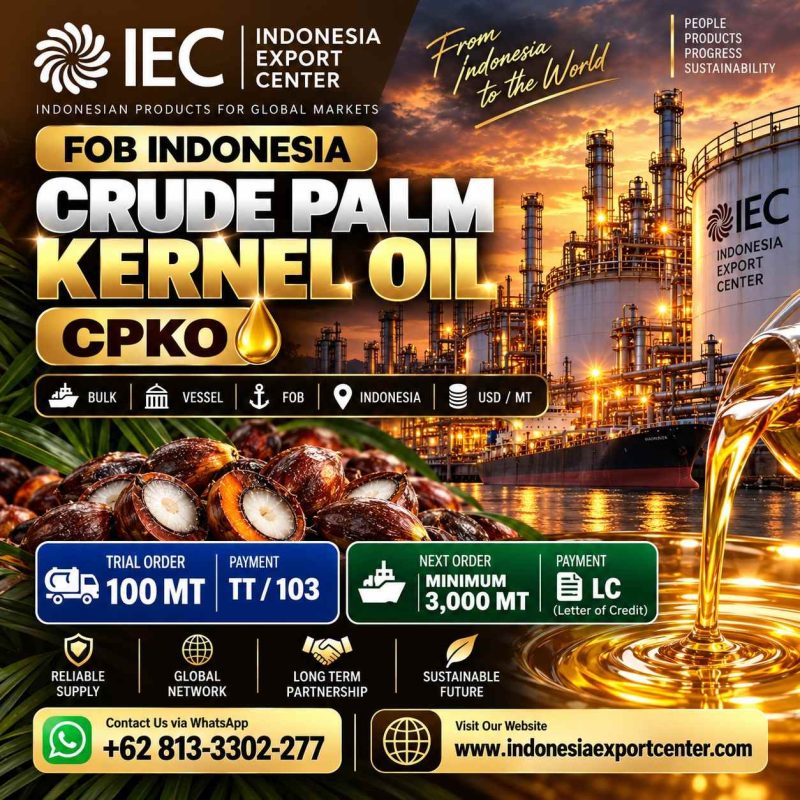
Bulk Indonesian CPKO Sourcing for Industrial Buyers
Are you looking to purchase bulk Crude Palm Kernel Oil from Indonesia for your refinery, oleochemical manufacturing facility, soap production plant, or international commodity trading business?
Indonesia Export Center (IEC) facilitates bulk CPKO sourcing discussions between international buyers and potential Indonesian suppliers.
Bulk crude palm kernel oil procurement requires careful coordination of technical specifications, purchasing volumes, cargo handling, transportation arrangements, quality inspection, documentation, and commercial responsibilities.
Unlike small packaged vegetable oil purchases, industrial bulk procurement involves substantial quantities and may require specialized storage facilities, loading equipment, cargo tanks, and transportation infrastructure.
IEC welcomes inquiries from businesses seeking commercial trial quantities, individual bulk shipments, recurring monthly purchases, and longer-term industrial supply arrangements.
Bulk Crude Palm Kernel Oil Product Profile
| Parameter | Reference Information |
|---|---|
| Product | Crude Palm Kernel Oil |
| Abbreviation | CPKO |
| Origin | Indonesia |
| Product Type | Unrefined Lauric Vegetable Oil |
| Commercial Grade | Industrial Feedstock |
| Supply Format | Bulk, Subject to Confirmation |
| Reference Trade Term | FOB Indonesia |
| Reference HS Code | 1513.21 |
| FFA as Lauric Acid | Maximum 5.0%, Indicative |
| Moisture and Impurities | Maximum 0.5%, Indicative |
| Iodine Value | Approximately 16–19 |
| Lauric Acid | Approximately 45–52% |
| Loading Facility | To Be Confirmed |
| MOQ | To Be Confirmed |
| Shipment Capacity | To Be Verified |
| Price | Upon Request |
Final specifications and commercial quantities must be confirmed through supplier-specific documentation.
Industrial Buyers of Bulk CPKO
Bulk CPKO may be relevant to businesses consuming substantial quantities of lauric oil feedstock.
Potential buyers include palm kernel oil refineries, fatty acid manufacturers, fatty alcohol producers, industrial soap factories, surfactant intermediate manufacturers, vegetable oil traders, and international commodity distributors.
Each buyer may require different quality specifications and transportation arrangements.
For example, an oil refinery may prioritize refining yield and FFA levels, while an oleochemical facility may require detailed fatty acid composition and contaminant limits.
A commodity trader may place additional emphasis on contractual delivery schedules, documentation, cargo inspection, and price validity.
Bulk Liquid Cargo Transportation Options
Bulk Tanker Shipments
Large commercial oil shipments may be transported using suitable bulk liquid cargo vessels.
The feasibility of this arrangement depends on cargo volume, terminal infrastructure, tank availability, vessel scheduling, and commercial agreements.
Buyers should identify their required parcel size and receiving terminal capabilities.
ISO Tank Containers
Suitable tank containers may be considered for certain industrial oil shipments.
Commercial feasibility depends on tank availability, cargo compatibility, temperature requirements, carrier acceptance, loading infrastructure, and destination handling capabilities.
No specific ISO tank capacity or availability is guaranteed.
Flexitank Arrangements
Flexitanks may be evaluated for suitable non-hazardous liquid cargo where permitted by the carrier and equipment provider.
CPKO’s physical behavior and temperature-related handling requirements must be evaluated before selecting this format.
Buyers should not assume that every flexitank configuration is appropriate for crude palm kernel oil.
Other Industrial Packaging
Alternative packaging formats may be considered according to supplier capabilities and buyer requirements.
Drums, intermediate bulk containers, and other formats require separate commercial and technical confirmation.
Understanding Bulk CPKO Purchasing Quantities
Industrial buyers commonly express their requirements in metric tons.
The following table illustrates how purchasing volumes translate into kilograms.
| Required Quantity | Equivalent Weight |
|---|---|
| 20 MT | 20,000 kg |
| 50 MT | 50,000 kg |
| 100 MT | 100,000 kg |
| 250 MT | 250,000 kg |
| 500 MT | 500,000 kg |
| 1,000 MT | 1,000,000 kg |
| 5,000 MT | 5,000,000 kg |
These figures are mathematical conversions only.
They do not represent confirmed MOQ, shipment capacity, or available inventory.
Planning Recurring Bulk CPKO Procurement
Manufacturers requiring continuous CPKO feedstock may benefit from structured purchasing schedules.
A procurement plan should account for daily oil consumption, production schedules, existing inventory, supplier lead time, shipment frequency, storage capacity, and contingency requirements.
For example:
| Hypothetical Daily Consumption | Consumption Over 30 Operating Days |
|---|---|
| 5 MT | 150 MT |
| 10 MT | 300 MT |
| 25 MT | 750 MT |
| 50 MT | 1,500 MT |
| 100 MT | 3,000 MT |
These examples illustrate procurement planning and do not represent IEC’s verified supply capacity.
Buyers should adjust their purchasing forecasts according to actual operating days and manufacturing demand.
Bulk CPKO Storage Requirements
Crude palm kernel oil may require appropriate temperature management to maintain suitable handling characteristics.
Storage requirements depend on oil composition, ambient temperature, storage duration, equipment design, and supplier recommendations.
Industrial buyers should evaluate:
- Tank material compatibility.
- Tank cleanliness.
- Appropriate temperature management.
- Moisture prevention.
- Product segregation.
- Inventory rotation.
- Sampling accessibility.
- Transfer equipment compatibility.
- Operational safety procedures.
Excessive heating or unsuitable storage conditions may affect oil quality.
Actual storage and handling procedures should be established by qualified facility operators according to product-specific information.
Loading and Transfer Considerations
Bulk CPKO loading arrangements may involve transfer pumps, pipelines, hoses, cargo tanks, weighing systems, and terminal facilities.
The contracting parties should establish responsibility for equipment preparation, cargo transfer, quantity measurement, inspection, and loading supervision.
Important commercial questions include:
- Where will the oil be loaded?
- Which party nominates the vessel or equipment?
- Is the loading facility compatible with the selected transportation method?
- How will the loaded quantity be measured?
- Who is responsible for tank cleanliness?
- Which party arranges inspection?
- What are the agreed loading dates?
- How will delays or additional handling expenses be addressed?
These questions should be resolved before confirming the shipment.
Bulk CPKO Quality Inspection
Bulk liquid cargo inspection may involve representative sampling and analytical testing.
The parties should agree on the sampling point, sampling method, laboratory, test methods, acceptance criteria, and contractual significance of the inspection results.
Potential analytical parameters include FFA, moisture, impurities, iodine value, fatty acid composition, color, and additional buyer-specific requirements.
Inspection may also include cargo quantity verification and review of relevant tank condition information.
A representative supplier COA does not automatically establish the quality of a future commercial shipment.
Quantity Verification for Bulk Oil Cargo
Bulk liquid cargo quantity may be established using agreed measurement systems.
Potential methods include calibrated weighing systems, tank measurements, and other contractually accepted procedures.
The appropriate method depends on the loading arrangement and available infrastructure.
Buyers and suppliers should agree on:
- Contract quantity.
- Permitted quantity tolerance.
- Measurement method.
- Gross or net weight basis.
- Quantity certificate requirements.
- Final invoicing basis.
- Procedures for resolving quantity discrepancies.
Clear quantity terms help reduce commercial disputes.
FOB Bulk CPKO Indonesia
FOB Indonesia is the reference trade arrangement for bulk CPKO sourcing.
Under FOB Incoterms 2020, the seller delivers the goods on board the vessel nominated by the buyer at the agreed loading port.
The buyer generally arranges the main ocean transportation.
The exact terminal, loading point, vessel nomination procedure, and cargo handling responsibilities require commercial confirmation.
For containerized arrangements where delivery occurs before vessel loading, FCA may be more suitable.
Bulk CPKO Price Considerations
Bulk purchasing prices may depend on:
- Required oil grade.
- FFA and other quality parameters.
- Purchasing quantity.
- Palm kernel oil market conditions.
- Shipment period.
- Supplier inventory and production arrangements.
- Loading facility expenses.
- Applicable export-related charges.
- Inspection requirements.
- Payment terms.
- Commercial quotation validity.
A larger purchasing quantity does not automatically guarantee a particular discount.
Buyers should request quotations using consistent specifications and delivery terms.
Bulk CPKO Landed Cost Planning
International procurement teams should evaluate the complete cost of obtaining usable oil at their manufacturing facility.
Potential cost components include product value, main ocean freight, insurance, destination handling, customs clearance, import duties, applicable taxes, inland transportation, storage, and processing expenses.
For bulk tanker arrangements, additional commercial considerations may include terminal charges, pumping expenses, vessel waiting time, and contractual demurrage provisions.
The inclusion or exclusion of these expenses depends on the commercial agreement.
Supply Continuity and Risk Management
Recurring industrial procurement requires a reliable planning framework.
Buyers may consider supplier verification, documented quality specifications, shipment scheduling, inventory reserves, alternative sourcing arrangements, and clearly defined contractual remedies.
IEC facilitates supplier matching and commercial communication but does not guarantee uninterrupted supply or production capacity without verified supplier commitments.
Long-term arrangements should be supported by written contracts.
Bulk CPKO Export Documentation
Potential shipment documentation may include commercial invoices, bills of lading, cargo quantity statements, certificates of analysis, certificates of origin where applicable, export customs documentation, weight certificates, and inspection reports.
Additional documents may be required according to the destination country and transportation arrangement.
The reference HS code is 1513.21, subject to customs classification verification.
Frequently Asked Questions
Can I purchase bulk CPKO from Indonesia?
Yes. IEC welcomes bulk industrial sourcing inquiries.
What is the minimum bulk order?
MOQ depends on supplier capabilities and the selected shipment arrangement.
Can I request 1,000 MT or more?
Large-volume inquiries may be submitted for supplier capacity evaluation.
Is bulk tanker transportation available?
Potential tanker arrangements require supplier, terminal, vessel, and commercial confirmation.
Can I request ISO tank shipments?
Yes. Feasibility must be evaluated for the actual cargo and transportation conditions.
Can I request monthly CPKO supply?
Recurring purchasing inquiries are welcome, subject to verified supplier capacity.
Is independent inspection possible?
Inspection arrangements may be discussed before contract confirmation.
Can IEC provide a fixed bulk CPKO price?
Commercial quotations depend on current supplier offers, specifications, quantity, and shipment terms.
Related Bulk CPKO Resources
- Crude Palm Kernel Oil Supplier Indonesia
- CPKO FOB Indonesia
- Crude Palm Kernel Oil Price per MT
- CPKO Specifications and COA
- How to Import CPKO from Indonesia
Discuss Your Bulk Crude Palm Kernel Oil Requirements
Submit your required quantity in metric tons, estimated monthly consumption, target specifications, preferred shipment format, destination port, and purchasing schedule.
Indonesia Export Center (IEC)
Bulk Crude Palm Kernel Oil | Industrial Feedstock | International Commodity Sourcing
Website: https://indonesiaexportcenter.com/
WhatsApp: +62 813-3302-277
Contact IEC today to discuss your bulk Indonesian CPKO procurement requirements.
All supply volumes, shipment formats, loading arrangements, specifications, and commercial terms require supplier verification.
