

INDONESIA EXPORT CENTER (IEC)
Food Safety Procurement Guide for Indonesian Coconut Sugar Importers, Manufacturers and Quality Assurance Teams
Coconut Sugar HACCP and Food Safety Verification
Food manufacturers need reliable ingredient suppliers with appropriate food safety controls.
For buyers searching for a coconut sugar HACCP supplier, Indonesia Export Center (IEC) facilitates sourcing inquiries for Indonesian coconut sugar granules and helps buyers identify the information required for supplier evaluation.
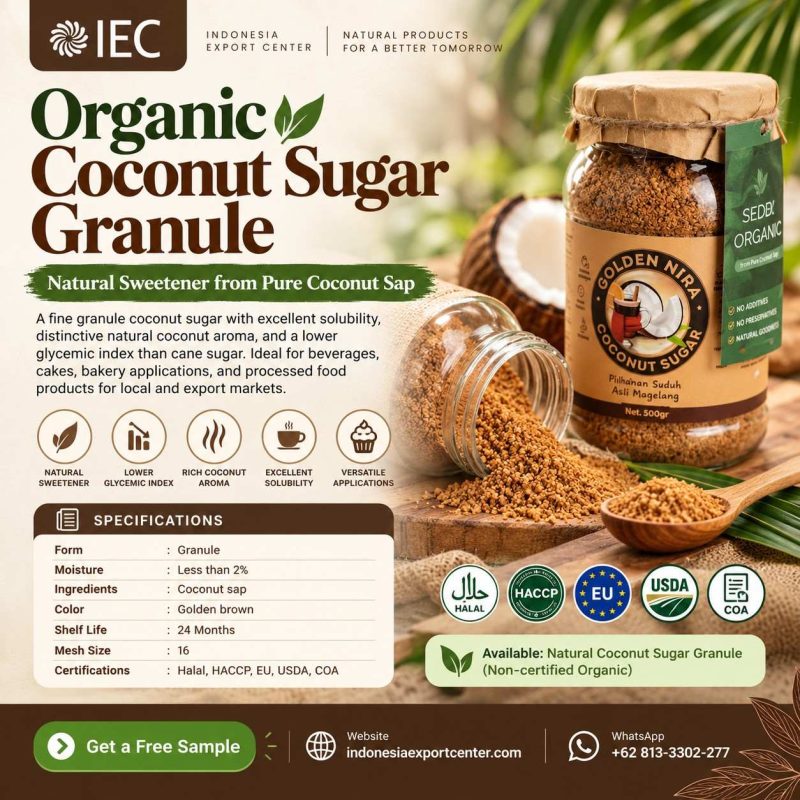
The IEC product flyer references HACCP alongside Halal, EU, USDA, and COA.
However, the supplied material does not contain a HACCP certificate, audit report, or detailed food safety management documentation.
Buyers should verify the applicable food safety arrangements before approving a supplier.
What Is HACCP?
Hazard Analysis and Critical Control Points (HACCP) is a systematic approach to identifying, evaluating, and controlling significant food safety hazards.
HACCP-based systems are used across many food manufacturing operations.
A HACCP program should be appropriate for the product, facility, production process, and identified hazards.
HACCP Is Not the Same as Product Certification
HACCP primarily concerns food safety management processes.
A supplier’s reference to HACCP does not mean that every product lot has been independently laboratory tested.
Similarly, a product COA does not prove that a facility operates an effective HACCP system.
Buyers should evaluate both management controls and product quality evidence.
IEC Coconut Sugar Reference Specifications
| Parameter | Promotional Information |
|---|---|
| Product | Organic Coconut Sugar Granule |
| Ingredient | Coconut Sap |
| Form | Granule |
| Moisture | Less than 2% |
| Mesh | 16 |
| Colour | Golden Brown |
| Shelf Life | 24 Months |
| HACCP | Referenced; documentation unverified |
The natural, non-certified-organic variant should also be assessed under the applicable supplier quality program.
Potential Food Safety Hazards
A coconut sugar food safety assessment may consider biological, chemical, and physical hazards.
The actual hazards depend on the raw materials, processing methods, facility conditions, and distribution arrangements.
Biological Hazards
Potential considerations include microbiological contamination arising from raw materials, processing environments, handling, or storage.
Chemical Hazards
Potential considerations may include relevant residues, contaminants, cleaning chemicals, or other hazards identified through risk assessment.
Physical Hazards
Potential physical hazards may include foreign materials introduced during production, handling, or packaging.
Good Manufacturing Practices
A HACCP-based system normally depends on appropriate prerequisite programs.
Relevant controls may include:
- Personnel hygiene.
- Cleaning and sanitation.
- Pest management.
- Water quality.
- Equipment maintenance.
- Supplier approval.
- Allergen management where relevant.
- Foreign matter control.
- Storage and transport hygiene.
- Traceability.
Seven HACCP Principles
A HACCP approach generally includes:
- Conduct a hazard analysis.
- Determine critical control points.
- Establish critical limits.
- Establish monitoring procedures.
- Establish corrective actions.
- Establish verification procedures.
- Establish documentation and recordkeeping.
The actual implementation must be tailored to the facility and process.
Supplier HACCP Verification Checklist
| Verification Area | Buyer Questions |
|---|---|
| Food Safety System | What system is implemented? |
| Scope | Which products and facilities are covered? |
| Hazard Analysis | Has it been documented? |
| Monitoring | Are relevant records maintained? |
| Corrective Actions | How are deviations managed? |
| Verification | How is system effectiveness reviewed? |
| Audit Evidence | Is relevant evidence available? |
| Traceability | Can lots be identified? |
| Recall Procedures | Is a procedure documented? |
HACCP Documentation vs Other Certifications
The buyer should distinguish:
- HACCP plans and implementation records.
- Third-party food safety certifications.
- Organic certificates.
- Halal certificates.
- Laboratory COAs.
- Regulatory registrations.
Each document serves a different purpose.
Coconut Sugar Quality Testing
A risk-based testing program may include:
- Moisture.
- Particle-size distribution.
- Microbiological parameters.
- Relevant contaminants.
- Foreign matter.
- Product identity.
- Packaging integrity.
The test scope should be determined by applicable requirements and buyer risk assessment.
Factory Audit Considerations
Food ingredient buyers may conduct a supplier audit or request an independent assessment.
Possible review areas include:
- Facility hygiene.
- Raw material receiving.
- Production controls.
- Employee training.
- Cleaning records.
- Pest management.
- Packaging operations.
- Product release.
- Traceability.
- Complaint management.
An audit should be proportionate to the supplier’s risk and the intended application.
Traceability and Recall Readiness
A food safety management system should support the identification of affected product lots when necessary.
Buyers may ask whether the supplier maintains:
- Raw material records.
- Production lot records.
- Finished product identification.
- Shipment records.
- Complaint procedures.
- Recall or withdrawal procedures.
Food Safety Requirements for Export
Exported coconut sugar may be subject to different destination-market requirements.
Importers should verify applicable food safety, registration, labelling, and documentation obligations.
HACCP implementation does not automatically authorize entry into every market.
Supplier Approval Process
Step 1: Obtain the product specification.
Step 2: Request food safety system information.
Step 3: Review relevant certificates or audit evidence.
Step 4: Assess product hazard controls.
Step 5: Review current analytical reports.
Step 6: Evaluate traceability.
Step 7: Obtain representative samples.
Step 8: Confirm corrective action and complaint procedures.
Step 9: Establish contractual quality requirements.
Step 10: Approve the supplier according to buyer procedures.
Coconut Sugar HACCP Documentation Request Template
Subject: Coconut Sugar HACCP and Food Safety Documentation Inquiry
Company: [Name]
Country: [Country]
Product Variant: [Organic / Natural]
Application: [Details]
Initial Quantity: [KG or MT]
Please provide:
- Current product specification.
- Description of the food safety management system.
- Relevant HACCP or audit documentation.
- Facility information.
- Representative COA.
- Microbiological testing information.
- Relevant contaminant results.
- Traceability procedures.
- Packaging specification.
- Sample feasibility.
- MOQ and quotation.
Frequently Asked Questions
Does the IEC flyer mention HACCP?
Yes, but current supporting documentation is not included.
Is HACCP a product laboratory test?
No. HACCP is a food safety management approach.
Does a COA prove HACCP compliance?
No.
Does organic certification replace HACCP?
No.
Can buyers request factory audit evidence?
Yes, subject to supplier cooperation and confidentiality arrangements.
Is moisture below 2% enough to prove food safety?
No.
Can buyers request microbiological reports?
Yes, subject to supplier and testing arrangements.
Does HACCP guarantee import eligibility?
No.
Request Coconut Sugar Food Safety Documents and RFQ
Qualifying an Indonesian coconut sugar supplier for international food manufacturing?
Contact IEC with your food safety requirements, technical specifications, order volume, and destination market.
REQUEST COCONUT SUGAR FOOD SAFETY DOCUMENTS & RFQ
INDONESIA EXPORT CENTER (IEC)
Website: https://indonesiaexportcenter.com/
WhatsApp: +62 813-3302-277
Food safety documentation, certifications, test results, samples, MOQ, pricing, and commercial availability require supplier verification.
Related Resources
Coconut Sugar COA and Quality Testing
Halal Coconut Sugar Supplier Indonesia
Coconut Sugar for Food Manufacturers
