

INDONESIA EXPORT CENTER (IEC)
Indonesian Coconut Sugar Sourcing for Halal Food Manufacturers, International Distributors, Foodservice Suppliers and Ingredient Importers
Source Halal Coconut Sugar from Indonesia
Are you searching for a halal coconut sugar supplier in Indonesia for commercial food production, ingredient distribution, or international import?
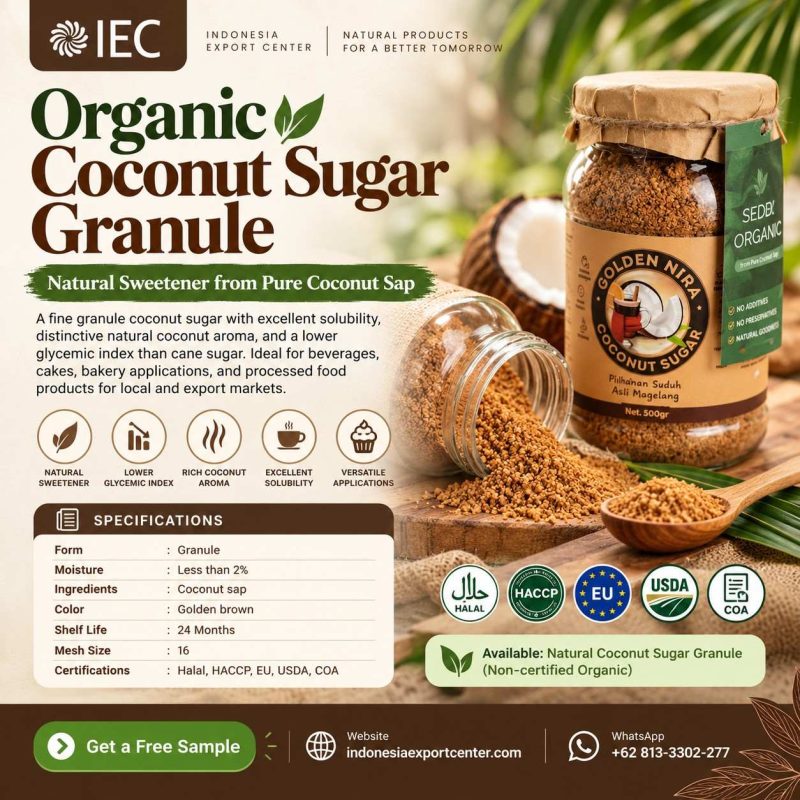
Indonesia Export Center (IEC) facilitates B2B sourcing inquiries for Indonesian coconut sugar granules, including products promoted with halal certification references.
Coconut sugar is made from coconut palm sap and can be evaluated as a sweetening ingredient in beverages, bakery products, snacks, desserts, and processed foods.
The IEC promotional flyer identifies halal among the product’s certification references.
However, the flyer does not include a complete certificate, certificate number, issuing body, product scope, or validity information.
International buyers should verify the current halal certification status before approving the ingredient for halal-labelled products.
Why Halal Certification Matters in Food Ingredient Procurement
Halal compliance may be an important purchasing requirement for food manufacturers and distributors serving Muslim consumers.
Ingredient buyers often need assurance that products satisfy the relevant halal requirements throughout production and handling.
The assessment may involve:
- Raw material origin.
- Processing aids.
- Manufacturing conditions.
- Cleaning procedures.
- Cross-contact controls.
- Storage.
- Packaging.
- Transportation.
- Certification documentation.
A plant-derived ingredient should not automatically be treated as formally halal-certified.
IEC Coconut Sugar Product Reference
| Parameter | Flyer Information |
|---|---|
| Product | Organic Coconut Sugar Granule |
| Main Ingredient | Coconut Sap |
| Form | Granule |
| Moisture | Less than 2% |
| Mesh | 16 |
| Colour | Golden Brown |
| Shelf Life | 24 Months |
| Certification Reference | Halal |
| Other References | HACCP, EU, USDA, COA |
All values and certification references require confirmation.
The flyer also identifies a natural coconut sugar variant, which should be verified separately.
Understanding Halal Certification
Halal certification is a formal process through which an authorized or recognized body evaluates a product and relevant production activities against applicable halal requirements.
The requirements and recognition arrangements may vary by country.
An Indonesian halal certificate may need additional recognition or verification for the buyer’s destination market.
Importers should confirm the relevant national rules before purchasing.
How to Verify a Halal Coconut Sugar Supplier
Step 1 – Request the Halal Certificate
Ask the supplier for the current certificate and supporting information.
Step 2 – Identify the Certificate Holder
The certificate should identify the relevant legal entity.
Check whether that entity corresponds to the actual manufacturer or responsible certified operator.
Step 3 – Identify the Issuing Body
Confirm the organization responsible for the certification.
For Indonesian halal matters, buyers may consult the relevant official halal authorities and applicable recognition arrangements.
Step 4 – Confirm Product Scope
Check that coconut sugar is included in the certified product list.
A certificate for another product does not establish certification for the coconut sugar being purchased.
Step 5 – Confirm Facility Scope
Determine which manufacturing or processing facilities are covered.
Step 6 – Check Validity and Current Status
Review certificate status, validity conditions, and any relevant changes.
Step 7 – Verify Destination Recognition
Confirm whether the certification is acceptable for the destination market and intended use.
Halal Coconut Sugar for Food Manufacturing
Potential applications include:
- Bakery manufacturing.
- Coffee and tea.
- Beverage powders.
- Breakfast cereals.
- Granola.
- Snack bars.
- Specialty desserts.
- Selected confectionery products.
Manufacturers should confirm both halal documentation and technical suitability.
Halal and Organic Are Different Requirements
Halal and organic certification serve different purposes.
A coconut sugar product may be halal-certified without being organic-certified.
Likewise, an organic-certified product is not automatically halal-certified.
Buyers requiring both should request valid evidence for each claim.
Halal Certification vs Food Safety Documentation
Halal certification should not replace normal food safety due diligence.
Buyers may separately require:
- Product specification.
- Certificate of Analysis.
- Microbiological testing.
- Relevant contaminant reports.
- Food safety system documentation.
- Traceability.
- Packaging specifications.
A halal certificate does not automatically establish compliance with all food import regulations.
Packaging and Traceability
For halal ingredient procurement, buyers may need clear product identification and traceability.
Potential controls include:
- Correct product name.
- Lot number.
- Manufacturer identification.
- Certified product identification.
- Packaging integrity.
- Storage segregation where applicable.
- Shipment records.
Commercial Supplier Evaluation
Before placing an order, request:
- Current halal certificate.
- Certified product list.
- Manufacturer information.
- Product specification.
- Current COA.
- Packaging details.
- Sample feasibility.
- MOQ.
- Production lead time.
- Export quotation.
Halal Coconut Sugar RFQ Template
Subject: Halal Coconut Sugar Supplier Inquiry – Indonesia
Company: [Company Name]
Destination Country: [Country]
Application: [Details]
Product Variant: [Organic / Natural]
Halal Standard or Recognition Requirement: [Details]
Initial Quantity: [KG or MT]
Monthly Demand: [Quantity]
Required Mesh: [Specification]
Maximum Moisture: [Specification]
Packaging: [Details]
Destination Port: [Port]
Preferred Incoterm: [Term]
Please provide current halal certification, product scope, manufacturing facility information, product specifications, COA, sample feasibility, MOQ, and export quotation.
Frequently Asked Questions
Is coconut sugar naturally plant-derived?
Yes. Coconut sugar is produced from coconut palm sap.
Does plant-derived mean halal-certified?
No. Formal certification requires appropriate verification.
Does the IEC flyer reference halal certification?
Yes, but the current certificate has not been independently verified.
Can halal coconut sugar be used in beverages?
It may be evaluated for suitable beverage formulations.
Is halal certification the same as HACCP?
No.
Can a buyer request halal and organic certification?
Yes, both should be verified separately.
Is halal certification recognized in every country?
Recognition requirements vary by destination.
Can buyers request a sample?
Sample feasibility requires supplier confirmation.
Request Halal Coconut Sugar Documentation and Export Quotation
Indonesia Export Center welcomes inquiries from halal food manufacturers, ingredient importers, distributors, and specialty food brands.
Provide your destination market, required certification, technical specifications, purchasing volume, and packaging needs.
REQUEST HALAL COCONUT SUGAR CERTIFICATION & RFQ
INDONESIA EXPORT CENTER (IEC)
Website: https://indonesiaexportcenter.com/
WhatsApp: +62 813-3302-277
Halal status, certification recognition, product specifications, samples, MOQ, prices, and supply availability require verification.
Related Resources
Organic Coconut Sugar Supplier Indonesia
Coconut Sugar HACCP and Food Safety Checks
Coconut Sugar COA and Quality Testing
