

INDONESIA EXPORT CENTER (IEC)
Technical Buying Guide for Indonesian Coconut Sugar Granules, Sieving Verification and Food Manufacturing Applications
Understanding Coconut Sugar Mesh Size
When sourcing coconut sugar for industrial food production, particle size is an important technical specification.
Buyers searching for coconut sugar mesh size information often need to determine whether a particular granulation is suitable for beverage production, bakery manufacturing, cereal blending, retail packaging, or other applications.
Indonesia Export Center (IEC) facilitates sourcing inquiries for Indonesian coconut sugar granules.
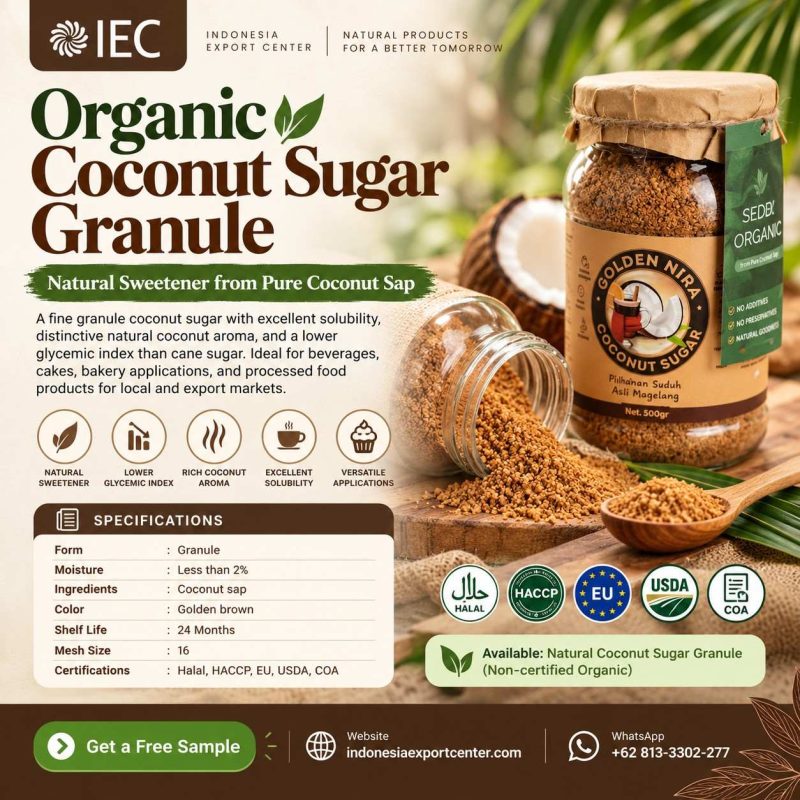
The IEC promotional flyer lists mesh size 16 for its organic coconut sugar granule product.
However, mesh 16 alone does not fully describe the size distribution of the material.
A complete evaluation should include the applicable sieve standard, the proportion of particles passing or retained, and the manufacturer’s specific application requirements.
What Does Mesh Size Mean?
Mesh is commonly used to describe sieve classification.
A sieve contains openings that allow smaller particles to pass while retaining larger particles.
The meaning of a mesh designation depends on the applicable sieve standard and how the supplier reports the result.
A buyer should not assume that every supplier uses identical classification procedures.
What Does Mesh 16 Mean for Coconut Sugar?
The IEC flyer identifies mesh 16.
This indicates a reported granulation reference, but the flyer does not specify:
- The sieve standard.
- The percentage passing.
- The percentage retained.
- The amount of fine particles.
- The full particle-size distribution.
- The testing method.
Therefore, the reported mesh size should be treated as preliminary technical information.
Why Mesh Size Matters
Particle size can influence:
- Mixing performance.
- Dissolution.
- Flowability.
- Dust generation.
- Segregation.
- Texture.
- Product appearance.
- Processing consistency.
The ideal particle size depends on the intended use.
IEC Coconut Sugar Product Reference
| Parameter | Promotional Information |
|---|---|
| Product | Organic Coconut Sugar Granule |
| Ingredient | Coconut Sap |
| Form | Granule |
| Mesh | 16 |
| Moisture | Less than 2% |
| Colour | Golden Brown |
| Shelf Life | 24 Months |
| Aroma | Distinctive Coconut Aroma |
A natural, non-certified-organic variant is also identified in the flyer.
Specifications should be confirmed separately for each offered product.
Coconut Sugar Mesh Size for Beverage Applications
Beverage manufacturers may need granules that dissolve adequately under their intended processing conditions.
Particle size may influence dissolution rate, but dissolution also depends on temperature, agitation, concentration, and other ingredients.
A mesh designation alone does not establish beverage performance.
Manufacturers should conduct application trials.
Coconut Sugar Mesh Size for Bakery Manufacturing
Bakery manufacturers may evaluate particle size in relation to:
- Dough mixing.
- Batter uniformity.
- Dissolution.
- Texture.
- Surface appearance.
- Processing consistency.
Different bakery products may require different granulations.
Coconut Sugar Mesh Size for Dry Blends
Dry ingredient blending requires attention to particle-size compatibility.
If coconut sugar differs substantially from the other ingredients, segregation may occur during handling or transportation.
A buyer may conduct blend-uniformity testing to assess this risk.
Coconut Sugar Mesh Size for Chocolate
Chocolate manufacturers often require very fine particle sizes in the finished product.
The reported mesh 16 should not be assumed suitable for direct use in finished chocolate.
Additional refining may be necessary, depending on the process.
Coconut Sugar Mesh Size for Retail Packaging
Retail products may be selected partly for their appearance and ease of handling.
Buyers should evaluate:
- Granule uniformity.
- Visible fines.
- Caking.
- Flow.
- Consumer dispensing.
- Packaging performance.
Sieve Analysis
A sieve analysis can provide a more complete understanding of particle size.
A typical report may identify the percentage of material retained on or passing through selected sieves.
The test method and reporting format should be agreed between the supplier and buyer.
Example Buyer Specification Table
| Test Item | Buyer Requirement |
|---|---|
| Sieve Standard | [Specify] |
| Nominal Mesh | [Specify] |
| Percentage Passing | [Specify] |
| Percentage Retained | [Specify] |
| Fines Content | [Specify] |
| Test Method | [Specify] |
| Sampling Procedure | [Specify] |
This is a specification template, not an IEC laboratory result.
Mesh Size vs Particle-Size Distribution
A single mesh number may describe a classification point.
Particle-size distribution provides information about the range of particle sizes in a sample.
Two coconut sugar products with the same nominal mesh designation may still have different proportions of coarse particles and fines.
For technical procurement, the full distribution may be more useful than a single number.
Particle Size and Powder Flow
Particle size can influence how coconut sugar moves through production equipment.
Manufacturers may assess:
- Hopper flow.
- Filling performance.
- Bridging.
- Dust generation.
- Conveying behaviour.
- Mixing uniformity.
Moisture and storage conditions also influence handling.
Particle Size and Moisture
Particle size and moisture should be evaluated together where relevant.
The IEC flyer reports moisture below 2%, but actual batch values require confirmation.
Manufacturers should not assume that a specified mesh size guarantees resistance to caking.
How to Verify Coconut Sugar Mesh Size
Step 1: Request the current product specification.
Step 2: Ask which sieve standard is used.
Step 3: Request the test method.
Step 4: Obtain a representative sample.
Step 5: Conduct independent sieve analysis if required.
Step 6: Compare results with the buyer’s specification.
Step 7: Evaluate the ingredient in the intended application.
Step 8: Establish batch acceptance criteria.
Supplier Quality Documentation
Buyers may request:
- Product specification sheet.
- Current COA.
- Sieve analysis.
- Moisture results.
- Microbiological results.
- Relevant contaminant reports.
- Packaging specification.
- Traceability documentation.
Mesh Size Selection Checklist
Before purchasing, confirm:
- Intended application.
- Required particle-size distribution.
- Acceptable fines content.
- Moisture requirements.
- Production equipment compatibility.
- Sample test results.
- Supplier batch consistency.
- Commercial quantity.
- Packaging.
- Inspection requirements.
Coconut Sugar Mesh Size RFQ Template
Subject: Indonesian Coconut Sugar Mesh Size and Technical Specification Inquiry
Company: [Name]
Country: [Country]
Application: [Details]
Product Variant: [Organic / Natural]
Required Mesh: [Value]
Sieve Standard: [Standard]
Percentage Passing: [Requirement]
Percentage Retained: [Requirement]
Maximum Moisture: [Specification]
Required Quantity: [KG or MT]
Packaging: [Details]
Destination Port: [Port]
Preferred Incoterm: [Term]
Please provide the current particle-size specification, sieve analysis, COA, sample feasibility, MOQ, and quotation.
Frequently Asked Questions
What mesh size is listed in the IEC coconut sugar flyer?
Mesh 16.
Does mesh 16 describe every particle in the product?
No. The complete particle-size distribution must be verified.
Is mesh 16 suitable for beverages?
Suitability depends on the beverage formulation and processing conditions.
Is mesh 16 suitable for bakery products?
It depends on the recipe and production process.
Can coconut sugar be supplied in other mesh sizes?
Alternative granulations require supplier confirmation.
Is a finer mesh always better?
No. Different applications require different particle characteristics.
Can buyers request sieve analysis?
Yes, subject to supplier documentation or testing arrangements.
Is mesh size the same as moisture content?
No. They describe different properties.
Request Coconut Sugar Mesh Specifications and Samples
Looking for Indonesian coconut sugar with a particular granulation for industrial manufacturing?
Contact Indonesia Export Center with your application, required particle size, order quantity, and destination.
REQUEST COCONUT SUGAR TECHNICAL SPECIFICATIONS & RFQ
INDONESIA EXPORT CENTER (IEC)
Website: https://indonesiaexportcenter.com/
WhatsApp: +62 813-3302-277
Mesh designation, sieve analysis, product specifications, sample availability, MOQ, and prices require supplier confirmation.
Related Resources
Low Moisture Coconut Sugar Granules
Coconut Sugar COA and Quality Testing
Coconut Sugar for Instant Drink Powders
