

INDONESIA EXPORT CENTER (IEC)
Technical Sourcing Guide for Low Moisture Coconut Sugar Used in Food Manufacturing and International Ingredient Procurement
Source Low Moisture Coconut Sugar from Indonesia
Moisture content is an important quality parameter for granulated food ingredients.
For buyers searching for low moisture coconut sugar, Indonesia Export Center (IEC) facilitates B2B sourcing inquiries for Indonesian coconut sugar granules.
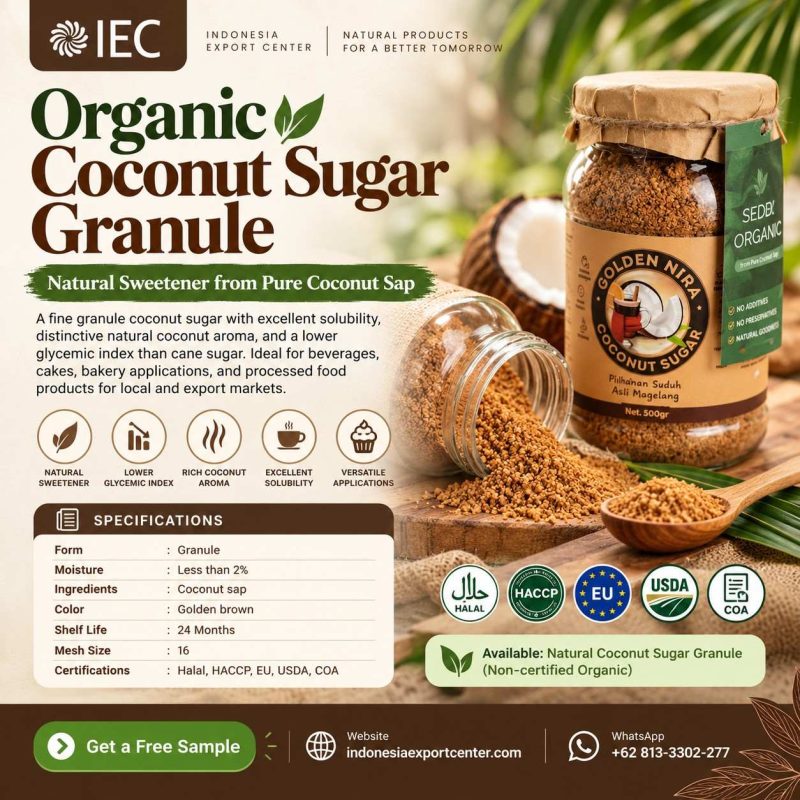
The IEC promotional flyer lists a moisture specification of less than 2% for its organic coconut sugar granule product.
This figure is a reference from promotional material and should not be interpreted as a verified result for every production batch.
Buyers should request current analytical documentation and establish appropriate acceptance criteria before placing commercial orders.
What Is Low Moisture Coconut Sugar?
Low moisture coconut sugar is coconut sugar with a relatively low water content, as defined by an agreed technical specification.
Coconut sugar is made from coconut palm sap and processed into a granulated sweetener.
Moisture content can influence product handling, storage, packaging, and quality.
However, moisture alone does not establish overall product safety or stability.
IEC Product Specifications
| Parameter | Promotional Reference |
|---|---|
| Product | Organic Coconut Sugar Granule |
| Ingredient | Coconut Sap |
| Form | Granule |
| Moisture | Less than 2% |
| Mesh | 16 |
| Colour | Golden Brown |
| Shelf Life | 24 Months |
| Aroma | Distinctive Coconut Aroma |
The flyer also mentions a natural, non-certified-organic variant.
Current specifications must be confirmed for the offered product.
Why Moisture Matters
Moisture content can influence several practical aspects of coconut sugar procurement.
These include:
- Flowability.
- Caking.
- Storage stability.
- Packaging requirements.
- Processing performance.
- Ingredient consistency.
Manufacturers should define acceptable moisture levels according to their applications.
Moisture and Caking
Caking occurs when particles form lumps or agglomerates.
Moisture uptake can contribute to caking, although other factors may also be involved.
Potential influences include:
- Ambient humidity.
- Packaging barrier performance.
- Temperature changes.
- Particle size.
- Storage duration.
- Handling conditions.
A moisture specification below 2% does not guarantee that the product will never cake.
Moisture vs Water Activity
Moisture content and water activity are different measurements.
Moisture content describes the amount of water in a material.
Water activity relates to the availability of water for physical, chemical, and microbiological processes.
Two ingredients with similar moisture content may have different water activity values.
Where relevant, manufacturers should evaluate both measurements.
Coconut Sugar Moisture Testing
Moisture may be measured using an appropriate validated analytical method.
The method should be suitable for the product matrix.
Buyers should ask the supplier to identify:
- Test method.
- Laboratory.
- Sample identification.
- Testing date.
- Result.
- Measurement units.
- Specification limit.
- Batch number.
Different methods may produce results that require careful interpretation.
Sampling and Batch Verification
A representative sample is essential for reliable moisture testing.
The buyer and supplier should agree on sampling procedures.
Potential considerations include:
- Lot size.
- Sampling points.
- Sample container.
- Moisture protection.
- Sample transport.
- Laboratory handling.
- Retained samples.
Testing a poorly handled sample may not accurately represent the commercial batch.
Moisture and Industrial Applications
Bakery Manufacturing
Moisture may influence ingredient handling and recipe consistency.
Instant Drink Powders
Moisture may affect dry blending, caking, and flow.
Breakfast Cereals
Moisture can be relevant to ingredient storage and dry-mix processing.
Sweetener Blends
Moisture differences between ingredients may affect the finished blend.
Retail Coconut Sugar
Moisture control may influence granule appearance and consumer handling.
Packaging for Low Moisture Coconut Sugar
Packaging should help protect the product against moisture exposure.
Potential buyer requirements include:
- Food-grade packaging.
- Moisture-resistant liners.
- Secure sealing.
- Appropriate carton protection.
- Lot identification.
- Storage instructions.
Actual packaging materials and barrier performance must be confirmed.
Warehouse Storage Considerations
Warehouse operators should follow the supplier’s validated storage instructions.
General considerations include:
- Clean storage areas.
- Protection from water.
- Controlled exposure to humidity.
- Intact packaging.
- Appropriate stock rotation.
- Lot identification.
- Pest management.
- Routine inspection.
Moisture and Shelf Life
The IEC flyer lists a 24-month shelf life.
This should be supported by appropriate documentation for the actual product and packaging.
Shelf life depends on factors beyond initial moisture content.
Relevant considerations may include packaging integrity, storage conditions, product quality, and contamination control.
Quality Documentation
A low-moisture coconut sugar buyer may request:
- Current COA.
- Moisture analysis.
- Product specification.
- Water activity results where relevant.
- Microbiological reports.
- Relevant contaminant testing.
- Packaging specification.
- Shelf-life support.
- Traceability records.
Low Moisture Coconut Sugar Buyer Checklist
| Requirement | Buyer Specification |
|---|---|
| Product Variant | Organic / Natural |
| Maximum Moisture | [%] |
| Test Method | [Method] |
| Water Activity | [If required] |
| Mesh | [Specification] |
| Packaging | [Details] |
| Storage Conditions | [Details] |
| Shelf Life | [Requirement] |
| COA | Required |
| Sampling Procedure | [Details] |
Supplier Qualification Process
Step 1: Request the product specification.
Step 2: Confirm the moisture limit.
Step 3: Review analytical methods.
Step 4: Obtain representative samples.
Step 5: Conduct independent testing if required.
Step 6: Evaluate storage and handling.
Step 7: Review packaging suitability.
Step 8: Confirm batch consistency and commercial terms.
Low Moisture Coconut Sugar RFQ Template
Subject: Low Moisture Coconut Sugar Supplier Inquiry – Indonesia
Company: [Name]
Country: [Country]
Application: [Details]
Product Variant: [Organic / Natural]
Required Moisture Limit: [Specification]
Required Mesh: [Specification]
Initial Quantity: [KG or MT]
Monthly Demand: [Quantity]
Packaging: [Details]
Required Certifications: [Details]
Destination Port: [Port]
Preferred Incoterm: [Term]
Please provide current moisture results, COA, test methods, sample feasibility, MOQ, packaging information, and export quotation.
Frequently Asked Questions
What moisture level is reported in the IEC flyer?
Less than 2%.
Is this moisture value verified for every batch?
No. Current batch documentation is required.
Does low moisture prevent caking completely?
No.
Is moisture the same as water activity?
No.
Can buyers request independent moisture testing?
Yes, subject to agreed testing arrangements.
Is low moisture coconut sugar suitable for instant beverages?
Potentially, subject to complete formulation testing.
Does moisture below 2% guarantee a 24-month shelf life?
No.
Can buyers request bulk quotations?
Yes, subject to supplier confirmation.
Request Low Moisture Coconut Sugar Specifications
Looking for Indonesian coconut sugar with controlled moisture for industrial food production?
Contact IEC with your maximum moisture requirement, application, order quantity, and destination.
REQUEST LOW MOISTURE COCONUT SUGAR SAMPLE & RFQ
INDONESIA EXPORT CENTER (IEC)
Website: https://indonesiaexportcenter.com/
WhatsApp: +62 813-3302-277
Moisture specifications, test results, shelf life, certifications, sample availability, MOQ, and pricing require verification.
Related Resources
Coconut Sugar COA and Quality Testing
Coconut Sugar Shelf Life and Storage
