

INDONESIA EXPORT CENTER (IEC)
B2B Ingredient Sourcing for Sweetener Manufacturers, Food Brands, Ingredient Blenders and International Distributors
Source Coconut Sugar for Sweetener Blend Manufacturing
Are you looking for coconut sugar for sweetener blends to develop specialty sweetener products, retail blends, or industrial food ingredients?
Indonesia Export Center (IEC) facilitates B2B sourcing inquiries for Indonesian coconut sugar granules.
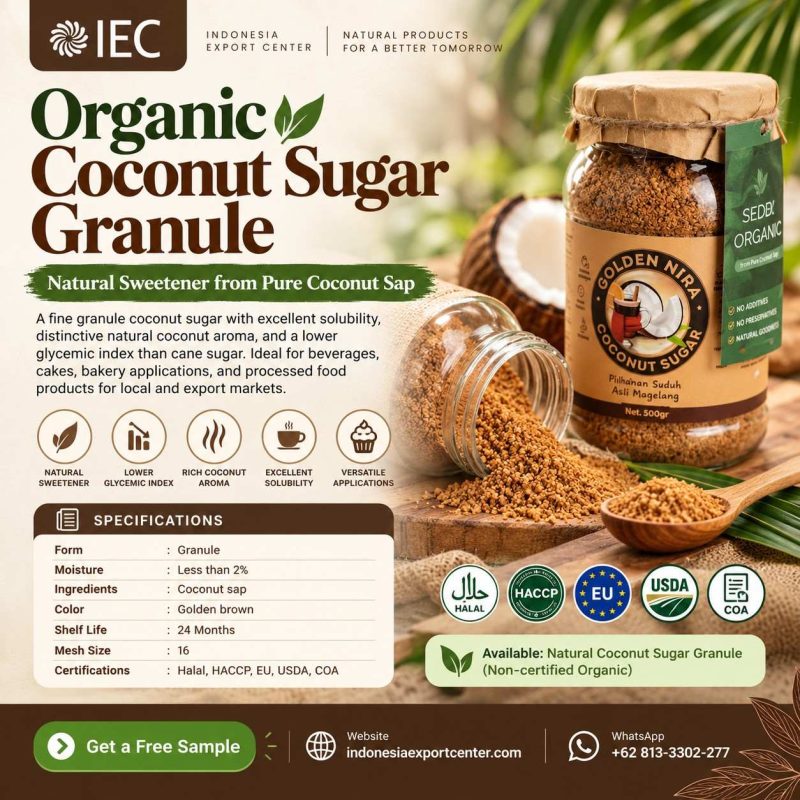
The IEC product flyer describes coconut sugar produced from coconut sap, featuring golden-brown granules, a distinctive coconut aroma, and good solubility.
The product may be evaluated as one ingredient in selected sweetener blends.
However, blending suitability depends on the physical properties, flavour, processing requirements, and regulatory status of all ingredients.
What Are Sweetener Blends?
Sweetener blends combine two or more ingredients to achieve a particular product profile.
A manufacturer may develop blends for:
- Retail sweetener products.
- Beverage formulations.
- Bakery applications.
- Foodservice products.
- Specialty ingredient distribution.
- Industrial food production.
The intended result may involve sweetness, flavour, texture, granulation, or ease of use.
Why Consider Coconut Sugar?
Coconut sugar may be considered for its:
- Coconut palm sap origin.
- Sweetening function.
- Golden-brown appearance.
- Distinctive aroma.
- Granulated form.
- Potential compatibility with selected dry ingredient systems.
These properties should be assessed against the complete formulation.
IEC Product Information
| Parameter | Promotional Reference |
|---|---|
| Product | Organic Coconut Sugar Granule |
| Ingredient | Coconut Sap |
| Form | Granule |
| Moisture | Less than 2% |
| Colour | Golden Brown |
| Mesh | 16 |
| Shelf Life | 24 Months |
| Aroma | Distinctive Coconut Aroma |
A natural, non-certified-organic variant is also identified.
The figures above require verification.
Potential Sweetener Blend Applications
Coconut sugar may be evaluated in blends intended for:
- Coffee and tea.
- Bakery products.
- Foodservice use.
- Specialty retail.
- Beverage powders.
- Selected processed foods.
The formulation must be designed for its intended application.
Blend Compatibility
Compatibility involves more than whether ingredients can be mixed together.
Manufacturers should evaluate:
- Particle size.
- Particle shape.
- Bulk density.
- Moisture.
- Hygroscopic behaviour.
- Flavour.
- Colour.
- Solubility.
- Processing compatibility.
- Storage stability.
Differences between ingredients may cause segregation or inconsistent product performance.
Granulation and Particle-Size Distribution
The IEC flyer lists mesh size 16.
A sweetener blender should request the full particle-size specification where necessary.
If ingredients have very different particle sizes, they may separate during handling.
Possible evaluations include sieve analysis, blend sampling, and finished-product uniformity testing.
Sweetness and Sensory Performance
A sweetener blend should be evaluated for its actual sweetness profile.
Manufacturers should not assume that replacing a portion of another sweetener with coconut sugar will preserve identical sweetness.
Sensory testing may consider:
- Initial sweetness.
- Sweetness persistence.
- Aroma.
- Aftertaste.
- Mouthfeel.
- Flavour compatibility.
Moisture and Caking
The IEC flyer reports moisture below 2%.
However, the finished blend may behave differently from its individual ingredients.
Manufacturers should assess moisture uptake, caking, powder flow, and storage conditions.
Organic Sweetener Blends
If the finished blend is intended to carry a certified organic claim, all relevant ingredients and handling arrangements must satisfy the applicable standard.
The IEC flyer references organic coconut sugar, but certification evidence must be verified.
The natural variant should not be represented as organic-certified.
Labelling Accuracy
Sweetener blend labels should accurately identify the ingredients and comply with destination-market rules.
Depending on the product, requirements may include:
- Ingredient list.
- Ingredient order.
- Nutrition information.
- Sugar declarations.
- Net quantity.
- Organic claims.
- Sweetener-related claims.
- Allergen information.
- Manufacturer or importer details.
- Lot identification.
The use of coconut sugar does not automatically justify sugar-free, low-sugar, or low-glycemic claims.
Quality Control for Sweetener Blenders
A supplier approval program may include:
- Product identity.
- Moisture.
- Granulation.
- Colour.
- Aroma.
- Microbiological quality.
- Relevant contaminants.
- Foreign matter.
- Packaging.
- Traceability.
Recommended Blend Development Workflow
Stage 1 – Define the Product
Establish the intended use and target characteristics.
Stage 2 – Review Ingredient Specifications
Obtain technical information for coconut sugar and all other ingredients.
Stage 3 – Conduct Bench Trials
Evaluate initial blending performance.
Stage 4 – Test Uniformity
Sample the blend at multiple points.
Stage 5 – Assess Sensory Quality
Evaluate sweetness, flavour, colour, and mouthfeel.
Stage 6 – Assess Storage Stability
Monitor caking, segregation, and product changes.
Stage 7 – Review Labelling
Confirm the accuracy of ingredients and claims.
Stage 8 – Approve Commercial Production
Finalize specifications and quality acceptance criteria.
Commercial Sourcing Considerations
Buyers should request information about:
- Product variant.
- Technical specifications.
- Available packaging.
- Current COA.
- Certification documents.
- Sample feasibility.
- MOQ.
- Lead time.
- Price.
- Shipment terms.
Sweetener Blend RFQ Template
Subject: Indonesian Coconut Sugar for Natural Sweetener Blend Manufacturing
Company: [Name]
Country: [Country]
Intended Application: [Details]
Product Variant: [Organic / Natural]
Initial Quantity: [KG or MT]
Monthly Demand: [Quantity]
Required Particle Size: [Specification]
Maximum Moisture: [Specification]
Certification Requirements: [Details]
Packaging: [Details]
Destination Port: [Port]
Preferred Incoterm: [Term]
Please provide available specifications, COA, sample feasibility, MOQ, and export quotation.
Frequently Asked Questions
Can coconut sugar be blended with other sweeteners?
Potentially, subject to compatibility and formulation testing.
Does coconut sugar provide the same sweetness as every other sweetener?
No. Sweetness and sensory performance must be evaluated.
Can coconut sugar blends be labelled natural?
Claims must comply with applicable market regulations.
Does coconut sugar make a blend sugar-free?
No.
Is mesh 16 suitable for all dry blends?
No. Suitability depends on the other ingredients and processing equipment.
Can organic coconut sugar be used in organic blends?
Potentially, where applicable certification requirements are satisfied.
Is the natural variant organic-certified?
Not according to the information supplied.
Can buyers request samples?
Yes, subject to supplier confirmation.
Request Coconut Sugar for Sweetener Blend Manufacturing
Developing an industrial or retail sweetener blend using Indonesian coconut sugar?
Contact IEC with your application, target specifications, purchasing volume, certification requirements, and destination.
REQUEST COCONUT SUGAR SAMPLE & EXPORT RFQ
INDONESIA EXPORT CENTER (IEC)
Website: https://indonesiaexportcenter.com/
WhatsApp: +62 813-3302-277
Product specifications, certifications, sample availability, MOQ, pricing, and commercial supply require confirmation.
Related Resources
Low Moisture Coconut Sugar Granules
Coconut Sugar for Food Manufacturers
