

INDONESIA EXPORT CENTER (IEC)
Industrial Coconut Sugar Sourcing for Instant Coffee, Tea Premixes, Powdered Drinks and Beverage Ingredient Blending
Indonesian Coconut Sugar for Instant Beverage Formulations
Powdered beverage manufacturers need sweetening ingredients that can be handled efficiently during production and perform consistently when consumers prepare the finished drink.
For businesses searching for coconut sugar for instant drink powder, Indonesia Export Center (IEC) facilitates B2B sourcing inquiries for Indonesian coconut sugar granules.
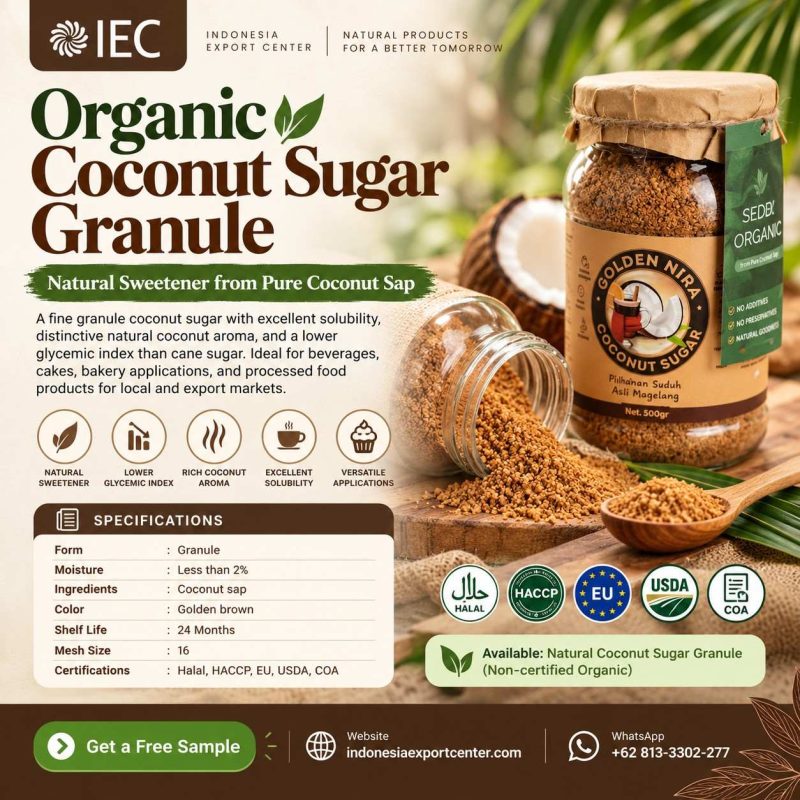
The IEC product flyer describes coconut sugar made from coconut sap, featuring golden-brown colour, a distinctive coconut aroma, and good solubility.
The flyer presents an organic coconut sugar product and also mentions a natural, non-certified-organic variant.
These products may be evaluated for selected instant beverage formulations, subject to application testing.
Why Powdered Beverage Manufacturers Consider Coconut Sugar
Coconut sugar may be evaluated for:
- Instant coffee mixes.
- Tea premixes.
- Specialty beverage powders.
- Plant-based drink powders.
- Selected cocoa beverage mixes.
- Private-label beverage products.
- Other suitable dry beverage formulations.
Manufacturers must assess ingredient performance in both the dry powder and the prepared beverage.
Product Specifications from IEC Promotional Material
| Parameter | Reported Information |
|---|---|
| Product | Organic Coconut Sugar Granule |
| Ingredient | Coconut Sap |
| Form | Granule |
| Moisture | Less than 2% |
| Colour | Golden Brown |
| Mesh | 16 |
| Shelf Life | 24 Months |
| Solubility | Described as Good |
| Aroma | Distinctive Coconut Aroma |
These values require verification through supplier documentation and appropriate batch testing.
Powder Blending Performance
Dry beverage manufacturing often involves blending ingredients with different particle sizes, shapes, and densities.
Potential problems include:
- Ingredient segregation.
- Uneven sweetness.
- Dust generation.
- Poor flow.
- Caking.
- Inconsistent filling weights.
Manufacturers should test whether coconut sugar distributes evenly throughout the formulation.
Particle Size and Blend Uniformity
The IEC flyer reports mesh size 16.
This reference does not establish the complete particle-size distribution.
Buyers may request:
- Sieve analysis.
- Percentage passing.
- Percentage retained.
- Fines content.
- Bulk density.
- Particle-size consistency.
The required granulation depends on the other ingredients and the blending equipment.
Moisture Control
The flyer reports moisture below 2%.
Low moisture may be relevant to powder handling, but it does not guarantee that a blended beverage powder will remain free-flowing.
Caking may also depend on:
- Ambient humidity.
- Other ingredients.
- Packaging barrier properties.
- Temperature.
- Storage duration.
- Powder composition.
Manufacturers should assess the complete formulation.
Caking and Powder Flow
Caking can interfere with filling, mixing, storage, and consumer use.
A powder manufacturer may evaluate:
- Flow through hoppers.
- Bridging.
- Powder compaction.
- Moisture uptake.
- Storage behaviour.
- Pack performance.
- Reconstitution.
Where appropriate, powder-flow and stability tests should be included in product development.
Dissolution in Hot Beverages
The IEC flyer describes good solubility, but no quantified dissolution performance is supplied.
Manufacturers should test:
- Water temperature.
- Mixing duration.
- Undissolved particles.
- Sediment.
- Appearance.
- Flavour.
- Final concentration.
Dissolution in Cold Beverages
Cold-water reconstitution may be more challenging for some formulations.
Manufacturers should test the finished beverage powder under realistic consumer preparation conditions.
Performance should not be inferred solely from the raw ingredient’s promotional description.
Flavour and Colour
Coconut sugar may contribute colour and a distinctive flavour profile.
Manufacturers should determine whether these characteristics complement coffee, tea, cocoa, or other ingredients.
Colour and flavour consistency should be included in supplier approval criteria.
Organic Instant Drink Products
Brands developing certified organic drink powders may request organic coconut sugar.
Current certification, product scope, handling arrangements, and destination-market recognition must be verified.
Packaging Requirements
Powdered beverage ingredient packaging should be selected according to product sensitivity and logistics requirements.
Potential considerations include:
- Food-contact suitability.
- Moisture barrier.
- Seal integrity.
- Pack size.
- Lot identification.
- Palletization.
- Storage conditions.
Supplier packaging options must be confirmed.
Quality Control Documentation
Manufacturers may request:
- Product specification.
- Current COA.
- Moisture results.
- Particle-size analysis.
- Microbiological results.
- Relevant contaminant reports.
- Packaging specification.
- Organic certification where applicable.
- Shelf-life documentation.
- Traceability information.
Recommended Product Development Process
Step 1: Define the intended beverage.
Step 2: Obtain coconut sugar samples and specifications.
Step 3: Evaluate raw ingredient quality.
Step 4: Conduct powder-blending trials.
Step 5: Measure blend uniformity.
Step 6: Assess powder flow and caking.
Step 7: Test hot and cold reconstitution.
Step 8: Evaluate sensory characteristics.
Step 9: Conduct finished-product stability testing.
Step 10: Approve commercial purchasing specifications.
Industrial Procurement Checklist
| Area | Buyer Requirement |
|---|---|
| Product Variant | Organic / Natural |
| Moisture | [Maximum] |
| Particle Size | [Specification] |
| Bulk Density | [If required] |
| Powder Flow | [Criteria] |
| Dissolution | [Test method] |
| Microbiology | [Limits] |
| Packaging | [Details] |
| Certification | [Details] |
| MOQ | Supplier confirmation |
Instant Drink Powder RFQ Template
Subject: Coconut Sugar for Instant Beverage Powder Manufacturing
Company: [Name]
Country: [Country]
Application: [Instant Coffee / Tea / Cocoa / Other]
Product Variant: [Organic / Natural]
Initial Quantity: [KG or MT]
Monthly Demand: [Quantity]
Required Mesh: [Specification]
Maximum Moisture: [Specification]
Powder Flow Requirements: [Details]
Dissolution Requirements: [Details]
Certification Requirements: [Details]
Packaging: [Details]
Destination Port: [Port]
Preferred Incoterm: [Term]
Please provide current specifications, COA, sample feasibility, MOQ, packaging details, and export quotation.
Frequently Asked Questions
Can coconut sugar be used in instant coffee mixes?
It may be evaluated in suitable formulations.
Does coconut sugar dissolve in cold water?
Performance requires testing under the intended conditions.
Is coconut sugar suitable for dry blending?
Suitability depends on particle size, bulk density, flow, and formulation characteristics.
Does moisture below 2% prevent caking?
Not necessarily.
Can coconut sugar affect the colour of an instant drink?
Yes, it may influence beverage appearance.
Is mesh 16 the same as a complete particle-size specification?
No.
Can manufacturers request organic coconut sugar?
Yes, subject to certification verification.
Is a fixed industrial MOQ available?
No verified MOQ is provided.
Request Coconut Sugar for Instant Beverage Manufacturing
Developing powdered coffee, tea, cocoa, or specialty drink products?
Contact Indonesia Export Center with your formulation requirements, expected volume, packaging needs, and destination.
REQUEST INSTANT DRINK COCONUT SUGAR SAMPLE & RFQ
INDONESIA EXPORT CENTER (IEC)
Website: https://indonesiaexportcenter.com/
WhatsApp: +62 813-3302-277
Product suitability, specifications, certification, samples, MOQ, prices, and availability require supplier confirmation.
Related Resources
Coconut Sugar for Beverage Manufacturers
Low Moisture Coconut Sugar Granules
