![Indonesia Export Center [IEC]](https://indonesiaexportcenter.com/wp-content/uploads/2023/07/logo-no-background.svg)
![Indonesia Export Center [IEC]](https://indonesiaexportcenter.com/wp-content/uploads/2023/07/svgviewer-output.svg)
Introduction
Indonesia is one of the world’s most important palm oil production and processing centers. International buyers can find many companies offering RBD Palm Olein CP8, CP10, retail-packed cooking oil, flexitank shipments, and bulk cargoes from Indonesia.
However, finding a company that offers palm olein is not the same as finding a supplier that can reliably execute an international shipment.
A dependable supplier must be able to prove its legal identity, product source, technical specifications, production or allocation capacity, food-safety controls, export capability, packaging arrangements, and commercial terms.
This guide explains how international buyers can evaluate a reliable RBD Palm Olein Supplier from Indonesia before issuing a Letter of Intent, purchase order, advance payment, or documentary credit.
1. Understand the Product Before Evaluating the Supplier
RBD Palm Olein is the liquid fraction obtained through the fractionation of refined palm oil. The Codex Standard for Named Vegetable Oils defines palm olein as the liquid fraction derived from the fractionation of palm oil.
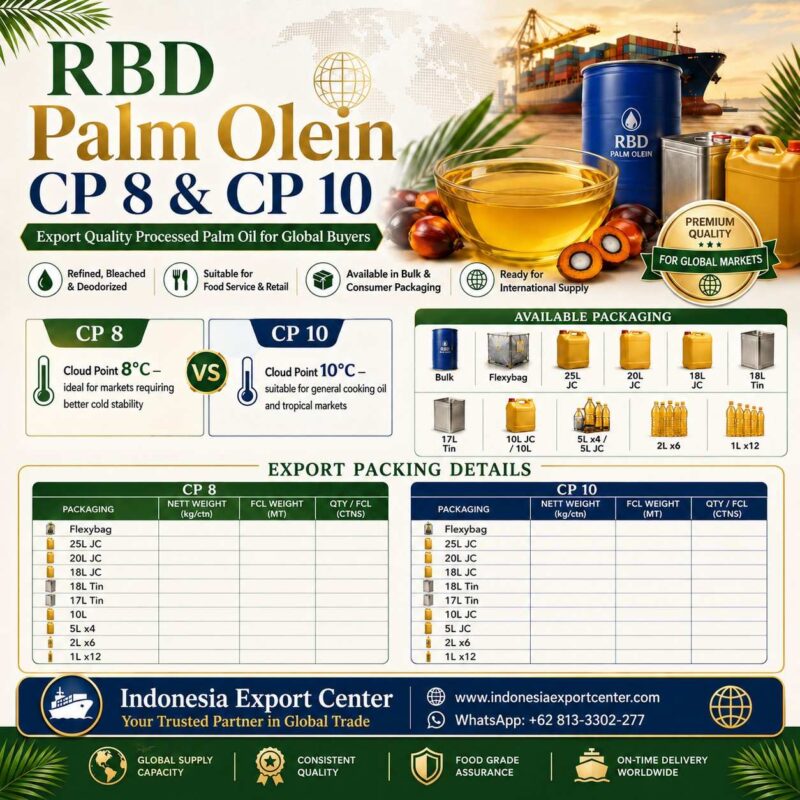
In international trade, RBD Palm Olein is commonly offered in different commercial grades, including CP8 and CP10. The “CP” designation refers to the cloud-point requirement stated in the commercial product specification.
CP8 is generally specified with a maximum cloud point of approximately 8°C, while CP10 is generally specified with a maximum cloud point of approximately 10°C. Nevertheless, buyers should never approve a product based only on the grade name. The complete parameters, limits, and testing methods must be written into the contract.
A reliable supplier should provide a specification sheet covering at least:
| Parameter | Why It Matters |
|---|---|
| Cloud point | Indicates the temperature at which the oil begins to appear cloudy |
| Free fatty acid, or FFA | Helps indicate refining quality and product condition |
| Moisture and impurities | Excess moisture or impurities may affect stability and quality |
| Iodine value | Indicates the degree of unsaturation and helps distinguish product characteristics |
| Colour | Important for retail appearance and food-processing applications |
| Slip melting point | Helps confirm the physical characteristics of the oil |
| Odour and taste | The oil should meet the agreed sensory requirements |
| Test method | Ensures the buyer and supplier use comparable analytical procedures |
The Palm Oil Refiners Association of Malaysia’s processed palm oil specifications identify parameters such as iodine value, melting point, colour, FFA, moisture, and impurities for RBD Palm Olein. These parameters are useful as an industry reference, but the final specification must still be agreed between the buyer and seller.
Buyers requiring a lower cloud point for cooler distribution environments should discuss the requirement with an experienced RBD Palm Olein CP8 Supplier. Buyers distributing oil mainly in warmer markets may consider working with an RBD Palm Olein CP10 Supplier, subject to the required national standard and intended application.
2. Verify the Supplier’s Legal Identity
The first due-diligence step is confirming that the supplier is a legally registered Indonesian business.
Ask for:
- Full registered company name
- Registered office address
- Business Identification Number, or NIB
- Tax identification details
- Company establishment document
- Details of the authorized director or signatory
- Corporate bank-account information
- Relevant business classification and licenses
Indonesia’s Online Single Submission system defines the NIB as the official identification number used to start or operate a business in Indonesia.
The company’s legal profile can also be cross-checked through the Directorate General of General Legal Administration, commonly known as AHU. The AHU system provides access to registered company and business-entity information.
The beneficiary name on the invoice and bank account should match the contracting company. Payments to unrelated personal accounts, unexplained third-party companies, or companies in different jurisdictions require additional verification.
A legitimate corporate registration does not automatically prove that the company owns palm oil or controls refinery capacity. Legal verification is only the first step.
3. Determine Whether the Seller Is a Refinery, Exporter, Trader, or Sourcing Company
Not every reliable supplier needs to own a refinery. However, every supplier must be transparent about its role.
The seller may operate as:
- A refinery or manufacturer
The company processes, fractionates, stores, or packs palm olein at its own facilities. - An authorized exporter or refinery marketing company
The company sells products allocated by a specific refinery and manages the export transaction. - A trading company
The company purchases from one or more refineries and resells to international buyers. - A sourcing or export facilitator
The company connects the buyer with a qualified producer and coordinates inspections, documentation, packing, and shipment.
Ask the supplier to explain:
- Which refinery will produce the goods?
- Who owns the product before shipment?
- Who will appear as the seller in the contract?
- Who will appear as the exporter on the customs documents?
- Which company will receive the payment?
- Where will the product be packed and loaded?
- Can the supplier provide verifiable evidence of refinery allocation?
A transparent trader with a documented refinery relationship may be more reliable than an unknown company claiming to own a refinery but refusing to disclose its production location.
4. Request a Recent Specification Sheet and Batch-Based COA
A product specification sheet describes the contractual quality limits. A Certificate of Analysis, or COA, reports the actual analytical results for a particular production batch or shipment.
These documents have different functions and should not be treated as interchangeable.
Before placing an order, request:
- Product data sheet
- Typical specification
- Recent sample COA
- Test methods used
- Name and address of the testing laboratory
- Confirmation that a shipment-specific COA will be issued
- Confirmation that independent sampling is permitted
For higher-value or first-time transactions, the buyer may require the final samples to be analyzed by an independent laboratory accredited to ISO/IEC 17025. This standard addresses laboratory competence, impartiality, and consistent operation, supporting confidence in testing results.
The sales contract should state whether the final quality determination will be based on:
- The refinery’s COA
- An independent laboratory at the loading port
- Joint sampling
- Inspection at the destination
- A mutually agreed umpire laboratory in case of dispute
Avoid vague wording such as “standard export quality” without measurable limits.
5. Evaluate Food-Safety and Quality Certifications
RBD Palm Olein is used for household cooking, food service, frying, instant noodles, snacks, margarine, shortening, and other food applications. The supplier should therefore demonstrate that the relevant refinery and packing operation have appropriate food-safety controls.
Depending on the destination market and buyer requirements, useful certifications may include:
- ISO 22000
- FSSC 22000
- HACCP
- Good Manufacturing Practices
- Indonesian CPPOB certification
- Halal certification
- ISO 9001
- RSPO Supply Chain Certification
- ISPO certification or related supply-chain evidence
ISO 22000 establishes requirements for a food-safety management system and incorporates HACCP principles and food-chain risk controls. The current published edition remains ISO 22000:2018, together with its applicable amendment.
Buyers should check more than the certificate logo. Verify:
- Certificate holder’s exact legal name
- Certified facility address
- Scope of certification
- Products covered
- Certificate number
- Issuing certification body
- Validity and expiry date
- Online verification status, where available
The refinery producing the oil and the facility performing the final retail packing may have separate certifications. Both operations may need evaluation when the order involves private-label bottles, jerry cans, pouches, or tins.
For Muslim-majority destination markets, request a valid halal certificate and verify whether it is accepted by the importing country’s competent authority. Indonesia’s halal assurance system is administered by BPJPH, the national body responsible for halal product assurance.
6. Check Sustainability and Traceability Claims
Sustainability claims should be supported by traceable certification and transaction records, not only by statements in a brochure.
The revised Indonesian Sustainable Palm Oil framework was established through Presidential Regulation No. 16 of 2025. The regulation describes ISPO as a sustainability system covering oil-palm plantations, downstream palm oil industries, and palm-based bioenergy businesses.
For buyers requiring RSPO-certified material, ask the supplier to confirm:
- RSPO membership status
- Valid Supply Chain Certification
- Certified facility
- Supply-chain model
- Product claim permitted
- Transaction documentation
- Traceability platform records
RSPO’s Supply Chain Certification Standard is designed to provide chain-of-custody assurance for certified palm oil products. RSPO-certified material may be traded under supply-chain models such as Identity Preserved, Segregated, Mass Balance, and Book and Claim.
A supplier should not describe ordinary palm olein as “RSPO certified” unless the specific product, facility, supply-chain model, and transaction support that claim.
7. Confirm Production, Allocation, and Packing Capacity
Large-looking company profiles do not prove that a supplier can execute the requested volume.
Ask for practical capacity information:
- Monthly refinery or allocated capacity
- Available volume for CP8 and CP10
- Minimum order quantity
- Maximum monthly commitment
- Number of containers that can be packed per week
- Current production schedule
- Packing-material lead time
- Earliest loading date
- Usual loading port
- Historical export experience
For private-label orders, capacity evaluation must include both oil availability and packaging readiness.
A refinery may have sufficient bulk oil but still need several weeks to prepare:
- Printed labels
- Lithographed tin cans
- Cartons
- PET bottles
- Caps and handles
- Arabic or multilingual artwork
- Pallets
- Shrink wrapping
- Regulatory label approvals
Request a written shipment plan showing the timeline for artwork approval, packaging production, oil allocation, packing, inspection, container booking, customs clearance, and vessel departure.
Be cautious when a seller claims immediate availability for large quantities in customized packaging without asking about artwork, label language, tin specifications, or printing lead time.
8. Review Packaging and Container-Loading Details
A reliable supplier should be able to provide accurate loading information for every packing format.
Common RBD Palm Olein packing options include:
- Flexitank
- ISO tank
- Bulk vessel
- Steel drum
- Intermediate bulk container
- Jerry can
- PET bottle
- Pouch
- Tin can
For packed products, request:
- Nominal volume per unit
- Net weight per unit
- Units per carton
- Cartons per container
- Total net weight
- Total gross weight
- Container type
- Palletized or floor-loaded arrangement
- Container loading photographs
- Packaging-material specifications
- Leakage-control procedures
- Shelf-life statement
- Production and expiry-date format
For flexitank shipments, ask about:
- Flexitank manufacturer and capacity
- Food-grade declaration
- Container inspection
- Loading temperature
- Seal numbers
- Leakage-response procedure
- Destination restrictions
- Insurance coverage
Independent pre-shipment inspection may include sampling, quality and quantity verification, container or tank cleanliness checks, packing verification, and loading supervision. These services help verify whether the cargo conforms to the agreed specifications before shipment.
9. Examine Export Capability and Documentation
The supplier must be able to explain the export process, not merely quote a product price.
Indonesia regulates the export of palm oil derivative products through Ministry of Trade Regulation No. 26 of 2024, as amended by Ministry of Trade Regulation No. 2 of 2025. Depending on the product classification and applicable policy, export approval or other supporting documentation may be required for customs filing.
Because export policies may change, buyers should ask the supplier to confirm the current requirements for the exact HS code, product, quantity, loading port, and shipment period.
Typical documents may include:
- Commercial invoice
- Packing list
- Bill of lading
- Certificate of origin
- Certificate of analysis
- Health certificate, when required
- Halal certificate
- Insurance certificate for CIF transactions
- Fumigation certificate for applicable wooden packaging
- Weight or quantity certificate
- Inspection certificate
- Export customs declaration
- Product-specific regulatory documents required by the destination country
The exact document set must be agreed before the buyer issues a purchase order or letter of credit.
10. Compare Quotations on the Same Commercial Basis
A quotation is meaningful only when all suppliers quote the same product and commercial scope.
The buyer’s request for quotation should specify:
- Product grade: CP8 or CP10
- Complete specification
- Quantity
- Packaging
- Private-label requirements
- Destination port
- Incoterm
- Container type
- Inspection requirement
- Required certificates
- Payment terms
- Delivery schedule
- Quotation validity
Use the full Incoterm expression, including the named port and version, for example:
- FOB Belawan Port, Indonesia, Incoterms® 2020
- CFR Jeddah Islamic Port, Saudi Arabia, Incoterms® 2020
- CIF Mogadishu Port, Somalia, Incoterms® 2020
Incoterms® 2020 establishes internationally recognized rules for allocating costs, risks, transport obligations, and responsibilities between buyers and sellers. FOB, CFR, and CIF are rules intended for sea and inland-waterway transport.
A lower quotation may exclude inspection, private-label packaging, export charges, documentation, insurance, or destination-related costs. Compare the complete landed commercial structure rather than only the price per metric ton.
11. Use Secure and Verifiable Payment Procedures
Payment terms should reflect the transaction size, supplier history, packaging investment, and allocation requirements.
Possible structures include:
- Irrevocable letter of credit at sight
- Confirmed letter of credit
- Advance payment followed by balance before loading
- Advance payment followed by balance against agreed shipping documents
- Escrow or bank-supported structures where available
Letters of credit are generally governed by the ICC Uniform Customs and Practice for Documentary Credits, commonly known as UCP 600, when incorporated into the credit.
Before transferring funds:
- Confirm that the beneficiary matches the contracting seller.
- Verify bank details through an independently confirmed communication channel.
- Check whether the bank account is corporate.
- Require a signed sales contract or proforma invoice.
- Verify the authorized signatory.
- Confirm what the advance payment covers.
- Define refund and non-performance provisions.
- Avoid changing bank details based only on an email or messaging-app instruction.
For a first transaction, consider a manageable trial order combined with inspection, controlled documentation, and clear performance milestones.
12. Conduct a Factory Visit or Independent Supplier Audit
A factory visit provides information that cannot be confirmed through certificates alone.
During the visit, inspect:
- Refinery or packing location
- Storage tanks
- Laboratory
- Filling and sealing equipment
- Packaging warehouse
- Finished-goods storage
- Traceability records
- Hygiene controls
- Pest-control program
- Calibration records
- Loading procedures
- Quality-control documentation
When the buyer cannot visit Indonesia, appoint a qualified third party to conduct:
- Supplier verification
- Facility audit
- Document review
- Pre-production meeting
- Packaging inspection
- Pre-shipment inspection
- Sampling and testing
- Container-loading supervision
A reliable supplier should cooperate with reasonable verification procedures, subject to confidentiality, safety, and refinery-access requirements.
13. Watch for Common Warning Signs
Proceed carefully when a supplier:
- Offers a price far below the prevailing market without a clear explanation
- Refuses to disclose its legal entity
- Uses a personal bank account
- Changes beneficiary details shortly before payment
- Cannot identify the refinery or packing facility
- Provides certificates issued to unrelated companies
- Sends edited or unverifiable COAs
- Claims unlimited capacity
- Guarantees immediate private-label production
- Refuses independent inspection
- Cannot explain the loading port
- Provides inconsistent product specifications
- Pressures the buyer to pay before basic verification
- Uses the same photographs for multiple unrelated facilities
- Claims to be a refinery but has no identifiable industrial address
- Avoids providing a formal sales contract
One warning sign does not always prove fraud, but several unresolved inconsistencies indicate a high-risk transaction.
Practical Supplier Evaluation Checklist
Before approving an Indonesian RBD Palm Olein supplier, confirm the following:
Corporate Verification
- Legal company name verified
- NIB and business licenses checked
- Company address confirmed
- Authorized signatory identified
- Corporate bank account verified
Product Verification
- CP8 or CP10 grade clearly stated
- Full specification agreed
- Recent COA reviewed
- Test methods identified
- Shipment-specific COA required
Certification Verification
- Food-safety certification valid
- Halal certificate checked where required
- ISPO or sustainability information reviewed
- RSPO claims verified where applicable
- Certification scope covers the relevant facility
Supply Verification
- Refinery source identified
- Allocation evidence reviewed
- Monthly capacity confirmed
- Packing capacity confirmed
- Lead time agreed
Shipment Verification
- Packing configuration confirmed
- Net and gross weights agreed
- Loading port identified
- Export eligibility checked
- Document list agreed
- Inspection procedure agreed
Commercial Verification
- Incoterm written correctly
- Price validity stated
- Payment milestones defined
- Bank details independently verified
- Claims and dispute procedure included
- Governing law and arbitration terms agreed
Conclusion
Evaluating a reliable RBD Palm Olein supplier in Indonesia requires more than comparing prices and reviewing a company brochure.
International buyers should verify the supplier’s legal identity, role in the supply chain, refinery relationship, technical specifications, batch documentation, certifications, packing capacity, export eligibility, inspection arrangements, and payment procedures.
The strongest supplier is not always the company offering the lowest price. It is the company that can provide consistent product quality, transparent documentation, realistic delivery planning, traceable supply, and clear responsibility throughout the transaction.
Buyers looking for a dependable RBD Palm Olein Supplier from Indonesia should begin with a detailed requirement covering grade, quantity, packaging, destination port, Incoterm, payment method, certification requirements, and shipment schedule.
For products requiring improved clarity at lower temperatures, consult an experienced RBD Palm Olein CP8 Supplier. For standard cooking-oil applications in warmer markets, request a technical and commercial offer from a qualified RBD Palm Olein CP10 Supplier.
A structured verification process protects both buyer and seller and creates a stronger foundation for long-term international palm olein supply.
Suggested Call to Action
Looking for RBD Palm Olein CP8 or CP10 from Indonesia?
Submit your complete purchasing requirement, including:
- Required grade
- Quantity
- Packaging
- Private-label details
- Destination port
- Preferred Incoterm
- Payment terms
- Required certificates
- Target shipment date
Our team will review the requirement, coordinate with qualified Indonesian suppliers, and prepare an indicative offer subject to refinery confirmation, export requirements, and shipping availability.
Read also
https://indonesiaexportcenter.com/product/rbd-palm-olein-cp-8-cp-10-from-indonesia/
https://indonesiaexportcenter.com/rbd-palm-olein-cp10-supplier-indonesia/
References
- FAO and WHO Codex Alimentarius, Standard for Named Vegetable Oils, CXS 210-1999.
- Palm Oil Refiners Association of Malaysia, Standard Specifications for Processed Palm Oil.
- Government of Indonesia, Presidential Regulation No. 16 of 2025 concerning the Indonesian Sustainable Palm Oil certification system.
- Roundtable on Sustainable Palm Oil, RSPO Supply Chain Certification Standard 2020.
- International Organization for Standardization, ISO 22000:2018 Food Safety Management Systems.
- International Organization for Standardization, ISO/IEC 17025:2017 — Competence of Testing and Calibration Laboratories.
- Indonesian Ministry of Trade, Regulation No. 26 of 2024 concerning exports of palm oil derivative products and its amendment.
- International Chamber of Commerce, Incoterms® 2020.
- International Chamber of Commerce, UCP 600 — Uniform Customs and Practice for Documentary Credits.
- Indonesian Online Single Submission System, business identification and NIB information.
