![Indonesia Export Center [IEC]](https://indonesiaexportcenter.com/wp-content/uploads/2023/07/logo-no-background.svg)
![Indonesia Export Center [IEC]](https://indonesiaexportcenter.com/wp-content/uploads/2023/07/svgviewer-output.svg)
Introduction
When international buyers request a quotation for RBD Palm Olein from Indonesia, price should not be the only consideration. Buyers must also understand the technical parameters that define the product’s grade, physical performance, refining quality, and suitability for the destination market.
The most frequently discussed specifications are:
- Cloud Point, or CP
- Iodine Value, or IV
- Free Fatty Acids, or FFA
- Moisture and Impurities, or M&I
These parameters are closely related to product clarity, low-temperature performance, refining efficiency, storage stability, and commercial acceptance.
The Codex Alimentarius defines palm olein as the liquid fraction obtained through the fractionation of palm oil. Codex also identifies an iodine value of at least 56 for palm olein and at least 60 for palm superolein. However, commercial terms such as CP8 and CP10 are generally used by refineries and traders to describe more specific cloud-point requirements rather than separate product identities under Codex.
This guide explains how buyers should read these specifications before selecting an RBD Palm Olein supplier from Indonesia.
Typical RBD Palm Olein Specifications at a Glance
The following table shows common commercial specifications. Final values may vary between refineries, destination-country regulations, private-label requirements, and individual sales contracts.
| Parameter | Standard RBD Palm Olein / CP10 | RBD Palm Olein CP8 |
|---|---|---|
| Cloud Point | 10°C maximum | 8°C maximum |
| Iodine Value, Wijs | 56 minimum | Commonly 57 minimum |
| FFA as Palmitic Acid | 0.10% maximum | 0.10% maximum |
| Moisture and Impurities | 0.10% maximum | 0.10% maximum |
| Slip Melting Point | 24°C maximum | Commonly 24°C maximum |
| Colour, 5¼-inch Lovibond Cell | 3 Red maximum | Commonly 3 Red maximum |
| Physical Form | Clear liquid under suitable storage conditions | Remains clear at a lower temperature than CP10 |
PORAM’s standard specification for RBD palm olein establishes a baseline of FFA at 0.1% maximum, moisture and impurities at 0.1% maximum, iodine value at 56 minimum, slip melting point at 24°C maximum, and colour at 3 Red maximum.
A published commercial specification for CP8 shows typical values of cloud point at 8°C maximum, iodine value at 57 minimum, FFA at 0.1% maximum, moisture and impurities at 0.1% maximum, and slip melting point at 24°C maximum.
These figures should be treated as common market specifications, not as a replacement for a supplier-specific Technical Data Sheet or Certificate of Analysis.
1. What Is the Cloud Point of RBD Palm Olein?
Definition of cloud point
The cloud point is the temperature at which an oil begins to develop visible cloudiness during controlled cooling.
The cloudy appearance is caused by the beginning of fat crystallization. Higher-melting triglycerides start forming very small crystals, which scatter light and make the oil appear hazy.
Clouding does not automatically mean the oil is contaminated, rancid, or unsafe. It is primarily a physical response to lower temperatures.
Cloud point testing for palm oil products can be conducted using MPOB P4.3, with AOCS Cc 6-25 recognized as an alternative method in the AOCS palm oil laboratory testing programme.
What do CP8 and CP10 mean?
In commercial palm olein terminology:
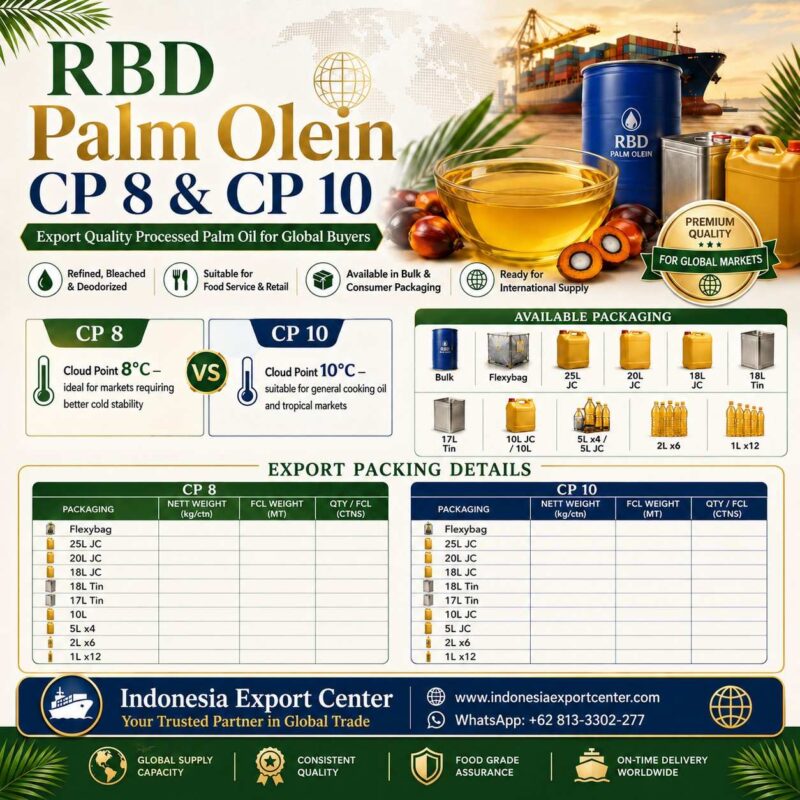
- CP8 generally means a cloud point of 8°C maximum.
- CP10 generally means a cloud point of 10°C maximum.
Therefore, CP8 can remain visually clear at a slightly lower temperature than CP10.
This does not mean that CP10 is lower-quality oil. It means that CP8 has been fractionated more selectively to reduce the proportion of higher-melting components.
Why cloud point matters to international buyers
Cloud point is particularly important when the oil will be:
- Shipped or stored during cold weather
- Distributed in temperate markets
- Displayed in transparent retail packaging
- Stored in an unheated warehouse
- Used in products where visual clarity is important
In warm tropical conditions, CP10 is often sufficient for general cooking and frying. In cooler markets, CP8 may provide better visual clarity and flow performance.
Cloud point is not the same as melting point
Buyers should not confuse cloud point with slip melting point.
Cloud point identifies the beginning of visible crystallization. Slip melting point measures the temperature at which a fat softens or rises under a prescribed laboratory procedure.
Codex lists a slip point of not more than 24°C for palm olein, while PORAM also uses 24°C maximum in its RBD palm olein specification.
An oil may begin to appear cloudy well below its slip melting point. These two parameters describe different physical events and should be reported separately.
2. What Is the Iodine Value of Palm Olein?
Definition of iodine value
The iodine value, commonly abbreviated as IV, indicates the degree of unsaturation in an oil or fat. It is conventionally expressed as grams of iodine absorbed per 100 grams of oil.
A higher iodine value generally indicates a larger proportion of unsaturated fatty acids. A lower iodine value generally indicates a larger proportion of saturated fatty acids.
ISO 3961 provides the international method for determining the iodine value of animal and vegetable fats and oils. The current ISO catalogue lists ISO 3961:2024 for this analysis.
Typical iodine values for palm olein
Codex provides the following identity characteristics:
- Palm oil: iodine value of approximately 50–55
- Palm olein: iodine value of at least 56
- Palm superolein: iodine value of at least 60
These values help distinguish palm oil and its more liquid fractions.
In commercial transactions, common targets include:
| Grade | Common Iodine Value Requirement |
|---|---|
| RBD Palm Olein CP10 | 56 minimum |
| RBD Palm Olein CP8 | Commonly 57 minimum |
| Palm Superolein | 60 minimum |
PORAM specifies an iodine value of 56 minimum for RBD palm olein. A common CP8 commercial data sheet specifies 57 minimum, while MPOB notes that palm superolein traded under PORAM requirements has an iodine value of 60 minimum.
Relationship between iodine value and cloud point
Iodine value and cloud point are related, but they are not interchangeable.
More selective fractionation generally removes a greater proportion of higher-melting saturated components. This tends to produce:
- A lower cloud point
- A somewhat higher iodine value
- Better clarity at lower temperatures
That is why CP8 commonly has an IV requirement slightly above that of CP10.
However, iodine value alone cannot guarantee a particular cloud point. Two shipments may have similar iodine values but differ in crystallization behaviour because of their triglyceride composition, processing conditions, and fractionation history.
Buyers should therefore specify both:
Cloud Point: 8°C maximum
Iodine Value: 57 minimum
rather than relying on only one of these parameters.
Does a higher iodine value always mean better quality?
No. Iodine value describes composition, not overall product quality.
A higher IV may be desirable for lower-temperature clarity, but it does not independently prove that the oil has:
- Low oxidation
- Low FFA
- Low moisture
- Acceptable colour
- Neutral odour
- Suitable contaminants control
- Proper storage history
Quality evaluation must consider the complete Certificate of Analysis.
3. What Is FFA in RBD Palm Olein?
Definition of free fatty acids
Free fatty acids, or FFA, are fatty acids that are no longer attached to glycerol molecules in the original triglyceride structure.
FFA can increase through hydrolysis when oil, fruit, or intermediate products are exposed to moisture, enzymes, unsuitable processing, or poor storage conditions.
Because RBD palm olein has undergone refining, bleaching, deodorization, and fractionation, its FFA should be substantially lower than that of crude palm oil.
Typical FFA specification
For RBD palm olein, a commonly accepted commercial requirement is:
FFA as Palmitic Acid: 0.10% maximum
This limit is found in PORAM’s RBD palm olein specification and in common CP8 product specifications.
Low FFA generally indicates effective refining and helps support:
- Neutral taste and odour
- Better storage stability
- Reduced tendency to smoke during heating
- Consistent frying performance
- Longer commercial shelf life when other quality factors are controlled
FFA percentage versus acid value
Buyers should pay attention to the unit used on the Certificate of Analysis.
FFA may be reported as:
- Percentage as palmitic acid
- Percentage as oleic acid
- Percentage as lauric acid
- Acid value in mg KOH per gram of oil
These figures cannot be compared directly without conversion.
ISO 660:2020 covers the determination of acid value and acidity in animal and vegetable fats and oils.
For palm oil products, commercial FFA is commonly expressed as palmitic acid. Based on the molecular weight of palmitic acid, an FFA level of 0.10% as palmitic acid is approximately equivalent to an acid value of about 0.22 mg KOH/g.
Codex gives a supplementary acid-value maximum of 0.6 mg KOH/g for refined oils, while PORAM’s commercial requirement of 0.10% FFA as palmitic acid is more restrictive when converted to the same basis.
Therefore, a buyer should never write only “FFA maximum 0.1” without specifying:
- The percentage unit
- The reference fatty acid
- The analytical method
A clearer contract statement is:
Free Fatty Acids: 0.10% maximum, expressed as palmitic acid, tested according to an agreed ISO, AOCS, or MPOB method.
4. What Do Moisture and Impurities Mean?
Moisture
Moisture refers to the water present in the oil.
Refined edible oil should contain very little moisture. Excess water can contribute to:
- Hydrolysis and increasing FFA
- Reduced storage stability
- Foaming or splattering during frying
- Tank corrosion
- Sediment development
- Microbiological risk at oil-water interfaces in poorly maintained systems
ISO 662:2016 specifies drying-based methods for determining moisture and volatile matter in animal and vegetable fats and oils.
Impurities
Impurities are insoluble materials that may remain in the oil, including fine particles, residual processing materials, sediment, or foreign matter.
ISO 663:2017 specifies a method for determining insoluble impurities in animal and vegetable fats and oils.
Why M&I is often reported as one figure
Palm olein trading specifications commonly combine these measurements as:
Moisture and Impurities, M&I: 0.10% maximum
PORAM uses this combined limit for RBD palm olein, and the same target is commonly used for CP8 and CP10 commercial grades.
Codex presents moisture-related and impurity-related factors separately in its supplementary quality table:
- Matter volatile at 105°C: 0.2% maximum
- Insoluble impurities: 0.05% maximum
Because the Codex figures are separated and may use different analytical reporting bases, they should not automatically be added together or treated as identical to the commercial M&I figure.
Why low M&I matters during international shipment
Low moisture and impurities are especially important for oil transported in:
- Flexitanks
- ISO tanks
- Road tankers
- IBCs
- Drums
- Retail tins and jerrycans
Even when the refinery produces compliant oil, contamination can occur if tanks, pipes, hoses, pumps, or filling lines are not clean and dry.
Buyers should therefore verify not only the refinery’s Certificate of Analysis but also the loading and packaging conditions.
5. CP8 vs CP10: How the Specifications Work Together
The difference between CP8 and CP10 cannot be understood through cloud point alone. Buyers should assess cloud point together with iodine value, FFA, moisture, impurities, colour, and melting behaviour.
| Characteristic | RBD Palm Olein CP8 | RBD Palm Olein CP10 |
|---|---|---|
| Cloud Point | 8°C maximum | 10°C maximum |
| Typical IV Requirement | 57 minimum | 56 minimum |
| Low-Temperature Clarity | Better | Standard |
| Fractionation | More selective | Standard commercial fractionation |
| Typical Climate | Temperate or moderately cool markets | Tropical and warm markets |
| FFA Target | Usually 0.10% maximum | Usually 0.10% maximum |
| M&I Target | Usually 0.10% maximum | Usually 0.10% maximum |
| Common Applications | Retail cooking oil requiring improved cold clarity, food processing | General cooking, deep frying, industrial food production |
The main grade difference is the low-temperature performance. FFA and M&I limits are generally refining-quality requirements and may remain the same for both grades.
CP8 should not automatically be described as chemically purer than CP10. It is more accurate to say that CP8 is a lower-cloud-point fraction designed to remain clear at a lower temperature.
6. How Buyers Should Read a Certificate of Analysis
Before approving an Indonesian supplier, buyers should request a recent Certificate of Analysis showing at least:
| Parameter | Information to Verify |
|---|---|
| Product Name | RBD Palm Olein CP8 or CP10 |
| Batch or Lot Number | Must match the shipment or production batch |
| Cloud Point | Maximum temperature and test method |
| Iodine Value | Minimum value and Wijs or agreed method |
| FFA | Percentage, reference fatty acid, and method |
| Moisture and Impurities | Maximum value and test method |
| Slip Melting Point | Maximum value |
| Colour | Lovibond cell size and maximum Red value |
| Peroxide Value | Shipment-specific limit where required |
| Production or Test Date | Should be relevant to the offered cargo |
| Laboratory Authorization | Refinery QC or independent inspection laboratory |
The COA should not simply state “passed.” It should preferably show the actual test result, such as:
- Cloud Point: 7.6°C
- Iodine Value: 57.4
- FFA as Palmitic: 0.06%
- Moisture and Impurities: 0.04%
Actual results help the buyer determine how much margin exists between the tested cargo and the contractual limit.
7. Common Specification Mistakes Made by Buyers
Mistake 1: Ordering “RBD Palm Olein” without stating the grade
A buyer may receive standard olein even though the destination market requires CP8.
Better wording:
RBD Palm Olein CP8, cloud point 8°C maximum.
Mistake 2: Requesting iodine value without cloud point
IV helps describe composition but cannot replace direct cloud-point testing.
Better wording:
Cloud point 8°C maximum and iodine value 57 minimum.
Mistake 3: Writing FFA without the reference basis
FFA expressed as palmitic acid cannot be directly compared with a result expressed as oleic acid or acid value.
Better wording:
FFA 0.10% maximum, expressed as palmitic acid.
Mistake 4: Treating temporary clouding as spoilage
Palm olein may become cloudy when exposed to temperatures near or below its cloud point. It may return to a clear state after controlled warming.
However, the buyer should investigate if the product contains sediment, water, foreign particles, an abnormal odour, or persistent separation.
Mistake 5: Accepting a generic COA
A COA without a batch number, test date, or product grade may not represent the actual shipment.
Request a cargo-specific or batch-specific COA, especially for large-volume contracts.
8. Suggested Specification Wording for an RFQ
International buyers can use the following format when requesting a quotation:
Product: RBD Palm Olein CP8 or CP10
Origin: Indonesia
Cloud Point: 8°C maximum for CP8 / 10°C maximum for CP10
Iodine Value: 57 minimum for CP8 / 56 minimum for CP10
FFA: 0.10% maximum, expressed as palmitic acid
Moisture and Impurities: 0.10% maximum
Slip Melting Point: 24°C maximum
Colour: 3 Red maximum in a 5¼-inch Lovibond cell
Packaging: Flexitank, bottle, jerrycan, tin, drum, IBC, or bulk
Required Documents: COA, Certificate of Origin, Halal Certificate, Health Certificate, packing list, commercial invoice, and other destination-specific documents
Inspection: Supplier laboratory or independent surveyor, as agreed
Incoterm: FOB, CFR, or CIF
Destination Port: To be stated by the buyer
The final sales contract should identify the applicable testing methods and state whether the specifications apply at the time of production, loading, or arrival.
9. RBD Palm Olein Standards in Indonesia
Indonesia has a national standard specifically covering RBD palm olein. The Indonesian National Standard catalogue lists SNI 01-0018-2006 — Refined Bleached Deodorized Palm Olein as an active standard.
For export transactions, however, the buyer and seller may also refer to:
- Codex Alimentarius
- PORAM specifications
- ISO analytical methods
- AOCS methods
- MPOB test methods
- Destination-country food regulations
- A mutually agreed refinery specification
A product may comply with one standard while the buyer’s private specification is stricter. Therefore, compliance language should be written clearly in the purchase contract.
10. Choosing the Correct RBD Palm Olein Grade
Choose RBD Palm Olein CP8 when:
- The oil will be distributed in a cooler climate
- Retail clarity is important
- Storage temperatures may approach 8–10°C
- The buyer requires IV 57 or another enhanced low-temperature specification
- The food formulation requires a more liquid palm fraction
Choose RBD Palm Olein CP10 when:
- The destination has a tropical or warm climate
- The oil will be used mainly for cooking or industrial frying
- Storage temperatures are normally above 10°C
- Standard RBD palm olein performance is acceptable
- Cost and broad refinery availability are important
The correct choice should be based on real storage and distribution temperatures, not merely on the assumption that one grade is universally superior.
Conclusion
Understanding RBD Palm Olein specifications allows buyers to compare offers based on technical quality rather than price alone.
The four central parameters perform different functions:
- Cloud point determines when the oil begins to appear cloudy during cooling.
- Iodine value indicates the degree of unsaturation and helps identify the palm fraction.
- FFA reflects refining quality and hydrolytic degradation.
- Moisture and impurities indicate cleanliness, dryness, and handling quality.
For standard RBD palm olein and CP10, common commercial requirements include IV 56 minimum, FFA 0.10% maximum, and M&I 0.10% maximum. CP8 normally adds a cloud point of 8°C maximum and commonly uses an IV of at least 57.
Before placing an order, buyers should request a supplier-specific specification sheet, recent Certificate of Analysis, packaging details, inspection procedure, destination compliance documents, and clear contractual test methods.
For Indonesian supply, buyers can explore the following related pages:
- RBD Palm Olein Supplier from Indonesia
- RBD Palm Olein CP8 Supplier
- RBD Palm Olein CP10 Supplier
Indonesia Export Center can assist international buyers with product sourcing, supplier communication, specification confirmation, quotation coordination, packaging options, and export-document preparation through qualified Indonesian partners.
Frequently Asked Questions
What does CP mean in RBD Palm Olein CP8 and CP10?
CP means cloud point. CP8 generally indicates a cloud point of 8°C maximum, while CP10 indicates a cloud point of 10°C maximum.
Is CP8 better than CP10?
CP8 offers better clarity at lower temperatures. CP10 remains suitable for general cooking and frying in warm climates. The correct grade depends on the destination, storage conditions, and application.
What is the standard iodine value for RBD Palm Olein?
Codex and PORAM use an iodine value of at least 56 for palm olein. CP8 is commonly sold with an IV of at least 57, while palm superolein has an IV of at least 60.
What is an acceptable FFA level for RBD Palm Olein?
A common commercial requirement is 0.10% maximum, expressed as palmitic acid. The reference fatty acid and analytical method should always be stated.
What is the normal moisture limit?
RBD palm olein is commonly traded with moisture and impurities at 0.10% maximum under PORAM-style commercial specifications.
Can palm olein become cloudy without being damaged?
Yes. Palm olein may become cloudy when stored near or below its cloud point because higher-melting components begin to crystallize. Clouding alone does not necessarily indicate contamination or spoilage.
Should buyers request both a specification sheet and a COA?
Yes. The specification sheet shows the contractual limits, while the COA shows the actual laboratory results for a particular batch or cargo.
Reference Basis
- Codex Alimentarius CXS 210-1999 — Standard for Named Vegetable Oils: definition, identity characteristics, iodine value, slip point, acid value, moisture-related and impurity-related factors.
- PORAM Standard Specifications for Processed Palm Oil: commercial requirements for RBD palm olein, including FFA, M&I, iodine value, melting point, and colour.
- Malaysian Palm Oil Board: commercial specifications for palm superolein.
- ISO 660:2020: determination of acid value and acidity.
- ISO 662:2016: determination of moisture and volatile matter.
- ISO 3961:2024: determination of iodine value.
- AOCS Palm Oil Laboratory Programme: cloud-point and other palm oil analytical methods.
- BSN: active Indonesian national standard for RBD palm olein, SNI 01-0018-2006.
Read also
https://indonesiaexportcenter.com/product/rbd-palm-olein-cp-8-cp-10-from-indonesia/
https://indonesiaexportcenter.com/rbd-palm-olein-cp10-supplier-indonesia/
