

IEC | INDONESIA EXPORT CENTER
CONNECTING INDONESIAN PRODUCTS TO THE WORLD
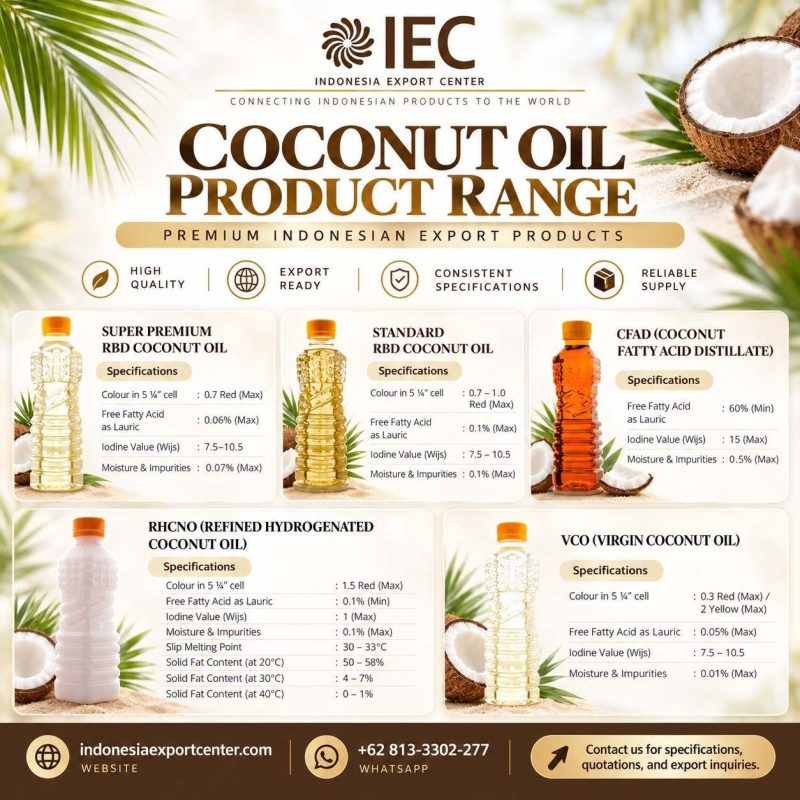
COCONUT OIL PRODUCT RANGE | PREMIUM INDONESIAN EXPORT PRODUCTS
Request Virgin Coconut Oil COA and Specification Documents from Indonesia
Need a virgin coconut oil certificate of analysis for raw material qualification, quality assurance, or international procurement?
A Certificate of Analysis (COA) is an important document for buyers evaluating Virgin Coconut Oil (VCO). It provides analytical information about a specific sample or production lot and helps quality teams determine whether the material meets agreed specifications.
For food manufacturers, cosmetic formulators, distributors, and ingredient importers, reviewing a VCO COA is an important part of supplier qualification.
IEC | Indonesia Export Center facilitates sourcing and export enquiries for Indonesian Virgin Coconut Oil, including requests for product specifications and relevant quality documentation.
This guide explains the key analytical parameters, the difference between a specification and a COA, and the verification steps buyers should take before approving a shipment.
No actual lot-specific VCO COA has been supplied or independently verified for publication on this page. The numerical values below are reference specifications only.
Request VCO Specifications and Lot-Specific COA
Contact IEC to enquire about:
- Manufacturer-issued VCO specifications
- Lot-specific Certificate of Analysis
- Analytical test methods
- Free Fatty Acid (FFA) results
- Moisture and impurities results
- Iodine value
- Colour measurement
- Additional testing, including microbiology where relevant
- Packaging and bulk supply information
- Export quotations
WhatsApp: +62 813-3302-277
Website: https://indonesiaexportcenter.com/
Include your intended application, required quantity, destination country, and testing requirements.
Virgin Coconut Oil – Reference Specifications
The following figures are the supplied reference specifications for Virgin Coconut Oil.
| Quality Parameter | Reference Specification |
|---|---|
| Colour in 5¼-inch Cell | 0.3 Red (Max) / 2 Yellow (Max) |
| Free Fatty Acid as Lauric | 0.05% (Max) |
| Iodine Value (Wijs) | 7.5–10.5 |
| Moisture & Impurities | 0.01% (Max) |
Important: These are reference limits, not actual COA test results.
A manufacturer-issued specification should confirm the agreed limits, units, and test methods for the material being purchased.
A lot-specific COA should report the actual analytical results for the relevant production lot.
What Is a Virgin Coconut Oil Certificate of Analysis?
A Certificate of Analysis is a document that reports analytical results for a product sample or lot.
For Virgin Coconut Oil, a COA may include physical and chemical quality parameters, along with additional tests relevant to the intended use.
A properly reviewed COA can support:
- Raw material approval
- Supplier qualification
- Lot acceptance
- Quality consistency evaluation
- Technical specification compliance
- Shipment documentation
- Traceability
- Customer quality assurance requirements
However, a COA does not automatically prove compliance with every food, cosmetic, or destination-market regulation.
Its usefulness depends on the identity of the tested sample, analytical methods, reported results, and authenticity of the document.
VCO Specification vs Certificate of Analysis
A technical specification and a Certificate of Analysis serve different purposes.
| Document | Main Purpose |
|---|---|
| Product Specification | Defines the expected or required quality parameters |
| Certificate of Analysis | Reports actual analytical results for a tested sample or lot |
| Safety Data Sheet | Communicates relevant hazard and handling information |
| Manufacturing Process Description | Explains how the product is produced |
| Certification Document | Provides evidence of a specific certification, where applicable |
| Traceability Record | Links the product to relevant manufacturing and shipment records |
Example: FFA Specification vs COA Result
Reference specification: FFA as Lauric – 0.05% maximum.
Actual COA result: Must be obtained from the relevant tested lot.
The maximum limit should not be presented as a measured result.
Understanding Key VCO COA Parameters
1. Free Fatty Acid (FFA) as Lauric
Supplied Reference Limit: 0.05% (Max)
FFA is a quality parameter commonly used in oil analysis.
It may help buyers assess the condition of the oil, but it should be interpreted alongside other quality results.
What QA Teams Should Check
- Actual measured result
- Unit and reporting basis
- Analytical method
- Specification limit
- Sample or lot identification
FFA expressed as Lauric is not the same as total lauric acid content.
The two values should not be confused when reviewing technical documents.
2. Moisture and Impurities
Supplied Reference Limit: 0.01% (Max)
Moisture and impurities are relevant to the quality evaluation of Virgin Coconut Oil.
The supplied limit is particularly tight and should be verified with the actual manufacturer.
What QA Teams Should Check
- Whether moisture and impurities are measured separately or reported together
- Analytical methods used
- Actual results
- Reporting units
- Method detection or quantification limits, where relevant
- Consistency with the agreed purchase specification
Why the Test Method Matters
Different analytical procedures may measure different aspects of moisture or impurities.
Buyers should not assume that results obtained using different methods are directly comparable.
3. Iodine Value (Wijs)
Supplied Reference Range: 7.5–10.5
The iodine value provides information related to the degree of unsaturation in an oil.
What QA Teams Should Check
- Actual iodine value
- Confirmation that the Wijs method or agreed equivalent was used
- Compliance with the specified range
- Consistency with the expected oil identity
Iodine value alone does not prove that a product is authentic or free from adulteration.
4. Colour in 5¼-inch Cell
Supplied Reference: 0.3 Red (Max) / 2 Yellow (Max)
Colour is one of the physical quality parameters that may be included in a VCO specification.
What QA Teams Should Check
- Actual reported colour
- Measurement method
- Cell length
- Appropriate colour scale
- Compliance with the agreed specification
The supplied values should be verified against the manufacturer’s actual analytical procedure.
Microbiological Testing for Virgin Coconut Oil
Microbiological testing may be relevant depending on the intended application, manufacturing process, handling conditions, buyer requirements, and destination-market regulations.
Because VCO is an oil-based product with low available water under appropriate conditions, its microbiological risk profile differs from many water-containing products.
However, low moisture does not eliminate the need for an appropriate hazard assessment.
When Microbiological Testing May Be Requested
Food manufacturers may request microbiological data as part of ingredient qualification.
Cosmetic manufacturers may require relevant information based on their raw material risk assessment.
Importers may also have customer-specific testing requirements.
Potential Microbiological Parameters
Depending on the risk assessment, requested tests may include:
- Total viable count
- Yeast and mold
- Relevant indicator organisms
- Relevant pathogens where justified
No microbiological limits, methods, or test results have been supplied for an available VCO lot.
Buyers should define appropriate acceptance criteria based on the intended use and applicable requirements.
Additional VCO Quality Tests Buyers May Request
The four supplied reference parameters may not be sufficient for every procurement requirement.
Additional testing may include:
Peroxide Value
May be used as part of an assessment of primary oxidation.
Fatty Acid Composition
May help evaluate the oil’s composition and support identity assessment.
Sensory Evaluation
May include odor, appearance, and other characteristics relevant to the intended application.
Contaminant Testing
May be required depending on the raw material, process, intended use, and destination market.
Authenticity Testing
May be considered when buyers require additional evidence regarding product identity or adulteration risk.
Stability Testing
May support evaluation of storage conditions and shelf-life expectations.
No verified analytical results for these additional parameters have been provided.
What Information Should a VCO COA Contain?
A buyer should evaluate whether the COA includes sufficient information to identify the tested material and interpret the results.
Recommended COA Review Fields
| COA Field | What to Verify |
|---|---|
| Product Name | Matches the purchased VCO |
| Manufacturer or Laboratory | Clearly identified |
| Batch or Lot Number | Matches the offered material |
| Sample Identification | Adequately identifies the tested sample |
| Test Date | Relevant to the material |
| Report Date | Clearly stated |
| Test Parameter | Matches buyer requirements |
| Test Method | Identified where appropriate |
| Specification Limit | Matches the agreed specification |
| Actual Result | Clearly reported |
| Unit | Correct and consistent |
| Authorization | Appropriate document approval |
A COA should not be accepted solely because it contains a familiar company name or professional-looking formatting.
How to Verify a Virgin Coconut Oil COA
Step 1 – Confirm the Actual Manufacturer
Identify the legal entity responsible for manufacturing the oil.
Step 2 – Request the Current Product Specification
Compare the offered product against the manufacturer’s current technical specification.
Step 3 – Obtain the Relevant Lot Number
Confirm the lot being offered for sale.
Step 4 – Request the Lot-Specific COA
Ensure the COA relates to the actual offered material.
Step 5 – Review Analytical Results
Compare every required result with the agreed specification.
Step 6 – Check Test Methods
Confirm that methods are suitable for the parameter and reporting requirements.
Step 7 – Verify Laboratory Information
Where appropriate, confirm the laboratory’s identity and relevant competence or accreditation scope.
Step 8 – Confirm Document Authenticity
If necessary, request verification directly from the issuer.
Step 9 – Evaluate Additional Testing Needs
Determine whether independent or supplementary testing is appropriate.
Step 10 – Approve or Reject the Lot
Apply the buyer’s established quality assurance procedures.
A valid-looking COA is not a substitute for proper supplier qualification and lot verification.
Lot-Specific COA vs Generic Sample COA
A generic sample COA may be useful for preliminary product evaluation.
However, it does not necessarily represent the material that will be delivered.
For commercial procurement, buyers should distinguish between:
- Representative sample data
- Historical production data
- Manufacturer reference specifications
- Actual lot-specific test results
Why Lot Matching Matters
The batch number on the COA should correspond to the actual material being supplied.
For shipments containing multiple production lots, appropriate documentation may be needed for each lot.
COA Requirements for Food and Cosmetic Applications
Different industries may require different supporting documents.
| Requirement | Food Manufacturing | Cosmetic Manufacturing |
|---|---|---|
| Manufacturer Specification | Commonly requested | Commonly requested |
| Lot-Specific COA | Commonly requested | Commonly requested |
| Ingredient Identity | Important | Important |
| Relevant Safety Assessment | Required according to applicable rules | Required according to applicable rules |
| Microbiological Evaluation | Risk-based | Risk-based |
| Contaminant Evaluation | Risk-based | Risk-based |
| Manufacturing Controls | Appropriate food controls | Appropriate cosmetic controls |
| Regulatory Assessment | Food regulations | Cosmetic regulations |
The exact requirements depend on the product, application, and destination market.
No food-grade or cosmetic-grade certification has been independently verified for a particular offered VCO lot.
VCO COA and International Procurement
International buyers should include documentation requirements in their purchase enquiries.
Before Quotation
Define the required specification and testing parameters.
Before Supplier Approval
Review the manufacturer, quality systems, and relevant documents.
Before Shipment
Confirm the actual lot and obtain the appropriate COA.
During Shipment
Maintain traceability between the product, packaging, and shipping records.
Upon Receipt
Apply the buyer’s incoming material inspection and acceptance procedures.
A commercial quotation should clearly identify the product, quantity, packaging, delivery terms, and documentation responsibilities.
VCO COA and Supplier Qualification Checklist
Before approving a VCO shipment, confirm:
-
Actual manufacturer identity
-
Product name and category
-
Manufacturer-issued specification
-
Actual lot or batch number
-
Lot-specific COA
-
FFA result
-
Moisture and impurities result
-
Iodine value result
-
Colour result
-
Relevant analytical methods
-
Additional testing requirements
-
Microbiological assessment, where relevant
-
Laboratory information
-
Document authenticity
-
Lot traceability
-
Packaging and storage requirements
-
Destination-market requirements
-
MOQ and available quantity
-
Commercial and shipping terms
Request for Quotation – VCO with Certificate of Analysis
Subject: RFQ – Virgin Coconut Oil with Lot-Specific COA
Dear IEC | Indonesia Export Center Team,
We are interested in sourcing Virgin Coconut Oil from Indonesia and require appropriate technical documentation for quality assurance and procurement.
Please advise whether a suitable manufacturer can provide VCO meeting our specification and documentation requirements.
BUYER INFORMATION
Company Name: [Company Name] Country: [Country] Business Type: [Food Manufacturer / Cosmetic Manufacturer / Importer / Distributor] Contact Person: [Name] Email: [Email] WhatsApp: [Number]
PRODUCT REQUIREMENTS
Product: Virgin Coconut Oil (VCO)
Intended Application: [Food / Cosmetic / Other]
Required Quantity: [MT]
Order Frequency: [Trial / One-Time / Monthly / Other]
REFERENCE SPECIFICATIONS
- Colour in 5¼-inch Cell: 0.3 Red (Max) / 2 Yellow (Max)
- FFA as Lauric: 0.05% (Max)
- Iodine Value (Wijs): 7.5–10.5
- Moisture & Impurities: 0.01% (Max)
Additional Specification Requirements: [Specify]
DOCUMENTATION REQUESTED
Please provide, where available:
- Actual manufacturer name and location
- Current manufacturer-issued VCO specification
- Lot-specific COA
- Analytical test methods
- Actual FFA result
- Actual moisture and impurities result
- Actual iodine value
- Actual colour result
- Relevant microbiological test information
- Additional required testing results
- Laboratory information
- Lot traceability information
- Storage and shelf-life information
- Packaging specifications
- Relevant certification evidence, if any
PACKAGING AND SHIPPING
Preferred Packaging: [Specify] Destination Country: [Country] Destination Port: [Port] Requested Incoterm: [FCA / FOB / CFR / CIF / CIP / Other] Target Shipment Period: [Month / Year]
COMMERCIAL INFORMATION REQUESTED
Please advise:
- MOQ
- Available quantity
- Price per MT
- Currency
- Packaging options
- Production lead time
- Shipment lead time
- Payment terms
- Quotation validity
- Recurring supply capability
Thank you. We look forward to reviewing the proposed material and supporting quality documents.
Kind regards,
[Your Name] [Company Name] [Country]SEND YOUR VCO COA ENQUIRY VIA WHATSAPP
Frequently Asked Questions – Virgin Coconut Oil Certificate of Analysis
What is a Virgin Coconut Oil Certificate of Analysis?
A COA reports analytical results for a particular sample or production lot.
Is a product specification the same as a COA?
No. A specification defines expected limits, while a COA reports actual test results.
What is the supplied FFA specification?
0.05% maximum, expressed as Lauric.
What is the supplied moisture and impurities specification?
0.01% maximum.
What is the supplied iodine value range?
7.5–10.5, identified as Wijs.
Does a COA prove the VCO is food grade?
Not by itself. Food suitability requires appropriate evaluation of the product and applicable requirements.
Is microbiological testing always required for VCO?
Requirements depend on the intended use, risk assessment, buyer specifications, and applicable regulations.
Can I request a microbiological report?
Yes. Availability and applicable testing requirements must be confirmed.
Can I request a lot-specific COA?
Yes. Availability must be confirmed with the actual supplier.
Can I request independent laboratory testing?
Independent testing may be discussed as part of the procurement requirements. Arrangements and costs must be confirmed.
Does a COA prove organic certification?
No. Organic certification requires separate appropriate evidence.
Does a COA prove the oil is cold pressed?
Not necessarily. Processing claims should be supported by appropriate manufacturing documentation.
Can I request a sample before placing a bulk order?
Yes, subject to availability.
What is the MOQ?
No fixed MOQ has been verified.
Can I request a bulk export quotation?
Yes. Provide the required quantity, destination, packaging preference, and documentation requirements.
Request Virgin Coconut Oil with Verifiable Technical Documentation
A virgin coconut oil certificate of analysis is an important part of quality assurance, but its value depends on the authenticity of the document and its connection to the actual product lot.
Buyers should verify the manufacturer, review the technical specification, examine analytical methods, confirm actual test results, and determine whether additional testing is needed for the intended application.
IEC | INDONESIA EXPORT CENTER
CONNECTING INDONESIAN PRODUCTS TO THE WORLD
Product: Virgin Coconut Oil (VCO)
Page Focus: Certificate of Analysis and Technical Specifications
Proposed Sourcing Country: Indonesia
Target Market: Global
Target Buyers: QA Teams, QC Teams, Procurement Professionals, Food and Cosmetic Manufacturers, Importers
Reference Colour: 0.3 Red (Max) / 2 Yellow (Max), 5¼-inch Cell
Reference FFA as Lauric: 0.05% (Max)
Reference Iodine Value: 7.5–10.5
Reference Moisture & Impurities: 0.01% (Max)
Manufacturer: To Be Verified
Lot-Specific COA: To Be Requested and Verified
Microbiological Testing: To Be Evaluated Where Relevant
Additional Testing: To Be Confirmed
Certifications: To Be Verified
MOQ: To Be Confirmed
Available Quantity: To Be Confirmed
Packaging: To Be Confirmed
Price per MT: Request Quotation
Shipment Lead Time: To Be Confirmed
Request VCO Certificate of Analysis and Bulk Quotation
Website: https://indonesiaexportcenter.com/
WhatsApp: +62 813-3302-277
REQUEST VIRGIN COCONUT OIL COA AND SPECIFICATIONS
Contact us for specifications, quotations, and export inquiries.
Technical Documentation and Commercial Disclaimer: This page provides general information about Virgin Coconut Oil quality documentation and sourcing. The numerical values shown are supplied reference specifications, not actual lot-specific COA results. No particular manufacturer, COA, laboratory result, microbiological report, certification, stock, MOQ, packaging configuration, price, production capacity, or shipment lead time has been independently verified. Buyers should obtain authentic manufacturer documentation, verify lot identification and analytical methods, conduct appropriate risk-based testing, and confirm applicable regulatory requirements before purchasing. IEC facilitates sourcing and export enquiries; the actual manufacturer, contractual seller, and exporter of record must be confirmed for each transaction.
