

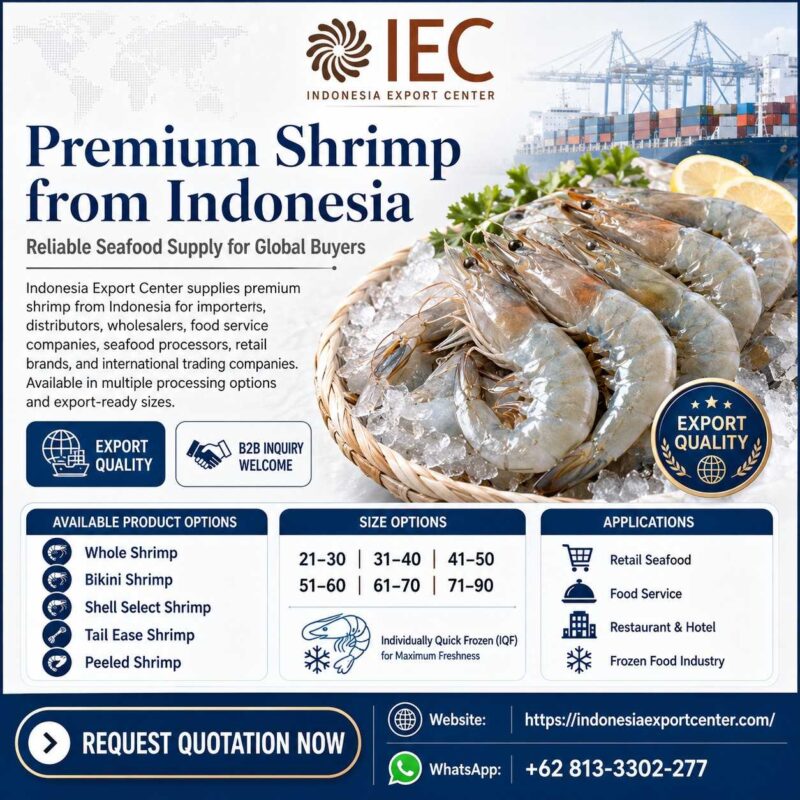
Indonesian Vannamei Shrimp Sourcing for Japanese Seafood Buyers
Indonesia Export Center (IEC) assists Japanese seafood importers, food manufacturers, supermarket suppliers, restaurant distributors, and international trading companies with sourcing inquiries for Indonesian vannamei shrimp.
Commercial seafood procurement for Japan requires careful attention to product consistency, processing accuracy, appearance, food safety documentation, packaging, and delivery reliability.
IEC helps buyers communicate detailed technical and commercial requirements to potential Indonesian seafood suppliers and processing facilities.
Whether your business requires peeled shrimp for prepared meals, tail-on shrimp for foodservice, shell-on products for further processing, or customized frozen retail products, IEC welcomes your business-to-business inquiry.
Actual manufacturing capability, product availability, and Japanese import compliance must be verified.
Indonesian Whiteleg Shrimp for Japan
Vannamei shrimp, scientifically known as Litopenaeus vannamei, is a farmed shrimp species widely used in commercial seafood manufacturing.
Its versatility makes it suitable for evaluation in different Japanese food applications, including tempura, prepared meals, seafood rice products, restaurant dishes, frozen foods, and retail seafood.
The appropriate shrimp grade depends on the intended recipe, product presentation, preparation process, and finished-product quality requirements.
IEC encourages buyers to provide detailed specifications rather than relying solely on commercial product names.
Shrimp Processing Options for Japanese Importers
| Product Form | Potential Application |
|---|---|
| Whole Shrimp | Traditional seafood preparation |
| HLSO | Further processing and commercial kitchens |
| Peeled Deveined | Prepared meals and food manufacturing |
| PDTO | Tempura and presentation-focused foodservice |
| Peeled Tail-Off | Frozen meals and seafood ingredients |
| Easy Peel | Retail and foodservice |
| Cooked Shrimp | Selected prepared seafood products |
| IQF Shrimp | Portioning and frozen distribution |
| Breaded Shrimp | Value-added frozen food inquiries |
These product forms are potential sourcing requirements. The exact availability and processing capability must be confirmed.
Shrimp for Japanese Tempura Manufacturing
Japanese food manufacturers may require shrimp with specific dimensions, tail presentation, processing consistency, and physical characteristics.
Peeled deveined tail-on shrimp may be evaluated for tempura applications.
Buyers should specify the required shrimp size, tail condition, vein removal, shell trimming, acceptable curvature, and preparation requirements.
Specialized processing such as stretching or straightening should be requested explicitly and confirmed with the supplier.
Representative samples should be evaluated within the buyer’s actual manufacturing process before commercial approval.
Shrimp for Sushi and Prepared Seafood
Certain cooked shrimp products may be considered for sushi and other prepared seafood applications.
However, the product must be evaluated according to its intended use and applicable food safety requirements.
Raw shrimp, cooked shrimp, and ready-to-eat shrimp are not automatically interchangeable.
Buyers should establish whether the product requires further cooking or is intended for direct consumption.
IEC does not claim that every supplier can produce sushi-grade or ready-to-eat shrimp.
Shrimp for Japanese Bento and Frozen Meals
Peeled tail-off and other processed shrimp may be evaluated for bento meals, prepared rice products, noodles, frozen convenience foods, and seafood ingredient applications.
Industrial buyers may prioritize size consistency, portion accuracy, texture, cooking yield, and efficient ingredient handling.
The actual product should be evaluated using representative samples and an approved technical specification.
Product Size References
IEC’s preliminary promotional material identifies the following shrimp size categories:
| Size Reference | Potential Buyer Application |
|---|---|
| 21–30 | Presentation-focused dishes |
| 31–40 | Foodservice and prepared foods |
| 41–50 | Retail and food manufacturing |
| 51–60 | Prepared meal ingredients |
| 61–70 | Smaller seafood portions |
| 71–90 | Industrial ingredient applications |
The counting unit must be confirmed.
Japanese buyers may also request narrower size grades or customized dimensional requirements for specific manufacturing applications.
No particular grade is guaranteed without supplier confirmation.
Product Consistency and Technical Specifications
Japanese procurement teams may require detailed product specifications covering more than average shrimp size.
Relevant parameters may include:
- Species identity.
- Individual piece weight.
- Length or dimensional requirements.
- Count grading.
- Size tolerance.
- Tail condition.
- Shell removal.
- Deveining quality.
- Physical appearance.
- Broken piece tolerance.
- Glaze.
- Net weight.
- Ingredient declaration.
- Cooking status.
- Frozen storage conditions.
These parameters should be agreed before commercial production.
IQF Frozen Shrimp for Japan
Individually Quick Frozen shrimp may support flexible portioning and commercial food preparation.
For Japanese food manufacturers, IQF products may be considered where standardized quantities are required for individual meals or production batches.
The buyer should evaluate product separation, surface condition, glaze consistency, packaging integrity, and performance after thawing.
IQF does not establish a particular shelf life or guarantee food safety.
Japanese Food Sanitation Requirements
Japanese importers should verify the applicable requirements under Japan’s food sanitation framework.
Commercial food imports may require notification to the relevant quarantine station under the Ministry of Health, Labour and Welfare.
The importer should determine the specific documentation, inspection, testing, and regulatory requirements for the actual product.
Potential areas of review include:
| Regulatory Area | Buyer Responsibility |
|---|---|
| Food Import Notification | Confirm applicable notification procedures |
| Veterinary Drug Residues | Verify relevant residue restrictions |
| Food Additives | Confirm permitted substances and usage |
| Microbiology | Establish applicable product criteria |
| Processing Hygiene | Review supplier food safety controls |
| Food Labeling | Verify applicable Japanese labeling requirements |
| Customs | Confirm classification and import procedures |
| Traceability | Request relevant sourcing and batch records |
Compliance must be established for the specific product and transaction.
Veterinary Drug Residue Testing
Japanese seafood buyers may require detailed laboratory documentation concerning veterinary drug residues and other regulated substances.
The actual testing panel should be established according to applicable Japanese requirements and buyer specifications.
Laboratory reports should identify the tested product, lot, analytical method, results, units, and relevant reporting information.
A general laboratory-tested claim is not sufficient to demonstrate compliance with every applicable requirement.
Ingredient and Additive Verification
Shrimp products may contain processing additives depending on the production method.
Japanese buyers should request complete ingredient declarations, information about processing aids where relevant, and details concerning any moisture-retention treatments.
For breaded, seasoned, or marinated shrimp, additional ingredients and allergens must also be evaluated.
The supplier should confirm the actual formulation before packaging artwork is approved.
Japanese Retail Labeling
Retail frozen seafood intended for Japan may require Japanese-language product information.
Potential label elements include product name, ingredients, allergens, net quantity, storage instructions, date marking, country of origin, responsible business details, and nutrition information where required.
The importer should review current requirements under the relevant Japanese food labeling framework.
Private-label artwork must be approved before production.
Quality Inspection and Sample Approval
Japanese buyers may establish a structured product approval process.
A commercial inspection program may include visual examination, size grading, weight verification, processing inspection, packaging checks, laboratory testing, and evaluation of finished-product performance.
Samples should be representative of the intended commercial specification.
Buyers should establish acceptable variation and procedures for handling non-conforming production lots.
Frozen Seafood Packaging for Japan
Potential packaging inquiries include consumer retail packs, foodservice bags, standardized industrial inner packs, and master cartons.
Buyers should specify the required net weight per pack, carton configuration, label language, packaging material, lot identification, and palletization requirements.
Customized packaging may require additional MOQ and production lead time.
Actual packaging capability must be confirmed.
Glazing and Net Weight Accuracy
Protective glaze should be distinguished from actual shrimp weight.
The buyer should establish the required glaze percentage, calculation convention, net weight, sampling procedure, and acceptance criteria.
For food manufacturers, accurate net shrimp weight supports ingredient planning and production cost calculations.
The commercial price basis should be clearly stated in the quotation.
Shipping Frozen Shrimp from Indonesia to Japan
Potential destination-port inquiries include Tokyo, Yokohama, Osaka, Kobe, Nagoya, and other suitable Japanese ports.
These destinations are examples for quotation requests rather than confirmed shipping routes.
Actual freight availability, sailing schedules, transit time, reefer capacity, and destination handling requirements must be confirmed.
The buyer and supplier should establish an appropriate frozen transportation specification.
Export Documentation
Potential documentation requests include commercial invoices, packing lists, bills of lading, certificates of origin where applicable, laboratory reports, product specifications, ingredient declarations, and relevant official documents.
The exact requirements should be established by the importer and responsible authorities.
Preferential tariff treatment under an applicable trade agreement should not be assumed without verifying origin rules and supporting documentation.
Japanese Shrimp Import Price Factors
The export price may depend on raw material size, processing accuracy, labor requirements, production yield, freezing method, packaging, quality testing, order quantity, and international freight.
Customized specifications may influence production costs.
IEC recommends obtaining a quotation based on the buyer’s complete technical requirements.
Recurring Supply and Long-Term Procurement
Japanese food manufacturers may require consistent monthly shipments to support production schedules.
A recurring supply arrangement should define approved specifications, expected volumes, delivery frequency, acceptable variation, inspection procedures, and corrective action requirements.
The supplier must confirm its actual production capacity and ability to meet the requested schedule.
Why Work with Indonesia Export Center?
IEC assists Japanese buyers with supplier matching, specification coordination, product sample inquiries, documentation requests, packaging discussions, commercial quotations, and export sourcing.
IEC operates as an independent sourcing and trade facilitation partner rather than the manufacturer or regulatory authority.
Frequently Asked Questions
Can I request shrimp specifically for tempura?
Yes. Submit your required dimensions, processing form, tail specification, and quality criteria.
Can IEC source cooked shrimp for Japan?
Cooked shrimp inquiries are welcome, subject to processing capability and applicable food safety requirements.
Can I request Japanese-language retail packaging?
Yes, subject to supplier capability and approved artwork.
Is IQF shrimp available?
IQF is identified in the preliminary product range, but specific product combinations require confirmation.
Can I request laboratory testing?
Yes. Please specify the required analytical parameters and acceptance criteria.
Can IEC guarantee Japanese import approval?
No. Compliance must be verified by the responsible importer and supplier.
Can I request recurring monthly shipments?
Yes. Actual capacity and lead time require confirmation.
Request a Vannamei Shrimp Quotation for Japan
Please provide your company name, intended application, processing form, size grade, dimensional requirements, count basis, raw or cooked condition, freezing method, glaze, net weight, packaging, quality criteria, initial quantity, monthly requirement, destination port, preferred Incoterms, required documents, and shipment schedule.
Contact Indonesia Export Center
INDONESIA EXPORT CENTER (IEC)
Website: https://indonesiaexportcenter.com/
WhatsApp: +62 813-3302-277
Direct inquiry: https://wa.me/628133302277
Request Your Indonesian Vannamei Shrimp Export Quotation for Japan Today.
Explore related products:
- Vannamei Shrimp Supplier Indonesia
- PDTO Vannamei Shrimp Supplier
- Cooked Vannamei Shrimp Supplier
- Retail Pack Vannamei Shrimp
- Vannamei Shrimp Export Quotation
Product specifications, processing capability, laboratory results, Japanese import requirements, prices, MOQ, and shipping arrangements require verification.
