

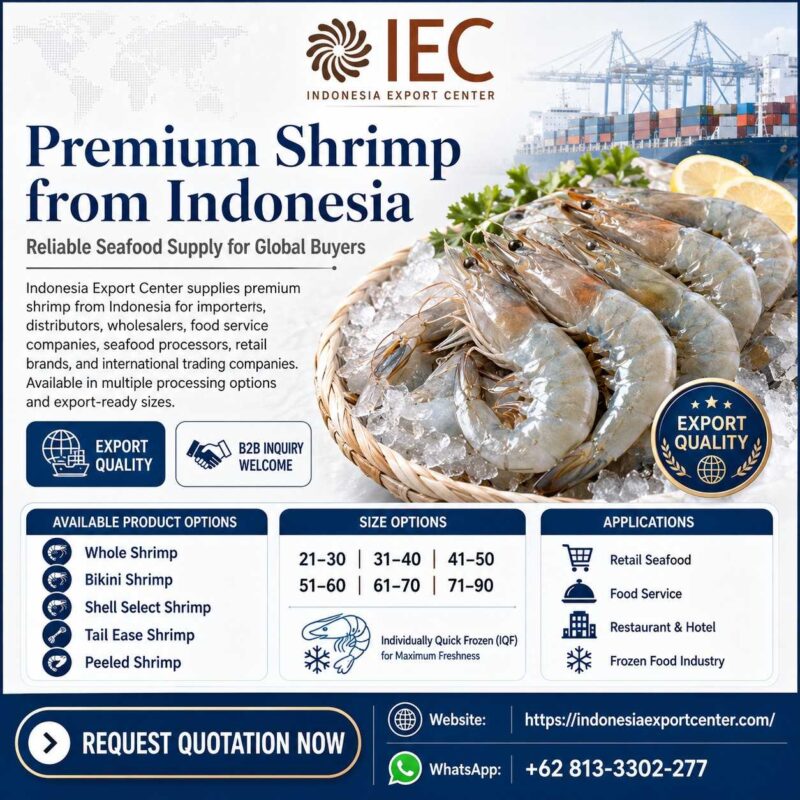
Indonesian Retail-Packed Frozen Shrimp for Global Distribution
Indonesia Export Center (IEC) welcomes sourcing inquiries from international supermarket chains, frozen seafood retailers, private-label brands, food importers, and retail distribution companies seeking Indonesian vannamei shrimp.
Retail-packed shrimp requires careful coordination between product quality, processing specifications, packaging, branding, traceability, and destination-market labeling requirements.
IEC assists international buyers in communicating their retail product requirements to potential Indonesian seafood suppliers.
Whether your business distributes frozen seafood in the European Union, supplies supermarkets in Japan, operates a private-label brand in the United Kingdom, or serves other international retail markets, IEC can facilitate supplier inquiries and commercial quotation requests.
Retail packaging and market-specific product compliance must be confirmed with the responsible supplier.
What Is Retail Pack Vannamei Shrimp?
Retail pack vannamei shrimp refers to shrimp packaged for sale through consumer-facing distribution channels.
Unlike industrial bulk packaging, retail packaging may require additional attention to product presentation, consumer information, branding, net quantity, preparation instructions, and applicable food labeling rules.
The appropriate retail pack depends on the target consumer, shrimp processing form, product size, and distribution strategy.
Retail Product Specification Overview
| Parameter | Buyer Inquiry |
|---|---|
| Product | Retail Pack Vannamei Shrimp |
| Scientific Name | Litopenaeus vannamei |
| Origin | Indonesia |
| Processing Options | Whole, shell-on, peeled, PD, PDTO, tail-off |
| Size References | 21–30 through 71–90 |
| Count Basis | Supplier confirmation required |
| Freezing Method | IQF inquiry |
| Product Condition | Raw or cooked |
| Packaging | Consumer retail packaging |
| Private Label | Subject to supplier capability |
| Glaze | Agreed specification |
| Net Weight | According to applicable requirements |
| Label Language | Target-market requirement |
| Storage | Approved frozen storage conditions |
| MOQ | Supplier confirmation required |
| Price | Request current quotation |
Retail Frozen Shrimp Product Categories
Whole Frozen Shrimp
Whole shrimp may be considered for consumers who prefer traditional seafood preparation and shell-on cooking.
Headless Shell-On Shrimp
This format may appeal to consumers seeking reduced preparation compared with whole shrimp while retaining the shell.
Peeled Deveined Shrimp
Peeled deveined shrimp may support convenient household preparation.
The supplier should confirm the exact processing standard.
Peeled Deveined Tail-On Shrimp
Tail-on shrimp may be considered for consumers preparing appetizers, seafood platters, and presentation-focused dishes.
Peeled Tail-Off Shrimp
Tail-off shrimp may be suitable for selected household recipes requiring convenient ingredient handling.
Cooked Frozen Shrimp
Cooked shrimp may be requested, but cooking status, intended use, food safety requirements, and supplier capability must be verified.
A cooked product should not automatically be described as ready to eat without appropriate evidence.
Selecting Retail Pack Sizes
Retail pack size can influence product positioning, consumer convenience, shelf-space requirements, and distribution planning.
| Illustrative Pack Size | Potential Positioning |
|---|---|
| 200 g | Small household portions |
| 250 g | Individual or small household meals |
| 300 g | Everyday frozen seafood |
| 400 g | Household meal preparation |
| 500 g | Standard retail seafood inquiry |
| 750 g | Larger household pack |
| 1 kg | Family or value-oriented pack |
These pack sizes are examples for buyer inquiries rather than confirmed supplier offerings.
IQF Shrimp for Consumer Convenience
IQF shrimp may allow consumers to select individual pieces from a frozen pack.
The actual convenience depends on product separation, glaze, packaging, and storage conditions.
Retail buyers should inspect representative samples to assess clumping, appearance, physical defects, and consistency.
IQF products still require appropriate frozen storage and safe preparation.
Private-Label Frozen Seafood Programs
Private-label seafood programs may allow retailers and importers to market products under their own brands.
A successful private-label project requires agreement on the product specification, packaging materials, artwork, label information, production quantity, quality standards, and shipment schedule.
The supplier should confirm whether it has the equipment and processes needed for the requested packaging format.
IEC can facilitate communication during the sourcing process.
Retail Packaging Design Considerations
A retail seafood package should communicate accurate product information while protecting the frozen contents.
Important design considerations include product visibility, brand identity, readability, label accuracy, packaging strength, and suitability for frozen storage.
Images used on packaging should accurately represent the product or be identified as serving suggestions where appropriate.
The packaging should not make unsupported claims regarding origin, sustainability, certifications, purity, or food safety.
Retail Label Information
Depending on the destination market, retail frozen shrimp labels may require:
| Label Element | Buyer Verification |
|---|---|
| Product Name | Correct commercial description |
| Species | Scientific or approved commercial name where required |
| Country of Origin | Verified origin information |
| Ingredients | Complete and accurate declaration |
| Allergens | Crustacean shellfish and other applicable allergens |
| Net Quantity | Accurate declared product weight |
| Storage Instructions | Approved frozen storage requirements |
| Lot Code | Traceability identification |
| Date Marking | Applicable date information |
| Preparation Instructions | Suitable for product condition |
| Importer Information | Responsible business details where required |
| Nutrition Declaration | According to applicable rules |
| Other Claims | Supporting documentation required |
The importer should verify the actual labeling obligations for the intended market.
Glazing and Consumer Net Weight
Protective ice glaze may be used to help protect frozen shrimp.
Retail buyers should ensure that the declared net quantity accurately reflects the product according to applicable requirements.
The buyer should establish how glaze is measured, how net weight is determined, and how compliance is checked.
A package should not misrepresent protective ice as shrimp product weight.
Product Traceability for Retail Distribution
Retail seafood businesses may require traceability records that connect individual product lots with the responsible processing facility and shipment.
Relevant records may include raw material identification, production date, processing batch, packaging lot, warehouse information, and shipment references.
The supplier should demonstrate its actual traceability capability.
A printed lot code alone does not establish complete supply-chain traceability.
Retail Shelf-Life Verification
Shelf life depends on the product, processing method, packaging, storage conditions, and validation evidence.
Buyers should request the supplier’s approved shelf-life specification and supporting information.
No universal frozen shrimp shelf life should be assumed.
Retail distributors should also establish inventory rotation and temperature monitoring procedures.
Cold-Chain Management
Retail frozen shrimp requires suitable temperature-controlled storage and transportation.
Approximately -18°C or colder is a common frozen storage reference, subject to the approved product specification and applicable rules.
The responsible parties should establish temperature monitoring, handling requirements, and procedures for addressing deviations.
Maintaining the cold chain is important throughout transportation, warehousing, and retail distribution.
Retail Pack Vannamei Shrimp for European Union Buyers
EU seafood importers should verify applicable establishment eligibility, official certification, food safety, consumer labeling, origin information, traceability, and allergen requirements.
The exact obligations depend on the product and intended market.
Private-label artwork should be reviewed before production.
Retail Frozen Shrimp for United Kingdom Buyers
UK importers should verify the applicable rules for the intended UK market.
Requirements may differ from those of the European Union.
Product eligibility, official documentation, labeling, and responsible business information should be reviewed.
Retail Pack Shrimp for Japan Buyers
Japanese seafood importers may require specific product descriptions, label language, quality specifications, and documentation.
The buyer should confirm applicable food sanitation, labeling, and import requirements before approving the product.
IEC can coordinate supplier inquiries but does not independently approve regulatory compliance.
Quality Inspection for Retail Products
Retail shrimp inspection may cover:
- Species and product identity.
- Size accuracy.
- Product appearance.
- Physical defects.
- Processing quality.
- Glaze and net weight.
- Pack seal integrity.
- Label accuracy.
- Lot identification.
- Date marking.
- Carton configuration.
- Frozen product temperature.
- Applicable food safety documentation.
Inspection criteria should be agreed before production.
Retail Packaging MOQ and Lead Time
Retail packaging may require minimum production quantities because of packaging materials, printing, and production setup.
The supplier should confirm whether the requested packaging can be produced within the buyer’s order volume.
Lead time may include artwork approval, material procurement, processing, freezing, packaging, inspection, and export preparation.
Pricing for Retail Packed Vannamei Shrimp
Retail product prices may depend on shrimp size, processing form, freezing method, glaze, pack weight, packaging material, printing requirements, order quantity, and logistics.
Buyers should request a quotation identifying the price per pack, carton, kilogram, or other agreed commercial unit.
Packaging setup charges and other customization costs should be clarified.
How IEC Supports Retail Seafood Buyers
IEC assists with supplier matching, retail product specification coordination, packaging inquiries, private-label discussions, sample requests, quotation coordination, and export documentation inquiries.
Our role is to facilitate sourcing rather than independently manufacture or certify retail seafood products.
Frequently Asked Questions
Can I source retail-packed vannamei shrimp from Indonesia?
Yes. IEC welcomes retail packaging inquiries subject to supplier capability.
Can I request private-label packaging?
Yes. Artwork, MOQ, packaging materials, and production capability require confirmation.
Is IQF shrimp suitable for retail?
It may be suitable for selected retail applications.
Can I request packaging in Japanese or European languages?
Yes, as a buyer requirement. Applicable labeling must be verified.
Is a fixed shelf life guaranteed?
No. Shelf life must be supported by the actual product specification.
Can IEC arrange product samples?
IEC can coordinate sample inquiries with potential suppliers.
Are retail products automatically approved for export?
No. Product and facility eligibility must be verified for the intended market.
Request Retail Pack Vannamei Shrimp Pricing
Please provide:
Company Name:
Country:
Target Retail Market:
Product Form:
Size and Count Basis:
Raw or Cooked:
Freezing Method:
Glaze Specification:
Net Weight per Pack:
Packaging Type:
Private Label Required:
Artwork Available:
Label Language:
Required Documents:
Initial Quantity:
Monthly Volume:
Destination Port:
Preferred Incoterms:
Target Shipment Date:
Contact Indonesia Export Center
INDONESIA EXPORT CENTER (IEC)
Website: https://indonesiaexportcenter.com/
WhatsApp: +62 813-3302-277
Direct inquiry: https://wa.me/628133302277
Request Your Retail Pack Vannamei Shrimp and Private-Label Seafood Quotation Today.
Related pages:
- Vannamei Shrimp Supplier Indonesia
- Custom Pack Frozen Vannamei Shrimp
- IQF Vannamei Shrimp Supplier
- Food Safety Requirements for Indonesian Shrimp
Retail packaging, private-label capability, shelf life, certifications, product availability, labeling compliance, MOQ, prices, and export eligibility require supplier verification.
