

IEC | INDONESIA EXPORT CENTER
CONNECTING INDONESIAN PRODUCTS TO THE WORLD
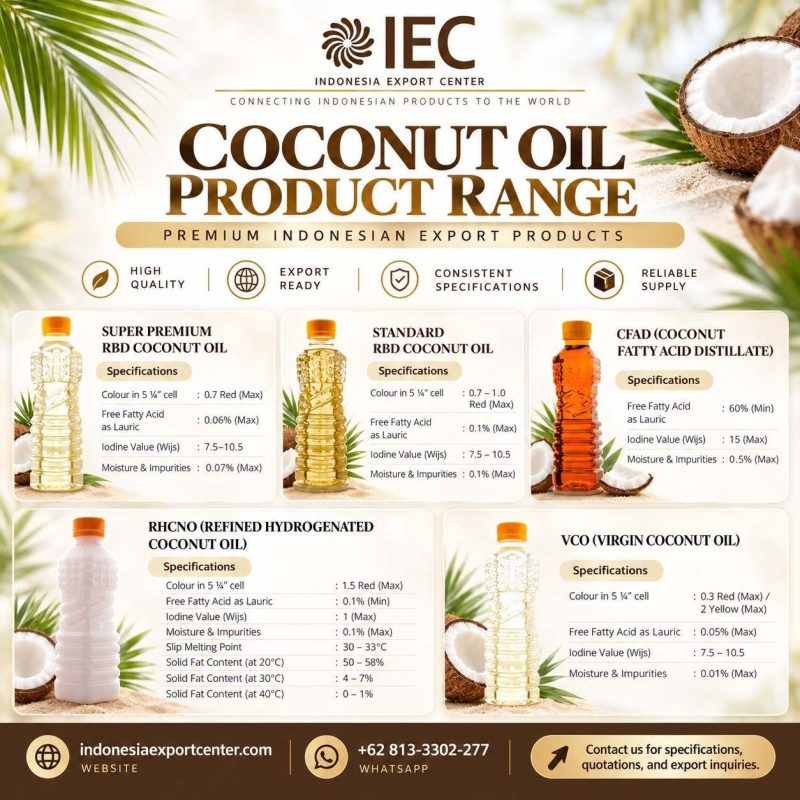
STANDARD RBD COCONUT OIL
Indonesian Refined Coconut Oil Sourcing and Export Coordination for International Importers
Export Documentation | Customs Clearance | Certificate of Analysis | International Shipping | Import Compliance | Bulk Trade Enquiries
Looking for a Refined Coconut Oil Exporter in Indonesia?
Finding a reliable refined coconut oil exporter Indonesia involves more than identifying a product supplier.
International import managers must also verify the manufacturer’s identity, product specifications, export documentation, contractual responsibilities, packaging, shipping arrangements and destination-country import requirements.
Indonesia Export Center (IEC) facilitates sourcing and export enquiries for Indonesian coconut oil products, including Standard RBD Coconut Oil.
RBD stands for Refined, Bleached and Deodorized.
For importers evaluating Indonesian refined coconut oil, a well-defined export workflow can help reduce documentation discrepancies, clarify responsibilities and support shipment planning.
IEC’s supplied Standard RBD Coconut Oil reference includes:
- Colour in 5¼-inch Cell: 0.7–1.0 Red (Max), subject to clarification
- Free Fatty Acid as Lauric: 0.1% Maximum
- Iodine Value (Wijs): 7.5–10.5
- Moisture & Impurities: 0.1% Maximum
These are reference values, not independently verified batch COA results.
REQUEST REFINED COCONUT OIL EXPORT INFORMATION AND QUOTATION
WhatsApp: https://wa.me/628133302277
Website: https://indonesiaexportcenter.com/
IEC facilitates sourcing and export enquiries. The actual manufacturer, contractual seller and exporter of record must be confirmed for each transaction.
1. Refined Coconut Oil Export from Indonesia – Product Overview
| Item | Details |
|---|---|
| Product | Standard RBD Coconut Oil |
| Product Category | Refined Coconut Oil |
| Country of Sourcing | Indonesia |
| Product Grade | Standard RBD |
| Intended Buyers | Import Managers, Commodity Importers, Distributors, Food Manufacturers |
| Technical Specifications | Supplied Reference Values |
| Manufacturer | To Be Confirmed |
| Contractual Seller | To Be Confirmed |
| Exporter of Record | To Be Confirmed |
| Available Quantity | To Be Confirmed |
| MOQ | To Be Confirmed |
| Packaging | To Be Confirmed |
| Batch COA | To Be Requested and Verified |
| Certifications | Subject to Verification |
| Export Documentation | Subject to Transaction |
| Export Lead Time | To Be Confirmed |
| Price | Request Quotation |
2. What Is Standard RBD Coconut Oil?
Standard RBD Coconut Oil is a refined coconut-derived oil.
The RBD process generally includes refining, bleaching and deodorization.
The exact manufacturing process and quality characteristics depend on the producer and applicable specification.
For international buyers, the finished product must be evaluated against the intended application and destination regulations.
3. Why Import Refined Coconut Oil from Indonesia?
Indonesia has an established coconut production and processing sector.
This creates potential sourcing opportunities for international buyers seeking coconut-derived products.
However, the capabilities of individual manufacturers and exporters vary.
Importers should verify the proposed supply arrangement rather than assume that all Indonesian suppliers offer the same capacity, certifications or export services.
4. Standard RBD Coconut Oil Technical Specifications
| Quality Parameter | Supplied Reference Specification |
|---|---|
| Colour in 5¼-inch Cell | 0.7–1.0 Red (Max) |
| Free Fatty Acid as Lauric | 0.1% (Max) |
| Iodine Value (Wijs) | 7.5–10.5 |
| Moisture & Impurities | 0.1% (Max) |
Technical note: The colour entry combines a range with a maximum designation. The manufacturer should clarify the intended limit, measurement scale and test method before the specification is used contractually.
The buyer should request a current technical data sheet and batch-specific COA.
5. Understanding Exporter vs Manufacturer vs Sourcing Facilitator
These roles should be distinguished.
Manufacturer
The company that physically produces the refined coconut oil.
Contractual Seller
The party selling the goods under the purchase agreement.
Exporter of Record
The party legally responsible for applicable export declarations and obligations.
Sourcing Facilitator
A party helping connect buyers with potential supply arrangements and coordinate commercial enquiries.
IEC facilitates sourcing and export enquiries and should not automatically be treated as the manufacturer or exporter of record.
6. Refined Coconut Oil Export Workflow
A typical export planning process may include:
- Buyer submits an enquiry.
- Product grade and quantity are defined.
- Supplier availability is checked.
- Technical specifications are reviewed.
- COA and relevant documentation are requested.
- Packaging requirements are confirmed.
- Export and import compliance are reviewed.
- Commercial quotation is prepared.
- Incoterms and payment terms are negotiated.
- Purchase contract is finalised.
- Production or stock allocation is confirmed.
- Pre-shipment quality checks are arranged.
- Export documents are prepared.
- Cargo is booked and dispatched.
- Import clearance is completed.
- Goods are received and verified.
The actual process depends on the supplier, buyer and destination.
7. Step One: Submit an Export Enquiry
Buyers should provide:
- Company name
- Destination country
- Product grade
- Quantity in MT
- Packaging preference
- Destination port
- Required documents
- Target shipment period
- Preferred Incoterm
Complete enquiries support more accurate commercial evaluation.
8. Step Two: Verify Product Specifications
The buyer should confirm that the offered oil meets the intended application.
Relevant parameters include:
- Colour
- Free fatty acid
- Iodine value
- Moisture
- Impurities
- Additional buyer-specific quality requirements
The current manufacturer’s specification should govern the technical review.
9. Step Three: Review the Certificate of Analysis
A COA may help verify the analytical characteristics of a defined batch or sample.
Buyers should review:
- Manufacturer identity
- Product name
- Batch identification
- Test methods
- Results
- Test date
- Document authenticity
No verified batch COA has been supplied for this page.
10. Step Four: Verify the Manufacturer
Manufacturer due diligence may include:
- Legal entity information
- Production facility
- Refining capability
- Quality controls
- Production capacity
- Traceability
- Certifications
- Export experience
These capabilities should not be assumed without evidence.
11. Step Five: Confirm Available Supply
Before proceeding, buyers should confirm:
- Available stock
- Production schedule
- Monthly capability
- Existing commitments
- Shipment readiness
- Repeat-supply feasibility
No verified inventory or production capacity has been supplied.
12. Step Six: Confirm Packaging
Packaging may vary according to the supplier and buyer requirements.
Possible enquiry categories include:
- Drums
- IBCs
- Suitable bulk liquid transport arrangements
- Other approved packaging
No specific packaging format has been confirmed as available.
13. Drum Packaging for Export
Where drum packaging is proposed, buyers should verify:
- Material
- Food-contact suitability
- Net weight
- Gross weight
- Sealing
- Cleanliness
- Palletisation
- Loading plan
14. Bulk Tank and Flexitank Arrangements
Some importers may enquire about tank containers or flexitank logistics.
Feasibility depends on:
- Cargo properties
- Equipment compatibility
- Loading facilities
- Discharge facilities
- Carrier acceptance
- Food safety requirements
- Temperature management
No tank or flexitank capability is confirmed for the proposed supplier.
15. Step Seven: Verify Export and Import Compliance
Export compliance and import compliance are separate responsibilities.
The parties should verify:
- Indonesian export requirements
- Destination import requirements
- Customs classification
- Product eligibility
- Food safety rules
- Applicable certificates
- Permits, if required
16. HS Code Classification
The Harmonized System is used for customs classification.
The correct code depends on the actual product and applicable national tariff schedule.
No specific HS code is confirmed here.
Buyers should consult a qualified customs specialist or relevant authority.
17. Indonesian Export Customs Procedures
The responsible exporting party must comply with applicable Indonesian export procedures.
This may involve:
- Export declarations
- Commercial documentation
- Applicable regulatory requirements
- Customs processing
- Cargo release
The actual process depends on the transaction.
18. Destination Import Customs Procedures
The importer should confirm:
- Import registration
- Customs classification
- Duty and tax rates
- Food product requirements
- Import permits
- Labelling
- Required documentation
Requirements vary by destination.
19. Commercial Invoice
A commercial invoice typically identifies:
- Seller
- Buyer
- Invoice number
- Invoice date
- Product description
- Quantity
- Unit price
- Total value
- Currency
- Incoterm
- Country of origin, where applicable
The invoice must match the commercial agreement.
20. Packing List
A packing list may include:
- Product name
- Package count
- Net weight
- Gross weight
- Packaging dimensions
- Shipping marks
- Batch references
The details should correspond to the actual packed goods.
21. Bill of Lading
For applicable sea freight shipments, a bill of lading may identify:
- Shipper
- Consignee
- Notify party
- Vessel
- Ports
- Cargo description
- Container details
- Seal number
The required transport document depends on the shipment arrangement.
22. Certificate of Origin
A Certificate of Origin may be requested or required.
It may support:
- Origin identification
- Customs processing
- Preferential tariff claims, where applicable
Preferential treatment depends on the relevant trade agreement and rules of origin.
23. Certificate of Analysis
A COA is a quality-related document, not a substitute for customs clearance documentation.
The buyer should specify when the COA must be issued and how it should relate to the shipment.
24. Health and Food Safety Certificates
Depending on the destination, certain food products may require additional certificates or regulatory documents.
The importer should verify:
- Whether a certificate is required
- Which authority must issue it
- The required format
- Product coverage
- Validity
No specific certificate is confirmed as available for this product.
25. Halal Certification
Some buyers or destinations may require Halal documentation.
No verified Halal certificate has been supplied.
Buyers should confirm certificate validity, scope, issuer and market recognition.
26. Other Quality Certifications
Buyers may request documentation relating to:
- Food safety management
- Quality management
- Manufacturing controls
- Traceability
- Product testing
No particular certification is claimed without verification.
27. Export Documentation Checklist
| Document | General Purpose | Requirement |
|---|---|---|
| Commercial Invoice | Transaction details | Confirm |
| Packing List | Packing and quantity details | Confirm |
| Bill of Lading / Transport Document | Shipment evidence | Confirm |
| Certificate of Origin | Origin documentation | If Required |
| Certificate of Analysis | Product quality evidence | As Agreed |
| Food Safety Certificate | Regulatory or buyer compliance | If Required |
| Halal Certificate | Market or buyer requirements | If Required |
| Insurance Certificate | Cargo insurance evidence | Where Applicable |
| Other Import Permits | Destination compliance | If Required |
28. Document Consistency
The following details should be consistent across relevant documents:
- Product name
- Grade
- Quantity
- Weight
- Package count
- Seller
- Buyer
- Shipment references
- Country of origin
Document discrepancies should be resolved before submission.
29. Incoterms for Refined Coconut Oil Export
Incoterms help define delivery responsibilities, costs and risk allocation.
Common terms that buyers may discuss include:
- FCA
- FOB
- CFR
- CIF
Availability depends on the supplier and logistics arrangement.
30. FOB Export Quotation
FOB is commonly discussed for suitable ocean freight transactions.
The named port of shipment should be identified.
The parties should confirm the agreed Incoterms version.
31. CFR Export Quotation
CFR may be used for certain sea freight arrangements.
Buyers should understand which party arranges freight and when risk transfers.
32. CIF Export Quotation
CIF may be used for certain sea freight transactions.
The seller generally contracts for carriage and the required insurance cover to the named destination port, subject to the agreed rule.
Buyers should review insurance terms carefully.
33. Export Price and Quotation Basis
An export quotation should identify:
- Product grade
- Quantity
- Currency
- Price per MT
- Packaging
- Incoterm
- Named port
- Payment terms
- Lead time
- Quotation validity
No current export price has been verified.
34. Minimum Order Quantity
The MOQ for Standard RBD Coconut Oil has not been confirmed.
It may depend on the supplier, packaging and shipment arrangements.
35. Export Lead Time
Lead time may include:
- Order confirmation
- Production or stock allocation
- Quality checks
- Packaging
- Documentation
- Cargo booking
- Inland transportation
No fixed lead time is guaranteed.
36. Freight Forwarder Coordination
A freight forwarder may coordinate:
- Shipment booking
- Container arrangements
- Transport documentation
- Cargo collection
- Freight quotations
- Shipment tracking
The scope depends on the service agreement.
37. Pre-Shipment Inspection
An agreed inspection may cover:
- Product identity
- Batch quality
- Quantity
- Packaging
- Loading
- Sealing
- Documentation
Inspection arrangements require confirmation.
38. Loading Supervision
Where requested, loading supervision may help verify:
- Container condition
- Packaging condition
- Cargo quantity
- Loading procedure
- Seal information
No particular inspection service is confirmed as included.
39. Export Packaging Quality
Packaging should be suitable for the actual product and transport conditions.
Relevant considerations include:
- Food-contact compliance
- Cleanliness
- Sealing
- Structural integrity
- Handling
- Labelling
40. Temperature and Transport Handling
Coconut oil may change physical state as temperature changes.
Buyers should agree on appropriate handling conditions with the supplier and logistics provider.
No specific heating or transport temperature requirement is established here.
41. Import Duty and Tax
Import duty and tax depend on:
- Destination country
- Tariff classification
- Origin rules
- Trade agreements
- Applicable tax laws
No universal duty rate is provided.
42. Export Insurance
Cargo insurance arrangements should be reviewed according to the agreed Incoterm and contract.
The scope of insurance should be appropriate to the cargo and transport risks.
43. Payment Terms and Trade Finance
Payment terms may be negotiated according to the transaction.
The parties should clarify:
- Currency
- Payment schedule
- Banking instructions
- Documentary requirements
- Conditions for shipment
- Dispute procedures
No particular payment method is guaranteed.
44. Export Contract Review
A purchase contract may include:
- Product specification
- Quantity
- Price
- Packaging
- Incoterm
- Shipment schedule
- Quality acceptance
- Inspection
- Documentation
- Payment
- Claims procedure
Large transactions may benefit from appropriate legal and commercial review.
45. Common Export Documentation Mistakes
Import managers should avoid:
- Using an unverified HS code
- Accepting inconsistent product descriptions
- Assuming a reference specification is a verified COA
- Overlooking food import regulations
- Failing to identify the exporter of record
- Confusing a sourcing facilitator with the manufacturer
- Assuming certificates are available without verification
- Using unclear Incoterms
- Shipping before required permits are confirmed
- Accepting incomplete packing information
46. Refined Coconut Oil Import Manager Checklist
Product
-
Standard RBD grade confirmed
-
Technical specification obtained
-
Colour specification clarified
-
COA reviewed
-
Intended application verified
Supplier
-
Manufacturer verified
-
Contractual seller identified
-
Exporter of record identified
-
Available volume confirmed
-
Production capability reviewed
Commercial
-
MOQ confirmed
-
Price per MT confirmed
-
Packaging confirmed
-
Incoterm agreed
-
Named port confirmed
-
Lead time confirmed
-
Payment terms agreed
Export Documentation
-
Commercial invoice prepared
-
Packing list prepared
-
Transport document arranged
-
COA available
-
Certificate of Origin reviewed
-
Required regulatory certificates confirmed
Import Compliance
-
HS classification verified
-
Import duties and taxes checked
-
Food safety requirements reviewed
-
Import permits checked
-
Customs broker appointed if needed
Refined Coconut Oil Export RFQ Template
Subject: RFQ – Standard RBD Coconut Oil Export from Indonesia
Dear Indonesia Export Center Team,
We are interested in importing Standard RBD Coconut Oil from Indonesia.
Please provide the available technical, commercial and export documentation information.
Buyer Information
Company Name: [Company Name]
Country: [Country]
Business Type: [Importer / Distributor / Manufacturer / Trading Company / Other]
Contact Person: [Name]
Email: [Email]
WhatsApp: [Number]
Product Requirements
Product: Standard RBD Coconut Oil
Intended Application: [Details]
Initial Quantity: [MT]
Monthly Requirement: [MT]
Annual Requirement: [MT]
Technical Specifications
Colour in 5¼-inch Cell: Please Confirm Acceptance Limit
FFA as Lauric: Maximum 0.1%
Iodine Value (Wijs): 7.5–10.5
Moisture & Impurities: Maximum 0.1%
Additional Specifications: [Details]
Current Technical Data Sheet: Required
Batch COA: Required
Packaging Requirements
Preferred Packaging: [Drums / IBC / Bulk Tank / Other]
Required Net Weight: [Weight]
Food-Contact Packaging Requirements: [Details]
Export and Shipping Requirements
Destination Country: [Country]
Destination Port: [Port]
Preferred Incoterm: [FCA / FOB / CFR / CIF / Other]
Target Shipment Period: [Month / Year]
Preferred Shipping Method: [Details]
Required Documentation
Commercial Invoice: Required
Packing List: Required
Transport Document: Required
Certificate of Origin: [Required / If Applicable]
Certificate of Analysis: Required
Food Safety Documentation: [Specify]
Halal Certificate: [Required / Not Required]
Other Certificates: [Specify]
Commercial Information Requested
Please provide:
- Actual manufacturer information
- Contractual seller information
- Exporter of record information
- Current product specification
- Batch COA or representative analysis, clearly identified
- Available certifications
- MOQ
- Available volume
- Packaging options
- Export price per MT
- Incoterm and named port
- Production lead time
- Shipping arrangements
- Export documentation availability
- Inspection arrangements
- Payment terms
- Quotation validity
We will verify destination import requirements with the relevant authorities and customs professionals before shipment.
Kind regards,
[Your Name] [Company Name] [Country]SEND YOUR REFINED COCONUT OIL EXPORT ENQUIRY
WhatsApp: https://wa.me/628133302277
Frequently Asked Questions – Refined Coconut Oil Exporter Indonesia
Can I import refined coconut oil from Indonesia?
IEC facilitates enquiries for Indonesian refined coconut oil sourcing. Actual supplier availability and destination import requirements must be verified.
What does RBD Coconut Oil mean?
RBD means Refined, Bleached and Deodorized Coconut Oil.
What export documents are normally used?
Depending on the transaction, documents may include a commercial invoice, packing list, transport document, Certificate of Origin, COA and applicable regulatory documents.
Is a Certificate of Analysis required?
A COA is commonly requested for quality verification. Whether it is legally or contractually required depends on the transaction and destination.
What is the HS code for RBD Coconut Oil?
The applicable classification must be verified for the product and destination. No specific code is asserted here.
Is a Certificate of Origin available?
Certificate arrangements depend on the transaction and applicable requirements.
Is Halal certification available?
No verified Halal certificate has been supplied. Availability must be confirmed.
What is the MOQ?
MOQ has not been confirmed.
What packaging is available?
Packaging formats and capacities require supplier confirmation.
Can I request FOB pricing?
FOB may be requested for suitable ocean freight transactions, subject to supplier confirmation.
Can I request CIF pricing?
CIF may be requested, subject to supplier and logistics arrangements.
How long does export preparation take?
Lead time depends on stock, production, packaging, documentation and shipping arrangements.
Can IEC coordinate export enquiries?
IEC facilitates sourcing and export enquiries. The actual scope of coordination must be agreed for each transaction.
Is IEC the manufacturer?
IEC should not automatically be considered the physical manufacturer.
Is IEC the exporter of record?
The exporter of record must be confirmed for the actual transaction.
Can I request a batch COA?
Yes, buyers may request one. Availability and authenticity must be verified.
Is Standard RBD Coconut Oil suitable for food manufacturing?
Suitability depends on verified product quality, food safety documentation and applicable regulations.
What is the supplied FFA specification?
The reference value is 0.1% maximum as lauric.
What is the supplied iodine value?
The reference range is 7.5–10.5 using the Wijs method.
How do I request an export quotation?
Send IEC your product grade, quantity, packaging preference, destination port and required documents.
Request Refined Coconut Oil Export Information from Indonesia
Plan Standard RBD Coconut Oil Imports with Clear Product and Documentation Requirements
Indonesia Export Center (IEC) welcomes enquiries from international import managers, edible oil distributors, commodity trading companies and food manufacturers.
Product: Standard RBD Coconut Oil
Country of Sourcing: Indonesia
Reference Colour: 0.7–1.0 Red (Max) in 5¼-inch Cell, Subject to Clarification
Reference FFA as Lauric: 0.1% Maximum
Reference Iodine Value (Wijs): 7.5–10.5
Reference Moisture & Impurities: 0.1% Maximum
Batch COA: To Be Requested and Verified
Manufacturer: To Be Confirmed
Exporter of Record: To Be Confirmed
MOQ: To Be Confirmed
Available Volume: To Be Confirmed
Packaging: To Be Confirmed
Export Price: Request Quotation
Production Lead Time: To Be Confirmed
Certifications: Subject to Verification
Export Documentation: Subject to Transaction and Destination
Contact IEC to discuss product specifications, supplier verification, export documentation and international commercial enquiries.
IEC | INDONESIA EXPORT CENTER
CONNECTING INDONESIAN PRODUCTS TO THE WORLD
Website: https://indonesiaexportcenter.com/
WhatsApp: +62 813-3302-277
REQUEST REFINED COCONUT OIL EXPORT QUOTATION AND DOCUMENTATION
Please include your company name, destination country, required quantity in MT, packaging preference, target shipment period and preferred Incoterm.
Export and Product Disclaimer: This page provides general sourcing and export planning information, not a guarantee of product availability, export readiness or customs compliance. The supplied specifications are reference values and are not independently verified batch results. The Standard RBD colour specification requires clarification. No manufacturer capacity, MOQ, packaging, COA, certification, export lead time or commercial terms have been independently verified. IEC facilitates sourcing and export enquiries; the manufacturer, contractual seller and exporter of record must be confirmed for each transaction. Importers should verify applicable requirements with relevant authorities before shipment.
