

IEC | INDONESIA EXPORT CENTER
CONNECTING INDONESIAN PRODUCTS TO THE WORLD
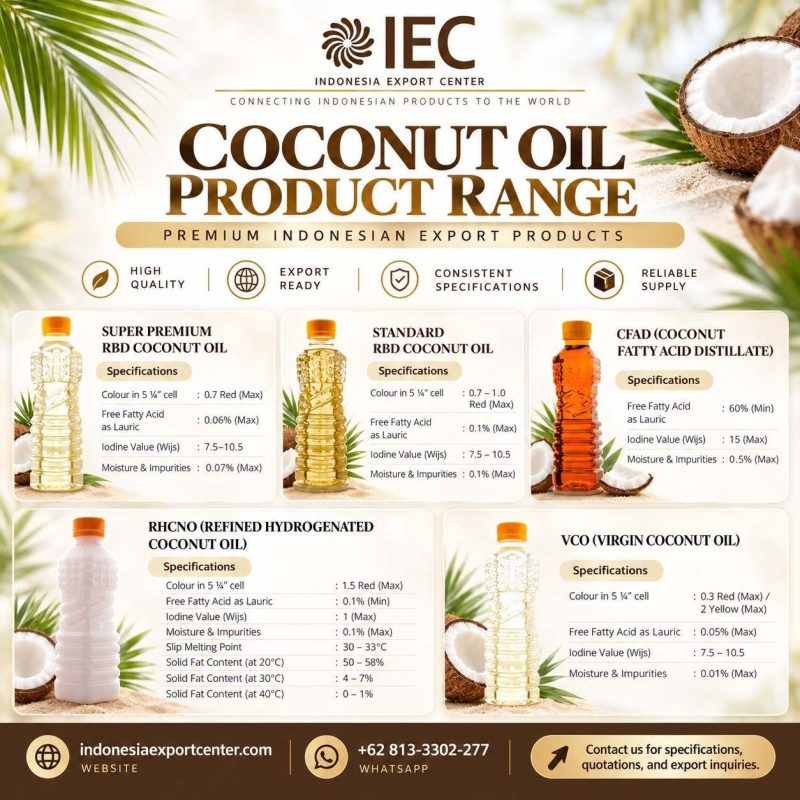
STANDARD RBD COCONUT OIL
Refined Coconut Oil Sourcing for Food Manufacturing and International Ingredient Procurement
Food Safety | Certificate of Analysis | Ingredient Specifications | Batch Traceability | Quality Assurance | Bulk Supply Enquiries
Looking for a Food Grade RBD Coconut Oil Supplier?
Are you searching for a food grade RBD coconut oil supplier for food manufacturing, ingredient distribution or international bulk procurement?
Indonesia Export Center (IEC) facilitates sourcing and export enquiries for Indonesian coconut oil products, including Standard RBD Coconut Oil.
RBD stands for Refined, Bleached and Deodorized.
For food manufacturers, selecting refined coconut oil involves more than confirming the basic product grade.
The proposed ingredient must meet the manufacturer’s technical requirements, food safety expectations, applicable regulations and quality assurance procedures.
Important purchasing considerations include:
- Product identity and grade
- Current technical specifications
- Certificate of Analysis (COA)
- Food safety documentation
- Contaminant testing
- Manufacturing controls
- Batch traceability
- Food-contact packaging
- Storage and handling
- Supplier qualification
- Regulatory compliance
- Commercial supply capability
IEC presents Standard RBD Coconut Oil as part of its Indonesian coconut oil sourcing range.
Food-grade status for the specific offered product must be established through appropriate manufacturer documentation, testing and destination-market compliance verification.
Standard RBD Coconut Oil – Reference Specifications
- Colour in 5¼-inch Cell: 0.7–1.0 Red (Max), subject to clarification
- Free Fatty Acid as Lauric: 0.1% Maximum
- Iodine Value (Wijs): 7.5–10.5
- Moisture & Impurities: 0.1% Maximum
These are supplied reference specifications, not independently verified analytical results for an identified production batch.
REQUEST FOOD GRADE RBD COCONUT OIL DOCUMENTATION AND BULK QUOTATION
WhatsApp: https://wa.me/628133302277
Website: https://indonesiaexportcenter.com/
IEC facilitates sourcing and export enquiries. Food-grade suitability, supplier qualifications, product availability and commercial terms require verification.
1. Standard RBD Coconut Oil for Food Industry Procurement
| Product Information | Details |
|---|---|
| Product | Standard RBD Coconut Oil |
| Category | Refined Coconut Oil |
| Country of Sourcing | Indonesia |
| Product Grade | Standard RBD |
| RBD Meaning | Refined, Bleached and Deodorized |
| Target Buyers | Food Manufacturers, Ingredient Importers, Food Distributors |
| Potential Use | Food Manufacturing, Subject to Verification |
| Reference Specifications | Provided Below |
| Verified Food-Grade Status | To Be Confirmed |
| Current Technical Data Sheet | To Be Requested |
| Batch COA | To Be Requested and Verified |
| Food Safety Documentation | To Be Confirmed |
| Manufacturer | To Be Confirmed |
| Certifications | Subject to Verification |
| MOQ | To Be Confirmed |
| Available Quantity | To Be Confirmed |
| Packaging | To Be Confirmed |
| Wholesale Price | Request Quotation |
| Lead Time | To Be Confirmed |
2. What Is Food Grade RBD Coconut Oil?
Food grade RBD coconut oil refers to refined coconut oil that meets applicable requirements for its intended use as a food ingredient.
RBD processing alone does not establish compliance with every food safety standard or destination-country regulation.
Food-grade evaluation should consider:
- Product composition
- Manufacturing conditions
- Quality specifications
- Contaminant limits
- Relevant laboratory testing
- Packaging
- Traceability
- Applicable legal requirements
A food-grade claim should be supported by evidence for the actual product.
3. What Does RBD Mean?
RBD means:
Refined – Bleached – Deodorized
These terms describe processing stages used in refining edible oils.
The precise refining process depends on the manufacturer.
Buyers should obtain appropriate technical information where processing details are relevant to their quality or regulatory requirements.
4. Why Food Manufacturers Evaluate RBD Coconut Oil
Food manufacturers may evaluate refined coconut oil for particular formulations because its properties can be useful in selected food processing applications.
However, suitability depends on the actual formulation and manufacturing conditions.
Buyers should assess:
- Required fat characteristics
- Processing temperature
- Product texture
- Ingredient compatibility
- Sensory requirements
- Shelf-life objectives
- Applicable food regulations
No universal performance claim is made for every application.
5. Food Manufacturing Applications
Potential applications for appropriately verified RBD coconut oil include:
- Bakery formulations
- Confectionery manufacturing
- Processed food production
- Food ingredient blending
- Selected fat-based formulations
- Other suitable food manufacturing processes
The offered product must be evaluated for each intended use.
6. Bakery Ingredient Applications
Bakery manufacturers may consider refined coconut oil for specific recipes.
Important technical factors include:
- Fat behaviour during processing
- Texture requirements
- Ingredient compatibility
- Storage conditions
- Finished-product stability
A production trial may be appropriate before commercial approval.
7. Confectionery Applications
Confectionery manufacturers may evaluate coconut-derived fats and oils for selected formulations.
Buyers should verify:
- Melting behaviour
- Solid fat profile, if relevant
- Sensory properties
- Compatibility with other ingredients
- Finished-product requirements
The supplied Standard RBD reference does not include a solid fat content profile.
8. Processed Food Manufacturing
Food processors may require refined coconut oil with clearly defined quality parameters.
Procurement teams should establish specifications based on:
- Intended use
- Processing conditions
- Product safety
- Functional performance
- Destination regulations
The reference specifications on this page may not cover every parameter required by a particular manufacturer.
9. Food Ingredient Distribution
Food ingredient distributors often require additional documentation to support downstream customers.
These may include:
- Product specifications
- COA
- Manufacturer information
- Food safety documents
- Traceability information
- Packaging details
- Regulatory declarations
Document availability should be confirmed before commercial commitments.
10. Standard RBD Coconut Oil Technical Specifications
The following values are taken from the supplied IEC product reference.
| Quality Parameter | Reference Specification |
|---|---|
| Colour in 5¼-inch Cell | 0.7–1.0 Red (Max) |
| Free Fatty Acid as Lauric | 0.1% (Max) |
| Iodine Value (Wijs) | 7.5–10.5 |
| Moisture & Impurities | 0.1% (Max) |
Important technical clarification: The supplied colour entry combines a range with a maximum designation. The manufacturer should confirm the actual acceptance limit, measurement scale, instrument and analytical method.
The supplied reference values should not be treated as verified batch results.
11. Understanding the Colour Parameter
Colour is one of the characteristics evaluated in refined oil specifications.
For this product, the supplied reference identifies a red colour value measured using a 5¼-inch cell.
Buyers should confirm:
- Measurement scale
- Test method
- Equipment
- Acceptance criteria
- Reporting format
- Batch result
An unambiguous specification should be agreed before purchasing.
12. Free Fatty Acid as Lauric
The supplied Standard RBD reference states:
Free Fatty Acid as Lauric: 0.1% Maximum
Free fatty acid content is an important analytical parameter in edible oil quality evaluation.
Buyers should confirm that the actual batch meets the agreed limit using an appropriate test method.
13. Iodine Value (Wijs)
The supplied reference states:
Iodine Value: 7.5–10.5
Iodine value is used to characterise the degree of unsaturation in fats and oils.
The buyer should confirm the applicable method and actual batch results.
14. Moisture and Impurities
The supplied reference states:
Moisture & Impurities: 0.1% Maximum
Buyers should clarify whether the limit is combined or represents separately tested parameters.
The current manufacturer specification should identify the analytical basis.
15. Why Food Safety Requires More Than Four Specifications
Colour, FFA, iodine value and moisture/impurities are useful quality parameters.
However, they do not independently establish that a product is safe or legally suitable for food use.
Additional evaluation may be necessary for:
- Chemical contaminants
- Processing-related contaminants
- Packaging migration
- Allergen management
- Traceability
- Manufacturing hygiene
- Regulatory compliance
The applicable testing scope depends on the product and destination.
16. Certificate of Analysis for Food Grade RBD Coconut Oil
A Certificate of Analysis (COA) provides analytical information for an identified sample or batch.
For food manufacturers, it can support incoming raw material verification.
A useful COA should include:
- Manufacturer name
- Product name
- Grade
- Batch or lot number
- Sample identification
- Test parameters
- Test methods
- Results
- Test date
- Authorised issuer
No verified batch COA has been supplied for this page.
17. Product Specification vs Certificate of Analysis
A product specification defines required or intended characteristics.
A COA reports actual test results for an identified sample or batch.
Food manufacturers should verify both.
A general specification does not prove that a particular shipment meets the requirements.
18. COA Verification Checklist
| COA Item | Buyer Verification |
|---|---|
| Product Name | Matches Purchase Order |
| Grade | Standard RBD |
| Manufacturer | Identified |
| Batch Number | Present |
| Test Methods | Appropriate |
| FFA Result | Within Agreed Limit |
| Iodine Value | Within Agreed Range |
| Moisture & Impurities | Within Agreed Limit |
| Colour | Meets Clarified Specification |
| Additional Tests | Meets Buyer Requirements |
| Issuer | Verified |
| Batch Linkage | Confirmed |
19. Chemical Contaminant Testing
Food manufacturers may need to evaluate chemical contaminants according to applicable regulations and risk assessments.
Potential areas of review include:
- Heavy metals
- Pesticide residues
- Processing contaminants
- Other regulated substances
The required parameters and limits depend on the product and destination market.
No contaminant test results have been supplied.
20. Processing Contaminants
Refined edible oils may require evaluation for relevant processing-related contaminants.
Depending on applicable regulations and buyer requirements, these may include substances such as:
- Glycidyl fatty acid esters
- 3-MCPD fatty acid esters
- Other relevant processing contaminants
Buyers should determine which tests and limits apply to the actual product.
No compliance claim is made without test evidence.
21. Oxidation and Quality Stability
Oxidation-related parameters may be relevant to edible oil quality.
Depending on the buyer’s requirements, additional tests may include:
- Peroxide value
- Other appropriate oxidation indicators
These parameters are not included in the supplied Standard RBD reference.
Buyers should request additional information where needed.
22. Sensory Quality Evaluation
Food manufacturers may evaluate:
- Appearance
- Odour
- Flavour
- Consistency
- Product-specific sensory characteristics
Acceptance criteria should be defined according to the intended application.
No sensory test report has been supplied.
23. Fatty Acid Composition
Fatty acid composition may be relevant to ingredient identification and formulation.
Buyers may request a fatty acid profile where needed.
The supplied reference does not include a complete fatty acid composition.
24. Melting Behaviour and Functional Performance
Coconut oil can change physical state as temperature changes.
Food manufacturers should evaluate the behaviour of the actual product under their processing conditions.
Where relevant, buyers may request:
- Melting characteristics
- Solid fat content
- Temperature-related handling information
These values have not been supplied for Standard RBD Coconut Oil.
25. Food Safety Management Systems
Food manufacturers may require evidence that a supplier operates suitable food safety controls.
Depending on the buyer and destination, requested information may include:
- HACCP-based controls
- Food safety management documentation
- Facility hygiene procedures
- Supplier approval procedures
- Product traceability
- Corrective action processes
No particular management system certification is confirmed here.
26. HACCP Documentation
HACCP stands for Hazard Analysis and Critical Control Points.
Buyers may request relevant information about the manufacturer’s hazard analysis and control system.
However, the presence or certification status of a HACCP system must be verified.
27. ISO 22000 and Other Food Safety Certifications
Some food manufacturers require specific food safety certifications.
Examples may include ISO 22000 or other recognised food safety schemes.
No ISO 22000, FSSC 22000, BRCGS or equivalent certification has been verified for the supplied product.
Buyers should request certificates and confirm their validity and scope.
28. Halal Certification
Halal certification may be relevant to certain buyers and destination markets.
The following should be checked:
- Certificate availability
- Issuing organisation
- Validity period
- Manufacturer coverage
- Product coverage
- Destination-market recognition
No verified Halal certificate has been supplied.
29. Kosher Certification
Some food manufacturers may require Kosher certification.
Availability must be confirmed with the proposed manufacturer.
No Kosher certification is claimed on this page.
30. Allergen Management
Food manufacturers should review allergen requirements relevant to their destination market and production processes.
Buyers may request:
- Ingredient declarations
- Allergen handling procedures
- Cross-contact controls
- Facility information
No verified allergen declaration has been supplied.
31. Non-GMO and Other Product Claims
Claims such as Non-GMO, organic or other specialised ingredient attributes require appropriate evidence.
They should not be assumed from the coconut origin alone.
No such certification or declaration has been verified for this product.
32. Batch Traceability
Traceability supports product identification throughout the supply chain.
Buyers should request information about:
- Manufacturer
- Batch number
- Production date
- Raw material records
- COA linkage
- Packaging lot
- Shipment identification
The actual traceability system requires verification.
33. Recall and Corrective Action Procedures
Food manufacturers may require information about supplier procedures for:
- Product complaints
- Nonconforming batches
- Traceability investigations
- Product withdrawal
- Recall coordination
- Corrective actions
The supplier’s procedures should be reviewed during qualification.
34. Supplier Qualification for Food Manufacturers
A supplier qualification process may include:
- Legal entity verification
- Facility identification
- Food safety documentation review
- Product specification review
- COA verification
- Contaminant testing assessment
- Traceability review
- Packaging compliance review
- Capacity verification
- Commercial evaluation
IEC facilitates enquiries, but the proposed manufacturer must be evaluated separately.
35. Manufacturer Audit
Depending on risk and procurement requirements, buyers may conduct:
- Document audits
- Remote assessments
- On-site audits
- Independent inspections
Audit feasibility and costs require confirmation.
36. Sample Evaluation
Before approving a new ingredient, buyers may request a sample for:
- Laboratory analysis
- Pilot production
- Sensory evaluation
- Packaging review
- Compatibility testing
Sample availability and conditions must be confirmed.
37. Pilot Production Trials
Food manufacturers may conduct trials to assess:
- Processing compatibility
- Product texture
- Ingredient interactions
- Finished-product quality
- Stability
- Production efficiency
Results should be documented before commercial-scale use.
38. Incoming Quality Control
An incoming inspection programme may include:
- Document verification
- Packaging inspection
- Batch identification
- Sampling
- Analytical testing
- Acceptance or rejection decisions
The procedure should follow the manufacturer’s quality system and applicable requirements.
39. Quality Acceptance Criteria
Buyers should establish written acceptance criteria before ordering.
These may cover:
- Analytical limits
- Packaging condition
- Documentation
- Batch traceability
- Quantity
- Inspection results
- Corrective action
40. Food-Contact Packaging
Packaging used for edible oil should be appropriate for food contact under applicable regulations.
Buyers should verify:
- Packaging material
- Compliance documentation
- Cleanliness
- Sealing
- Migration requirements, where relevant
- Handling conditions
No specific packaging format has been confirmed.
41. Drum Packaging
Some buyers may request drum-packed edible oil.
Availability, drum material, net weight and food-contact suitability must be confirmed with the supplier.
42. IBC and Bulk Liquid Packaging
Depending on supplier and logistics capability, buyers may enquire about IBCs or other suitable bulk liquid packaging systems.
No specific IBC, tank or flexitank arrangement is confirmed.
43. Storage Conditions
Appropriate storage conditions should be based on the actual manufacturer specification.
Buyers should consider:
- Temperature
- Packaging integrity
- Contamination prevention
- Warehouse hygiene
- Stock rotation
- Handling procedures
No verified storage temperature range has been supplied.
44. Shelf Life
Shelf life depends on product quality, packaging and storage conditions.
No verified shelf-life period has been supplied for Standard RBD Coconut Oil.
Buyers should request a manufacturer-issued shelf-life statement.
45. Food Ingredient Labelling
Food ingredient labelling requirements may vary by destination.
Buyers should verify:
- Product identity
- Ingredient declaration
- Net quantity
- Lot identification
- Origin
- Manufacturer information
- Required regulatory statements
46. Import Regulations for Food Manufacturers
Destination markets may impose requirements relating to:
- Food import registration
- Product safety
- Contaminant limits
- Labelling
- Traceability
- Food-contact packaging
- Customs documentation
- Import permits
Requirements should be verified with relevant authorities.
47. Bulk Supply and Commercial Procurement
After technical approval, buyers should confirm:
- MOQ
- Available volume
- Monthly capacity
- Packaging
- Price
- Incoterm
- Lead time
- Payment terms
- Export documentation
No specific commercial values have been verified.
48. Standard vs Super Premium RBD Coconut Oil
IEC’s supplied coconut oil reference includes two RBD grades.
| Parameter | Standard RBD | Super Premium RBD |
|---|---|---|
| Colour in 5¼-inch Cell | 0.7–1.0 Red (Max), clarification required | 0.7 Red (Max) |
| FFA as Lauric | 0.1% (Max) | 0.06% (Max) |
| Iodine Value (Wijs) | 7.5–10.5 | 7.5–10.5 |
| Moisture & Impurities | 0.1% (Max) | 0.07% (Max) |
These are supplied reference specifications, not verified COA results.
A food manufacturer should select a grade based on actual application requirements and confirmed product performance.
49. Food Grade RBD Coconut Oil Supplier Checklist
Product and Quality
-
Standard RBD grade confirmed
-
Current technical specification obtained
-
Colour specification clarified
-
Batch COA reviewed
-
Test methods confirmed
-
Additional quality parameters assessed
Food Safety
-
Food-grade status verified
-
Applicable contaminant limits reviewed
-
Relevant test reports obtained
-
Manufacturing controls reviewed
-
Food safety certifications verified if required
-
Allergen information reviewed
-
Traceability system reviewed
Packaging and Handling
-
Food-contact packaging verified
-
Packaging type confirmed
-
Storage instructions obtained
-
Shelf-life statement obtained
-
Shipment handling conditions reviewed
Supplier and Commercial
-
Manufacturer verified
-
Production availability confirmed
-
MOQ confirmed
-
Order quantity confirmed
-
Price and currency confirmed
-
Incoterm agreed
-
Lead time confirmed
-
Payment terms agreed
Import Compliance
-
Destination food regulations reviewed
-
HS classification verified
-
Import permits checked
-
Required documents confirmed
-
Importer and exporter of record identified
Food Grade RBD Coconut Oil RFQ Template
Subject: RFQ – Standard RBD Coconut Oil for Food Manufacturing
Dear Indonesia Export Center Team,
We are evaluating Standard RBD Coconut Oil from Indonesia for use in food manufacturing.
Please provide the available technical, food safety and commercial documentation for supplier qualification.
Buyer Information
Company Name: [Company Name]
Country: [Country]
Business Type: [Food Manufacturer / Ingredient Importer / Distributor / Other]
Contact Person: [Name]
Email: [Email]
WhatsApp: [Number]
Product Requirements
Product: Standard RBD Coconut Oil
Intended Food Application: [Details]
Required Quantity: [MT]
Estimated Monthly Demand: [MT]
Estimated Annual Demand: [MT]
Reference Specifications
Colour in 5¼-inch Cell: Please Confirm Acceptance Limit
FFA as Lauric: Maximum 0.1%
Iodine Value (Wijs): 7.5–10.5
Moisture & Impurities: Maximum 0.1%
Additional Required Parameters: [Details]
Food Safety Documentation
Current Technical Data Sheet: Required
Batch Certificate of Analysis: Required
Relevant Contaminant Test Reports: [Specify]
Food Safety Management Documentation: [Specify]
Halal Certification: [Required / Not Required]
Kosher Certification: [Required / Not Required]
Other Certifications: [Specify]
Allergen Declaration: [Required / If Available]
Traceability Information: Required
Shelf-Life Statement: Required
Packaging Requirements
Preferred Packaging: [Type]
Net Weight per Unit: [Weight]
Food-Contact Packaging Documentation: Required
Storage and Handling Instructions: Required
Shipping Requirements
Destination Country: [Country]
Destination Port: [Port]
Preferred Incoterm: [FCA / FOB / CFR / CIF / Other]
Target Shipment Period: [Month / Year]
Commercial Information Requested
Please provide:
- Actual manufacturer information
- Contractual seller and exporter of record
- Current technical specification
- Batch-specific COA or clearly identified representative test results
- Available food safety certifications
- Relevant contaminant test information
- Product traceability information
- Shelf-life statement
- Available packaging formats
- Food-contact packaging documentation
- MOQ
- Available quantity
- Monthly supply capability
- Price per MT
- Incoterm and named port
- Production lead time
- Sample availability
- Third-party inspection arrangements
- Payment terms
- Export documentation
- Quotation validity
We will evaluate the documentation against our internal supplier qualification requirements and applicable destination-market food regulations.
Kind regards,
[Your Name] [Company Name] [Country]SEND YOUR FOOD GRADE RBD COCONUT OIL ENQUIRY
WhatsApp: https://wa.me/628133302277
Frequently Asked Questions – Food Grade RBD Coconut Oil Supplier
What is food grade RBD coconut oil?
It is refined, bleached and deodorized coconut oil that meets applicable requirements for its intended food use. Food-grade suitability must be verified for the actual product.
Is all RBD coconut oil food grade?
No. RBD processing alone does not establish compliance with every food safety requirement.
Can Standard RBD Coconut Oil be used in food manufacturing?
It may be considered for suitable applications, subject to technical evaluation, food safety verification and applicable regulations.
What is the FFA specification?
The supplied Standard RBD reference states 0.1% maximum FFA as lauric.
What is the iodine value?
The supplied reference states 7.5–10.5 using the Wijs method.
What is the moisture and impurities specification?
The supplied reference states 0.1% maximum.
What is the colour specification?
The supplied reference states 0.7–1.0 Red (Max) in a 5¼-inch cell. The exact acceptance limit requires clarification.
Is a Certificate of Analysis available?
A current COA should be requested. No verified batch COA has been supplied for this page.
Does a COA prove food safety compliance?
Not necessarily. A COA covers the parameters tested and does not replace a complete regulatory and food safety assessment.
Is ISO 22000 certification available?
No verified ISO 22000 certificate has been supplied. Certification availability must be confirmed.
Is Halal certification available?
No verified Halal certificate has been supplied. Buyers should request and validate the relevant certificate.
Is Kosher certification available?
Availability requires supplier confirmation.
Are contaminant test reports available?
The required testing scope and report availability must be confirmed with the supplier.
Is allergen documentation available?
Allergen declarations and related manufacturing information should be requested.
Is food-contact packaging available?
Packaging availability and compliance require verification.
What is the product shelf life?
No verified shelf-life period has been supplied.
What is the minimum order quantity?
MOQ has not been confirmed.
Can I request samples for food manufacturing trials?
Sample availability and conditions must be confirmed.
Can IEC support food ingredient sourcing enquiries?
IEC facilitates sourcing and export enquiries for Indonesian coconut oil products.
Is IEC the manufacturer?
IEC should not automatically be considered the physical manufacturer.
How do I request technical documents and pricing?
Contact IEC with your required grade, application, quantity, packaging, destination and documentation requirements.
Request Food Grade RBD Coconut Oil Sourcing Information from Indonesia
Evaluate Standard RBD Coconut Oil for Food Manufacturing with Proper Quality and Safety Documentation
Indonesia Export Center (IEC) welcomes enquiries from international food manufacturers, ingredient importers, distributors and procurement teams.
Product: Standard RBD Coconut Oil
Country of Sourcing: Indonesia
Reference Colour: 0.7–1.0 Red (Max) in 5¼-inch Cell, Subject to Clarification
Reference FFA as Lauric: 0.1% Maximum
Reference Iodine Value (Wijs): 7.5–10.5
Reference Moisture & Impurities: 0.1% Maximum
Verified Food-Grade Status: To Be Confirmed
Batch COA: To Be Requested and Verified
Food Safety Documentation: To Be Confirmed
Halal / Kosher Certifications: To Be Confirmed
Other Certifications: Subject to Verification
MOQ: To Be Confirmed
Available Volume: To Be Confirmed
Packaging: To Be Confirmed
Shelf Life: To Be Confirmed
Wholesale Price: Request Quotation
Production Lead Time: To Be Confirmed
Export Documentation: Subject to Transaction and Destination
Contact IEC to request available product information and discuss the technical requirements for your intended food manufacturing application.
IEC | INDONESIA EXPORT CENTER
CONNECTING INDONESIAN PRODUCTS TO THE WORLD
Website: https://indonesiaexportcenter.com/
WhatsApp: +62 813-3302-277
REQUEST FOOD GRADE RBD COCONUT OIL DOCUMENTATION AND BULK QUOTATION
Please include your company name, intended food application, required quantity in MT, destination country, packaging preference and required food safety documentation.
Food Safety and Product Disclaimer: The specifications on this page are supplied reference values and are not independently verified batch results. Food-grade suitability, regulatory compliance, contaminant limits, manufacturer qualifications and certifications have not been established for the specific offered product. The Standard RBD colour specification requires clarification. No current COA, stock, MOQ, packaging, shelf life, price or lead time has been verified. IEC facilitates sourcing and export enquiries; the actual manufacturer, contractual seller and exporter of record must be identified for each transaction. Food manufacturers and importers should complete their own technical, food safety and regulatory assessments before commercial use.
