

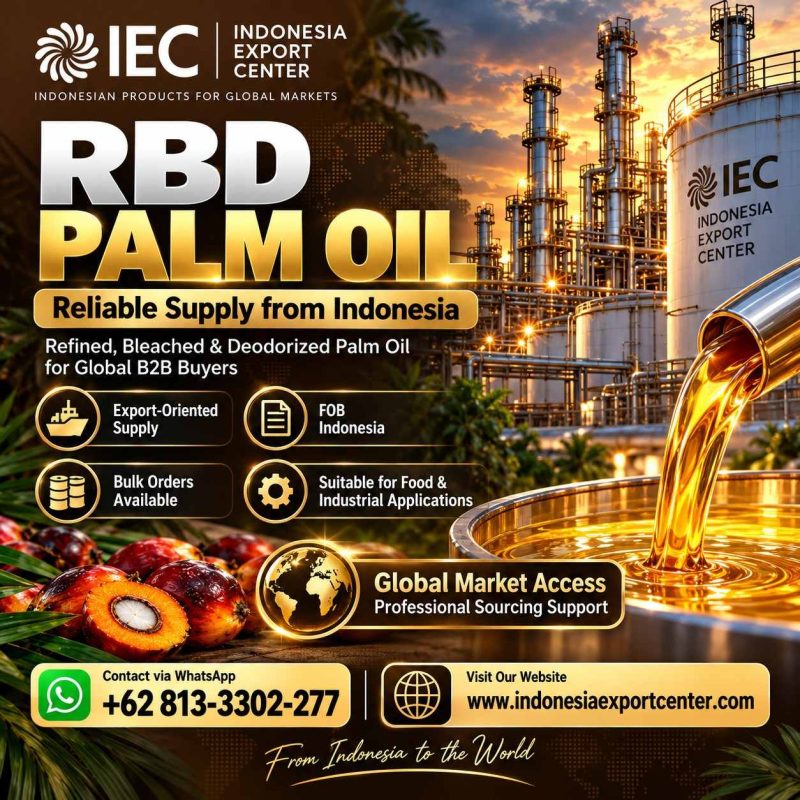
Understanding RBD Palm Oil Quality Specifications
Technical specifications are essential when purchasing RBD Palm Oil for international food manufacturing, industrial processing or commodity distribution.
Two offers described as RBD Palm Oil may have different quality limits, analytical methods or application suitability.
For this reason, professional buyers should request a current Technical Data Sheet (TDS) and a Certificate of Analysis (COA) relevant to the product and shipment.
Indonesia Export Center (IEC) facilitates technical document requests and sourcing inquiries for Indonesian RBD Palm Oil.
This guide explains the major parameters that procurement and quality assurance teams should review.
IEC Reference RBD Palm Oil Specifications
The following values originate from IEC promotional material.
| Parameter | Reference Value | Status |
|---|---|---|
| Product | RBD Palm Oil | Product description |
| Origin | Indonesia | Promotional reference |
| FFA, as palmitic | Maximum 0.10% | Unverified supplier specification |
| Moisture & Impurities | Maximum 0.10% | Unverified supplier specification |
| Iodine Value, Wijs | 50–55 | Unverified supplier specification |
| Melting point | Approximately 33–39°C | Method not supplied |
| Colour, 5¼-inch Lovibond cell | Maximum 3.0 Red | Unverified supplier specification |
| Peroxide Value | Not supplied | Request if relevant |
| Anisidine Value | Not supplied | Request if relevant |
| Fatty acid profile | Not supplied | Request if relevant |
| Solid Fat Content | Not supplied | Request if relevant |
| Batch COA | Not provided | Request actual document |
These values are not independently verified batch test results.
What Is a Technical Data Sheet?
A TDS describes the product and its intended technical specification.
It may include:
- Product identification.
- Physical characteristics.
- Chemical parameters.
- Test methods.
- Acceptance limits.
- Storage recommendations.
- Handling information.
- Packaging options.
- Other supplier-defined technical information.
The buyer should confirm that the TDS applies to the exact product being offered.
What Is a Certificate of Analysis?
A COA reports analytical results for a defined sample or batch.
A useful COA should identify:
- Product name.
- Manufacturer or issuing party.
- Batch or lot number.
- Sampling date where applicable.
- Test date.
- Report date.
- Test parameters.
- Test methods.
- Results.
- Units.
- Acceptance limits where specified.
- Authorized signatory or laboratory identification.
A generic example COA should not be treated as proof of quality for a specific shipment.
Free Fatty Acids (FFA)
FFA is an important parameter in refined palm oil quality evaluation.
The IEC reference states:
FFA, as palmitic acid: maximum 0.10%.
The expression “as palmitic acid” matters because FFA can be reported using different reference acids.
Buyers should ensure that quotations, specifications and laboratory reports use comparable reporting bases.
Moisture and Impurities
Moisture and impurities are relevant to refined oil quality and handling.
The IEC reference states:
Moisture & Impurities: maximum 0.10%.
Buyers should confirm whether the value is reported as a combined parameter and which analytical methods are used.
Moisture and impurities should not be assumed to represent every possible contaminant.
Iodine Value
Iodine Value is a measure related to the degree of unsaturation in fats and oils.
The IEC reference states:
Iodine Value, Wijs: 50–55.
This parameter can help buyers assess whether the material falls within their required product characteristics.
However, iodine value alone does not establish melting performance or complete fatty acid composition.
Melting Point
The IEC promotional material gives an approximate melting point of 33–39°C.
For fats, different melting-point methods can produce different results.
Buyers should confirm whether the supplier is reporting slip melting point or another defined measurement.
A broad melting range should not be used as a substitute for an SFC curve when the application requires detailed physical characterization.
Lovibond Colour
The IEC reference specifies:
Colour: maximum 3.0 Red, using a 5¼-inch Lovibond cell.
Colour readings depend on the specified measurement conditions and method.
Buyers should compare results obtained using the same relevant method.
Additional Quality Parameters
Depending on the application, buyers may require:
Peroxide Value
Relevant to certain oxidation characteristics.
Anisidine Value
May provide information about secondary oxidation products.
Fatty Acid Composition
Useful for detailed formulation and technical evaluation.
Solid Fat Content
Important for margarine, shortening and other structured fat applications.
Contaminant Testing
Food buyers may require assessment of applicable contaminants, including those relevant to refined oils under destination-market regulations.
Traceability
The buyer should be able to identify the relevant product lot and supporting documents.
Sampling and Inspection
A quality agreement should define how samples are collected and tested.
Important considerations include:
- Sampling location.
- Sampling procedure.
- Representative sample requirements.
- Sample sealing.
- Chain of custody.
- Laboratory selection.
- Retained samples.
- Dispute resolution.
- Acceptance criteria.
For bulk cargo, the sampling plan should reflect the actual loading and shipment arrangement.
Comparing Two COAs
| Review Area | Buyer Question |
|---|---|
| Product identity | Same RBD Palm Oil grade? |
| Batch | Traceable to offered cargo? |
| FFA | Same reporting basis? |
| Moisture | Same method and definition? |
| Iodine Value | Comparable test method? |
| Melting point | Same measurement method? |
| Colour | Same Lovibond cell length? |
| Oxidation | Required results included? |
| Contaminants | Relevant market limits assessed? |
| Dates | Current and applicable? |
COA vs Certification
A COA is not the same as a food safety or sustainability certificate.
For example, a batch COA does not by itself establish RSPO certification, Halal certification or compliance with every applicable food safety regulation.
Certification status must be verified separately.
Technical Document Request Template
Subject: RBD Palm Oil TDS and COA Request
Company: [Company]
Application: [Application]
Destination: [Country]
Required quantity: [MT]
Required FFA: [Limit]
Required M&I: [Limit]
Required IV: [Range]
Required melting point: [Range and Method]
Required colour: [Limit and Method]
Additional testing: [Details]
Please provide the current product TDS, representative or batch-specific COA as available, test methods, applicable certifications, MOQ, packaging options and quotation.
Frequently Asked Questions
What is the reference FFA for IEC’s RBD Palm Oil?
The promotional reference is a maximum of 0.10% as palmitic acid.
Is this a guaranteed specification?
No. Supplier verification is required.
What does IV 50–55 mean?
It is the stated reference iodine value range using the Wijs method.
Does a COA prove food-grade compliance?
Not necessarily. Additional regulatory and quality requirements may apply.
Is a melting point enough for margarine formulation?
No. SFC and other physical properties may also be necessary.
Can buyers request a batch-specific COA?
Yes, subject to supplier and laboratory documentation availability.
Request RBD Palm Oil TDS and COA
Quality assurance managers and procurement teams may send their required specifications to IEC for supplier document inquiries.
Indonesia Export Center (IEC)
Website: https://indonesiaexportcenter.com/
WhatsApp: +62 813-3302-277
Technical values are preliminary references. Actual test results, certification status and acceptance criteria must be verified.
Related Resources
RBD Palm Oil Supplier Indonesia
RBD Palm Oil for Margarine Manufacturing
RBD Palm Oil for Shortening Production
