

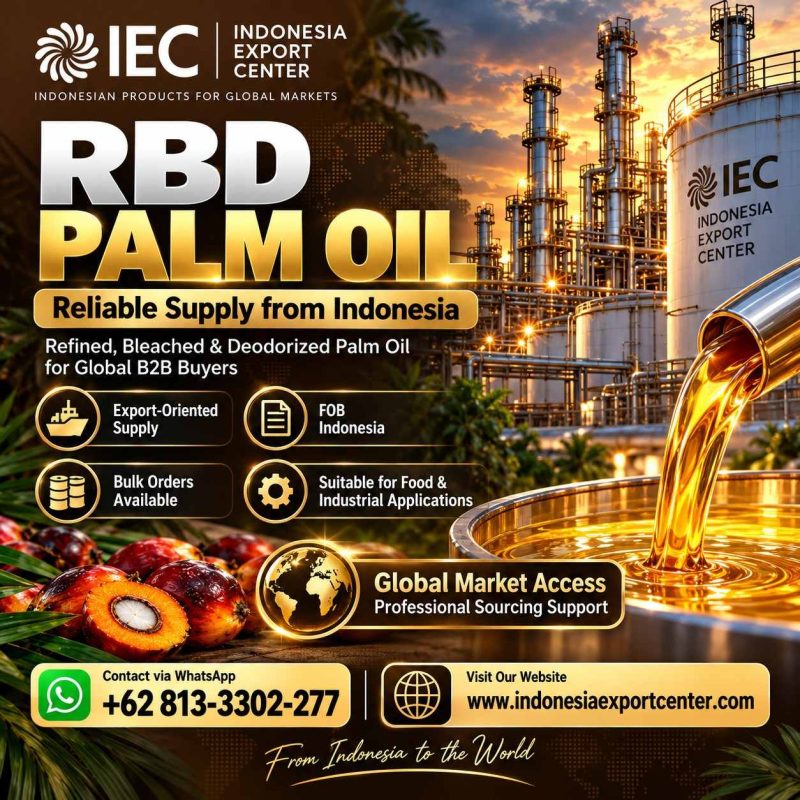
RBD Palm Oil Sourcing for Industrial Shortening Manufacturers
Industrial shortening is used in bakery and food processing applications where fat functionality can influence dough handling, texture, aeration, tenderness, structure and product consistency.
For businesses seeking RBD palm oil for shortening production, Indonesia Export Center (IEC) facilitates inquiries with prospective Indonesian suppliers.
RBD Palm Oil may be evaluated as a component of shortening formulations. Depending on the desired performance, manufacturers may also investigate palm stearin, palm olein and other suitable fats.
The most appropriate material depends on the shortening application, processing method and required functional properties.
What Is Shortening?
Shortening is a fat-based ingredient used in various bakery and food applications.
Different shortening formulations are designed to provide different physical and processing characteristics.
A shortening for cookies may require different performance from one used in cakes, pastries or industrial fillings.
Manufacturers therefore evaluate not only chemical quality but also the behaviour of the fat system during mixing, heating, cooling and storage.
Reference RBD Palm Oil Specifications
| Parameter | IEC Promotional Reference |
|---|---|
| Product | RBD Palm Oil |
| Origin | Indonesia |
| FFA, as palmitic | 0.10% maximum |
| Moisture & Impurities | 0.10% maximum |
| Iodine Value | 50–55 |
| Melting point | Approximately 33–39°C |
| Lovibond colour | 3.0 Red maximum |
| Solid Fat Content | Not provided |
| Plasticity data | Not provided |
| Crystallization profile | Not provided |
These figures should be verified against the actual supplier’s TDS and COA.
Why Fat Selection Matters in Shortening
The physical characteristics of shortening affect the way it interacts with flour, sugar, water and other ingredients.
Important characteristics may include:
- Plasticity.
- Firmness.
- Solid Fat Content.
- Melting behaviour.
- Crystallization.
- Oxidative stability.
- Aeration performance.
- Mixing behaviour.
- Texture contribution.
- Storage stability.
A general RBD Palm Oil specification does not establish all these functional properties.
Shortening Applications
Bread and Bakery Products
Certain shortening formulations may contribute to dough handling and finished-product characteristics.
The effect depends on the recipe and processing conditions.
Cookies and Biscuits
Shortening can influence spread, texture and mouthfeel.
Manufacturers should evaluate candidate fats under actual baking conditions.
Cakes
Some cake formulations require fats with suitable aeration and mixing performance.
These characteristics must be tested rather than inferred from melting point alone.
Pastry Products
Pastry applications may require controlled plasticity and melting behaviour.
A specialized fat blend may be necessary.
Industrial Fillings
Fat systems for fillings may require specific firmness, crystallization and temperature stability.
RBD Palm Oil vs Palm Stearin for Shortening
RBD Palm Oil and Palm Stearin differ in their physical properties.
Palm stearin is generally the higher-melting fraction produced during fractionation.
It may be evaluated when a formulation requires greater structure.
However, not every palm stearin grade is suitable for every shortening application.
The appropriate choice depends on technical testing.
Solid Fat Content and Plasticity
SFC testing is particularly relevant to shortening development.
The relationship between solid and liquid fat at different temperatures can affect processing and finished-product texture.
Buyers should request an SFC curve where available and compare it with their formulation targets.
Plasticity testing and pilot production trials may also be necessary.
Oxidative Quality and Shelf Life
Shortening manufacturers should evaluate relevant oxidation and stability parameters.
Depending on the product, testing may include peroxide value, anisidine value, sensory evaluation and other suitable measurements.
Shelf-life performance depends on the complete formulation, packaging and storage conditions.
Food Safety and Regulatory Considerations
Food-grade shortening raw materials should comply with applicable regulations and customer specifications.
Buyers may need to review:
- Refined oil quality.
- Relevant contaminants.
- Food safety management.
- Traceability.
- Packaging suitability.
- Destination-market requirements.
- Sustainability documentation where required.
No product-specific certification should be assumed without evidence.
Supplier Qualification Checklist
| Area | Procurement Question |
|---|---|
| Grade | Is it suitable for the intended formulation? |
| TDS | Is the current technical sheet available? |
| COA | Are batch results available? |
| SFC | Can the supplier provide an SFC curve? |
| Melting | What method and result apply? |
| Quality | Are oxidation parameters documented? |
| Volume | Can the supplier support the required quantity? |
| Logistics | What bulk handling is available? |
| Documents | What certificates can be verified? |
| Samples | Can a trial sample be supplied? |
Application Trial Programme
A shortening development programme may involve:
- Defining target texture and performance.
- Reviewing candidate fat specifications.
- Preparing laboratory blends.
- Measuring physical characteristics.
- Testing in the intended food product.
- Evaluating storage behaviour.
- Adjusting the formulation.
- Conducting production-scale validation.
No universal substitution ratio can be recommended for all shortening formulations.
Shortening Procurement RFQ
Subject: RBD Palm Oil for Shortening Production – Technical Inquiry
Company: [Company]
Country: [Country]
Shortening application: [Cookies / Cakes / Pastry / Other]
Required oil or fat grade: [Details]
Target melting characteristics: [Details]
Target SFC: [Details]
Required quantity: [MT]
Packaging or loading: [Details]
Destination port: [Port]
Preferred Incoterm: [Term]
Please provide current TDS, available COA, relevant SFC data, samples, MOQ, lead time and export quotation.
Frequently Asked Questions
Is RBD Palm Oil suitable for shortening?
It may be suitable as part of a formulation, subject to testing.
Does all shortening require palm stearin?
No. Formulations vary by application and desired properties.
Is iodine value sufficient to choose a shortening fat?
No. Physical and functional testing is also needed.
Can IEC provide food-grade shortening fat?
IEC can facilitate inquiries for appropriate supplier specifications.
Are samples guaranteed?
No. Sample availability requires confirmation.
Is a fixed price available?
No current commercial price has been verified.
Request a Matching Shortening Specification
Send your target application, required fat properties and purchasing quantity to Indonesia Export Center.
REQUEST MATCHING SPECIFICATION
Indonesia Export Center (IEC)
Website: https://indonesiaexportcenter.com/
WhatsApp: +62 813-3302-277
Application suitability must be confirmed through technical evaluation and supplier documentation.
Related Resources
RBD Palm Oil for Margarine Manufacturing
RBD Palm Oil Specifications and COA
RBD Palm Oil for Food Manufacturing
