

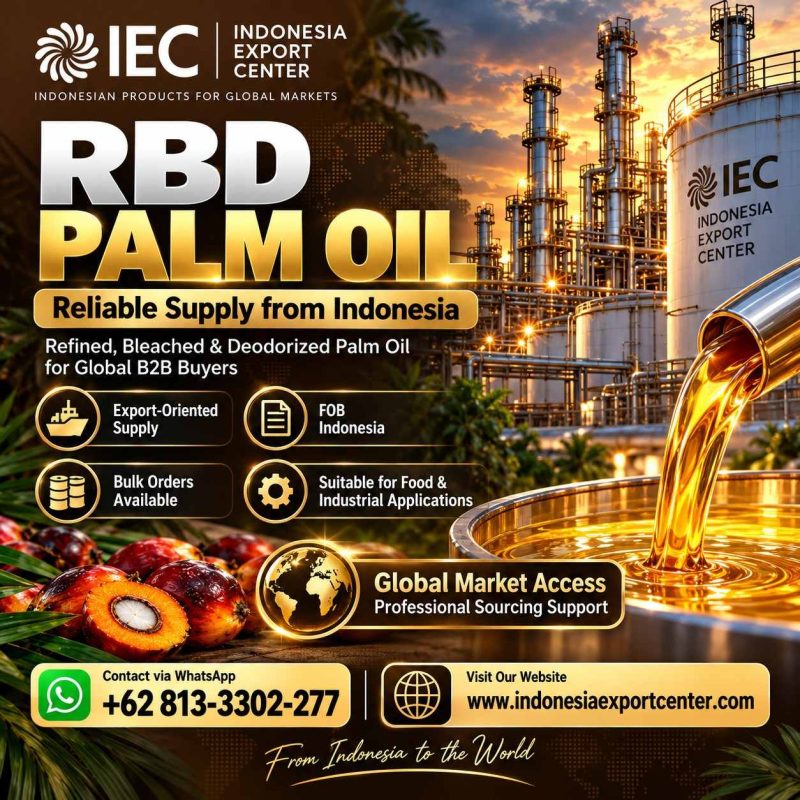
Understanding RBD Palm Oil Export Documentation
International RBD Palm Oil transactions require accurate commercial, shipping, quality and customs documentation.
A shipment may involve several parties, including the Indonesian seller, exporter of record, freight forwarder, carrier, customs broker, bank, inspection company and overseas importer.
For buyers searching for an RBD palm oil export documents checklist, Indonesia Export Center (IEC) provides sourcing support and facilitates requests for relevant supplier documentation.
The precise documents required depend on the destination country, product classification, transport method, trade term, payment arrangement and current regulations.
This guide is a procurement planning resource, not a declaration that every listed document is mandatory or currently available.
RBD Palm Oil Product Information
RBD Palm Oil is refined, bleached and deodorized palm oil.
The IEC promotional reference identifies the following preliminary specifications:
| Parameter | Reference |
|---|---|
| Origin | Indonesia |
| FFA, as palmitic | Maximum 0.10% |
| Moisture & Impurities | Maximum 0.10% |
| Iodine Value, Wijs | 50–55 |
| Melting point | Approximately 33–39°C |
| Lovibond Colour | Maximum 3.0 Red |
The supplier’s actual TDS and COA should establish the product being shipped.
1. Commercial Invoice
The commercial invoice is a central trade document describing the transaction.
It commonly includes:
- Seller and buyer details.
- Invoice number and date.
- Product description.
- Quantity and unit of measurement.
- Unit price and total value.
- Currency.
- Agreed Incoterm.
- Named port or delivery location.
- Other relevant transaction information.
The invoice should be consistent with the sales contract and other shipping documents.
2. Packing List or Cargo Quantity Documentation
For packaged shipments, a packing list may identify the number of drums, IBCs or other units.
It may include net and gross weights, packaging marks and shipment references.
For bulk liquid cargo, the applicable cargo quantity and measurement documents may differ from those used for packaged goods.
The parties should confirm the documentation appropriate to the shipment.
3. Bill of Lading
A bill of lading is an important maritime transport document.
Depending on its form and terms, it may serve as evidence of the carriage contract, receipt of goods and a document of title.
Buyers should verify:
- Shipper.
- Consignee.
- Notify party.
- Vessel.
- Loading port.
- Discharge port.
- Cargo description.
- Quantity.
- Document type.
- Freight terms.
- On-board information where required.
Bank requirements should be checked when a letter of credit is used.
4. Certificate of Origin
A Certificate of Origin may be required or requested to establish the declared origin of goods.
The type of certificate depends on the destination and applicable trade arrangements.
Buyers should determine whether a preferential origin document is relevant and whether the shipment satisfies the applicable origin rules.
A Certificate of Origin does not independently prove product quality.
5. Certificate of Analysis
A COA provides analytical information about a defined product sample or batch.
For RBD Palm Oil, relevant parameters may include FFA, moisture and impurities, iodine value, colour and other contracted quality tests.
A useful COA should identify the product, batch or sample, test methods, results, dates and issuing party.
A generic example COA is not a substitute for shipment-specific evidence.
6. Technical Data Sheet
The TDS describes the supplier’s technical specification.
It should be reviewed before contract execution.
The TDS may include physical and chemical properties, analytical methods, handling recommendations and storage information.
7. Inspection Certificate
An inspection certificate may be required by the buyer, financing bank or applicable regulation.
Inspection can cover quality, quantity, packaging, tank condition or other agreed matters.
The certificate should state the inspection scope and the party issuing it.
8. Food Safety and Regulatory Documents
Food-grade RBD Palm Oil may require additional documentation depending on the destination.
Buyers should verify applicable food safety requirements, contaminant limits, import registrations, permits and other regulatory conditions.
No particular certificate should be assumed mandatory or sufficient for every country.
9. Sustainability and Traceability Documents
Some buyers request sustainability-related documentation.
Where RSPO or another certification is claimed, buyers should verify the certificate holder, validity, applicable scope and supply-chain model.
A sustainability certificate is not interchangeable with a COA or Certificate of Origin.
10. Insurance Documents
For shipments requiring insurance evidence, the buyer should confirm the policy or certificate details.
The required document depends on the contract, Incoterm and financing arrangement.
For CIF shipments, the insurance obligation should be reviewed under the agreed Incoterms rule.
11. Customs and Export Declarations
The exporter of record must comply with applicable Indonesian customs and export requirements.
The importer must separately comply with destination-country customs requirements.
Classification, export levies, duties and any restrictions should be verified using current official information.
Document Checklist by Purpose
| Document | Primary Purpose | Always Mandatory? |
|---|---|---|
| Commercial Invoice | Transaction value and description | Generally central to trade documentation |
| Packing List / Cargo Quantity Record | Shipment contents and quantity | Depends on shipment format and requirements |
| Bill of Lading | Maritime transport | Applicable to relevant sea shipments |
| Certificate of Origin | Origin evidence | Depends on market and agreement |
| TDS | Product specification | Commercially important; requirement varies |
| COA | Analytical quality evidence | Contract- and market-dependent |
| Inspection Certificate | Independent verification | When required |
| Insurance Certificate | Evidence of insurance | Depends on term and contract |
| Food Safety Documents | Regulatory compliance | Destination-dependent |
| Sustainability Certificate | Certified sourcing claims | Only where applicable |
| Customs Declarations | Export and import formalities | Governed by applicable law |
Document Consistency Checks
Before shipment, compare the documents for consistency.
Check that the product description, seller identity, quantity, ports, shipment dates and contractual references agree.
Discrepancies can create customs delays, payment problems or disputes.
For letter-of-credit transactions, document wording and presentation requirements deserve particular attention.
Country-Specific Import Requirements
Import rules differ across markets.
For example, India, Pakistan and Bangladesh may have different product classification, licensing, customs, food safety and financing requirements.
A document accepted in one destination may not satisfy another country’s requirements.
The importer and licensed customs professionals should confirm current requirements before shipment.
Export Documentation RFQ
Subject: RBD Palm Oil Export Documentation Inquiry
Company: [Company]
Destination country: [Country]
Product: RBD Palm Oil
Quantity: [MT]
Packaging: [Details]
Destination port: [Port]
Incoterm: [FOB / CFR / CIF / Other]
Payment method: [TT / LC / Other]
Required documents: [List]
Please confirm which documents can be provided for the proposed shipment, including TDS, COA, origin documentation, shipping documents, inspection evidence and applicable certificates.
Frequently Asked Questions
Is a COA mandatory for every RBD Palm Oil shipment?
Requirements vary. Buyers should establish the applicable contractual and regulatory obligations.
Does a TDS replace a COA?
No. They serve different purposes.
Is a Certificate of Origin the same as a quality certificate?
No.
Are Halal and sustainability certificates automatically included?
No. Their availability and scope must be verified.
Can IEC issue all export documents?
IEC facilitates requests. Documents must be issued by the appropriate authorized parties.
Do export requirements change?
Yes. Buyers should verify current regulations before shipping.
Request an RBD Palm Oil Document Checklist
Send your destination country, shipment details and required documentation to IEC.
Indonesia Export Center (IEC)
Website: https://indonesiaexportcenter.com/
WhatsApp: +62 813-3302-277
Document requirements vary by destination, transaction and current law. IEC is an independent sourcing intermediary and does not automatically act as exporter of record.
Related Resources
How to Import RBD Palm Oil from Indonesia
RBD Palm Oil Specifications and COA
RBD Palm Oil LC Payment and Contract Guide
