

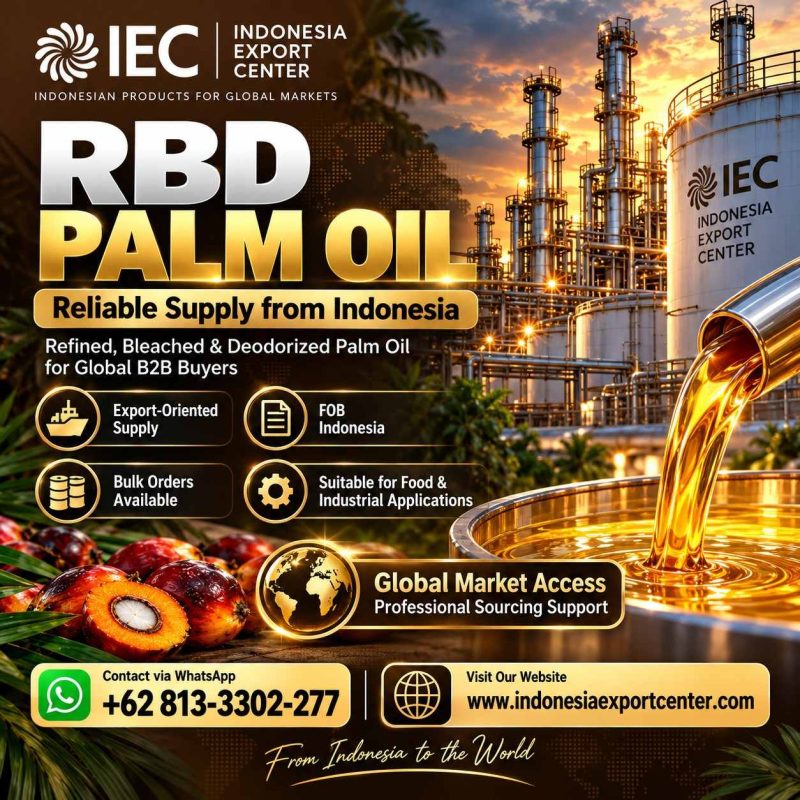
A Practical Import Guide for International RBD Palm Oil Buyers
Importing RBD Palm Oil from Indonesia involves supplier qualification, product specification review, commercial negotiation, regulatory checks, payment arrangements, logistics coordination and customs clearance.
For first-time importers, the process can be complex because refined palm oil is traded in different grades and shipment formats.
Indonesia Export Center (IEC) facilitates inquiries from international buyers interested in sourcing Indonesian RBD Palm Oil.
This guide outlines a structured procurement journey from the initial request for quotation to cargo receipt.
IEC does not guarantee supplier availability, import eligibility, financing approval or shipment performance.
Step 1: Define Your Product Requirement
Begin by identifying the exact product needed.
RBD Palm Oil is different from RBD Palm Olein and RBD Palm Stearin.
A buyer should specify the intended application and the technical properties required.
Reference RBD Palm Oil Specifications
| Parameter | IEC Promotional Reference |
|---|---|
| FFA, as palmitic | Maximum 0.10% |
| Moisture & Impurities | Maximum 0.10% |
| Iodine Value | 50–55 |
| Melting point | Approximately 33–39°C |
| Lovibond Colour | Maximum 3.0 Red |
These are preliminary references. The actual specification must be agreed with the supplier.
Step 2: Confirm Import Eligibility in Your Country
Before requesting shipment, determine whether the intended product may be imported into your market.
Review:
- Customs classification.
- Importer registration.
- Applicable licences.
- Food safety requirements.
- Product standards.
- Import duties and taxes.
- Documentation requirements.
- Any current restrictions.
- Sustainability or traceability obligations where applicable.
Consult the destination country’s official authorities and qualified customs advisers.
Step 3: Identify and Verify Prospective Suppliers
Supplier due diligence should establish who will produce, sell and export the goods.
Request the legal company name, business registration information, refinery identity and relevant supporting documents.
If dealing with a trader, clarify the trader’s commercial relationship with the actual producer.
Do not assume that an intermediary owns a refinery or controls the quoted inventory.
Step 4: Prepare a Detailed RFQ
A complete Request for Quotation should include:
- Product grade.
- Required technical specification.
- Intended application.
- Quantity in metric tonnes.
- Preferred packaging.
- Destination country.
- Destination port.
- Preferred Incoterm.
- Shipment schedule.
- Required documentation.
- Inspection requirements.
- Preferred payment method.
A detailed RFQ makes it easier to compare offers on the same basis.
Step 5: Review Technical Documentation
Request the current TDS and available COA.
Check that the product grade and test methods correspond to your requirements.
For food manufacturing, review applicable food safety and contaminant requirements.
For margarine and shortening, additional physical property data may be needed.
Step 6: Evaluate Samples or Representative Data
Where commercially feasible, buyers may request samples.
Sample testing can help evaluate product suitability.
However, a sample result does not automatically guarantee that every future shipment will have identical characteristics.
The contract should establish the agreed quality limits and acceptance process.
Step 7: Compare Supplier Quotations
Review the quotation date, currency, product specification, quantity, packaging, loading port, destination and payment terms.
A low unit price may not represent the lowest total cost if freight, inspection, storage or destination expenses are higher.
Step 8: Choose the Appropriate Incoterm
Common maritime trade terms include FOB, CFR and CIF.
Under FOB, the buyer generally arranges main carriage.
Under CFR, the seller contracts the main freight.
Under CIF, the seller contracts freight and required insurance.
Risk transfer and cost allocation should be understood separately.
For certain containerized shipments, FCA or CIP may be more suitable.
Step 9: Negotiate the Sales Contract
A sales contract or Sale and Purchase Agreement (SPA) should define the commercial transaction.
Important clauses may include:
- Buyer and seller identity.
- Product grade.
- Technical specification.
- Quantity and tolerance.
- Price and currency.
- Incoterm and named location.
- Shipment period.
- Inspection.
- Quality acceptance.
- Required documents.
- Payment.
- Claims.
- Dispute resolution.
- Applicable law.
The parties should obtain appropriate legal review where necessary.
Step 10: Establish Payment Arrangements
Payment may involve advance payment, documentary credit or another mutually agreed structure.
The available method depends on the supplier and the buyer’s financing arrangements.
For a letter of credit, the buyer should consult its bank before finalizing document requirements.
IEC does not guarantee bank acceptance or transaction financing.
Step 11: Confirm Production and Shipment Readiness
Before shipping, request confirmation of the agreed product quantity, loading arrangement and expected schedule.
The buyer should also verify any required inspection and documentation arrangements.
Do not assume that a preliminary quotation represents confirmed inventory.
Step 12: Arrange Cargo Inspection
Where appropriate, arrange pre-shipment inspection.
The scope may cover quality, quantity, packaging, tank cleanliness, seals and documentation.
The parties should agree on the inspection company, sampling method and acceptance criteria.
Step 13: Coordinate Shipping
Confirm the vessel or container arrangement, loading location, transport documentation and destination facilities.
For bulk liquid shipments, verify cargo-handling and temperature procedures with the relevant professionals.
Step 14: Prepare Customs Documentation
The exporter and importer must comply with their respective customs obligations.
Documents may include the commercial invoice, packing or cargo quantity records, transport documents, origin documentation, COA and other required certificates.
Step 15: Complete Import Clearance
The importer or appointed customs broker should complete the applicable destination-country clearance procedures.
Duties, taxes, inspection requirements and release conditions depend on current law.
Step 16: Receive and Inspect the Cargo
Upon arrival, buyers should verify cargo quantity and condition according to the agreed procedures.
Any discrepancies should be documented promptly.
The sales contract should define notification deadlines and claim procedures.
Step 17: Evaluate Supplier Performance
After delivery, review:
- Quality consistency.
- Document accuracy.
- Shipment timing.
- Communication.
- Cargo condition.
- Quantity.
- Claims handling.
- Overall landed cost.
This information can support future purchasing decisions.
Import Planning Checklist
| Stage | Buyer Action |
|---|---|
| Product selection | Confirm exact grade |
| Compliance | Check import eligibility |
| Supplier | Verify legal identity |
| RFQ | Specify volume and terms |
| Quality | Review TDS and COA |
| Commercial | Compare quotations |
| Contract | Agree written conditions |
| Payment | Confirm banking arrangements |
| Inspection | Establish sampling and testing |
| Logistics | Verify cargo handling |
| Customs | Prepare destination requirements |
| Delivery | Inspect and reconcile cargo |
Common Import Mistakes
Confusing RBD Palm Oil with Palm Olein
These are related but different products.
Requesting Prices Without Specifications
A quotation is difficult to evaluate without a defined grade.
Ignoring Destination Regulations
A supplier’s ability to export does not automatically establish the buyer’s right to import.
Assuming All Certificates Are Available
Certification and document availability must be verified.
Overlooking Cargo Handling
Temperature, cleanliness and unloading requirements may affect shipment performance.
Using Incomplete Contracts
Unclear quality, quantity and claims provisions can create avoidable disputes.
Import Inquiry Template
Subject: RBD Palm Oil Import Requirements – Indonesia Sourcing
Company: [Company]
Country: [Country]
Intended application: [Application]
Product: RBD Palm Oil
Specification: [Details]
Quantity: [MT]
Packaging: [Details]
Destination port: [Port]
Preferred Incoterm: [Term]
Payment preference: [Details]
Required documents: [Details]
Expected shipment period: [Date]
Please advise prospective supplier feasibility, available technical documentation, MOQ, quotation process and shipping arrangements.
Frequently Asked Questions
Can a first-time importer buy RBD Palm Oil from Indonesia?
Potentially, provided the importer satisfies applicable requirements and reaches an agreement with a suitable supplier.
Does IEC act as the exporter?
Not automatically. IEC is an independent sourcing intermediary.
Is there a fixed minimum order?
No verified universal MOQ is available.
Can buyers request samples?
Sample feasibility must be confirmed.
Is an LC mandatory?
Not universally. Payment requirements depend on the contract and applicable rules.
Can IEC guarantee customs clearance?
No. Clearance depends on the importer, authorities and documentation.
Submit Your RBD Palm Oil Import Requirements
Indonesia Export Center welcomes inquiries from first-time importers, established distributors and industrial buyers.
Indonesia Export Center (IEC)
Website: https://indonesiaexportcenter.com/
WhatsApp: +62 813-3302-277
Supplier feasibility, import eligibility, financing, certifications and shipment arrangements require independent verification and commercial agreement.
Related Resources
RBD Palm Oil Supplier Indonesia
RBD Palm Oil LC Payment and Contract Guide
