

IEC | INDONESIA EXPORT CENTER
Your Global Sourcing Partner
Understanding the Difference Between PFAD and RBD Palm Olein
Palm Fatty Acid Distillate (PFAD) and Refined, Bleached and Deodorized Palm Olein (RBD Palm Olein) are both associated with the palm oil processing industry.
However, they are fundamentally different products.
PFAD is a fatty acid-rich by-product generated during certain refining processes, while RBD palm olein is a refined liquid fraction of palm oil obtained through fractionation.
For importers, manufacturers, and commodity buyers, understanding this distinction is essential to avoid purchasing the wrong material.
Indonesia Export Center (IEC) facilitates inquiries involving potential Indonesian palm-derived product suppliers. Availability and suitability of any particular product must be confirmed.
What Is PFAD?
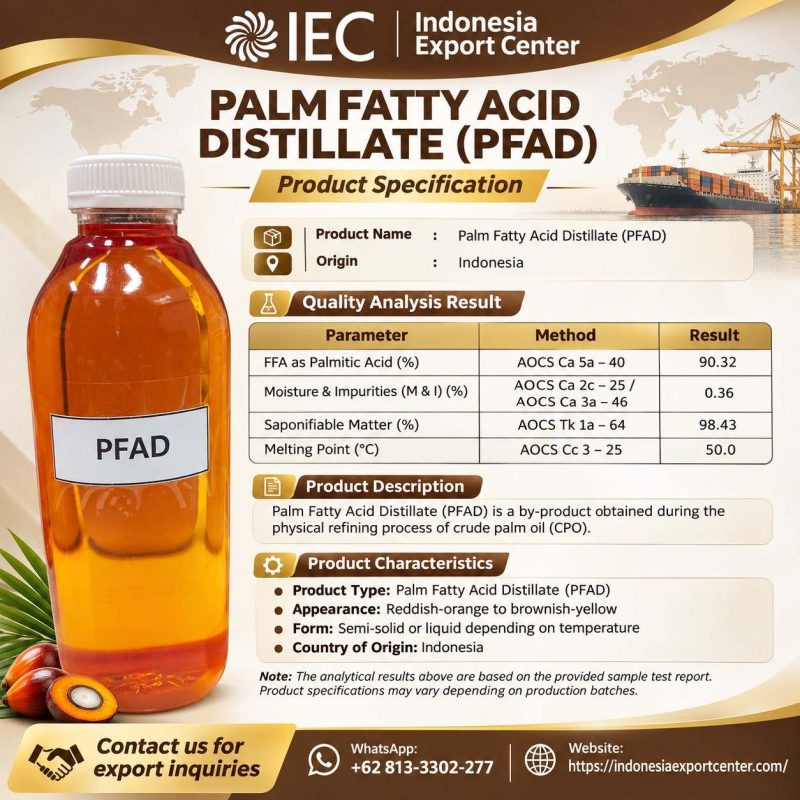
PFAD stands for Palm Fatty Acid Distillate.
It is generated when free fatty acids and certain other volatile components are separated during palm oil refining.
PFAD is typically characterized by relatively high free fatty acid content.
Potential applications include selected oleochemical, biodiesel, fatty acid ester, and industrial chemical processes.
What Is RBD Palm Olein?
RBD Palm Olein is the liquid fraction obtained from refined palm oil through fractionation.
It is commonly used in edible oil applications when the product meets applicable food safety and quality requirements.
It may also be used in certain industrial applications.
RBD palm olein is not simply another name for PFAD.
PFAD vs RBD Palm Olein Comparison
| Characteristic | PFAD | RBD Palm Olein |
|---|---|---|
| Full Name | Palm Fatty Acid Distillate | Refined, Bleached and Deodorized Palm Olein |
| Production Origin | Refining distillate stream | Refined palm oil liquid fraction |
| Main Chemical Character | Fatty acid-rich | Predominantly triglyceride oil |
| FFA Characteristic | Typically high | Generally controlled at a much lower level |
| Common Market | Industrial feedstock | Edible oil and selected industrial markets |
| Physical Behavior | May solidify or become semi-solid | Generally liquid under suitable conditions |
| Quality Requirements | Industrial application-specific | Grade and intended-use-specific |
| Food-Grade Status | Must not be assumed | Requires applicable food-grade verification |
Difference in Production Processes
PFAD Production
PFAD arises during certain palm oil refining operations when free fatty acids and other volatile substances are separated.
RBD Palm Olein Production
Palm oil undergoes refining and fractionation to produce different fractions, including palm olein and palm stearin.
The liquid fraction is commercially identified as palm olein.
Difference in Chemical Composition
PFAD is generally rich in free fatty acids.
RBD palm olein predominantly contains triglycerides, with specifications designed for its intended market.
These compositional differences affect how the products behave during processing and which manufacturing routes may be appropriate.
Difference in Industrial Applications
PFAD Applications
PFAD may be evaluated for:
- Biodiesel feedstock processing.
- Oleochemical manufacturing.
- Fatty acid ester production.
- Selected soap feedstock processes.
- Other industrial chemical applications.
RBD Palm Olein Applications
Suitable grades may be used for:
- Cooking oil.
- Food processing.
- Frying applications.
- Food manufacturing.
- Selected industrial applications.
Product qualification remains necessary.
Food-Grade Considerations
A critical distinction is that PFAD should not be represented as interchangeable with food-grade RBD palm olein.
A material’s suitability for food use requires appropriate manufacturing controls, specifications, regulatory compliance, and supporting documentation.
The IEC PFAD brochure does not establish food-grade status.
IEC PFAD Reference Specifications
| Parameter | PFAD Reference |
|---|---|
| FFA (as Palmitic) | Minimum 90% |
| Moisture & Impurities | Maximum 1.0% |
| Iodine Value | Maximum 50 |
| Melting Point | 36–46°C |
| Colour (Gardner) | Maximum 7 |
| Appearance | White / Off White Solid |
These values are not RBD palm olein specifications.
Which Product Should Buyers Choose?
Choose a PFAD Inquiry When:
Your industrial process is designed to use fatty acid-rich material and your technical team has established suitable feedstock requirements.
Choose an RBD Palm Olein Inquiry When:
You require a refined palm oil liquid fraction for an application compatible with that product.
Request Technical Clarification When:
The application, required composition, regulatory classification, or product grade is uncertain.
Procurement Questions for Comparing the Two Products
- What is the intended application?
- Is a fatty acid-rich or triglyceride-rich material required?
- What FFA level is acceptable?
- What are the relevant contaminants?
- Is food-grade compliance necessary?
- What are the storage and handling requirements?
- Which certificates and laboratory reports are required?
- What is the actual product being offered?
Why Price Alone Is Not Enough
PFAD and RBD palm olein should not be compared solely on price per metric ton.
The buyer should evaluate the total manufacturing cost, including pretreatment, processing efficiency, technical suitability, logistics, and compliance.
A cheaper but incompatible feedstock may create greater overall costs.
Sample Product Selection RFQ
Subject: Indonesian Palm-Derived Product Inquiry – PFAD or RBD Palm Olein
Company: [Name]
Country: [Country]
Application: [Details]
Required Product: [PFAD / RBD Palm Olein / Technical Review Needed]
Quantity: [MT]
Required Specifications: [Details]
Destination Port: [Port]
Preferred Incoterm: [Term]
Shipment Period: [Dates]
Please provide information on potential suppliers and appropriate product documentation.
Frequently Asked Questions
Is PFAD the same as RBD palm olein?
No. They are different products with different compositions and uses.
Is PFAD an edible cooking oil?
Food-grade suitability must not be assumed. The supplied IEC PFAD reference describes an industrial material.
Does RBD palm olein have 90% FFA?
No. That is not the typical characteristic of refined palm olein.
Can PFAD replace RBD palm olein?
Not without specific technical evaluation; they are not general substitutes.
Are both derived from palm oil processing?
Yes, but through different processing streams.
Can IEC help identify the appropriate supplier category?
IEC can facilitate product-specific sourcing inquiries, while final technical selection remains with the buyer.
Request Indonesian Palm-Derived Product Sourcing Information
Avoid product selection errors by defining your intended application and technical requirements before requesting a quotation.
IEC | INDONESIA EXPORT CENTER
Website: https://indonesiaexportcenter.com/
WhatsApp: +62 813-3302-277
Related Resources
Palm Fatty Acid Distillate Indonesia
