

IEC | INDONESIA EXPORT CENTER
Your Global Sourcing Partner
Understanding Sustainability Due Diligence for Indonesian PFAD
Sustainability and traceability are increasingly important considerations in international industrial procurement.
For companies sourcing Palm Fatty Acid Distillate from Indonesia, questions may arise concerning the material’s origin, refinery source, upstream palm oil supply chain, certification status, and eligibility under specific buyer or regulatory programs.
PFAD is produced during certain palm oil refining processes and is often described as a by-product. However, the term “by-product” does not automatically establish sustainability, waste classification, greenhouse gas savings, or regulatory eligibility.
Each claim requires a defined basis and appropriate evidence.
Indonesia Export Center (IEC) facilitates potential Indonesian PFAD supplier inquiries. IEC does not automatically verify plantation-level traceability, certify suppliers, or guarantee sustainability claims.
What Does PFAD Traceability Mean?
Traceability refers to the ability to identify and document relevant stages in a product’s supply chain.
For PFAD, this may involve:
- Contracting seller.
- Producing refinery.
- Product batch or tank.
- Refining process.
- Upstream palm oil suppliers.
- Mills.
- Plantations, where relevant and available.
The level of traceability required depends on the buyer’s policy and applicable regulations.
Why PFAD Traceability Can Be Complex
PFAD is associated with palm oil refining.
A refinery may process feedstock obtained from multiple upstream sources, potentially making full origin reconstruction more complex.
Buyers should therefore distinguish between:
Supplier Traceability: Identification of the immediate seller.
Refinery Traceability: Identification of the facility where PFAD was generated.
Batch Traceability: Identification of the relevant production or storage batch.
Upstream Traceability: Documentation concerning the palm oil supply chain.
Plantation Traceability: Evidence linking relevant feedstock to plantation-level sources.
These levels should not be treated as equivalent.
IEC PFAD Reference Specifications
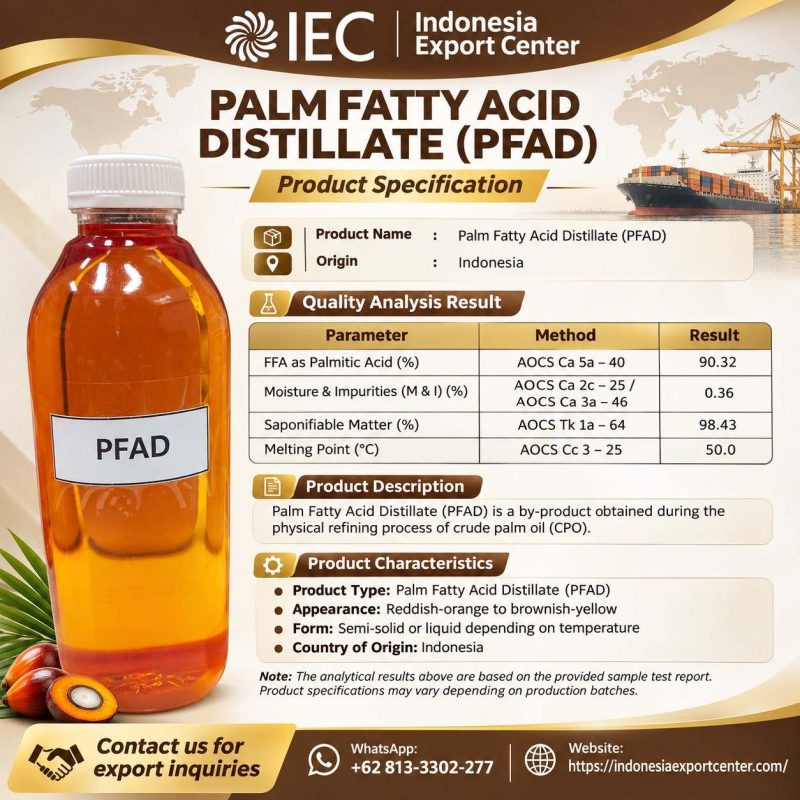
| Parameter | Reference |
|---|---|
| FFA, as Palmitic | Minimum 90% |
| Moisture & Impurities | Maximum 1.0% |
| Iodine Value | Maximum 50 |
| Melting Point | 36–46°C |
| Gardner Colour | Maximum 7 |
| Appearance | White / Off White Solid |
These parameters describe reference product quality, not sustainability performance.
A COA alone does not establish traceability or certification.
Key Sustainability Questions for PFAD Buyers
1. Who Produced the Material?
Ask for the refinery identity where available.
The contracting seller may be different from the producing refinery.
2. What Is the Product’s Actual Origin?
Clarify whether origin refers to the country of shipment, refinery location, or upstream feedstock origin.
3. Can the Shipment Be Linked to a Batch?
Request appropriate batch, tank, or production records.
4. What Upstream Information Is Available?
Ask whether the supplier can provide documented information concerning relevant mills or plantation sources.
5. Is Any Certification Claimed?
If so, request evidence of the specific certification, holder, scope, validity, and applicable product chain.
6. What Chain-of-Custody Model Applies?
Certification programs may use different chain-of-custody arrangements.
These arrangements should not be described as identical.
7. Are Sustainability Claims Independently Verified?
Request appropriate audit or verification evidence where required.
8. Are Regulatory Requirements Applicable?
Assess the specific destination, use, classification, and relevant legal framework.
Understanding Certification Claims
Buyers may encounter sustainability programs associated with palm oil supply chains.
For example, an RSPO-related claim should be evaluated using the applicable certification and chain-of-custody rules.
Important distinctions include:
- Organization membership.
- Facility certification.
- Product certification claims.
- Chain-of-custody model.
- Actual transaction documentation.
A company being a member of a sustainability organization does not automatically mean every product it sells carries a certified claim.
PFAD and Waste or Residue Classification
The description of PFAD as a refining by-product does not automatically determine its treatment under a biofuel, waste, residue, or sustainability framework.
Different programs may use different eligibility criteria.
Buyers should confirm the relevant legal and technical definitions before making claims.
PFAD and Deforestation-Related Due Diligence
For markets with deforestation-related requirements, buyers should assess whether the actual product and transaction fall within the relevant rules.
Questions may include:
- What is the correct product classification?
- Which legal requirements apply?
- What information must the operator collect?
- Are upstream origin records required?
- What evidence is available?
- What is the applicable compliance timeline?
The regulatory position must be verified using current official requirements.
Sustainability Evidence Checklist
| Buyer Question | Evidence to Request |
|---|---|
| Who is the supplier? | Legal registration |
| Who produced the PFAD? | Refinery information |
| Which batch is offered? | Batch or tank records |
| What is the stated origin? | Relevant supporting records |
| Is certification claimed? | Valid certification evidence |
| What chain-of-custody model applies? | Applicable transaction documents |
| Is plantation traceability required? | Relevant upstream records |
| Are emissions claims made? | Methodology and verified calculations |
| Is regulatory eligibility claimed? | Applicable legal basis and evidence |
Common Unsupported Claims to Avoid
“All PFAD Is Sustainable”
Sustainability depends on the applicable criteria and supporting evidence.
“PFAD Has Zero Emissions”
Such a claim cannot be established without a defined and justified accounting methodology.
“PFAD Is Automatically Certified”
Certification requires valid evidence.
“Country of Origin Proves Plantation Origin”
These are different levels of information.
“PFAD Always Qualifies as Waste”
Classification depends on the relevant program and legal framework.
Supplier Due Diligence Process
A practical sequence is:
- Identify the contracting seller.
- Request refinery information.
- Confirm the proposed product.
- Review current quality documents.
- Request available origin records.
- Identify the buyer’s sustainability criteria.
- Verify certification claims.
- Evaluate gaps.
- Request additional evidence where necessary.
- Document the procurement decision.
PFAD Sustainability Inquiry Template
Subject: PFAD Traceability and Sustainability Documentation Request
Buyer Company: [Name]
Country: [Country]
Product: Palm Fatty Acid Distillate
Quantity: [MT]
Application: [Details]
Required Traceability Level: [Supplier / Refinery / Batch / Upstream]
Certification Requirement: [If Applicable]
Regulatory Framework: [If Applicable]
Required Origin Records: [Details]
Required Emissions Documentation: [If Applicable]
Destination Country: [Country]
Please identify which documents can be supported by verifiable supplier records and which information remains unavailable or unconfirmed.
Frequently Asked Questions
Is PFAD automatically sustainable because it is a by-product?
No.
Does a COA prove sustainable sourcing?
No. A COA reports analytical results.
Can PFAD be traced to a refinery?
Potentially, where suitable records are available.
Is plantation-level traceability always available?
No. Availability must be verified.
Does RSPO membership establish a certified shipment?
No. Product claims require appropriate certification and chain-of-custody evidence.
Can IEC guarantee traceability records?
No. Documentation must be confirmed with the relevant supplier.
Request PFAD Traceability and Supplier Information
Looking for Indonesian PFAD while conducting responsible sourcing and supply-chain due diligence?
Share your purchasing specifications and documentation requirements with IEC.
REQUEST PFAD TRACEABILITY INFORMATION
IEC | INDONESIA EXPORT CENTER
Website: https://indonesiaexportcenter.com/
WhatsApp: +62 813-3302-277
Related Resources
PFAD Supplier Due Diligence Checklist
PFAD Carbon Accounting and Feedstock Claims
