

IEC | INDONESIA EXPORT CENTER
Your Global Sourcing Partner
Source Indonesian PFAD for South Korean Industrial Manufacturing
South Korean manufacturers and industrial trading companies evaluating imported palm-derived feedstocks need reliable technical information, clearly identified commercial counterparties, and a structured supplier qualification process.
Palm Fatty Acid Distillate (PFAD) is a fatty acid-rich material generated during certain palm oil refining processes. It may be evaluated for selected oleochemical, fatty acid ester, industrial soap, and biodiesel-related applications, subject to technical and regulatory suitability.
For South Korean buyers, purchasing PFAD from Indonesia involves several interconnected decisions: defining a suitable grade, obtaining representative samples, reviewing analytical data, checking Korean import requirements, and confirming the feasibility of the proposed shipment.
Indonesia Export Center (IEC) helps facilitate inquiries involving potential Indonesian PFAD suppliers. IEC is a sourcing intermediary and does not guarantee inventory, supplier certification, product approval, or delivery.
Why South Korean Buyers Evaluate Indonesian PFAD
Industrial procurement teams may investigate Indonesian PFAD when seeking to:
- Evaluate alternative fatty acid feedstock sources.
- Compare different supplier specifications.
- Support industrial raw material diversification.
- Assess material suitability for chemical conversion.
- Plan trial shipments before recurring procurement.
- Obtain additional commercial quotations.
- Evaluate supply-chain documentation.
Each purchasing decision should be based on verified commercial and technical information rather than assumptions about origin.
Understanding PFAD as an Industrial Feedstock
PFAD is distinct from crude palm oil, refined palm olein, palm kernel oil, and palm stearin.
Its high free fatty acid content can make it relevant to certain chemical conversion pathways. However, the composition and impurities of the actual material determine whether it is suitable for a particular process.
Potential uses include oleochemical intermediates, fatty acid esters, industrial soaps, and selected biofuel feedstock processes.
PFAD should not automatically be treated as food-grade material or a finished chemical product.
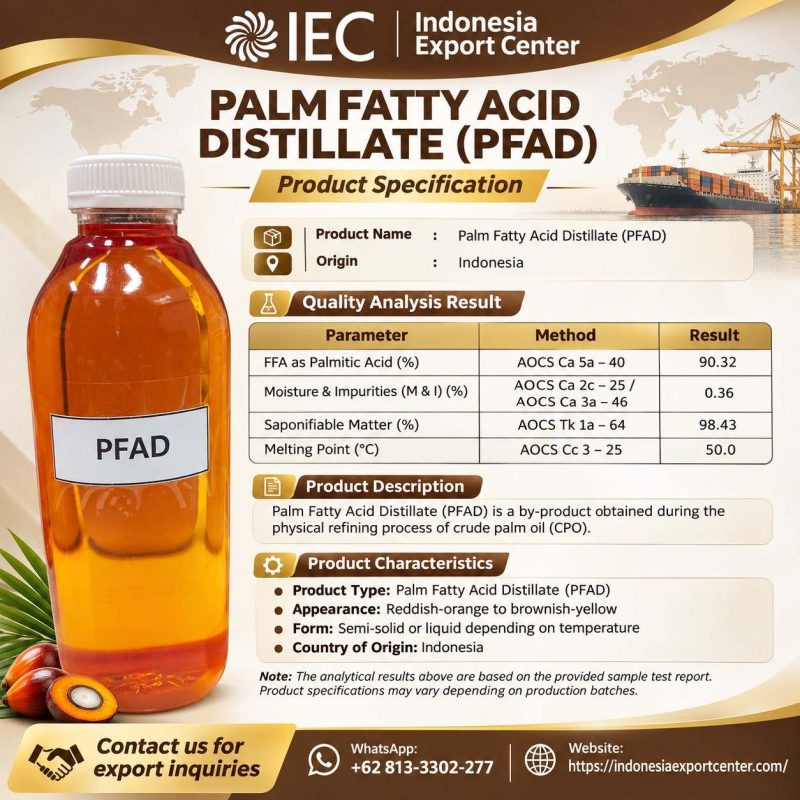
IEC PFAD Reference Specifications
| Parameter | Reference Specification |
|---|---|
| Free Fatty Acids (as Palmitic) | Minimum 90% |
| Moisture & Impurities | Maximum 1.0% |
| Iodine Value | Maximum 50 |
| Melting Point | 36–46°C |
| Colour (Gardner) | Maximum 7 |
| Appearance | White / Off White Solid |
Packaging concepts: Bulk in Tank and Flexibag.
These values come from IEC’s product brochure. Actual quality must be established through a relevant Certificate of Analysis (COA), sampling, and agreed inspection procedures.
Step 1 – Define the Korean Buyer’s Technical Requirements
Before requesting a quotation, the buyer should establish its acceptance specification.
Important questions include:
- What minimum FFA is required?
- Is FFA reported as palmitic acid?
- What are the acceptable moisture and impurity limits?
- Is fatty acid composition required?
- Which iodine value range is acceptable?
- Are colour and odour important?
- Are additional contaminants relevant to the application?
- Which analytical methods will be used?
A specification should be based on the manufacturing process rather than simply copied from a supplier brochure.
Step 2 – Request Technical Documentation
South Korean quality and procurement teams may request:
- Product specification sheet.
- Current COA.
- Available Safety Data Sheet.
- Description of the refining origin.
- Sampling and analytical methods.
- Product identification or batch information.
- Packaging details.
- Available origin or traceability information.
A supplier should not be assumed to possess a certification or approval that has not been verified.
Step 3 – Qualify a Representative Sample
For specialty chemical and industrial manufacturing applications, sample qualification can be an important purchasing stage.
A useful qualification sequence is:
Document review → Sample request → Laboratory testing → Application trial → Commercial evaluation.
The sample should be identifiable and, where possible, linked to its source lot.
The laboratory may compare results against the buyer’s own acceptance limits.
A successful sample trial does not guarantee that future commercial shipments will have identical characteristics.
Step 4 – Verify South Korean Regulatory Requirements
The Korean importer should confirm current requirements under the applicable customs, chemical, environmental, and product-specific frameworks.
Depending on the product and intended use, relevant screening may involve:
- Customs classification.
- Import declarations.
- Applicable duties and taxes.
- Chemical regulatory obligations.
- Safety documentation.
- End-use restrictions.
- Required registrations or notifications.
- Product-specific testing.
Where relevant, the importer should evaluate obligations under South Korea’s chemical regulatory system, including K-REACH, with qualified local specialists.
PFAD should not be described as automatically K-REACH compliant or exempt. The applicable status depends on substance identity, legal requirements, exemptions, and the responsible parties.
Step 5 – Select the Receiving Port and Facility
A South Korean buyer may investigate logistics through ports such as Busan, Incheon, Ulsan, or other appropriate receiving locations.
These are examples for route evaluation, not confirmed PFAD shipment services.
The buyer must verify:
- Actual terminal acceptance.
- Cargo compatibility.
- Storage capacity.
- Heating and pumping requirements.
- Customs arrangements.
- Inland transport.
- Discharge facilities.
Step 6 – Assess PFAD Temperature Management
PFAD may become viscous or solid under certain temperature conditions.
The brochure’s melting range of 36–46°C is not a universal pumping or storage temperature.
The receiving facility should establish cargo-specific procedures using actual viscosity, melting, equipment, and safety information.
Step 7 – Compare Commercial Quotations
| Comparison Factor | Buyer Review |
|---|---|
| Supplier Identity | Verify legal company |
| Product Grade | Match technical specification |
| COA | Review current results |
| Quantity | Confirm |
| Price | Request dated offer |
| Currency | Specify |
| Incoterm | Specify edition and named place |
| Destination | Confirm port |
| Packaging | Approve |
| Inspection | Agree |
| Payment | Negotiate |
| Delivery | Confirm feasibility |
Step 8 – Consider Sustainability Requirements
Certain South Korean buyers may have internal environmental or supply-chain policies.
Where such requirements apply, request relevant documentation rather than assuming that PFAD’s by-product status establishes sustainability or emissions benefits.
Claims should be supported by appropriate evidence.
South Korea PFAD Supplier Qualification Checklist
- Confirm product identity.
- Establish buyer specifications.
- Review supplier registration.
- Confirm selling authority.
- Obtain current COA.
- Request representative samples.
- Complete laboratory evaluation.
- Screen applicable Korean regulations.
- Confirm receiving facilities.
- Verify shipping arrangements.
- Agree on payment and inspection.
- Document quality acceptance procedures.
PFAD RFQ Template for South Korean Buyers
Subject: Indonesian PFAD Supplier Inquiry – South Korea
Buyer Company: [Name]
Country: Republic of Korea
Industrial Application: [Details]
Product: Palm Fatty Acid Distillate
Required Quantity: [MT]
Monthly Demand: [MT]
FFA Requirement: [Minimum, as Palmitic]
Moisture & Impurities: [Maximum]
Additional Analytical Requirements: [Details]
Sample Requirement: [Quantity]
Destination Port: [Port]
Preferred Incoterm: [Term]
Required Documents: [COA / Specification / SDS / Other]
Shipment Period: [Dates]
Please provide potential supplier information, current technical documentation, and details needed to evaluate a commercial quotation.
Frequently Asked Questions
Can South Korean companies request PFAD from Indonesia?
Yes. Buyers may submit sourcing inquiries, subject to supplier availability and applicable import requirements.
Can PFAD be used in Korean oleochemical manufacturing?
Potentially, if the material meets the process specifications and relevant requirements.
Is IEC’s PFAD automatically approved under Korean chemical regulations?
No. Applicable regulatory obligations require independent verification.
Can buyers request samples before a commercial order?
Yes, subject to supplier confirmation and shipping feasibility.
Does IEC guarantee delivery to Busan or Ulsan?
No. Route and facility compatibility must be verified.
Can Korean buyers request recurring monthly supply?
Yes. Actual capacity and terms must be confirmed.
Request PFAD Supplier Information for South Korea
Looking for Indonesian Palm Fatty Acid Distillate for industrial manufacturing in South Korea?
Send IEC your product specifications, application, quantity, documentation requirements, and preferred destination.
REQUEST PFAD SUPPLIER INFORMATION
IEC | INDONESIA EXPORT CENTER
Website: https://indonesiaexportcenter.com/
WhatsApp: +62 813-3302-277
Related Resources
