

IEC | INDONESIA EXPORT CENTER
Your Global Sourcing Partner
Sourcing Indonesian PFAD for Malaysian Industrial Manufacturers
Malaysia has an established palm oil processing and oleochemical industry. For Malaysian manufacturers, traders, and industrial procurement teams, purchasing Palm Fatty Acid Distillate from Indonesia may be considered as part of a broader raw material sourcing strategy.
Because Malaysia also has domestic palm-derived feedstock production, Malaysian buyers may compare Indonesian PFAD with locally available alternatives.
A sound comparison should consider actual product quality, supply reliability, delivered cost, processing suitability, and regulatory requirements.
Indonesia Export Center (IEC) facilitates inquiries involving potential Indonesian PFAD suppliers.
IEC does not guarantee that Indonesian PFAD will be cheaper than Malaysian alternatives or that any particular shipment route is available.
Why Malaysian Buyers May Evaluate Indonesian PFAD
Potential procurement considerations include:
- Diversifying supply sources.
- Comparing commercial quotations.
- Evaluating different refinery sources.
- Supporting industrial production planning.
- Seeking alternative delivery schedules.
- Comparing technical specifications.
- Reviewing total delivered feedstock costs.
The economic benefit depends on actual offers and operating requirements.
What Is Palm Fatty Acid Distillate?
PFAD is a fatty acid-rich by-product generated during certain palm oil refining processes.
It may be evaluated for:
- Oleochemical manufacturing.
- Fatty acid ester production.
- Industrial soap manufacturing.
- Selected biodiesel feedstock processes.
- Other suitable chemical applications.
PFAD is not interchangeable with every other palm-derived raw material.
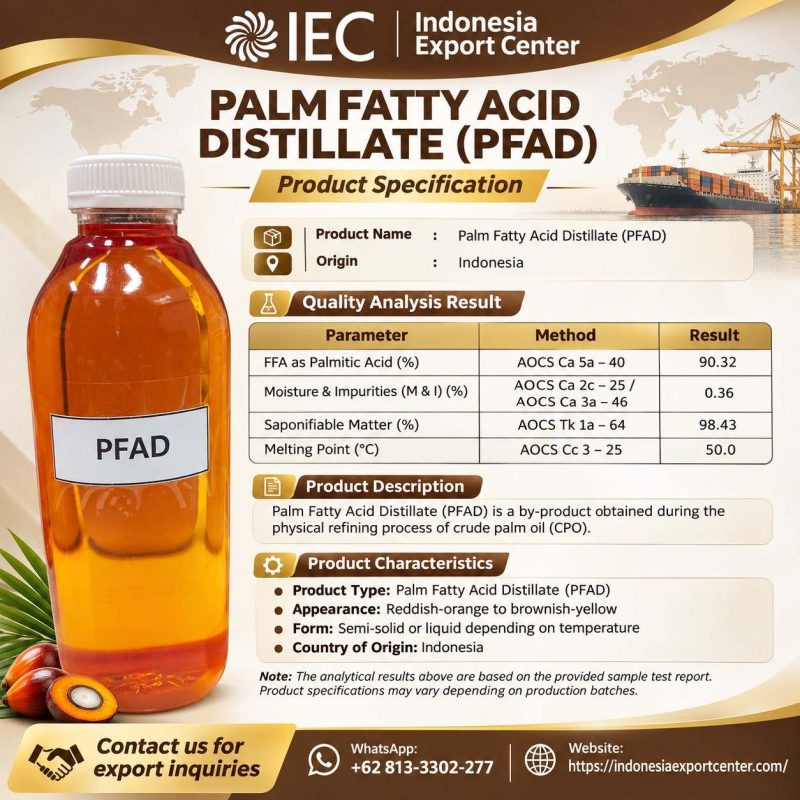
IEC PFAD Reference Specifications
| Parameter | Reference Target |
|---|---|
| FFA, as Palmitic | Minimum 90% |
| Moisture & Impurities | Maximum 1.0% |
| Iodine Value | Maximum 50 |
| Melting Point | 36–46°C |
| Colour (Gardner) | Maximum 7 |
| Appearance | White / Off White Solid |
These specifications are references from the IEC brochure.
Actual cargo characteristics require verification.
Indonesian PFAD vs Malaysian Domestic Supply
Malaysian industrial buyers may compare imported PFAD against domestic sources.
The comparison should be based on actual supplier offers rather than assumptions about country of origin.
| Evaluation Area | Indonesian Supply | Malaysian Domestic Supply |
|---|---|---|
| Product Specification | Verify actual COA | Verify actual COA |
| Supplier Identity | Verify | Verify |
| Available Quantity | Confirm | Confirm |
| Product Price | Obtain quotation | Obtain quotation |
| Freight | Calculate applicable transport | Calculate applicable transport |
| Customs | Review import requirements | Review domestic requirements |
| Delivery Time | Confirm route | Confirm route |
| Quality Consistency | Evaluate | Evaluate |
| Payment Terms | Negotiate | Negotiate |
| Total Delivered Cost | Calculate | Calculate |
Neither origin is automatically superior.
Step 1 – Identify the Malaysian Buyer’s Application
The buyer should specify whether the material will be used for:
- Oleochemical conversion.
- Fatty acid processing.
- Industrial soap.
- Biodiesel feedstock evaluation.
- Other manufacturing applications.
The required technical parameters should reflect the actual process.
Step 2 – Establish a Comparable Quality Basis
A meaningful supplier comparison requires consistent specifications.
For example, two quotations should not be treated as equivalent if they use different FFA reporting bases or moisture limits.
Buyers should compare:
- FFA as palmitic.
- Moisture.
- Insoluble impurities.
- Iodine value.
- Fatty acid composition, if needed.
- Melting behavior.
- Colour.
- Additional contaminants.
Step 3 – Verify Indonesian Supplier Credentials
Request:
- Legal company identity.
- Supplier role.
- Product source.
- Selling authority.
- Current COA.
- Confirmed quantity.
- Export arrangements.
- Payment information.
The buyer should distinguish between a refinery, trader, distributor, and sourcing intermediary.
Step 4 – Select the Malaysian Receiving Location
The receiving location should be selected based on the buyer’s manufacturing facility and logistics requirements.
Potential Malaysian port areas for initial route evaluation include:
- Port Klang.
- Port of Tanjung Pelepas.
- Pasir Gudang.
- Penang.
- Other suitable receiving locations.
These are examples, not confirmations of PFAD-compatible services or available shipments.
The buyer must verify port, terminal, storage, and discharge capability.
Step 5 – Evaluate Cross-Border Logistics
Transport planning should consider:
- Indonesian loading location.
- Malaysian destination.
- Shipping method.
- Packaging compatibility.
- Transit time.
- Cargo temperature.
- Discharge arrangements.
- Inland transport.
- Terminal charges.
- Storage costs.
PFAD may become solid or highly viscous under certain temperature conditions.
Step 6 – Verify Malaysian Import Requirements
The Malaysian importer should confirm the current requirements with qualified customs and regulatory professionals.
Potential areas include:
- Importer eligibility.
- Correct customs classification.
- Applicable duties and taxes.
- Import permits or controls.
- Product-specific requirements.
- Documentation.
- Origin-related provisions.
- Relevant industrial regulations.
Do not assume preferential treatment applies automatically because Indonesia and Malaysia are ASEAN members.
Any preferential tariff claim requires applicable rules-of-origin compliance and supporting documentation.
Step 7 – Calculate Total Delivered Cost
A meaningful comparison should include all relevant costs.
Estimated Delivered Cost = Product Price + Freight + Insurance + Customs Costs + Terminal Charges + Inland Transport + Storage + Other Relevant Expenses
The calculation should also consider technical processing costs where feedstock quality differs.
Step 8 – Compare Commercial Terms
Potential purchasing arrangements include:
- FOB named Indonesian port.
- CIF named Malaysian destination port.
- Other Incoterms suitable for the shipment.
The selected term should reflect the actual transport arrangement and responsibilities.
Step 9 – Consider Monthly Supply Planning
Manufacturers with recurring demand should assess:
- Monthly consumption.
- Minimum inventory requirements.
- Lead time.
- Shipment frequency.
- Storage capacity.
- Supplier performance.
- Alternative supply sources.
Recurring supply should not be assumed until confirmed contractually and operationally.
Step 10 – Establish Quality and Inspection Requirements
The contract may specify:
- Representative sampling.
- COA.
- Independent testing.
- Quantity verification.
- Loading inspection.
- Destination testing.
- Retained samples.
- Claims procedures.
These measures can support consistent procurement.
Malaysia PFAD Procurement Checklist
| Requirement | Buyer Action |
|---|---|
| Industrial Application | Define |
| Required Specification | Establish |
| Indonesian Supplier | Verify |
| Current COA | Obtain |
| Domestic Price Benchmark | Compare |
| Imported Price | Obtain Quotation |
| Destination Port | Confirm |
| Freight | Verify |
| Customs Classification | Check |
| Duties and Taxes | Verify |
| Packaging | Approve |
| Payment | Negotiate |
| Inspection | Agree |
| Total Delivered Cost | Calculate |
PFAD RFQ Template for Malaysian Buyers
Subject: Indonesian PFAD Supplier Inquiry – Malaysia
Company Name: [Company]
Country: Malaysia
Business Location: [State / City]
Industrial Application: [Details]
Product: Palm Fatty Acid Distillate
Initial Quantity: [MT]
Monthly Requirement: [MT]
FFA Requirement: [Minimum, as Palmitic]
Moisture & Impurities: [Maximum]
Iodine Value: [Maximum]
Additional Requirements: [Details]
Preferred Packaging: [Bulk Tank / Approved Alternative]
Destination Port: [Malaysian Port]
Preferred Incoterm: [FOB / CIF / Other]
Shipment Period: [Dates]
Inspection Requirements: [Details]
Please provide information regarding potential Indonesian PFAD suppliers, product specifications, confirmed quantities, and commercial quotation requirements.
Frequently Asked Questions
Can Malaysian companies import PFAD from Indonesia?
They may evaluate import opportunities, subject to supplier availability and applicable regulations.
Is Indonesian PFAD cheaper than Malaysian PFAD?
Not necessarily. Actual prices and delivered costs must be compared.
Can Malaysian manufacturers request monthly supply?
Yes, subject to supplier capacity and contractual agreement.
Does ASEAN membership automatically eliminate import duties?
No. Applicable tariff treatment depends on the product, origin rules, documentation, and current regulations.
Can IEC guarantee shipments to Port Klang?
No. Logistics feasibility requires confirmation.
Should buyers compare COAs from both countries?
Yes. Comparable analytical information supports better procurement decisions.
Can IEC provide a fixed Malaysia delivered price?
No guaranteed price is published. A quotation requires supplier and logistics confirmation.
Request PFAD Supplier Information for Malaysia
Are you a Malaysian industrial manufacturer or trader evaluating Indonesian Palm Fatty Acid Distillate?
Share your purchasing volume, technical requirements, preferred delivery location, and commercial terms with IEC.
REQUEST PFAD SUPPLIER QUOTATION FOR MALAYSIA
IEC | INDONESIA EXPORT CENTER
Your Global Sourcing Partner
Website: https://indonesiaexportcenter.com/
WhatsApp: +62 813-3302-277
Related Resources
PFAD Long Term Supply Contract Guide
