

IEC | INDONESIA EXPORT CENTER
Your Global Sourcing Partner
Understanding Customs Classification for Palm Fatty Acid Distillate
Correct customs classification is an important requirement when importing or exporting Palm Fatty Acid Distillate.
For international buyers, customs brokers, commodity traders, and logistics managers, an incorrect tariff classification may affect import duties, taxes, documentation, regulatory requirements, and customs clearance.
PFAD is a fatty acid-rich by-product generated during certain palm oil refining processes.
Although PFAD is associated with the palm oil industry, it should not automatically be classified under the same tariff code as crude palm oil, RBD palm olein, or other palm-derived materials.
The correct HS classification must be verified using the actual product characteristics, applicable tariff schedule, and customs rules in the relevant jurisdiction.
Indonesia Export Center (IEC) facilitates potential Indonesian PFAD supplier inquiries but does not issue binding customs classification decisions.
What Is an HS Code?
The Harmonized System (HS) is an internationally used commodity classification framework.
It provides standardized headings and subheadings for identifying goods in international trade.
The internationally harmonized system generally operates at the six-digit level, while individual jurisdictions may apply additional digits for national tariff classification.
Therefore, a code used in one country may not be identical at every digit level to the code required in another country.
Why PFAD Classification Requires Care
PFAD is not simply refined palm oil or crude palm oil.
Its production origin and fatty acid-rich composition may be relevant to customs classification.
Depending on the applicable tariff rules, customs authorities may consider:
- Product identity.
- Manufacturing process.
- Chemical composition.
- Free fatty acid content.
- Intended classification heading.
- Relevant legal notes.
- Product documentation.
- Laboratory evidence.
The correct classification cannot be established solely from a marketing brochure.
PFAD vs Other Palm-Derived Products
| Product | Classification Consideration |
|---|---|
| PFAD | Fatty acid-rich refining distillate |
| Crude Palm Oil | Unrefined palm oil |
| RBD Palm Olein | Refined liquid palm oil fraction |
| Palm Stearin | Higher-melting palm fraction |
| Palm Acid Oil | Product identity and production route require verification |
| Distilled Fatty Acids | Further processing and composition may affect classification |
Similar commercial uses do not necessarily mean identical customs classifications.
Is There One Universal PFAD HS Code?
A specific tariff classification should not be asserted without examining the applicable legal provisions and product details.
Buyers should consult a qualified customs broker or the relevant customs authority.
Where appropriate, a formal classification ruling may provide greater certainty.
IEC does not publish an unverified PFAD HS code as a guaranteed classification.
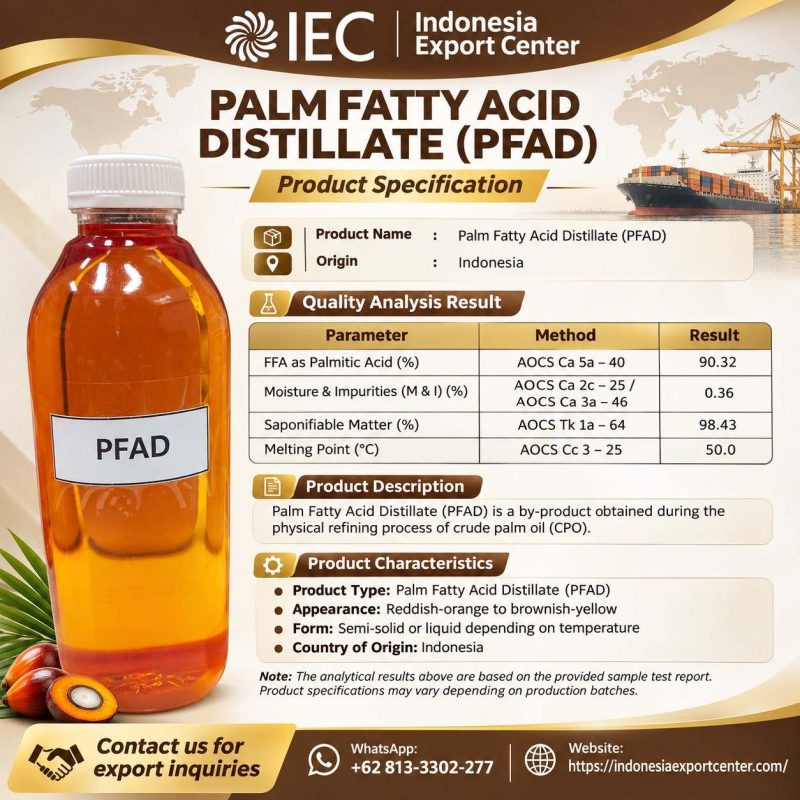
IEC PFAD Reference Specifications
| Parameter | Reference |
|---|---|
| FFA, as Palmitic | Minimum 90% |
| Moisture & Impurities | Maximum 1.0% |
| Iodine Value | Maximum 50 |
| Melting Point | 36–46°C |
| Colour (Gardner) | Maximum 7 |
| Appearance | White / Off White Solid |
These specifications may support product description and technical review, but they do not by themselves determine the customs classification.
How to Verify the Correct PFAD HS Code
Step 1 – Confirm Product Identity
Verify that the material is Palm Fatty Acid Distillate.
Step 2 – Obtain a Technical Specification
Request a detailed product description and relevant composition information.
Step 3 – Review Production-Origin Information
Understand how the material was generated.
Step 4 – Consult the Applicable Tariff Schedule
Review the currently effective tariff provisions in the exporting and importing jurisdictions.
Step 5 – Review Legal Classification Rules
Apply the relevant legal notes and interpretation rules.
Step 6 – Consult a Qualified Customs Professional
A customs broker or trade compliance specialist can help evaluate the classification.
Step 7 – Consider a Formal Ruling
Where available and appropriate, request an official classification determination.
Step 8 – Verify Documentation Consistency
Ensure commercial documents accurately describe the product.
Indonesia Export Classification
For shipments originating from Indonesia, the exporter should verify the relevant Indonesian customs classification and applicable export requirements.
Potential considerations include:
- Export declarations.
- Tariff classification.
- Export duties or levies, if applicable.
- Product-specific regulatory measures.
- Exporter eligibility.
- Required documentation.
These rules may change and should be checked at the time of the proposed transaction.
Destination-Country Import Classification
The importing party should independently verify the applicable classification in its own jurisdiction.
A classification used by the Indonesian exporter does not automatically determine the importing country’s full national tariff code.
The importer should confirm:
- Applicable tariff heading.
- Import duty.
- Taxes.
- Import permits.
- Regulatory controls.
- Documentation.
- Customs valuation.
- Preferential treatment, if applicable and supported.
Why Product Descriptions Matter
A commercial invoice should accurately identify the goods.
Using a vague description such as “palm oil product” may not provide enough information for customs review.
A more specific description may include the actual commercial product name and relevant technical details, subject to the customs broker’s guidance.
Descriptions must be truthful and consistent with the cargo.
Documents Relevant to Customs Review
Depending on the transaction:
- Commercial invoice.
- Packing list or quantity statement.
- Bill of lading.
- Product specification.
- COA.
- Certificate of Origin, if required.
- Relevant declarations.
- Permits or approvals, where applicable.
- Additional customs documentation.
The exact requirements depend on the destination and applicable rules.
Common Classification Mistakes
Assuming PFAD Is Crude Palm Oil
PFAD and crude palm oil are different products.
Copying a Supplier’s Code Without Verification
The buyer should review the applicable import tariff classification.
Using an Outdated Tariff Schedule
Tariff classifications and national measures can change.
Ignoring Product Composition
Chemical characteristics may be relevant.
Confusing Export and Import Requirements
Different jurisdictions may apply different national tariff extensions and regulatory requirements.
Treating a COA as a Classification Ruling
A COA reports analytical results; it does not establish a legally binding customs code.
Customs Classification Verification Checklist
| Requirement | Buyer Action |
|---|---|
| Product Identity | Confirm PFAD |
| Technical Specification | Obtain current document |
| Production Process | Review available information |
| Composition | Request relevant analytical data |
| Export Classification | Verify Indonesian requirements |
| Import Classification | Verify destination requirements |
| Tariff Schedule | Check current edition |
| Duties and Taxes | Confirm applicable rates |
| Permits | Review requirements |
| Documents | Check consistency |
| Official Ruling | Consider where appropriate |
PFAD Customs Information Request Template
Subject: PFAD Product Documentation for Customs Classification Review
Company: [Name]
Country: [Country]
Product: Palm Fatty Acid Distillate
Quantity: [MT]
Application: [Details]
Product Description Required: Yes
Technical Specification Required: Yes
Current COA Required: Yes
Production-Origin Information: [If Available]
Export Country: Indonesia
Import Country: [Country]
Destination Port: [Port]
Preferred Incoterm: [Term]
Please provide relevant product documentation to support independent customs classification review and commercial sourcing evaluation.
Frequently Asked Questions
What is the HS code for PFAD?
The applicable classification must be verified under the relevant tariff rules using the actual product information. IEC does not assert an unverified code.
Is PFAD classified the same as crude palm oil?
Not automatically.
Can a supplier provide an HS code?
A supplier may propose a code, but the importer should independently verify the applicable classification.
Are HS codes identical in every country?
The harmonized system uses internationally standardized six-digit classifications, while national tariff extensions can differ.
Does a COA determine the HS code?
No. It may support classification review but does not replace legal analysis.
Can customs duties change?
Yes. Applicable duties and regulatory measures can change.
Does IEC guarantee customs clearance?
No. Clearance remains subject to the responsible parties and customs authorities.
Should importers consult customs brokers?
Yes, particularly for transactions involving uncertain product classification.
Request PFAD Supplier and Product Documentation
Looking to source Palm Fatty Acid Distillate from Indonesia while preparing the technical information required for customs review?
Share your destination, quantity, and product requirements with IEC.
REQUEST PFAD SOURCING INFORMATION
IEC | INDONESIA EXPORT CENTER
Your Global Sourcing Partner
Website: https://indonesiaexportcenter.com/
WhatsApp: +62 813-3302-277
Related Resources
How to Import PFAD from Indonesia
PFAD Exporter Indonesia Sourcing Guide
