

IEC | INDONESIA EXPORT CENTER
Your Global Sourcing Partner
A Practical Guide to Importing Palm Fatty Acid Distillate from Indonesia
Importing Palm Fatty Acid Distillate (PFAD) from Indonesia can be an important procurement option for international companies involved in oleochemical manufacturing, biodiesel production, industrial chemical processing, and commodity distribution.
However, purchasing PFAD internationally requires more than obtaining a competitive quotation. Buyers must verify product identity, evaluate the supplier, review laboratory specifications, negotiate a suitable contract, arrange compliant transportation, and satisfy the import requirements of their destination country.
For first-time importers, understanding the complete procurement process can help reduce commercial misunderstandings, documentation errors, quality disputes, and unexpected logistics costs.
Indonesia Export Center (IEC) facilitates business-to-business sourcing inquiries involving potential Indonesian PFAD suppliers.
IEC operates as a sourcing intermediary. It does not automatically act as the product manufacturer, cargo owner, contracting seller, or exporter of record. All commercial and regulatory responsibilities must be confirmed for each proposed transaction.
What Is PFAD?
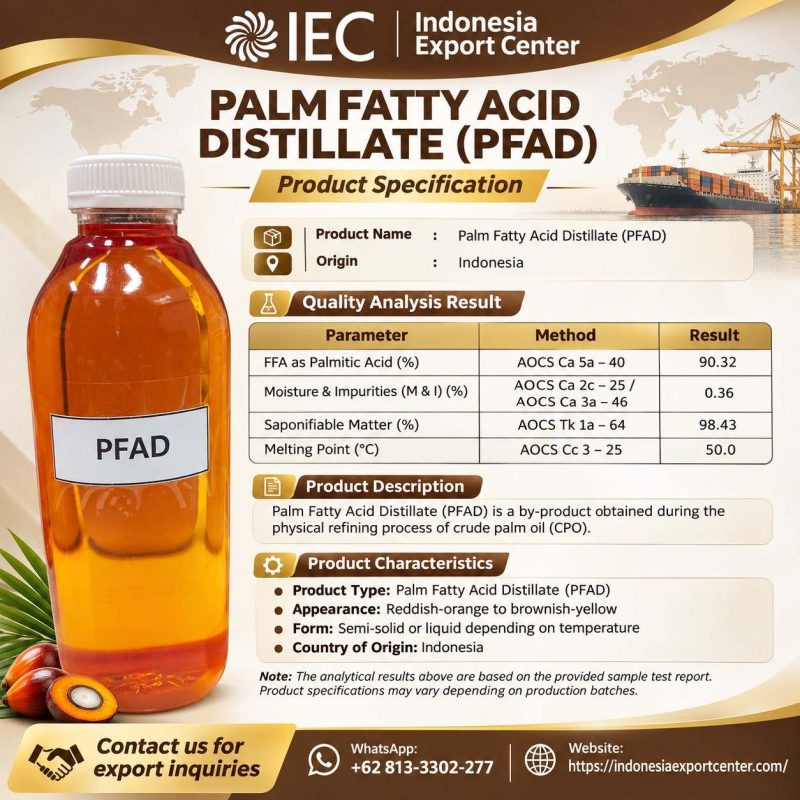
Palm Fatty Acid Distillate is a fatty acid-rich by-product generated during certain palm oil refining processes.
It generally contains a high proportion of free fatty acids, making it relevant to industrial applications where fatty acid-based feedstocks are required.
Potential buyers include:
- Biodiesel manufacturers.
- Oleochemical processing facilities.
- Fatty acid ester producers.
- Industrial soap manufacturers.
- Chemical raw material distributors.
- Commodity importers and trading companies.
PFAD is not interchangeable with crude palm oil, RBD palm olein, palm stearin, or palm acid oil. Each product has different characteristics and purchasing considerations.
Indonesian PFAD Reference Specifications
The IEC product brochure provides the following reference specifications:
| Parameter | Reference Specification |
|---|---|
| Free Fatty Acids (as Palmitic) | Minimum 90% |
| Moisture & Impurities | Maximum 1.0% |
| Iodine Value | Maximum 50 |
| Melting Point | 36–46°C |
| Colour (Gardner) | Maximum 7 |
| Appearance | White / Off White Solid |
Important: These values are reference targets only. A current, cargo-specific Certificate of Analysis (COA) is necessary to establish actual product quality.
The brochure identifies bulk in tank and flexibag as potential packaging arrangements, subject to technical and logistics approval.
Step 1: Identify Your Industrial Requirements
Before contacting a supplier, establish the exact purpose of the purchase.
Your procurement team should define:
- Intended industrial application.
- Required free fatty acid content.
- Acceptable moisture and impurity limits.
- Iodine value requirement.
- Melting characteristics.
- Additional laboratory parameters.
- Initial order quantity.
- Monthly consumption.
- Destination country and port.
- Preferred delivery schedule.
For manufacturers, technical requirements should be reviewed by the production or quality assurance department.
A product that meets a general commercial specification may still be unsuitable for a particular industrial process.
Step 2: Prepare a Complete Request for Quotation
A clear RFQ helps potential suppliers determine whether they can fulfill the inquiry.
Include:
| RFQ Field | Information Required |
|---|---|
| Product | Palm Fatty Acid Distillate |
| Buyer | Registered company name |
| Application | Industrial end use |
| Quantity | Metric tons |
| Specifications | Required parameters and methods |
| Packaging | Bulk tank or approved alternative |
| Destination | Named port and country |
| Incoterm | FOB, CFR, CIF, or another agreed term |
| Shipment | Required period |
| Payment | Proposed payment arrangement |
| Inspection | Required testing and survey |
| Documentation | Destination-specific requirements |
The more precise the inquiry, the easier it is to evaluate supplier suitability.
Step 3: Evaluate Potential Indonesian Suppliers
A supplier may be a refinery, trader, authorized distributor, or another commercial entity.
Before proceeding, verify:
- Legal company identity.
- Business registration information.
- Authorized representative.
- Product source.
- Authority to sell the proposed cargo.
- Actual quantity available.
- Quality documentation.
- Export capability.
- Loading arrangements.
- Payment beneficiary details.
Do not assume that a company advertising PFAD necessarily owns available cargo.
Step 4: Request Product Samples and a COA
A sample can help the buyer evaluate technical suitability.
The sample should be appropriately identified and, where practical, linked to the intended supply.
A COA should include the product name, sample or batch identification, analytical results, units, methods, and issuing laboratory.
For important purchases, buyers may arrange independent laboratory analysis or third-party inspection.
A generic sample or old COA does not guarantee that the shipment will have identical properties.
Step 5: Confirm Product Classification
Correct customs classification is important for export and import documentation.
Buyers should work with a qualified customs broker to determine the applicable tariff classification based on the actual product, composition, processing history, and destination jurisdiction.
Do not assume that the customs classification for crude palm oil or refined palm oil automatically applies to PFAD.
The applicable tariff schedule and legal requirements must be checked at the time of shipment.
Step 6: Verify Export and Import Regulations
Before signing a binding purchase agreement, confirm the currently applicable requirements in Indonesia and the destination country.
Potential considerations include:
- Exporter eligibility.
- Customs declarations.
- Product-specific export measures.
- Applicable duties or levies.
- Destination import permits.
- Customs tariff classification.
- Chemical or industrial material registration requirements.
- Sustainability or traceability obligations, where applicable.
- Sanctions and restricted-party screening.
These requirements can change. The responsible exporter, importer, customs brokers, and legal advisers should verify the rules in force for the actual transaction.
Step 7: Negotiate Commercial Terms
A PFAD purchase agreement should clearly identify:
- Contracting buyer and seller.
- Product description.
- Quality specifications.
- Quantity and tolerances.
- Unit price and currency.
- Delivery Incoterm.
- Named ports.
- Shipment period.
- Payment method.
- Inspection procedures.
- Documentation obligations.
- Quality claims.
- Quantity disputes.
- Governing law and dispute resolution.
A properly documented agreement reduces ambiguity.
Step 8: Select Appropriate Shipping Arrangements
PFAD can become more viscous or solidify under certain temperature conditions.
Consequently, logistics planning must consider the actual product’s thermal behavior.
The IEC brochure identifies bulk tank and flexibag options, but neither should be assumed suitable without confirmation.
Buyers should verify equipment compatibility, approved heating procedures, carrier acceptance, and destination unloading capabilities.
Step 9: Arrange Pre-Shipment Inspection
Depending on the transaction, buyers may request an independent surveyor to review:
- Cargo identity.
- Sampling.
- Laboratory testing.
- Tank cleanliness.
- Quantity determination.
- Loading conditions.
- Sealing.
- Documentation.
The inspection scope should be agreed before shipment.
Step 10: Prepare Export and Shipping Documents
Depending on the applicable transaction, documents may include:
- Commercial invoice.
- Packing list or quantity statement.
- Bill of lading.
- Certificate of Analysis.
- Certificate of Origin, where required.
- Insurance certificate, where applicable.
- Inspection certificate, if agreed.
- Relevant customs or regulatory documentation.
The exact requirements depend on the shipment and destination.
Step 11: Arrange Destination Customs Clearance
The importer should coordinate with a qualified customs broker before the cargo arrives.
Confirm customs classification, valuation, duties, taxes, import authorizations, and document consistency.
Avoid waiting until the vessel arrives to identify missing import requirements.
Step 12: Receive and Inspect the PFAD
At the receiving facility, the buyer should establish:
- Tank readiness.
- Approved unloading procedures.
- Cargo temperature and pumpability.
- Quantity measurement.
- Sampling.
- Laboratory acceptance.
- Documentation reconciliation.
Any quality or quantity discrepancy should be handled under the agreed contract.
Common Importing Risks and Preventive Actions
| Risk | Recommended Control |
|---|---|
| Unverified Supplier | Conduct legal and commercial due diligence |
| Incorrect Specifications | Use a detailed quality schedule |
| Inconsistent COA | Verify sample and lot identity |
| Unconfirmed Export Status | Check responsible exporter |
| Shipping Incompatibility | Obtain technical approval |
| Unexpected Import Costs | Calculate landed cost |
| Documentation Errors | Review documents before dispatch |
| Payment Fraud | Independently verify banking details |
| Quality Disputes | Agree on inspection and claims procedures |
PFAD Import RFQ Template
Subject: Indonesian PFAD Import Inquiry – Supplier and Export Quotation
Company Name: [Company]
Country: [Country]
Business Activity: [Manufacturer / Importer / Trader]
Product: Palm Fatty Acid Distillate
Intended Application: [Application]
Initial Quantity: [MT]
Monthly Requirement: [MT]
FFA Requirement: [Minimum, as Palmitic]
Moisture & Impurities: [Maximum]
Iodine Value: [Requirement]
Melting Point: [Requirement]
Packaging: [Bulk Tank / Flexibag Subject to Approval]
Destination Port: [Port, Country]
Preferred Incoterm: [Term]
Required Shipment Date: [Date]
Required Documents: [Details]
Inspection Requirements: [Details]
Please provide information regarding potential Indonesian PFAD suppliers, relevant product documentation, confirmed supply capability, and commercial quotation procedures.
Frequently Asked Questions
Can I import PFAD directly from Indonesia?
Potentially, provided the parties satisfy applicable export and import requirements and a suitable supplier is confirmed.
Is there a universal minimum order quantity?
No. MOQ depends on the supplier, shipment arrangement, and commercial terms.
Do I need a Certificate of Analysis?
A relevant COA is strongly recommended for industrial quality verification.
Is PFAD shipped in flexibags?
Flexibag transport may be possible where the specific cargo and equipment are approved.
Can IEC arrange supplier introductions?
IEC facilitates sourcing inquiries and potential supplier introductions.
Does IEC guarantee customs clearance?
No. Import and export compliance remains the responsibility of the relevant parties.
How do I obtain a price?
Submit a detailed RFQ for a dated commercial quotation.
Start Your PFAD Import Inquiry
Looking to import Palm Fatty Acid Distillate from Indonesia for industrial production or commodity distribution?
Share your required specifications, volume, destination, and delivery schedule with IEC.
REQUEST INDONESIAN PFAD SUPPLIER INFORMATION
IEC | INDONESIA EXPORT CENTER
Website: https://indonesiaexportcenter.com/
WhatsApp: +62 813-3302-277
Related Resources
PFAD COA and Quality Verification
