

Industrial Palm Fatty Acid Distillate for Oleochemical Manufacturing
Are you looking for Palm Fatty Acid Distillate for oleochemical production, industrial fatty acid processing, or soap manufacturing?
Indonesia Export Center (IEC) assists international companies seeking palm-derived industrial raw materials from Indonesia.
PFAD is a fatty acid-rich material generated during the refining of crude palm oil. It contains free fatty acids and other palm-derived constituents that may be used in selected chemical processing applications.
For oleochemical companies, PFAD can represent a potential source of fatty acid feedstock for downstream manufacturing.
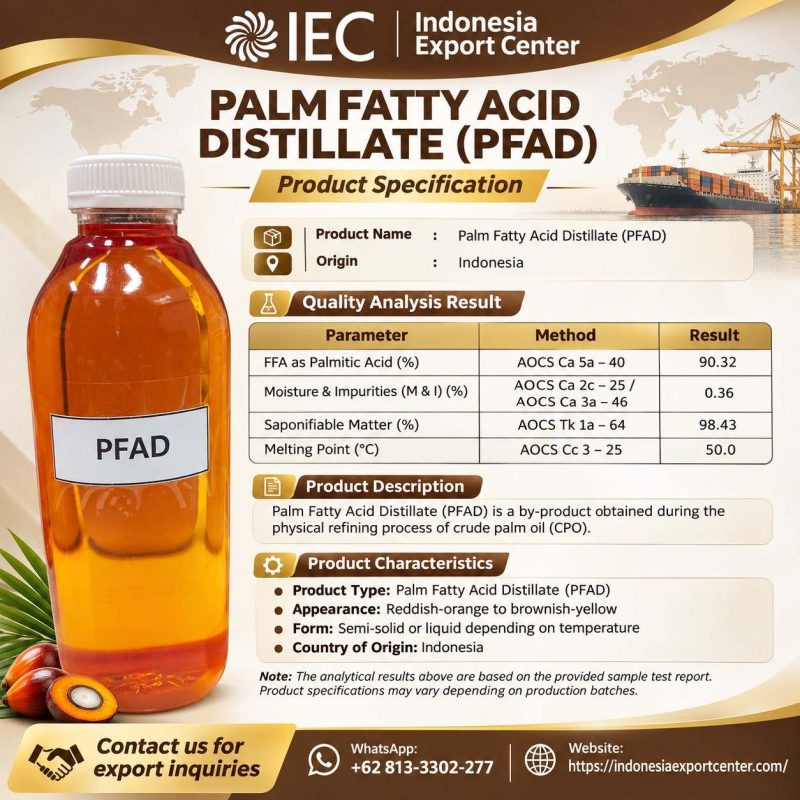
Our featured Indonesian PFAD sample has a reported Free Fatty Acid content of 90.32% as Palmitic Acid.
This sample provides useful preliminary information for buyers evaluating industrial feedstock options.
Actual product suitability must be determined from the complete chemical composition, required manufacturing process, and supplier-issued quality documentation.
Product: Palm Fatty Acid Distillate
Abbreviation: PFAD
Origin: Indonesia
Industrial Sector: Oleochemicals, Soap Manufacturing, and Fatty Acid Processing
Contact Indonesia Export Center: +62 813-3302-277
What Is PFAD in the Oleochemical Industry?
The oleochemical industry produces chemical materials derived from fats, oils, and fatty acids.
Common categories of oleochemical products include fatty acids, fatty alcohols, fatty acid esters, glycerol derivatives, and other chemical intermediates.
Palm Fatty Acid Distillate is relevant to this industry because it contains a substantial free fatty acid fraction.
PFAD is produced during the physical refining of crude palm oil.
In the refining process, free fatty acids are separated from the main oil stream under controlled temperature and vacuum conditions.
The collected distillate contains free fatty acids, including palmitic and oleic acids, together with smaller amounts of other components.
Because the actual composition may vary, oleochemical buyers should evaluate the product before introducing it into commercial manufacturing.
Indonesian PFAD Product Specifications
The following quality analysis describes a featured PFAD sample from Indonesia.
| Parameter | Analytical Method | Sample Result |
|---|---|---|
| FFA as Palmitic Acid (%) | AOCS Ca 5a – 40 | 90.32 |
| Moisture & Impurities (%) | AOCS Ca 2c – 25 / AOCS Ca 3a – 46 | 0.36 |
| Saponifiable Matter (%) | AOCS Tk 1a – 64 | 98.43 |
| Melting Point (°C) | AOCS Cc 3 – 25 | 50.0 |
Product Characteristics
Product Name: Palm Fatty Acid Distillate (PFAD)
Country of Origin: Indonesia
Appearance: Reddish-orange to brownish-yellow
Physical Condition: Semi-solid or liquid depending on temperature
Product Classification: Palm Oil Derivative for Industrial Applications
The above data represent the tested sample. Commercial product specifications may differ according to the supplier, refinery, and production batch.
For purchasing decisions, buyers should request current technical documentation and agree on applicable specifications.
Industrial Applications of PFAD in Oleochemicals
Industrial Fatty Acid Production
PFAD can be considered as a raw material for further fatty acid processing.
Industrial fatty acids may be used to manufacture other chemical intermediates, depending on the required purity and composition.
Processing methods may involve separation, purification, distillation, or chemical conversion.
The suitability of PFAD depends on the chemical requirements of the intended production system.
Fatty Acid Ester Manufacturing
Fatty acid esters are used in a variety of industrial applications.
Because PFAD contains free fatty acids, it may be considered for suitable esterification processes.
Manufacturers should evaluate the type of ester being produced, alcohol selection, catalyst compatibility, and purification requirements.
Soap Manufacturing
PFAD can be utilized in certain soap manufacturing processes.
Soap production involves converting appropriate fatty acids or fats into salts used as cleaning agents.
Manufacturers may combine or process different raw materials to obtain the desired final product characteristics.
PFAD selection should take account of fatty acid profile, color, odor, impurities, processing conditions, and formulation requirements.
Detergent and Surfactant-Related Processing
Oleochemical intermediates are widely used in manufacturing cleaning products and surfactants.
PFAD may serve as an upstream fatty acid feedstock for selected processing pathways.
However, PFAD itself should not be described as a finished detergent ingredient suitable for every formulation.
Appropriate conversion, purification, and quality control may be necessary.
Other Chemical Manufacturing Processes
PFAD may also be evaluated for selected fatty acid-based chemical production routes.
Each application should be supported by technical review and, where necessary, laboratory or pilot-scale testing.
Understanding the Fatty Acid Composition of PFAD
A high FFA result is a useful indicator, but it does not provide a complete picture of the product’s chemical composition.
PFAD generally contains a mixture of fatty acids.
For oleochemical manufacturers, the proportions of individual fatty acids can be especially important.
Palmitic Acid
Palmitic acid is a saturated fatty acid commonly present in palm-derived materials.
Its presence may influence melting behavior and downstream product characteristics.
Oleic Acid
Oleic acid is an unsaturated fatty acid found in palm oil-derived materials.
Its concentration may affect physical properties and the suitability of PFAD for certain chemical applications.
Other Fatty Acid Components
Depending on the feedstock and process, PFAD may contain other fatty acids in smaller quantities.
A fatty acid profile measured using an appropriate analytical method may be required when individual component concentrations are commercially important.
Quality Control for Oleochemical Raw Materials
Free Fatty Acid Analysis
The FFA percentage is an important indicator when evaluating PFAD for fatty acid-based processing.
The featured sample reports 90.32% FFA as Palmitic Acid.
Purchasers should establish an acceptable specification range with the supplier.
Saponifiable Matter
Saponifiable matter is another parameter relevant to the assessment of fatty acid-rich materials.
The featured sample has a reported value of 98.43%.
The buyer should understand how this parameter relates to its intended manufacturing process.
Moisture and Impurities
The featured sample reports a combined moisture and impurities value of 0.36%.
Industrial buyers may need more detailed information about the different components of this result.
Color and Odor
Color and odor can be important for selected downstream chemical products.
The sample appearance is described as reddish-orange to brownish-yellow.
Any specific color or odor requirement should be identified before purchasing.
Additional Analytical Testing
Some manufacturers may also require iodine value, acid value, unsaponifiable matter, metals, or other technical parameters.
These additional results are not established by the featured sample analysis and should be requested separately.
PFAD Versus Other Palm Oil Derivatives
Industrial buyers frequently compare PFAD with other palm-derived raw materials.
PFAD Versus RBD Palm Oil
RBD Palm Oil is refined, bleached, and deodorized palm oil.
PFAD is the fatty acid-rich distillate recovered during the refining process.
The two products have different compositions and are not interchangeable in every industrial application.
PFAD Versus RBD Palm Stearin
Palm Stearin is generally obtained through fractionation of palm oil and represents a higher-melting oil fraction.
PFAD is a distillate associated with the removal of free fatty acids during refining.
Their chemical properties, processing requirements, and end uses differ.
PFAD Versus Palm Kernel Fatty Acid Distillate
Palm Kernel Fatty Acid Distillate originates from palm kernel oil processing.
Its fatty acid composition may differ substantially from PFAD derived from palm oil.
Buyers should verify the feedstock origin and fatty acid profile before selecting a material.
Industrial Packaging and Handling
Packaging and transport requirements must account for PFAD’s physical characteristics.
The featured sample has a reported melting point of 50.0°C.
Depending on ambient conditions, PFAD may require appropriate heating and handling arrangements.
Potential transport methods include suitable bulk tanks or other approved industrial packaging systems.
The supplier, packaging provider, and transport operator should determine a safe and appropriate method.
Bulk buyers should also consider tank cleanliness, contamination prevention, unloading arrangements, and storage conditions.
Export Sourcing from Indonesia
Indonesia has an extensive palm oil processing industry that generates various commercial raw materials for downstream applications.
International oleochemical manufacturers may explore sourcing opportunities through Indonesian refining companies, processors, trading businesses, and other authorized suppliers.
Indonesia Export Center helps facilitate initial inquiries from buyers seeking palm oil derivatives.
Our support may include product information requests, supplier communication, quotation inquiries, and initial export coordination.
IEC is not necessarily the manufacturer or contracting seller of the listed product.
Buyers should confirm the actual seller’s legal identity, technical capability, documentation, and commercial terms.
Frequently Asked Questions
Can PFAD be used for oleochemical manufacturing?
Yes. PFAD may serve as a fatty acid feedstock for selected oleochemical processing routes.
Is PFAD suitable for soap production?
PFAD may be suitable for certain soap manufacturing processes, depending on formulation requirements and processing technology.
What is the fatty acid content of the featured sample?
The sample reports 90.32% free fatty acids expressed as Palmitic Acid.
Does the FFA result describe the individual fatty acid composition?
No. A separate fatty acid profile is needed to determine the proportions of individual fatty acids.
Can PFAD replace refined palm oil in manufacturing?
Not necessarily. PFAD and refined palm oil have different compositions and processing requirements.
Can IEC assist with industrial PFAD sourcing?
IEC welcomes inquiries from international industrial buyers seeking relevant Indonesian supply partners.
Request a PFAD Oleochemical Raw Material Quotation
Are you planning to purchase Palm Fatty Acid Distillate for chemical manufacturing?
Please send your required technical specifications, estimated purchasing volume, destination country, preferred packaging, and shipment schedule.
Indonesia Export Center can help communicate your procurement requirements to potential Indonesian suppliers.
INDONESIA EXPORT CENTER (IEC)
Connecting Indonesian Industrial Products with Global Buyers.
WhatsApp: +62 813-3302-277
Website: https://indonesiaexportcenter.com/
Contact IEC today for Palm Fatty Acid Distillate sourcing inquiries.
