

Source Palm Fatty Acid Distillate for Biodiesel Manufacturing
Are you looking for PFAD for biodiesel production or an Indonesian supplier of high free fatty acid industrial feedstock?
Indonesia Export Center (IEC) helps international manufacturers and commodity buyers explore sourcing opportunities for Palm Fatty Acid Distillate from Indonesia.
Palm Fatty Acid Distillate is a fatty acid-rich material produced during the physical refining of crude palm oil. Its high free fatty acid concentration makes it relevant to biodiesel manufacturers operating suitable conversion technologies.
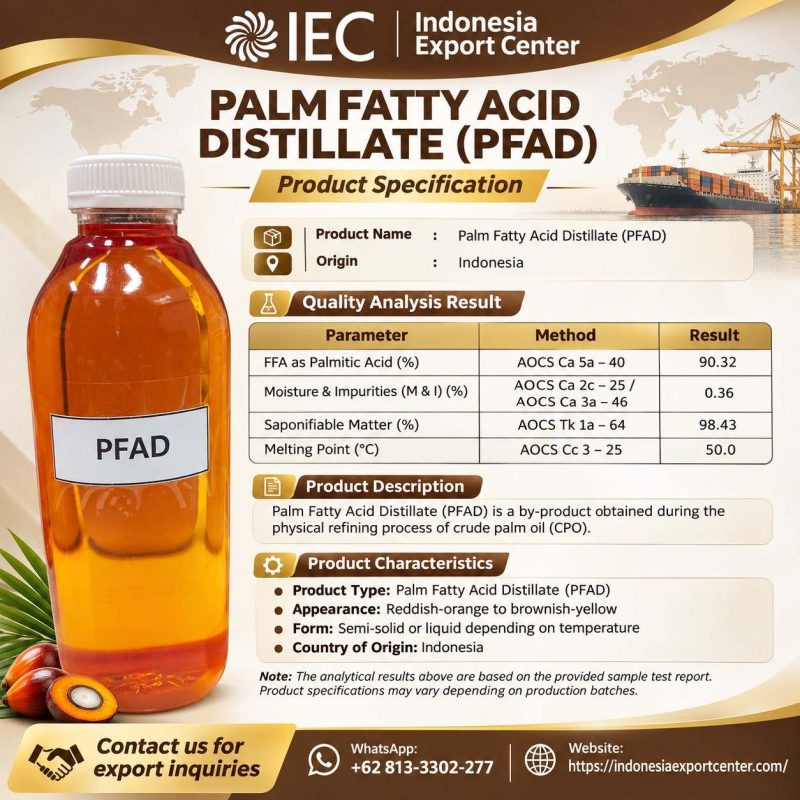
Our featured Indonesian PFAD sample reports a Free Fatty Acid content of 90.32% as Palmitic Acid.
This sample result may be useful for companies evaluating palm-derived fatty acid materials for biodiesel or related chemical conversion processes.
Product suitability must always be verified against the actual requirements of the manufacturing facility.
Product: Palm Fatty Acid Distillate (PFAD)
Origin: Indonesia
Industry: Biodiesel and Industrial Biofuel Feedstock
Commercial Inquiry: Indonesia Export Center
WhatsApp: +62 813-3302-277
What Is PFAD and How Is It Produced?
PFAD is generated during the physical refining of crude palm oil.
Crude palm oil contains triglycerides, free fatty acids, and other naturally occurring palm-derived constituents.
During refining, the free fatty acids are separated from the main oil stream through a process involving elevated temperatures and vacuum conditions.
The resulting distillate is collected as PFAD.
The material generally contains a mixture of free fatty acids, particularly palmitic and oleic acids, along with other components whose concentrations depend on the refining process and feedstock characteristics.
Unlike refined palm oil used in conventional triglyceride-based processing, PFAD has a substantial free fatty acid fraction.
This distinction is important because biodiesel production processes must be designed to handle the chemistry of the selected raw material.
Why Is PFAD Used as Biodiesel Feedstock?
Biodiesel typically consists of fatty acid alkyl esters manufactured from suitable fats, oils, or fatty acid materials.
PFAD is relevant because free fatty acids can be chemically converted into fatty acid esters.
In an appropriate process, fatty acids react with an alcohol through esterification to produce the corresponding esters and water.
For biodiesel manufacturing using methanol, the desired ester products are commonly fatty acid methyl esters, known as FAME.
A high-FFA feedstock such as PFAD generally requires special consideration compared with low-FFA refined vegetable oil.
Manufacturers must evaluate the reaction system, catalyst selection, water removal, purification, and compatibility with final fuel specifications.
PFAD is not automatically suitable for every biodiesel plant.
Before procurement, the buyer should confirm that its processing technology is designed to accommodate the intended feedstock.
Indonesian PFAD Specifications for Biodiesel Buyers
The featured Indonesian sample has the following analytical results.
| Quality Parameter | Test Method | Result |
|---|---|---|
| FFA as Palmitic Acid (%) | AOCS Ca 5a – 40 | 90.32 |
| Moisture & Impurities (%) | AOCS Ca 2c – 25 / AOCS Ca 3a – 46 | 0.36 |
| Saponifiable Matter (%) | AOCS Tk 1a – 64 | 98.43 |
| Melting Point (°C) | AOCS Cc 3 – 25 | 50.0 |
Physical Description
Product Name: Palm Fatty Acid Distillate
Appearance: Reddish-orange to brownish-yellow
Physical Form: Semi-solid or liquid depending on temperature
Country of Origin: Indonesia
These results represent a tested sample only. They are not a guaranteed production specification.
Before purchasing commercial quantities, buyers should review the relevant supplier’s current product specification and batch-specific analytical documentation.
Important Feedstock Quality Parameters
Free Fatty Acid Content
FFA content is a major parameter for manufacturers using esterification-based conversion processes.
The featured PFAD sample contains 90.32% FFA expressed as Palmitic Acid.
This analytical result should not be confused with a complete fatty acid profile.
A separate compositional analysis may be required to understand the proportions of palmitic, oleic, and other fatty acids.
Moisture Content
Water is an important consideration in esterification because water is also formed during the conversion reaction.
Excess water can influence reaction performance and equilibrium conditions.
Manufacturers may therefore establish moisture limits based on their process requirements.
The featured sample reports 0.36% for the combined moisture and impurities parameter.
Impurities and Contaminants
Contaminants can affect catalyst performance, equipment operation, purification, and final product quality.
Depending on the production route, buyers may require additional testing for metals, phosphorus, sulfur, or other relevant constituents.
Melting and Flow Characteristics
The featured sample has a reported melting point of 50.0°C.
Temperature-dependent behavior can influence tank storage, loading, pumping, and discharge.
Buyers should evaluate the product’s actual handling characteristics and the availability of suitable equipment.
PFAD Conversion into Biodiesel
Esterification of Free Fatty Acids
Esterification is a chemical reaction that converts free fatty acids and an alcohol into fatty acid esters and water.
This process is relevant to high-FFA materials such as PFAD.
The specific reaction conditions depend on the selected catalyst, alcohol, equipment configuration, and processing objectives.
Processing of Remaining Glycerides
PFAD may also contain glycerides.
Depending on the plant design, these components may require additional conversion steps to maximize the use of the feedstock.
Manufacturers should assess the full feedstock composition rather than relying only on an FFA percentage.
Product Purification
After conversion, the product typically requires appropriate separation and purification.
The required procedures depend on the production technology and applicable biodiesel quality standards.
Fuel Quality Verification
The resulting biodiesel must comply with the technical requirements applicable to its intended market.
Feedstock quality alone does not establish that the final biodiesel product meets any particular fuel standard.
PFAD Compared with Other Biodiesel Feedstocks
Biodiesel producers may evaluate several different raw materials, including refined vegetable oils, used cooking oil, animal fats, and fatty acid distillates.
PFAD differs from these materials in chemical composition, processing requirements, and supply-chain characteristics.
PFAD Versus Refined Palm Oil
Refined palm oil generally contains a higher proportion of triglycerides and a much lower level of free fatty acids.
PFAD is comparatively rich in free fatty acids and may require a different conversion strategy.
PFAD Versus Used Cooking Oil
Used cooking oil can vary significantly according to its original source, cooking history, collection practices, and contamination.
PFAD originates from palm oil refining but also requires proper batch analysis and supplier verification.
PFAD Versus Other Fatty Acid Distillates
Fatty acid distillates can originate from different vegetable oils and refining processes.
Their fatty acid profiles and other quality parameters can differ, making technical comparison necessary.
Sustainability, Traceability, and Regulatory Considerations
International biofuel markets may impose specific requirements regarding feedstock origin, sustainability, greenhouse gas accounting, traceability, and certification.
PFAD’s regulatory classification and eligibility are not identical across all jurisdictions.
Buyers should not assume that PFAD automatically qualifies as a waste, residue, or preferred low-carbon feedstock under every regulatory framework.
The intended destination market and applicable regulations must be assessed independently.
If certification is required, purchasers should specify the certification scheme, chain-of-custody requirements, documentation, and intended market.
Any sustainability claims must be supported by verified information for the relevant supplier and shipment.
PFAD Shipping and Storage for Biodiesel Manufacturers
Feedstock logistics are important for biodiesel plants purchasing industrial quantities.
Depending on the material’s physical characteristics, transportation may involve suitable bulk tanks or other approved industrial packaging systems.
The supplier and logistics provider should confirm whether heating arrangements are required.
Buyers should also evaluate unloading facilities, storage capacity, inventory management, and the effect of shipment delays on production schedules.
A complete quotation should identify the agreed delivery terms, product quantity, shipment window, and handling arrangements.
Why Source PFAD from Indonesia?
Indonesia has a large palm oil refining and processing industry.
This makes the country relevant to international manufacturers looking for palm-derived industrial raw materials.
Buyers may explore opportunities through refineries, industrial processors, trading companies, or export-oriented sourcing partners.
Indonesia Export Center helps facilitate initial inquiries and communication with potential Indonesian suppliers.
The actual availability of PFAD, production capacity, and export conditions depend on the participating supplier.
How to Request a PFAD Biodiesel Feedstock Quotation
To support a useful technical and commercial discussion, please provide:
- Required quantity in metric tons.
- Minimum acceptable FFA content.
- Maximum acceptable moisture and impurities.
- Any additional analytical parameters.
- Intended biodiesel manufacturing process.
- Destination country and port.
- Preferred packaging or transport method.
- Required shipment schedule.
- Applicable certification or regulatory requirements.
A complete inquiry enables suppliers to evaluate whether the available product may meet the buyer’s requirements.
Frequently Asked Questions
Can PFAD be used to produce biodiesel?
Yes. PFAD can be used in suitable biodiesel conversion processes. Its high free fatty acid content requires appropriate process technology.
Is PFAD the same as refined palm oil?
No. PFAD is a fatty acid-rich refining by-product, whereas refined palm oil is a different product with different chemical characteristics.
What is the FFA content of this Indonesian PFAD sample?
The featured sample reports 90.32% FFA as Palmitic Acid.
Does high FFA guarantee high biodiesel yield?
No. Actual yield depends on the complete feedstock composition, reaction technology, operating conditions, and purification losses.
Can PFAD qualify for renewable fuel certification?
Eligibility depends on the applicable certification scheme, regulatory jurisdiction, supply chain, and supporting documentation.
How can I source PFAD from Indonesia?
Contact Indonesia Export Center with your feedstock requirements, order quantity, destination port, and intended shipment schedule.
Contact IEC for PFAD Biodiesel Feedstock
Indonesia Export Center welcomes inquiries from biodiesel manufacturers, industrial biofuel companies, and international raw material traders.
We help buyers communicate technical requirements and explore potential supply arrangements involving Indonesian Palm Fatty Acid Distillate.
INDONESIA EXPORT CENTER (IEC)
WhatsApp: +62 813-3302-277
Website: https://indonesiaexportcenter.com/
Request a PFAD biodiesel feedstock sourcing quotation today.
