

IEC | INDONESIA EXPORT CENTER
Your Global Sourcing Partner
How to Verify Palm Fatty Acid Distillate Quality Before Purchasing
Quality verification is a critical stage in international PFAD procurement.
For manufacturers and importers, a supplier’s commercial product description may not provide enough information to determine whether a particular shipment is suitable for industrial processing.
A Certificate of Analysis (COA) helps document the analytical characteristics of an identified product sample or lot.
However, not every COA offers the same level of assurance. Buyers should evaluate its issuing laboratory, sampling procedure, testing methods, dates, product identification, and relationship to the proposed cargo.
Indonesia Export Center (IEC) facilitates sourcing inquiries involving potential Indonesian PFAD suppliers. IEC does not independently certify cargo quality or guarantee any laboratory result.
What Is a PFAD Certificate of Analysis?
A COA is a document reporting the analytical results of a sample or batch.
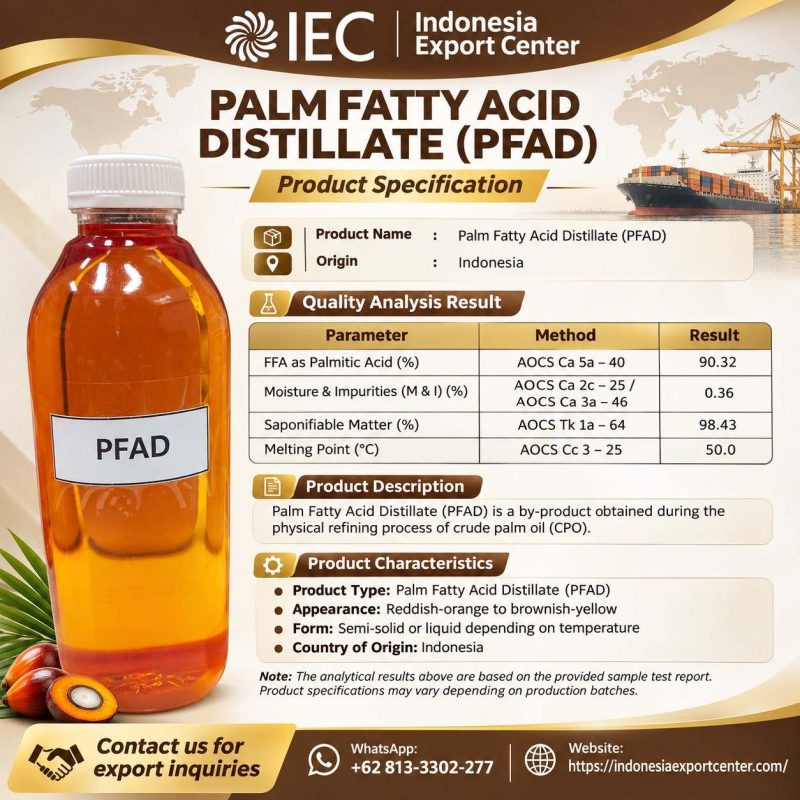
For Palm Fatty Acid Distillate, it may include free fatty acids, moisture, impurities, iodine value, melting point, colour, and additional parameters.
The results should be compared with the purchase contract’s agreed specification.
IEC PFAD Reference Specification
| Parameter | Reference Specification |
|---|---|
| FFA (as Palmitic) | Minimum 90% |
| Moisture & Impurities | Maximum 1.0% |
| Iodine Value | Maximum 50 |
| Melting Point | 36–46°C |
| Colour (Gardner) | Maximum 7 |
| Appearance | White / Off White Solid |
These figures originate from the IEC PFAD product brochure. They are not results from a specific tested shipment.
Why a COA Matters
A relevant COA can help buyers:
- Compare offered material with technical requirements.
- Identify potential quality deviations.
- Evaluate feedstock suitability.
- Review supplier consistency.
- Establish a baseline for contractual quality acceptance.
- Support incoming quality control.
A COA alone does not prove cargo ownership, legal origin, supplier authorization, or export eligibility.
Essential Information on a PFAD COA
A useful document should identify:
- Product name.
- Supplier or laboratory.
- Batch or lot number.
- Sample identification.
- Sampling date.
- Testing date.
- Test parameters.
- Results and units.
- Analytical methods.
- Report authorization.
Where applicable, buyers should also review the laboratory’s relevant competence and accreditation scope.
Free Fatty Acid Verification
FFA is a central quality parameter for PFAD.
The IEC reference uses FFA expressed as palmitic acid.
The reporting basis should be explicitly stated because values expressed as different fatty acids are not directly interchangeable.
A supplier reporting FFA as oleic acid should not automatically be treated as meeting a specification expressed as palmitic acid.
Moisture and Impurities Testing
Water and insoluble materials may affect processing and handling.
Buyers should confirm whether the laboratory reports moisture and impurities separately or as a combined result.
Iodine Value Testing
Iodine value helps characterize the unsaturation of the fatty material.
The buyer should specify the applicable analytical method.
Melting Point Evaluation
PFAD can display temperature-dependent physical behavior.
The term “melting point” should be defined by an agreed method, especially because complex fatty mixtures may not have one sharply defined melting temperature.
Gardner Colour Measurement
Colour assessment should use the agreed Gardner method and appropriate sample preparation.
Appearance alone is not sufficient to establish product quality.
Additional Tests for Industrial Buyers
Depending on the application, buyers may request:
- Acid value.
- Fatty acid profile.
- Saponification value.
- Unsaponifiable matter.
- Metal content.
- Ash.
- Oxidation-related parameters.
- Other application-specific contaminants.
The need for these tests should be determined by the buyer’s technical team.
Representative Sampling
A laboratory result is only as useful as the sample it represents.
Sampling should address:
- Sampling location.
- Cargo condition.
- Temperature and homogenization.
- Appropriate equipment.
- Sample containers.
- Sample identification.
- Sealing.
- Chain of custody.
- Retained reference samples.
Sampling procedures should be agreed before loading or acceptance.
Independent Inspection
Buyers may appoint an independent inspection company to perform an agreed scope of work.
Possible activities include:
- Witnessing sampling.
- Reviewing tank cleanliness.
- Verifying cargo identity.
- Conducting or arranging laboratory tests.
- Measuring quantity.
- Observing loading.
- Issuing inspection reports.
The inspection provider’s scope must be documented. An inspection report does not automatically cover matters outside that scope.
Pre-Shipment vs Destination Testing
| Stage | Main Purpose |
|---|---|
| Pre-Shipment | Evaluate cargo before dispatch |
| Loading | Confirm agreed loading-stage characteristics |
| Destination | Assess received material |
| Retained Sample Testing | Support investigations or disputes |
The contract should state which results govern acceptance and how disagreements will be resolved.
COA Verification Checklist
| Review Item | Buyer Question |
|---|---|
| Product Identity | Is the document clearly for PFAD? |
| Batch Reference | Is the lot identified? |
| Date | Is the report relevant to the offered cargo? |
| FFA Basis | Is the result expressed as palmitic acid? |
| Methods | Are analytical procedures identified? |
| Laboratory | Is the issuing entity verifiable? |
| Results | Do they meet the agreed specification? |
| Sample Link | Does the sample represent the cargo? |
| Additional Tests | Are application-specific requirements covered? |
| Contract | Are acceptance procedures defined? |
Handling an Off-Specification Result
If a result falls outside the agreed specification, buyers should follow the contract’s procedures.
Possible next steps include:
- Confirming sample identity.
- Reviewing analytical methods.
- Conducting an agreed retest.
- Consulting the independent surveyor.
- Evaluating the commercial implications.
- Following contractual acceptance or rejection provisions.
No universal tolerance should be assumed.
PFAD COA Request Template
Subject: PFAD Certificate of Analysis and Quality Verification Request
Company: [Name]
Product: Palm Fatty Acid Distillate
Quantity: [MT]
Required FFA: [Minimum, as Palmitic]
Moisture & Impurities: [Maximum]
Iodine Value: [Maximum]
Melting Point: [Range]
Gardner Colour: [Maximum]
Additional Tests: [Details]
Required Laboratory: [If Applicable]
Inspection Stage: [Pre-Shipment / Loading / Destination]
Please provide the relevant product specification, current COA, sample identification, testing methods, and proposed inspection arrangements.
Frequently Asked Questions
What does COA mean?
Certificate of Analysis.
Is a supplier brochure the same as a COA?
No. A brochure describes reference specifications, while a COA reports analytical results.
Is FFA minimum 90% guaranteed?
No. It is the IEC brochure reference and must be verified for the actual cargo.
Can buyers request independent testing?
Yes, subject to agreement with the supplier and inspection provider.
Should samples be sealed?
Appropriate sealing and chain-of-custody procedures can improve traceability.
Does a COA prove the cargo is certified sustainable?
No. Sustainability certification requires separate evidence.
Can IEC guarantee laboratory compliance?
No. IEC facilitates sourcing inquiries.
Request PFAD COA and Supplier Documentation
Improve your industrial procurement process with clear quality requirements, relevant laboratory records, and agreed inspection procedures.
REQUEST PFAD COA AND SUPPLIER INFORMATION
IEC | INDONESIA EXPORT CENTER
Website: https://indonesiaexportcenter.com/
WhatsApp: +62 813-3302-277
Related Resources
PFAD FFA 90 Percent Specification
