

How to Choose the Right Refined Glycerin Grade
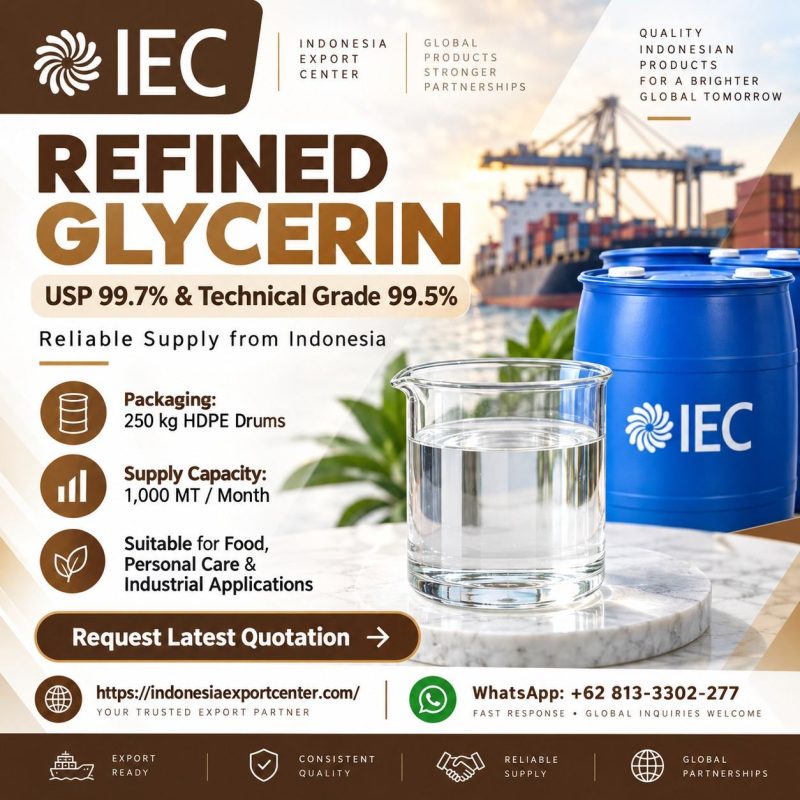
International buyers frequently compare USP 99.7% refined glycerin with Technical Grade 99.5% glycerin when selecting a raw material for manufacturing.
Although the stated glycerol concentrations are relatively close, the two commercial grade descriptions may represent different quality requirements and intended applications.
USP glycerin vs technical glycerin should therefore be evaluated based on complete specifications, documentation, regulatory suitability, and manufacturing requirements rather than purity percentage alone.
Indonesia Export Center (IEC) supports buyers seeking Indonesian refined glycerin supplier options for both proposed grades.
Understanding Refined Glycerin
Glycerin, also called glycerol, is a hygroscopic, viscous liquid used across industrial and consumer product manufacturing.
Its chemical formula is C3H8O3.
It may be used in suitable applications as a humectant, solvent, formulation component, or chemical feedstock.
The appropriate grade depends on the product being manufactured and the relevant quality requirements.
What Is USP 99.7% Glycerin?
USP refers to the United States Pharmacopeia.
A product marketed as USP 99.7% generally targets buyers seeking a higher-specification material.
However, USP compliance requires more than a stated assay.
The supplier must demonstrate compliance with the applicable monograph, including relevant identity and impurity requirements.
The buyer should request a current COA and supporting technical documentation.
What Is Technical Grade Glycerin 99.5%?
Technical Grade 99.5% refers to a glycerin product intended for industrial use according to an agreed technical specification.
Potential applications include selected soap, detergent, chemical, resin, and oleochemical processes.
The designation does not automatically establish suitability for food, pharmaceutical, or cosmetic applications.
The actual specification must be reviewed.
Comparison Table
| Characteristic | USP 99.7% | Technical 99.5% |
|---|---|---|
| Stated Glycerol Assay | 99.7% | 99.5% |
| Main Market Positioning | Higher-specification applications | Industrial applications |
| USP Compliance | Requires evidence | Not assumed |
| Food Suitability | Requires separate verification | Not assumed |
| Pharmaceutical Suitability | Requires full qualification | Not assumed |
| Cosmetic Suitability | Requires qualification | Requires qualification |
| Industrial Applications | Possible | Possible |
| COA | Essential for evaluation | Essential for evaluation |
| TDS | Recommended | Recommended |
| Price | Supplier quotation | Supplier quotation |
| Substitution | Not automatic | Not automatic |
Why Purity Alone Is Insufficient
A glycerin product with a stated purity of 99.7% may still require additional testing before it can be approved for a sensitive application.
Similarly, a 99.5% technical product may be entirely suitable for a particular industrial process if it meets the required specification.
The relevant question is not simply which percentage is higher.
The relevant question is whether the product meets the buyer’s complete technical and regulatory requirements.
Impurity Profiles
Different grades may be evaluated against different impurity limits.
Relevant parameters can include water content, inorganic residues, organic impurities, color, and acidity or alkalinity.
For pharmaceutical and certain sensitive applications, DEG and EG controls are especially important.
Buyers should not infer impurity compliance from the assay percentage.
Food Manufacturing Considerations
Food manufacturers must verify the applicable food ingredient requirements.
A USP designation does not automatically satisfy every food regulatory requirement.
The buyer should obtain relevant supplier documentation and confirm compliance in the destination market.
Cosmetic Manufacturing Considerations
Cosmetic manufacturers may evaluate glycerin for its humectant properties.
However, ingredient suitability depends on quality, impurity controls, formulation compatibility, and regulatory requirements.
A product described as technical grade should not automatically be accepted as cosmetic grade.
Pharmaceutical Manufacturing Considerations
Pharmaceutical manufacturers must apply appropriate material qualification and regulatory controls.
This may involve supplier assessment, compendial testing, contaminant controls, traceability, and other quality requirements.
A nominal purity statement is not sufficient.
Industrial Chemical Applications
Industrial manufacturers may use technical grade glycerin where it meets process requirements.
Some processes may require additional impurity restrictions.
The buyer should establish measurable acceptance criteria before purchasing.
Packaging Comparison
The preliminary sourcing reference identifies 250 kg HDPE drums for refined glycerin.
The proposed configuration is 80 drums per 20-foot container, equivalent to 20 MT net product weight.
The supplier must confirm packaging availability and suitability for each grade.
For sensitive applications, packaging cleanliness and material compatibility may require additional verification.
Commercial Price Differences
The two grades may be quoted differently because of manufacturing requirements, testing, quality controls, and market conditions.
However, no current verified price is provided.
Buyers should request quotations based on identical quantities, packaging, loading ports, and delivery terms.
Supplier Documentation Checklist
Before selecting a grade, request:
- Product specification.
- Technical Data Sheet.
- Batch Certificate of Analysis.
- Safety Data Sheet.
- Feedstock origin declaration, if relevant.
- Applicable quality or regulatory documents.
- Packaging specifications.
- Current commercial quotation.
Grade Selection Decision Guide
Choose a higher-specification inquiry when: The intended application requires additional quality controls or documented compliance.
Choose a technical-grade inquiry when: The intended industrial process permits the offered specification and does not require additional regulated-use qualifications.
Request both grades when: The buyer’s technical team needs to compare cost, quality, and process suitability.
Final selection should follow appropriate technical evaluation.
Can One Grade Replace the Other?
Not automatically.
Changing a raw material grade can affect regulatory status, impurity exposure, processing, and finished-product performance.
Manufacturers should evaluate the replacement through their established change-control and qualification procedures.
Frequently Asked Questions
What is the main difference between 99.7% and 99.5% glycerin?
The stated assay differs, but the full specifications and intended-use requirements are more important.
Is USP 99.7% always food grade?
No. Food suitability requires separate verification.
Can technical 99.5% glycerin be used in pharmaceuticals?
It should not be assumed suitable without the necessary qualification and regulatory evidence.
Is USP glycerin always more expensive?
No universal price relationship can be guaranteed.
Can both grades be packed in 250 kg drums?
The proposed packaging is subject to supplier confirmation.
Can IEC provide both grade specifications?
IEC can receive requests for the relevant supplier documents.
Should I request samples?
Sample or trial arrangements may be discussed, subject to availability.
Compare Indonesian Glycerin Grades and Request Samples
Company Name:
Country:
Intended Application:
Grade Required: USP 99.7% / Technical 99.5% / Both
Technical Specification:
Required Documentation:
Sample Requirement:
Initial Quantity (MT):
Monthly Volume (MT):
Destination Port:
Preferred Trade Terms:
Indonesia Export Center (IEC)
Website: https://indonesiaexportcenter.com/
WhatsApp: +62 813-3302-277
Contact IEC to compare supplier-confirmed glycerin grades, request technical documentation, and discuss bulk quotations.
Related pages:
- USP 99.7% Refined Glycerin Supplier
- Technical Grade Glycerin 99.5%
- Refined Glycerin COA Specifications
Grade descriptions, regulatory suitability, certifications, and commercial terms require verification for the specific supplier and product.
