![Indonesia Export Center [IEC]](https://indonesiaexportcenter.com/wp-content/uploads/2023/07/logo-no-background.svg)
![Indonesia Export Center [IEC]](https://indonesiaexportcenter.com/wp-content/uploads/2023/07/svgviewer-output.svg)
Introduction
Indonesia is an important sourcing destination for coconut-based growing media, including compressed cocopeat blocks and cocopeat slabs. For international buyers, however, selecting the right product specification is only one part of the purchasing process.
A successful import also requires:
- Clear technical specifications
- Confirmation of destination-country import requirements
- Complete commercial and shipping documents
- Realistic production and logistics planning
- Agreed inspection and payment procedures
- Coordination between the supplier, freight forwarder, quarantine authority, carrier, and customs broker
This guide explains how to import cocopeat from Indonesia, from supplier evaluation and product specification confirmation to export documentation, container shipment, and destination customs clearance.
Import regulations are not identical in every market. The phytosanitary authority or National Plant Protection Organization, commonly abbreviated as NPPO, of the importing country determines the applicable plant-health requirements. These requirements may be published in national regulations, stated in an import permit, or arranged through bilateral agreements.
Importers should therefore confirm their destination-country requirements before production begins—not after the container has already been loaded.
Why Import Cocopeat from Indonesia?
Cocopeat, also known as coir pith, is produced from the pith material generated during coconut-husk processing. After processing, drying, screening, and compression, it can be supplied as compact blocks or longer slabs for easier international transportation.
Compressed cocopeat is commonly purchased by:
- Hydroponic growing-media distributors
- Commercial nurseries
- Greenhouse operators
- Potting-mix manufacturers
- Soil-substrate blenders
- Garden-product wholesalers
- Agricultural input distributors
- Private-label gardening brands
The compressed format enables buyers to transport a larger amount of expandable growing medium within a container. Once hydrated, each block or slab expands into loose cocopeat that can be incorporated into growing-media formulations.
However, buyers must assess more than the product’s country of origin. Electrical conductivity, moisture, pH, expansion volume, compression consistency, impurities, particle composition, packaging, and shipment documentation can all affect commercial usability.
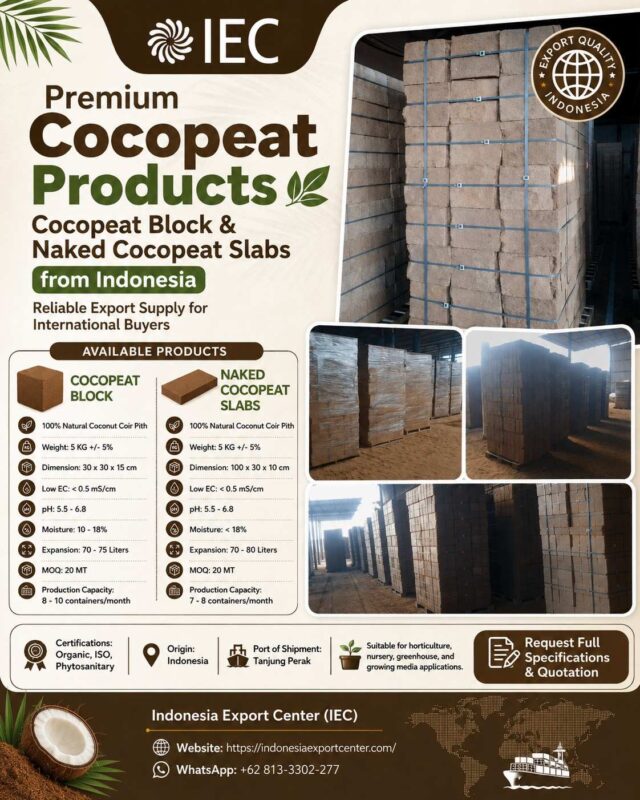
Available Indonesian Cocopeat Specifications
The following commercial specifications can be offered for international orders.
| Feature | Cocopeat Block | Naked Cocopeat Slab |
|---|---|---|
| Raw material | 100% natural coconut coir pith | 100% natural coconut coir pith |
| Nominal weight | 5 kg ± 5% | 5 kg ± 5% |
| Dimensions | 30 × 30 × 15 cm | 100 × 30 × 10 cm |
| Electrical conductivity | Below 0.5 mS/cm | Below 0.5 mS/cm |
| pH | 5.5–6.8 | 5.5–6.8 |
| Moisture | 10–18% | Below 18% |
| Expansion volume | 70–75 liters | 70–80 liters |
| Compression ratio | 5:1 | 5:1 |
| Impurities | Below 3% | Below 3% |
| Fiber content | Below 2% | Below 2% |
| Individual packing | No individual wrapping | No individual wrapping |
| Minimum order quantity | 20 MT | 20 MT |
| Production lead time | 25–30 days | 25–30 days |
| Monthly production capacity | 8–10 containers | 7–8 containers |
| Available documentation or certification | Organic, ISO and phytosanitary, subject to scope and verification | Organic, ISO and phytosanitary, subject to scope and verification |
| Country of origin | Indonesia | Indonesia |
| Port of shipment | Tanjung Perak, Indonesia | Tanjung Perak, Indonesia |
Important Specification Note
The specification table should be treated as the commercial product standard to be confirmed in the quotation, purchase order, and sales contract.
Before ordering, buyers should agree on:
- The EC testing method
- Water-to-cocopeat ratio used during EC testing
- Expansion testing procedure
- Acceptable weight tolerance
- Moisture testing method
- Sampling frequency
- Inspection method
- Allowed quantity variance
- Final loading configuration
- Labeling and private-label requirements
A numerical EC result is only commercially useful when the buyer and supplier use a mutually agreed testing procedure.
What Does a 20 MT MOQ Mean?
The standard minimum order quantity for both formats is 20 metric tons.
Based on a nominal product weight of 5 kg per unit:
20,000 kg ÷ 5 kg = approximately 4,000 blocks or slabs
This figure is a nominal calculation. The final quantity may differ because the product has a weight tolerance of ±5%, and the final shipment must also consider:
- Actual production weight
- Packing configuration
- Container payload restrictions
- Pallet or non-pallet loading
- Dunnage requirements
- Shipping-line limitations
- Destination-country road weight restrictions
Buyers should request a final loading plan before confirming the purchase order. The plan should state the estimated number of units, net weight, gross weight, package count, container type, and loading method.
Documents Needed to Import Cocopeat from Indonesia
The exact document package depends on the destination country, Incoterm, payment arrangement, and whether the shipment is subject to plant-quarantine controls.
The following documents are commonly discussed during an international cocopeat transaction.
1. Pro Forma Invoice
The pro forma invoice is normally issued before payment and should include:
- Seller and buyer information
- Product name and description
- Technical specifications
- Quantity and unit price
- Total contract value
- Country of origin
- Port of loading
- Destination port
- Incoterm
- Payment terms
- Production lead time
- Quotation validity
- Bank details
- Required documentation
The buyer should review every commercial detail before transferring the down payment.
2. Sales Contract or Purchase Order
A formal purchase order or sales contract helps prevent disputes about quality, quantity, shipment timing, payment, and documentation.
For cocopeat orders, it should define:
- Product form
- EC and pH range
- Moisture limit
- Expansion volume
- Block dimensions
- Net-weight tolerance
- Packing method
- Inspection procedure
- Claims procedure
- Shipment window
- Document requirements
- Payment milestones
3. Commercial Invoice
The commercial invoice is issued for the actual shipment. It should be consistent with the purchase order, packing list, customs declaration, certificate of origin, and Bill of Lading.
Important details include:
- Accurate product description
- Quantity
- Unit price
- Total value
- Currency
- Incoterm
- Country of origin
- Buyer and seller details
- Applicable product or HS classification
Importers should confirm the correct HS classification with their customs broker before shipment. Product classification can affect import duties, reporting requirements, permits, and customs treatment.
4. Packing List
The packing list describes the physical composition of the shipment. It normally includes:
- Total number of blocks or slabs
- Number of packages or pallets
- Net weight
- Gross weight
- Package dimensions
- Container number, when available
- Seal number, when available
- Packing configuration
The information must match the cargo actually loaded into the container.
5. Indonesian Export Customs Declaration
Indonesian exporters submit a Pemberitahuan Ekspor Barang, or PEB, as part of the export customs process.
Indonesia’s Directorate General of Customs and Excise describes the general export procedure as beginning with cargo preparation, followed by submission of the PEB. Physical inspection may be performed under a risk-management system for shipments selected for examination.
The exporter or appointed customs-service provider generally manages this process. The overseas buyer does not normally submit the Indonesian PEB but may request supporting evidence that export customs formalities have been completed.
6. Bill of Lading
The carrier or freight forwarder issues the Bill of Lading after the cargo has been accepted for ocean transportation.
It records important shipment information such as:
- Shipper
- Consignee
- Notify party
- Port of loading
- Port of discharge
- Cargo description
- Package count
- Gross weight
- Container number
- Seal number
- Freight arrangement
Buyers should review the draft Bill of Lading before the final document is issued. Incorrect consignee details, cargo descriptions, or document instructions can delay customs clearance.
7. Phytosanitary Certificate
A phytosanitary certificate may be required when cocopeat is regulated as a plant product, growing medium, or other regulated article by the destination country.
ISPM 12 provides international guidance for the preparation and issuance of phytosanitary certificates. It also states that import requirements should be specified by the NPPO of the importing country through regulations, permits, or other official arrangements.
Indonesia’s quarantine system provides verification for plant-export documents, including phytosanitary certificates for export and certificates for processed or non-regulated products.
A phytosanitary certificate is therefore not a substitute for checking the importing country’s rules. Before production, the importer should determine whether the destination requires:
- An import permit
- A phytosanitary certificate
- A specific treatment
- Laboratory analysis
- Pest-free declarations
- Additional declarations
- Registration of the production facility
- Inspection on arrival
- Restrictions on soil or organic contamination
The supplier must receive the exact wording of any required additional declaration early enough to coordinate with the Indonesian quarantine authority.
8. Certificate of Origin
A Certificate of Origin confirms that the exported goods originate from Indonesia. Indonesia’s Ministry of Trade explains that a Certificate of Origin may be issued because of an importing-country requirement or under a bilateral, regional, or multilateral trade arrangement. Preferential certificates may enable eligible goods to receive reduced or exempted import tariffs.
The importer should ask its customs broker:
- Whether a Certificate of Origin is mandatory
- Whether a non-preferential certificate is sufficient
- Whether a preferential trade agreement applies
- Which specific certificate or origin declaration is accepted
The certificate should not be requested automatically without first confirming the applicable origin scheme.
9. Certificate of Analysis
A Certificate of Analysis, or COA, is a commercial quality document rather than a universal customs requirement.
For cocopeat, a COA may report:
- EC
- pH
- Moisture
- Expansion volume
- Impurities
- Fiber percentage
- Weight
- Particle-size distribution
- Other buyer-requested parameters
Buyers should confirm whether the COA is issued by:
- The producer’s internal laboratory
- An independent laboratory
- A surveyor
- An inspection company
For higher-value or repeat contracts, third-party testing may be agreed before shipment.
10. Treatment or Fumigation Certificate
Treatment should not be ordered merely because the cargo is agricultural.
It should be conducted when:
- Required by the destination country
- Stated in an import permit
- Requested by the quarantine authority
- Agreed contractually by the buyer and seller
- Required for the selected packing material
The treatment type, dosage, exposure time, temperature, and certificate wording must correspond to the importing country’s official requirements.
11. ISPM 15 Documentation for Wood Packaging
ISPM 15 applies to raw-wood packaging materials used in international trade, including certain pallets and dunnage. It is intended to reduce the movement of pests associated with raw wood. It does not regulate cocopeat itself.
When wooden pallets or raw-wood dunnage are used, the buyer should confirm that they are treated and marked as required by the destination country.
Processed wood products such as plywood may fall outside the standard where they have been manufactured in a manner that removes the relevant pest risk.
12. Insurance Certificate
An insurance certificate may be required when:
- The agreed Incoterm places insurance responsibility on the seller
- The buyer arranges cargo insurance separately
- A bank or letter-of-credit transaction requires evidence of insurance
- The sales contract specifically requires it
Insurance responsibility should be stated clearly in the quotation and contract.
Are Organic and ISO Certificates Mandatory?
Organic and ISO certificates should be evaluated separately from export and phytosanitary documents.
They are not automatically mandatory for every cocopeat shipment.
Organic Certification
The buyer should confirm:
- Name of the certification body
- Certificate number
- Validity period
- Certified company name
- Certified facility
- Products covered
- Applicable organic standard
- Countries or markets where it is recognized
An organic certificate for one company, facility, or product cannot automatically be applied to every shipment handled by a trader.
ISO Certification
ISO certification usually relates to a company’s management system, manufacturing process, environmental system, food-safety system, laboratory, or another defined scope.
The buyer should verify:
- The relevant ISO standard
- Certificate scope
- Issuing certification body
- Accreditation status
- Validity
- Name and address of the certified organization
Neither an organic certificate nor an ISO certificate replaces destination-country customs and quarantine requirements.
Step-by-Step Cocopeat Import Process
Step 1: Confirm Destination-Country Import Requirements
Before requesting a final quotation, the importer should contact:
- Its customs broker
- The destination-country plant-quarantine authority
- The relevant agricultural department
- The destination country’s NPPO
- The port or border inspection authority, where necessary
The International Plant Protection Convention maintains information on national plant-protection organizations. Official communication between exporting and importing NPPOs is the appropriate channel for clarification of phytosanitary requirements.
The importer should obtain written confirmation of any:
- Import permit
- Phytosanitary certificate
- Treatment
- Pest declaration
- Laboratory test
- Packaging restriction
- Port-of-entry limitation
This step should be completed before production begins.
Step 2: Send a Detailed Request for Quotation
A professional request for quotation should state:
- Product format: block or slab
- Required quantity
- Destination port
- Target EC
- pH range
- Moisture limit
- Expansion requirement
- Packing method
- Label requirements
- Required certificates
- Required inspection
- Preferred Incoterm
- Desired shipment date
Providing complete information helps the exporter calculate an accurate price and production plan.
Step 3: Evaluate the Supplier
Before paying a deposit, buyers should evaluate:
- Legal company identity
- Factory or processing location
- Export experience
- Production capacity
- Quality-control system
- Access to quarantine and export documentation
- Bank-account ownership
- Product samples
- Previous shipment records
- Certificate validity
- Ability to meet destination requirements
A video factory inspection, third-party audit, or pre-contract sample evaluation may be useful for a new supplier relationship.
Step 4: Approve Samples and Testing Procedures
The buyer should not approve a sample only based on appearance.
Testing may include:
- EC
- pH
- Expansion
- Moisture
- Weight
- Impurities
- Fiber content
- Particle composition
- Hydration behavior
The approved sample should be linked to a written specification and test method. Commercial production will naturally have some variation, so the contract should state realistic tolerances.
Step 5: Confirm the Quotation and Contract
The standard commercial terms offered for this product are:
- Quotation validity: Seven days from the date of issuance
- Payment: 50% down payment by T/T after order confirmation
- Balance: Remaining 50% payable before release of the Bill of Lading
- MOQ: 20 MT
- Production lead time: Approximately 25–30 days
- Port of shipment: Tanjung Perak, Indonesia
The buyer should also confirm whether the quotation is:
- EXW
- FOB
- CFR
- CIF
- Another agreed Incoterm
The quotation should state which party pays for inland transportation, terminal handling, ocean freight, insurance, destination charges, customs clearance, import duties, and quarantine inspection.
Step 6: Pay the Down Payment
Under the stated payment terms, production begins after receipt of the 50% T/T down payment and order confirmation.
Before transferring funds, the buyer should verify:
- Beneficiary name
- Bank name
- Bank address
- SWIFT code
- Account number
- Correspondence between the beneficiary and seller
- Pro forma invoice authenticity
Changes to bank details should be verified through an independent communication channel to reduce payment-fraud risk.
Step 7: Production and Quality Control
The stated production lead time is approximately 25–30 days.
The process may include:
- Collection or sourcing of coconut coir pith
- Washing or processing according to the agreed EC grade
- Drying
- Screening
- Moisture adjustment
- Compression into blocks or slabs
- Weight checking
- Expansion testing
- Packing preparation
- Final inspection
The buyer should clarify whether the lead time begins from:
- Purchase-order confirmation
- Deposit receipt
- Sample approval
- Label approval
- Import-permit confirmation
Ocean transit time, port congestion, customs clearance, and destination inspection are not normally included in the production lead time.
Step 8: Pre-Shipment Inspection
A pre-shipment inspection can verify:
- Product dimensions
- Unit weight
- Package count
- Moisture
- EC and pH
- Expansion
- Packing condition
- Container cleanliness
- Loading method
- Container and seal numbers
Inspection can be conducted by:
- The supplier
- The buyer’s representative
- An independent surveyor
- A laboratory
- A recognized inspection company
The contract should identify who pays the inspection cost and what happens if the cargo fails the agreed specification.
Step 9: Export Customs and Quarantine Processing
Before loading or export clearance, the exporter coordinates the required procedures with:
- Indonesian Customs
- Indonesian Quarantine Authority
- Freight forwarder
- Shipping line
- Port terminal
- Certificate-of-origin issuing authority, when applicable
The exporter submits the PEB and prepares the required supporting documents. Quarantine inspection and certification are arranged when required by the importing country.
The certificate wording, cargo description, package count, weight, container information, and destination must remain consistent across the document package.
Step 10: Container Stuffing and Shipment
Before loading, the container should be checked for:
- Water leakage
- Holes or structural damage
- Odor
- Oil contamination
- Chemical residue
- Excessive rust
- Wet flooring
- Pest contamination
- Unsuitable previous cargo
Because cocopeat can absorb moisture, a dry and clean container is important. The loading team should also minimize exposure to rain and standing water.
After loading:
- The container is sealed
- The seal number is recorded
- The container is delivered to the terminal
- Export customs formalities are completed
- The container is loaded onto the nominated vessel
Step 11: Review the Shipping Documents
The buyer should review draft documents before final issuance, particularly:
- Commercial invoice
- Packing list
- Bill of Lading
- Certificate of Origin
- Phytosanitary certificate
- Certificate of Analysis
- Treatment certificate, when applicable
Names, addresses, product descriptions, quantities, weights, container numbers, and ports should be consistent.
Step 12: Pay the Balance and Receive the Documents
Under the stated commercial terms, the remaining 50% balance is paid before release of the Bill of Lading.
The contract should specify whether the buyer receives:
- Original negotiable Bill of Lading
- Telex release
- Sea waybill
- Electronic document set
- Couriered original documents
The required format should be confirmed with the buyer’s bank and customs broker before shipment.
Step 13: Destination Customs and Quarantine Clearance
Before the vessel arrives, the buyer should send the document set to its customs broker and plant-quarantine agent.
On arrival, authorities may conduct:
- Document verification
- Customs assessment
- Container inspection
- Sampling
- Pest inspection
- Laboratory testing
- Treatment verification
- Wood-packaging inspection
Under international phytosanitary principles, importing-country authorities normally verify whether consignments comply with their import requirements at entry.
Non-compliant cargo may be delayed, treated, re-exported, destroyed, or otherwise handled according to the destination country’s legislation. This is why import requirements must be confirmed before shipment.
Estimated Import Timeline
A practical timeline may look as follows:
| Activity | Indicative Time |
|---|---|
| Import-requirement confirmation | Depends on destination authority |
| Supplier evaluation and sample approval | Depends on buyer |
| Quotation and contract finalization | Several working days |
| Production | Approximately 25–30 days |
| Inspection and document preparation | Based on shipment schedule |
| Export customs and port handling | Subject to booking and port conditions |
| Ocean transit | Depends on destination and shipping route |
| Import clearance | Depends on customs and quarantine examination |
The 25–30-day lead time refers primarily to production. Buyers should not treat it as the total door-to-door delivery period.
Important Questions to Ask a Cocopeat Supplier
Before placing an order, ask the supplier:
- What test method is used for EC?
- Is the EC result measured in mS/cm?
- What water ratio is used during EC testing?
- Is the cocopeat washed, buffered, or only screened?
- What is the actual expansion-test procedure?
- What is the accepted moisture tolerance?
- How is each block weighed?
- How frequently are production samples tested?
- Can the supplier provide a batch-specific COA?
- Is third-party inspection accepted?
- How many units are expected in the container?
- Is the cargo palletized or floor-loaded?
- Are the wooden pallets ISPM 15 compliant?
- Can the supplier arrange a phytosanitary certificate if required?
- Can the supplier meet the exact additional declaration in the import permit?
- Which documents are included in the price?
- Is the offer FOB, CFR, or CIF?
- What shipment-date tolerance applies?
- What is the claims procedure?
- When will the draft Bill of Lading be available?
Clear answers help distinguish a document-ready exporter from a seller that only has access to the physical product.
Common Import Mistakes to Avoid
Assuming a Phytosanitary Certificate Is Always Sufficient
A phytosanitary certificate only certifies against the requirements communicated for the shipment. The destination country may additionally require an import permit, treatment, additional declaration, or inspection.
Confirming the Order Before Checking Import Rules
Production should not begin until the buyer understands the destination-country restrictions.
Focusing Only on the Lowest Price
A low price may exclude:
- Export documentation
- Quarantine inspection
- Treatment
- Pallets
- Container transport
- Terminal charges
- Ocean freight
- Insurance
- Third-party inspection
Buyers should compare quotations using the same Incoterm and document scope.
Failing to Define Test Methods
Different EC or expansion procedures can produce different results. The method should be agreed before contracting.
Accepting Unverified Certificates
Organic, ISO, phytosanitary, COA, and treatment documents serve different purposes. Buyers should verify the issuer, scope, shipment reference, and validity of each document.
Ignoring Wood-Packaging Requirements
Even when the cocopeat itself meets import requirements, non-compliant raw-wood pallets or dunnage may create a separate quarantine problem.
Paying Against Incomplete Documents
Before final payment, the buyer should review inspection results and draft shipping documents according to the agreed contract.
Frequently Asked Questions
Is a phytosanitary certificate required to import cocopeat?
It depends on the destination country. The importer must check with the destination-country NPPO or customs broker. Some countries regulate cocopeat as a plant product or growing medium and may require a phytosanitary certificate, import permit, treatment, or additional declaration.
What is the MOQ for Indonesian cocopeat?
The stated minimum order quantity is 20 MT for both 5 kg cocopeat blocks and naked cocopeat slabs.
How many 5 kg blocks are included in 20 MT?
A nominal 20 MT order is approximately 4,000 units. Final quantity depends on actual unit weight, packing, and loading limitations.
What is the production lead time?
The estimated production lead time is 25–30 days after order confirmation and fulfillment of the agreed starting conditions.
What are the payment terms?
The stated payment terms are 50% down payment by T/T upon order confirmation and 50% balance before release of the Bill of Lading.
How long is the quotation valid?
The quotation is valid for seven days from the date of issuance.
What is the port of shipment?
The stated port of shipment is Tanjung Perak, Indonesia.
Is cocopeat individually wrapped?
The offered cocopeat blocks and slabs use naked packing without individual wrapping. The final container-loading and outer-packing arrangement should be confirmed in the purchase contract.
Can the supplier provide organic and ISO certification?
Organic and ISO documentation may be available, but buyers should verify the issuing body, certificate holder, validity, facility, product scope, and market recognition.
Can the supplier arrange a Certificate of Origin?
A Certificate of Origin can generally be arranged when required, but the buyer should first confirm the correct certificate or preferential origin scheme with its customs broker.
Final Buyer Checklist
Before importing cocopeat from Indonesia, confirm that you have:
- Approved the product specification
- Agreed on the testing methods
- Verified the supplier
- Checked the importing country’s regulations
- Obtained an import permit when required
- Confirmed phytosanitary requirements
- Confirmed treatment requirements
- Confirmed the HS classification with a customs broker
- Selected an Incoterm
- Approved the packing and loading plan
- Agreed on inspection procedures
- Verified the payment details
- Reviewed the document list
- Reviewed draft shipping documents
- Prepared destination customs and quarantine clearance
Conclusion
Understanding how to import cocopeat from Indonesia requires more than finding a supplier and negotiating a price.
International buyers must coordinate product quality, phytosanitary compliance, export documentation, payment milestones, container loading, ocean shipping, and destination clearance.
For the cocopeat specifications discussed in this article, the commercial starting point is:
- 5 kg compressed cocopeat blocks or slabs
- EC below 0.5 mS/cm
- pH of 5.5–6.8
- Expansion of 70–80 liters, depending on product format
- MOQ of 20 MT
- Production lead time of approximately 25–30 days
- Shipment from Tanjung Perak, Indonesia
- 50% T/T down payment and 50% before Bill of Lading release
The most important action for buyers is to verify the destination-country import requirements before confirming production. Phytosanitary conditions are determined by the importing market and may differ according to the product description, treatment status, packaging, intended use, and port of entry.
A reliable Indonesian cocopeat supplier should be able to provide clear specifications, consistent documentation, transparent payment terms, realistic loading information, and active coordination with the exporter, forwarder, quarantine authority, and inspection parties.
Call to Action
Looking for a Cocopeat Supplier from Indonesia?
Source Indonesian cocopeat for hydroponics, nurseries, potting-mix production, growing-media distribution, and private-label garden products.
Available options include:
- 5 kg cocopeat blocks
- Naked cocopeat slabs
- Low-EC specification
- Expansion up to 70–80 liters
- MOQ from 20 MT
- Export documentation support
- Shipment through Tanjung Perak, Indonesia
Send your required specification, destination port, quantity, packaging preference, and import-document requirements to receive a detailed commercial quotation.
Read Also Our Product
https://indonesiaexportcenter.com/product/product-cocopeat-block-slabs-supplier-exporter-indonesia/
Regulatory References
- Indonesian Directorate General of Customs and Excise—general export procedure and PEB submission.
- International Plant Protection Convention—ISPM 12 requirements and guidance for phytosanitary certificates.
- International Plant Protection Convention—import requirements are determined by the NPPO of the importing country.
- Indonesian Quarantine Authority—verification of phytosanitary export documents.
- Indonesian Ministry of Trade—Certificate of Origin and preferential origin documents.
- International Plant Protection Convention—ISPM 15 for raw-wood packaging materials used in international trade.
Regulatory notice: Import, customs, quarantine, treatment, labeling, and documentation requirements may change. Importers should verify current requirements with the relevant customs authority, NPPO, import-permit authority, and licensed customs broker before placing an order.
