![Indonesia Export Center [IEC]](https://indonesiaexportcenter.com/wp-content/uploads/2023/07/logo-no-background.svg)
![Indonesia Export Center [IEC]](https://indonesiaexportcenter.com/wp-content/uploads/2023/07/svgviewer-output.svg)
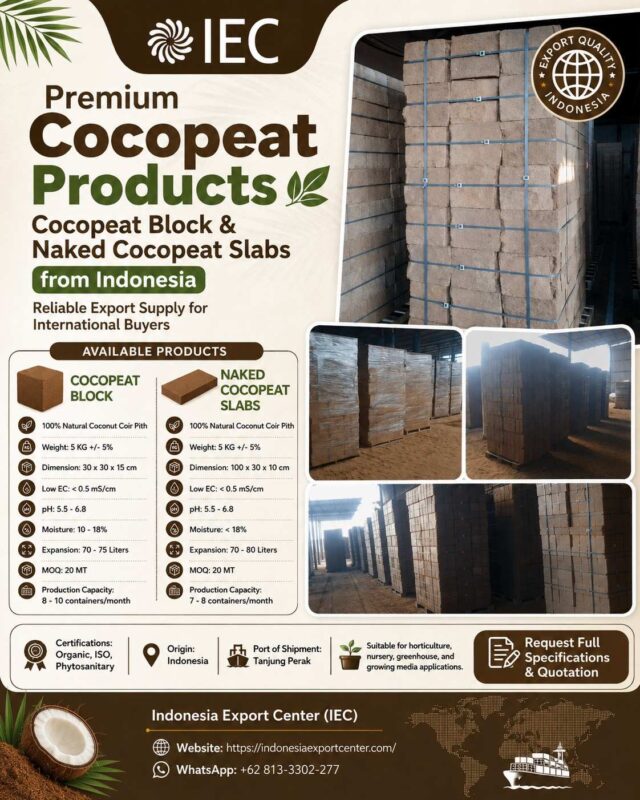
Cocopeat Supplier for United States Importers
Reliable Indonesian Cocopeat for Potting Mix, Hydroponics, Nurseries, and Private-Label Garden Products
Indonesia Export Center supplies compressed cocopeat products from Indonesia for United States importers, horticultural distributors, potting-mix manufacturers, hydroponic suppliers, commercial nurseries, garden-product wholesalers, and private-label brands.
Our cocopeat is manufactured from 100% natural coconut coir pith and compressed at a 5:1 ratio to reduce shipping volume. Available products include standard 5 kg cocopeat blocks and elongated naked cocopeat slabs, with loading, palletization, labeling, and export documentation arranged according to buyer requirements.
Main Product Advantages
🌱 Made from 100% natural coconut coir pith
📦 Compressed for efficient container loading
💧 Low EC specification below 0.5 mS/cm
🪴 Suitable for potting-mix and soilless-growing applications
🏷️ Private-label and wholesale packing options available
🚢 Export shipments from Tanjung Perak Port, Indonesia
📄 Commercial and phytosanitary documentation support
Looking for a dependable cocopeat supplier for USA distribution?
Send us your required volume, destination port, preferred packing, and application to receive a customized commercial quotation.
CTA: Request a Cocopeat Quotation
Indonesian Cocopeat Supply for the United States Market
United States buyers require more than a competitive product. They also need consistent specifications, practical pallet arrangements, clear commercial documentation, and efficient container utilization.
As an Indonesian cocopeat export supplier and sourcing partner, Indonesia Export Center coordinates product preparation and shipment planning for buyers that require:
- Bulk 5 kg cocopeat blocks
- Wholesale coir pith for potting-mix production
- Low EC cocopeat for professional horticulture
- Cocopeat slabs for growing-media applications
- Palletized container shipments
- Private-label garden products
- Long-term supply programs
Cocopeat is commonly used as a component in soilless growing media because it can provide moisture retention and aeration. The USDA National Agricultural Library also identifies coconut coir as one of the growing media that may be used in hydroponic systems.
Available Cocopeat Products
1. Cocopeat Block 5 kg
The 5 kg compressed block is suitable for importers, distributors, commercial growers, garden suppliers, and potting-mix manufacturers that require compact bulk shipments.
Each block is compressed at a ratio of approximately 5:1 and expands to approximately 70–75 liters after proper hydration and loosening.
Common Applications
- Potting-mix manufacturing
- Hydroponic substrate preparation
- Commercial nursery production
- Greenhouse growing media
- Seedling and propagation mixes
- Soil-amendment products
- Retail garden products
- Private-label cocopeat blocks
2. Naked Cocopeat Slabs
Naked cocopeat slabs provide an elongated compressed format for buyers that require alternative dimensions for handling, processing, or growing-media preparation.
Each 5 kg slab expands to approximately 70–80 liters after hydration.
Common Applications
- Commercial growing-media preparation
- Nursery substrate production
- Greenhouse operations
- Hydroponic growing systems
- Custom potting-mix formulations
- Bulk horticultural distribution
Cocopeat Product Specifications
| Feature | Cocopeat Block | Naked Cocopeat Slabs |
|---|---|---|
| Raw Material | 100% natural coconut coir pith | 100% natural coconut coir pith |
| Weight | 5 kg ± 5% | 5 kg ± 5% |
| Dimension | 30 × 30 × 15 cm | 100 × 30 × 10 cm |
| Electrical Conductivity | Below 0.5 mS/cm | Below 0.5 mS/cm |
| pH | 5.5–6.8 | 5.5–6.8 |
| Moisture | 10–18% | Below 18% |
| Expansion Volume | 70–75 liters | 70–80 liters |
| Compression Ratio | 5:1 | 5:1 |
| Impurities | Below 3% | Below 3% |
| Fiber Content | Below 2% | Below 2% |
| Standard Packing | No individual wrapping | No individual wrapping |
| Minimum Order Quantity | 20 metric tons | 20 metric tons |
| Estimated Lead Time | 25–30 days | 25–30 days |
| Monthly Production Capacity | 8–10 containers | 7–8 containers |
| Available Supporting Documents | Organic, ISO, and phytosanitary documentation, subject to verification | Organic, ISO, and phytosanitary documentation, subject to verification |
| Country of Origin | Indonesia | Indonesia |
| Port of Shipment | Tanjung Perak, Indonesia | Tanjung Perak, Indonesia |
Final specifications should be confirmed in the approved quotation, product specification sheet, and pre-shipment documentation. Certification scope and document validity must also be verified for the relevant supplier, production batch, and shipment.
Why Low EC Matters for United States Buyers
Electrical conductivity indicates the concentration of soluble salts in the cocopeat extract. Excessive salt levels may interfere with nutrient-management programs, particularly in hydroponic systems, seedling production, and controlled-environment agriculture.
Our offered cocopeat specification has an EC level of:
EC Below 0.5 mS/cm
This low EC specification is intended for buyers that need cocopeat for:
- Hydroponic growing media
- Professional nursery production
- Greenhouse crops
- Seedling and propagation mixes
- Potting-mix manufacturing
- Controlled nutrient programs
- Horticultural products requiring lower soluble-salt levels
Because testing methods can produce different results, buyers should specify their preferred EC-testing method, extraction ratio, water quality, and acceptable tolerance before order confirmation.
A representative sample or pre-shipment test report can be requested for commercial evaluation.
Suitable for Potting-Mix Production
Cocopeat can be incorporated into commercial potting-mix formulations as a moisture-retaining organic substrate component.
Depending on the intended crop and container system, manufacturers may blend cocopeat with:
- Perlite
- Vermiculite
- Pine bark
- Compost
- Wood fiber
- Rice hulls
- Pumice
- Other horticultural substrate components
The final formulation should be developed according to the required air-filled porosity, drainage, water-holding capacity, nutrient program, crop type, container size, and irrigation method.
Recent U.S. extension guidance describes coconut coir as a moisture-retaining base ingredient used in soilless potting media.
Recommended Buyer Evaluation
Before using a new cocopeat batch in commercial production, buyers should conduct their own:
🧪 EC and pH testing
💧 Hydration and expansion testing
🌬️ Porosity and drainage evaluation
🌱 Crop or seedling trials
🧂 Sodium and chloride testing where required
📊 Potting-mix compatibility testing
Cocopeat for Hydroponic Distribution
Cocopeat is widely recognized as a growing-medium option for hydroponic and soilless production. It functions primarily as a physical rooting substrate, while plant nutrients are normally supplied through a controlled nutrient solution.
Our 5 kg cocopeat blocks can be supplied to:
- Hydroponic distributors
- Commercial greenhouse suppliers
- Indoor-growing retailers
- Controlled-environment agriculture companies
- Agricultural input wholesalers
- Private-label hydroponic brands
Buyers should determine whether the cocopeat will be used as a standalone substrate or blended with perlite, clay pebbles, bark, or other components.
Palletized Loading for U.S. Importers
Designed Around Warehouse and Container Requirements
Standard products are supplied without individual wrapping. However, palletized loading and secondary packaging can be arranged based on the buyer’s warehouse system, distribution model, and destination requirements.
Available shipment arrangements may include:
- Blocks loaded directly without individual wrapping
- Export palletization
- Stretch-wrapped pallets
- Pallet corner protection
- Buyer-specific pallet labels
- Product identification labels
- Batch and lot-number labeling
- Container floor loading
- Customized pallet height
- Custom outer bags or secondary packaging
The final loading configuration depends on:
- Product dimensions
- Pallet footprint
- Maximum pallet height
- Container payload limitation
- Destination-port requirements
- Warehouse handling equipment
- Buyer preference for floor loading or pallets
- Ocean-carrier weight restrictions
A provisional container loading plan can be prepared before production. Final quantities remain subject to actual block weight, pallet weight, container payload, and stuffing conditions.
ISPM 15-Compliant Pallet Options
When solid-wood pallets or other regulated wood packaging materials are used, the materials should comply with applicable U.S. wood-packaging requirements.
USDA APHIS states that regulated wood packaging material entering the United States must be pest-free, debarked, appropriately treated, and marked with an official ISPM 15 mark. Noncompliant wood packaging may be refused entry.
For United States shipments, buyers may request:
- ISPM 15-marked wooden pallets
- Heat-treated pallet documentation
- Non-wood or alternative pallet options
- Pallet-mark photographs before loading
- Pallet information included in the packing list
Pallet requirements must be confirmed before production and container booking.
Private-Label Cocopeat for Garden Suppliers
Indonesia Export Center can coordinate private-label arrangements for U.S. garden-product distributors, horticultural retailers, and agricultural brands.
Available Customization Options
🏷️ Buyer brand or private-label artwork
📋 Custom product identification
📦 Customized secondary packaging
🔢 Batch and production coding
🌱 Application instructions
💧 Hydration instructions
📏 Metric and U.S. customary measurements
🔳 Barcode or SKU placement
🪴 Potting-mix or hydroponic positioning
🚚 Customized pallet labels
Because the standard product is supplied without individual wrapping, retail-ready packing must be discussed separately. Private-label availability is subject to packaging design, minimum quantity, printing requirements, production feasibility, and final cost approval.
Buyers should supply finalized artwork and legally compliant product claims. All U.S. labeling, retail, environmental, and marketing requirements remain subject to buyer review and approval.
Container Efficiency and Shipment Planning
Cocopeat is compressed to reduce its shipping volume. However, effective container planning requires more than filling the maximum theoretical number of blocks.
We evaluate container loading based on:
- Product weight and permitted tolerance
- Block or slab dimensions
- Pallet dimensions and pallet weight
- Container type and maximum payload
- Floor-loaded or palletized configuration
- Port and carrier weight restrictions
- Safe stuffing and unloading procedures
- Buyer’s destination warehouse requirements
Container Loading Options
Floor-Loaded Containers
Floor loading can maximize the use of container space and reduce the weight occupied by pallets. It may be suitable for importers that have sufficient labor or mechanical unloading arrangements at destination.
Palletized Containers
Palletized loading can simplify warehouse handling, inventory movement, and distribution. However, the pallets reduce the total space and payload available for the product.
We recommend that buyers compare the operational savings of palletized handling against the additional pallet cost and reduced container capacity.
Quality-Control Support
Quality consistency is important for wholesale coir pith, potting-mix production, and hydroponic distribution.
Before shipment, the following parameters may be checked according to the agreed inspection scope:
- Net block weight
- Block dimensions
- Moisture level
- Electrical conductivity
- pH
- Expansion volume
- Impurity level
- Fiber content
- Packaging condition
- Pallet condition
- Container cleanliness
- Product and pallet labeling
Available Quality Documents
Depending on the order and agreed inspection plan, shipment documentation may include:
- Product specification sheet
- Certificate of Analysis
- Internal quality-control report
- Weight or quantity report
- Packing photographs
- Container-loading photographs
- Batch identification
- Third-party inspection report, when separately arranged
Third-party inspection costs, laboratory testing, and buyer-specific testing protocols must be agreed upon before production.
United States Import Documentation Support
Commercial shipments can be prepared with documentation commonly requested by importers, freight forwarders, customs brokers, banks, and agricultural inspection authorities.
Standard Commercial Documents
📄 Commercial invoice
📦 Packing list
🚢 Ocean bill of lading
📑 Product specification sheet
🧪 Certificate of Analysis, when agreed
🌍 Certificate of origin, when requested
🌿 Phytosanitary certificate, when applicable
🏷️ Pallet and product identification
📸 Loading and stuffing photographs
📋 Fumigation or pallet-treatment information, when applicable
U.S. Customs and Border Protection emphasizes the importance of accurate cargo descriptions and commercial invoices containing an adequate description, quantities, and merchandise values.
USDA APHIS Verification
Import conditions for plant-derived products can vary according to the specific commodity, condition of the product, intended use, country of origin, and current pest-risk requirements.
USDA APHIS recommends checking the Agricultural Commodity Import Requirements database for the current requirements applicable to a specific product and origin.
Before shipment, the U.S. importer and customs broker should confirm:
- Product admissibility
- Applicable USDA APHIS requirements
- Whether an import permit is needed
- Whether a phytosanitary certificate is required
- Appropriate customs classification
- Entry documentation
- Port-of-entry inspection arrangements
- State-level requirements, where applicable
Indonesia Export Center can support document preparation, but the importer of record and appointed customs broker are responsible for confirming final U.S. entry requirements.
Order and Shipment Process
Step 1 — Send Your Requirement
Please provide:
- Product type
- Required specification
- Estimated order quantity
- Destination port
- Preferred Incoterm
- Palletized or floor-loaded shipment
- Private-label requirements
- Required quality documents
- Expected shipment schedule
Step 2 — Specification Review
We review the requested EC, pH, moisture, expansion, packing, labeling, palletization, and documentation.
Step 3 — Commercial Quotation
A formal quotation is issued based on the confirmed specification, quantity, Incoterm, packaging, testing, and destination.
Step 4 — Sample or Pre-Production Approval
A representative sample, packaging design, or specification sheet may be submitted for buyer approval when agreed.
Step 5 — Order Confirmation and Deposit
Production is scheduled after order confirmation and receipt of the agreed down payment.
Step 6 — Production and Quality Control
The supplier processes, compresses, tests, and prepares the products according to the confirmed order.
Step 7 — Palletization and Container Loading
The products are floor-loaded or palletized according to the approved loading plan.
Step 8 — Balance Payment and Shipping Documents
The payment balance is completed before release of the original or surrendered Bill of Lading, according to the agreed contract.
Commercial Terms and Conditions
Minimum Order Quantity
20 metric tons per product
Mixed-product or mixed-packing arrangements are subject to production and container-loading approval.
Estimated Lead Time
25–30 days
Lead time begins after:
- Specification confirmation
- Purchase-order approval
- Deposit receipt
- Packaging or artwork approval, when applicable
Lead time may be affected by production schedules, packaging availability, vessel space, public holidays, inspections, and port conditions.
Payment Terms
- 50% down payment by T/T upon order confirmation
- 50% balance payment by T/T before release of the Bill of Lading
Any alternative payment arrangement must be reviewed and approved in writing.
Quotation Validity
The commercial quotation is valid for 7 calendar days from the date of issuance, unless otherwise stated in the quotation.
Freight rates, pallet costs, packaging costs, exchange rates, port charges, and raw-material availability may change after the quotation-validity period.
Frequently Asked Questions
What is the minimum order for cocopeat shipments to the United States?
The standard minimum order quantity is 20 metric tons for either 5 kg cocopeat blocks or naked cocopeat slabs.
What is the EC level of the cocopeat?
The offered specification is below 0.5 mS/cm. The testing method and acceptable tolerance should be confirmed before production.
How much does one 5 kg cocopeat block expand?
One properly hydrated and loosened block is expected to expand to approximately 70–75 liters.
Are the cocopeat blocks individually wrapped?
No. The standard products are supplied without individual wrapping. Pallet wrapping, secondary packaging, or custom private-label packing can be discussed separately.
Can you provide private-label cocopeat blocks?
Yes. Private-label outer packaging, labels, barcodes, pallet marks, and buyer branding may be arranged subject to minimum quantity, artwork approval, packaging feasibility, and additional costs.
Can the products be palletized?
Yes. Palletized loading can be arranged. Wooden pallets intended for U.S. shipments should meet applicable ISPM 15 requirements.
Is the cocopeat suitable for potting-mix production?
The product can be evaluated as a component in potting-mix formulations. Buyers should conduct formulation trials and verify EC, pH, particle characteristics, air porosity, drainage, and water-holding performance.
Is the cocopeat suitable for hydroponics?
The low EC specification is intended for horticultural and soilless-growing applications. Final suitability depends on the crop, irrigation system, nutrient program, container, particle distribution, and buyer testing.
Can you provide a phytosanitary certificate?
Phytosanitary documentation can be arranged when applicable to the commodity and shipment. Requirements must be confirmed with the importer, customs broker, USDA APHIS, and the relevant Indonesian issuing authority.
Where is the shipment loaded?
The indicated port of shipment is Tanjung Perak Port, Indonesia.
What information is needed for an accurate quotation?
Please provide the quantity, destination port, Incoterm, product format, pallet preference, private-label requirements, testing requirements, and expected shipment date.
Work With a Reliable Cocopeat Supplier for USA Distribution
Whether you are sourcing a 5 kg cocopeat block for USA distribution, wholesale coir pith for potting-mix manufacturing, or low EC cocopeat for hydroponic customers, we can prepare a supply proposal based on your commercial and logistical requirements.
Request Your Customized Quotation
Please send us:
✅ Product and specification
✅ Required quantity
✅ Destination port and ZIP code, if inland delivery is requested
✅ Preferred Incoterm
✅ Palletized or floor-loaded preference
✅ Private-label requirements
✅ Required certifications and documents
✅ Target delivery schedule
Our team will review your requirements and prepare the appropriate product, packing, documentation, and shipment proposal.
Read Also Our Product
https://indonesiaexportcenter.com/product/product-cocopeat-block-slabs-supplier-exporter-indonesia/
