

INDONESIA EXPORT CENTER (IEC)
B2B Organic Ingredient Sourcing for European Food Manufacturers, Distributors and Private-Label Brands
Source EU Organic Coconut Sugar from Indonesia
European food manufacturers and ingredient importers require reliable documentation when purchasing organic agricultural ingredients from outside the European Union.
For businesses searching for an EU organic coconut sugar supplier, Indonesia Export Center (IEC) facilitates sourcing inquiries involving Indonesian coconut sugar granules promoted as organic.
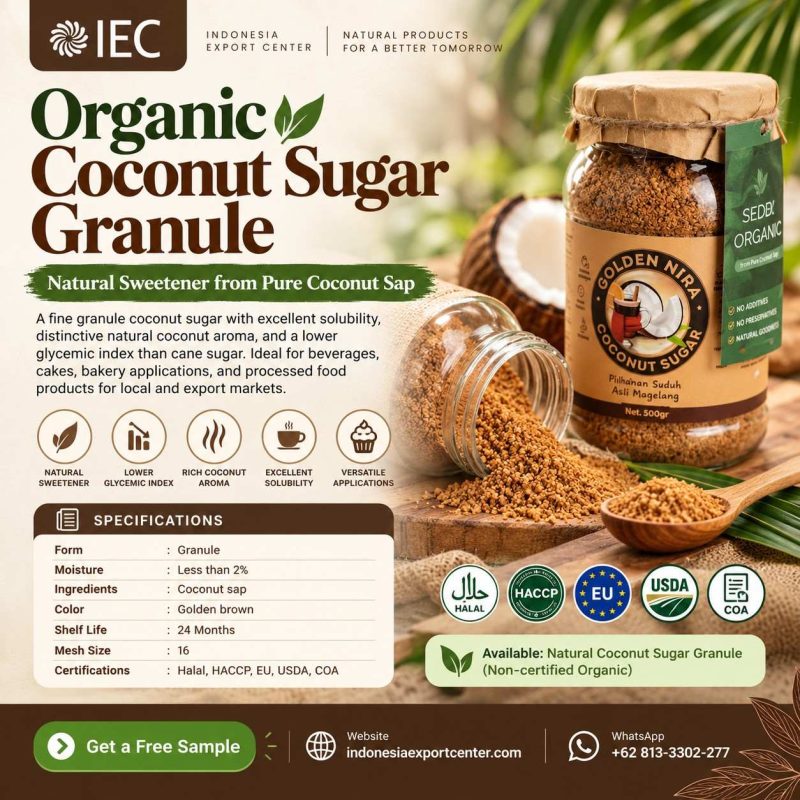
The IEC product flyer describes coconut sugar made from coconut palm sap, with golden-brown granules, moisture below 2%, mesh size 16, and a stated shelf life of 24 months.
The flyer also references EU organic certification.
However, this reference does not independently verify the current organic certification status of any supplier or shipment.
European importers should verify the relevant operator, certification body, product scope, and import documentation before purchasing coconut sugar as organic.
What Is EU Organic Coconut Sugar?
EU Organic coconut sugar refers to coconut sugar marketed as organic under applicable European Union organic production and labelling requirements.
Organic status is not determined by ingredient origin alone.
It depends on compliance with the relevant rules governing production, processing, handling, certification, and importation.
EU Organic Regulatory Framework
EU organic production and labelling are governed by a regulatory framework that includes Regulation (EU) 2018/848 and associated implementing and delegated measures.
Importers should check the current rules applicable to the product and country of origin.
Official resource: https://agriculture.ec.europa.eu/farming/organic-farming_en
IEC Product Reference
| Parameter | Flyer Information |
|---|---|
| Product | Organic Coconut Sugar Granule |
| Ingredient | Coconut Sap |
| Form | Granules |
| Moisture | Less than 2% |
| Mesh | 16 |
| Colour | Golden Brown |
| Shelf Life | 24 Months |
| Certification Reference | EU Organic |
| Additional References | USDA, Halal, HACCP, COA |
The information above requires supplier and document verification.
How European Buyers Verify Organic Suppliers
Identify the Operator
Request the legal name and location of the certified producer or handler.
Verify the Control Body
Identify the relevant organic control body and confirm its recognition for the applicable activities and product categories.
Check Certification Scope
The certificate must cover the relevant product and operator activities.
Review Supply-Chain Controls
Confirm organic identification and traceability throughout the relevant supply chain.
Check Import Documentation
Determine the applicable certificate of inspection and import procedures.
Verify Current Requirements
Organic import rules and recognized certification arrangements should be checked before shipment.
Certificate of Inspection and TRACES
Organic products imported into the European Union generally require appropriate organic import controls.
The Certificate of Inspection (COI), handled through the applicable TRACES system procedures, is an important consideration.
Importers should confirm the responsible parties, timing, required entries, and verification procedures before dispatch.
A COI is not interchangeable with a commercial invoice or laboratory COA.
Organic Certificate vs COI vs COA
| Document | Purpose |
|---|---|
| Organic Certificate | Certification status and scope |
| Certificate of Inspection | Organic import control |
| Certificate of Analysis | Laboratory or analytical information |
| Commercial Invoice | Commercial transaction |
| Packing List | Shipment contents |
| Transport Document | Cargo movement |
| Traceability Records | Product origin and lot identification |
EU Organic Logo and Labelling
European importers should review the rules governing organic product descriptions and use of the EU organic logo.
Labelling requirements may include information concerning the relevant control body and origin of agricultural raw materials.
The precise obligations depend on the product and how it is marketed.
A supplier’s use of an EU organic logo in promotional material does not automatically authorize the buyer to use that logo on finished products.
Coconut Sugar Quality Requirements
Organic status does not replace technical quality requirements.
Buyers may request:
- Current COA.
- Moisture results.
- Particle-size analysis.
- Microbiological reports.
- Relevant contaminant testing.
- Foreign matter controls.
- Packaging specification.
- Shelf-life documentation.
- Traceability information.
Coconut Sugar Applications in European Food Manufacturing
Potential applications include:
- Organic bakery products.
- Breakfast cereals.
- Granola.
- Snack bars.
- Coffee and tea.
- Beverage mixes.
- Specialty confectionery.
- Plant-based foods.
Manufacturers should conduct application-specific trials.
Organic vs Natural Coconut Sugar
The IEC flyer also identifies a natural coconut sugar variant.
This variant should not be marketed as EU organic-certified without separate valid certification.
Natural and organic are different categories.
Packaging and Transport
European buyers may request bulk ingredient packaging suitable for international transport.
Important considerations include moisture protection, food-contact compliance, lot identification, and traceability.
Supplier packaging options require confirmation.
Supplier Approval Checklist
- Identify the certified operator.
- Verify the control body.
- Review certificate validity.
- Confirm product scope.
- Check relevant import procedures.
- Verify COI arrangements.
- Request product specifications.
- Review current COA.
- Confirm packaging.
- Obtain commercial quotation.
EU Organic Coconut Sugar RFQ Template
Subject: EU Organic Coconut Sugar Import Inquiry
Company: [Name]
EU Destination Country: [Country]
Product: Organic Coconut Sugar Granules
Application: [Details]
Required Quantity: [KG or MT]
Monthly Demand: [Quantity]
Required Certification: EU Organic
Required Mesh: [Specification]
Maximum Moisture: [Specification]
Packaging: [Details]
Destination Port: [Port]
Preferred Incoterm: [Term]
Please provide current organic certification documents, operator details, COI arrangements, product specifications, COA, sample feasibility, MOQ, and export quotation.
Frequently Asked Questions
Does the IEC flyer mention EU Organic?
Yes, but current certification has not been independently verified.
Is an EU Organic logo sufficient?
No.
What is a COI?
A Certificate of Inspection used in applicable EU organic import procedures.
Is a COI the same as a COA?
No.
Can natural coconut sugar be labelled organic?
Not without satisfying the applicable organic certification requirements.
Can buyers request samples?
Yes, subject to supplier confirmation.
Is the stated 24-month shelf life guaranteed?
Supporting evidence must be reviewed.
Are commercial prices available?
Quotations require supplier confirmation.
Request EU Organic Coconut Sugar Documentation and Quotation
Looking for Indonesian coconut sugar for the European organic food ingredient market?
Contact IEC with your destination country, certification requirements, technical specifications, and purchasing volume.
REQUEST EU ORGANIC COCONUT SUGAR SAMPLE & RFQ
INDONESIA EXPORT CENTER (IEC)
Website: https://indonesiaexportcenter.com/
WhatsApp: +62 813-3302-277
Organic status, import eligibility, COI arrangements, product specifications, samples, MOQ, and prices require verification against current requirements.
Related Resources
Organic Coconut Sugar Supplier Indonesia
Organic vs Natural Coconut Sugar
Coconut Sugar COA and Quality Testing
