

IEC | INDONESIA EXPORT CENTER
Your Global Sourcing Partner
Comparing Natural Gum Copal with Synthetic Resins
Industrial manufacturers often evaluate different resin materials when developing varnishes, lacquers, protective coatings, adhesives, and specialty finishes.
Natural Gum Copal and synthetic resins may both be considered in certain formulation studies, but they are not directly equivalent material categories.
Gum Copal refers to certain naturally derived tree resins, while synthetic resins encompass a broad range of manufactured polymers and resin systems with different chemical structures and performance characteristics.
Therefore, the decision between Gum Copal and a synthetic resin should be based on the exact application, formulation requirements, manufacturing conditions, and available evidence.
Indonesia Export Center (IEC) facilitates B2B inquiries involving potential Indonesian Gum Copal suppliers.
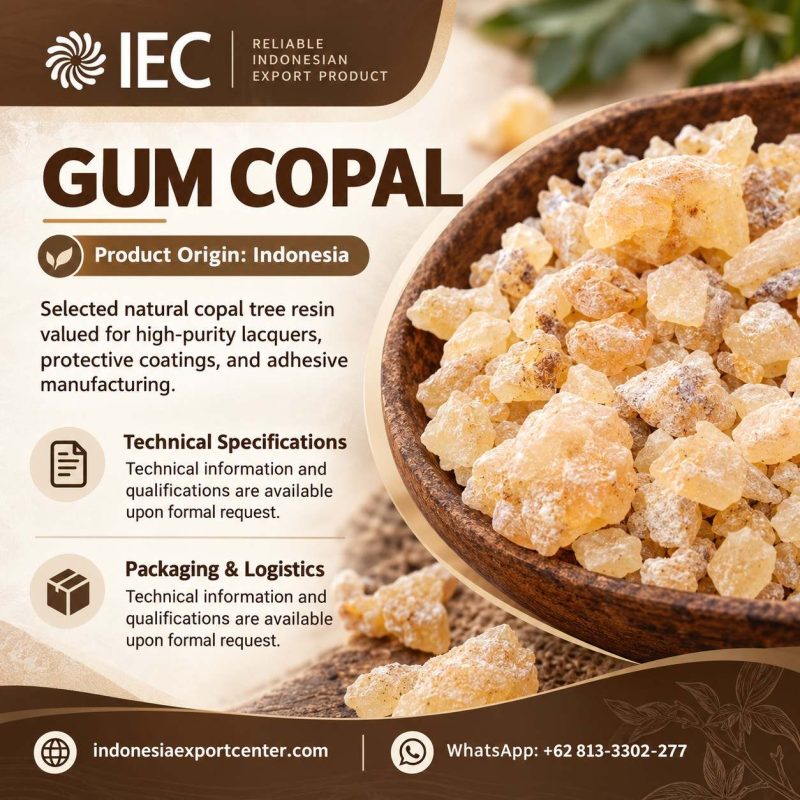
The IEC brochure identifies the material as selected natural copal tree resin originating from Indonesia.
IEC does not claim that Gum Copal is universally superior, more sustainable, cheaper, or directly interchangeable with synthetic resins.
What Is Natural Gum Copal?
Gum Copal is a commercial natural resin category.
Its characteristics depend on botanical source, grade, composition, preparation, and other material-specific factors.
For industrial procurement, buyers should verify the exact resin identity and obtain relevant technical information.
What Is Synthetic Resin?
Synthetic resin is a broad term covering many manufactured materials.
Examples of resin families used in industrial applications include:
- Acrylic resins.
- Alkyd resins.
- Epoxy resins.
- Polyurethane systems.
- Polyester resins.
- Phenolic resins.
- Other specialized polymer systems.
These materials are not interchangeable with one another.
A comparison with Gum Copal should identify the specific synthetic resin grade and formulation.
Natural vs Synthetic Resin Comparison
| Factor | Gum Copal | Synthetic Resin |
|---|---|---|
| Origin | Natural tree resin | Manufactured chemical or polymer system |
| Chemical Composition | Source-dependent | Depends on designed chemistry |
| Grade Consistency | Requires supplier verification | Depends on manufacturer controls |
| Solubility | Must be tested | Grade-dependent |
| Thermal Behavior | Must be characterized | Chemistry-dependent |
| Processing | Material-specific | System-specific |
| Coating Performance | Requires formulation testing | Requires formulation testing |
| Cost | Quotation-dependent | Product-dependent |
| Sustainability | Requires evidence-based assessment | Requires evidence-based assessment |
| Regulatory Status | Must be checked | Must be checked |
1. Material Consistency
Industrial buyers often require predictable properties from one batch to another.
For Gum Copal, consistency may depend on:
- Resin identity.
- Collection and preparation.
- Sorting.
- Supplier quality controls.
- Lot management.
Synthetic resin consistency also depends on manufacturing controls and product specifications.
Neither category should be assumed perfectly consistent without evidence.
2. Chemical Composition
Natural resins may contain complex mixtures of organic constituents.
Synthetic resins may be manufactured to defined chemical structures or performance targets.
However, this does not mean every synthetic resin is chemically uniform or that every natural resin is unsuitable for controlled manufacturing.
The buyer should compare actual technical data.
3. Solubility and Formulation Compatibility
A formulation may require a resin to interact with:
- Solvents.
- Other binders.
- Pigments.
- Fillers.
- Additives.
- Substrates.
Compatibility must be tested.
A resin’s natural or synthetic origin alone cannot establish its behavior in a finished product.
4. Thermal Characteristics
Processing requirements may involve:
- Softening behavior.
- Viscosity changes.
- Thermal stability.
- Curing or drying conditions.
- Storage conditions.
Different resin systems require different evaluation methods.
5. Film Formation and Coating Performance
For coatings, buyers may evaluate:
- Adhesion.
- Hardness.
- Flexibility.
- Gloss.
- Colour.
- Resistance to water.
- Resistance to chemicals.
- Weathering.
- Durability.
These properties depend on the complete formulation and testing conditions.
6. Adhesive Performance
For adhesives, relevant criteria may include:
- Tack.
- Bond strength.
- Cohesion.
- Open time.
- Viscosity.
- Substrate compatibility.
- Aging behavior.
No universal adhesive performance comparison is justified.
7. Manufacturing Cost
Raw material price is only one part of total manufacturing cost.
Other factors include:
- Processing energy.
- Mixing time.
- Filtration.
- Material loss.
- Equipment requirements.
- Quality testing.
- Rework.
- Finished-product yield.
A lower resin price does not necessarily mean a lower total cost.
8. Environmental and Sustainability Considerations
Natural origin does not automatically mean a material has a lower environmental footprint.
A meaningful comparison may require:
- Defined life-cycle boundaries.
- Raw material sourcing information.
- Energy use.
- Transportation.
- Processing.
- Waste management.
- Product lifetime.
- End-of-life treatment.
Environmental claims should be supported by appropriate evidence and relevant assessment methods.
IEC does not provide verified life-cycle emissions figures for Gum Copal.
9. Supply Chain Considerations
Procurement teams should evaluate:
- Supplier identity.
- Material availability.
- Grade consistency.
- Documentation.
- Delivery schedules.
- Price volatility.
- Geographic sourcing.
- Commercial risks.
10. How to Evaluate Gum Copal as a Candidate Alternative
Step 1 – Identify the Existing Resin
Record the exact synthetic resin grade and its function.
Step 2 – Define Performance Requirements
Establish measurable acceptance criteria.
Step 3 – Obtain Gum Copal Samples
Request representative material, subject to availability.
Step 4 – Characterize the Material
Conduct relevant analytical tests.
Step 5 – Develop Trial Formulations
Use controlled laboratory procedures.
Step 6 – Compare Finished Products
Evaluate performance under equivalent conditions.
Step 7 – Assess Manufacturing Feasibility
Review processing and equipment requirements.
Step 8 – Evaluate Total Cost
Include material and operational costs.
Step 9 – Complete Supplier Qualification
Verify quality, availability, and commercial terms.
Resin Selection Matrix
| Decision Area | Required Evaluation |
|---|---|
| Product Function | Defined |
| Material Identity | Confirmed |
| Technical Specification | Compared |
| Solubility | Tested |
| Thermal Behavior | Tested |
| Formulation Compatibility | Tested |
| Finished Performance | Verified |
| Regulatory Requirements | Checked |
| Environmental Claims | Supported by evidence |
| Cost | Calculated |
| Supplier Reliability | Evaluated |
Gum Copal vs Synthetic Resin RFQ Template
Subject: Indonesian Gum Copal for Resin Formulation Evaluation
Company: [Name]
Country: [Country]
Current Resin System: [Details]
Application: [Details]
Required Performance: [Details]
Required Gum Copal Grade: [If Known]
Laboratory Tests: [Details]
Sample Quantity: [KG]
Commercial Quantity: [KG / MT]
Destination: [Port, Country]
Please provide available Gum Copal technical information, sample options, and potential supplier details for formulation evaluation.
Frequently Asked Questions
Is Gum Copal better than synthetic resin?
There is no universal answer.
Is natural Gum Copal automatically environmentally superior?
No. Environmental claims require supporting evidence.
Can Gum Copal replace acrylic or epoxy resin?
That depends on the application and would require extensive formulation testing.
Is Gum Copal cheaper than synthetic resin?
Prices depend on the actual products and commercial conditions.
Can natural and synthetic resins be blended?
Compatibility depends on the materials and formulation.
Does IEC guarantee equivalent performance?
No.
Request Gum Copal for Industrial Resin Evaluation
Considering natural Gum Copal for a coating, varnish, lacquer, or adhesive formulation?
Contact IEC with your application, technical requirements, sample needs, and purchasing quantity.
REQUEST INDONESIAN GUM COPAL INFORMATION
IEC | INDONESIA EXPORT CENTER
Website: https://indonesiaexportcenter.com/
WhatsApp: +62 813-3302-277
Related Resources
Gum Copal for Protective Coatings
