

IEC | INDONESIA EXPORT CENTER
Your Global Sourcing Partner
Understanding Foreign Matter in Natural Gum Copal
Foreign matter and contamination are important considerations when evaluating natural Gum Copal for industrial manufacturing.
Because Gum Copal is a natural tree resin, its commercial quality can depend on how it is collected, handled, sorted, cleaned, stored, and packaged.
Unwanted materials may affect processing, product appearance, equipment operation, and the suitability of the resin for a particular formulation.
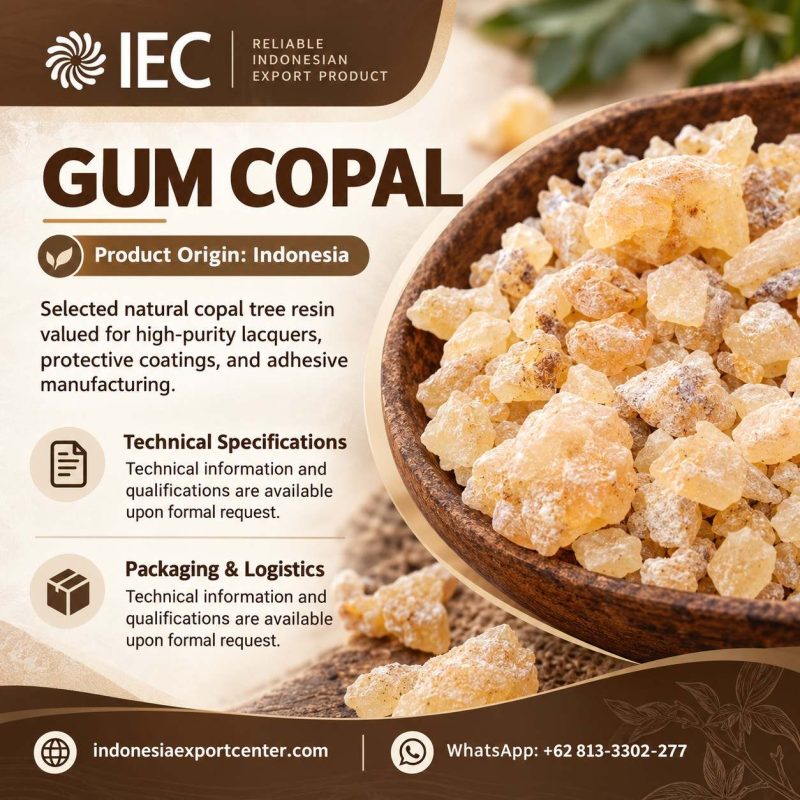
Indonesia Export Center (IEC) facilitates sourcing inquiries involving potential Indonesian Gum Copal suppliers.
The IEC brochure identifies the product as Indonesian-origin natural copal tree resin. It does not publish a verified maximum impurity percentage.
Therefore, buyers should establish their own acceptance criteria and request supplier documentation before purchasing.
What Is Foreign Matter?
Foreign matter generally refers to unwanted material that is not part of the intended commercial resin product.
Depending on the material and its handling history, examples may include:
- Bark fragments.
- Soil.
- Dust.
- Sand.
- Plant debris.
- Packaging fragments.
- Other extraneous materials.
The presence and amount of these materials must be established through inspection or testing.
Why Foreign Matter Matters
Processing Efficiency
Unwanted material may require additional preparation, cleaning, or filtration.
Equipment Protection
Certain particles may interfere with processing equipment.
Product Appearance
Visible contamination may affect the appearance of resin-based formulations.
Quality Consistency
Variation in foreign matter can influence manufacturing repeatability.
Commercial Acceptance
Buyers may specify maximum acceptable levels in the purchase contract.
Foreign Matter vs Chemical Impurities
These are not necessarily the same.
Foreign Matter generally refers to extraneous physical material.
Chemical Impurities may refer to unwanted chemical constituents identified using appropriate analytical methods.
A visual inspection cannot establish the absence of all chemical contaminants.
The buyer should define which types of contamination are relevant to the application.
Step 1 – Define the Quality Requirement
Before testing, determine:
- Which foreign materials are unacceptable.
- Whether visible contamination is permitted.
- Whether a numerical limit is required.
- Which analytical or inspection method will be used.
- How results will be reported.
Step 2 – Inspect Representative Samples
A sample should represent the relevant shipment or lot.
Inspection may evaluate:
- Visible particles.
- Surface contamination.
- Mixed material.
- Unexpected colour or texture.
- Packaging contamination.
Photographs may support inspection records but should not replace necessary testing.
Step 3 – Select an Appropriate Test Method
Depending on the material, laboratories may consider suitable procedures involving:
- Visual sorting.
- Separation of foreign material.
- Gravimetric measurement.
- Other validated analytical methods.
The method should define which materials are classified as foreign matter.
Step 4 – Calculate Foreign Matter Percentage
Where a suitable gravimetric procedure is used:
Foreign Matter (%) = Mass of Identified Foreign Matter ÷ Original Sample Mass × 100
The result is valid only when the method appropriately identifies and separates the relevant foreign material.
This formula does not establish a universal acceptance limit.
Step 5 – Document the Results
| Reporting Item | Required Information |
|---|---|
| Product | Gum Copal |
| Grade | Supplier grade |
| Lot | Identification |
| Sample Mass | Recorded |
| Foreign Matter Definition | Specified |
| Method | Documented |
| Result | Percentage or agreed unit |
| Test Date | Recorded |
| Laboratory | Identified |
| Acceptance Limit | Contractually agreed |
Step 6 – Evaluate Sorting and Cleaning
A supplier may prepare natural resin through sorting or other appropriate operations.
Buyers should ask:
- Is the material sorted?
- How is foreign matter identified?
- Is cleaning performed?
- How is the final product inspected?
- Are records maintained?
- Is the grade consistent?
The supplier’s actual practices must be verified.
Step 7 – Prevent Contamination During Storage
Relevant controls may include:
- Clean storage areas.
- Suitable packaging.
- Separation from unrelated materials.
- Protection from moisture and debris.
- Package integrity.
- Clear lot identification.
Step 8 – Review Contamination During Shipping
Buyers should consider:
- Packaging condition.
- Loading cleanliness.
- Container suitability.
- Cargo segregation.
- Handling procedures.
- Receiving inspection.
Step 9 – Establish Rejection Procedures
If the delivered material fails agreed requirements, the parties should follow the contract.
The procedure may address:
- Notification.
- Sampling.
- Inspection.
- Retesting.
- Evidence retention.
- Contractual remedies.
No automatic rejection threshold is assumed.
Foreign Matter Inspection Checklist
- Resin identity confirmed.
- Supplier grade defined.
- Lot identified.
- Sample representative.
- Foreign matter definition agreed.
- Test method documented.
- Results recorded.
- Acceptance limit specified.
- Packaging inspected.
- Claims procedure agreed.
Supplier Questions
- What foreign matter limits are offered?
- Are the limits supported by test results?
- How is the resin sorted?
- Are samples available?
- Is contamination inspected before packing?
- What packaging is used?
- Can independent inspection be arranged?
- What happens if the shipment fails acceptance criteria?
Gum Copal Impurity Specification Inquiry
Subject: Indonesian Gum Copal Foreign Matter and Quality Inquiry
Company: [Name]
Country: [Country]
Product: Natural Gum Copal
Required Grade: [Details]
Industrial Application: [Details]
Acceptable Foreign Matter: [Buyer-defined]
Required Test Method: [Details]
Sample Quantity: [KG]
Commercial Quantity: [KG / MT]
Packaging Requirements: [Details]
Destination: [Port, Country]
Please provide available supplier quality information, sorting procedures, representative samples, and relevant test results.
Frequently Asked Questions
Does Gum Copal naturally contain foreign matter?
Natural resin may contain extraneous material depending on collection and handling. Actual levels require inspection.
What is the maximum allowable impurity percentage?
No verified universal limit is provided in IEC’s brochure.
Can visual inspection detect every impurity?
No.
Can foreign matter affect industrial processing?
It may, depending on the type and amount of contamination.
Can buyers request cleaner grades?
Yes, subject to supplier capability.
Does IEC guarantee contaminant-free Gum Copal?
No. Quality must be established through agreed specifications and verification.
Request Gum Copal Quality Information
Looking for Indonesian Gum Copal with documented cleanliness and quality requirements?
Send IEC your application, grade, acceptable foreign matter criteria, and purchasing quantity.
REQUEST GUM COPAL QUALITY INFORMATION
IEC | INDONESIA EXPORT CENTER
Website: https://indonesiaexportcenter.com/
WhatsApp: +62 813-3302-277
Related Resources
Gum Copal Technical Specifications Guide
Gum Copal Moisture Content Testing
