

IEC | INDONESIA EXPORT CENTER
Your Global Sourcing Partner
Why Moisture Content Matters in Gum Copal Procurement
Moisture content is a potential quality consideration when evaluating natural Gum Copal for industrial use.
Depending on the material and manufacturing process, moisture may influence storage behavior, handling, processing efficiency, or the suitability of the resin for a particular formulation.
For international buyers, moisture testing should be supported by representative sampling, an appropriate analytical method, and clearly defined acceptance criteria.
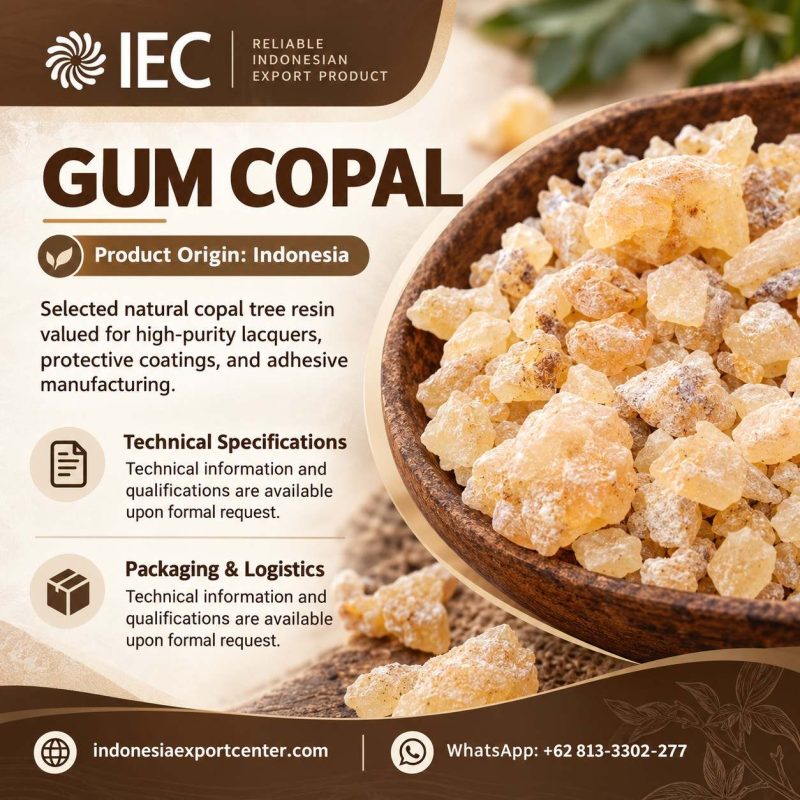
Indonesia Export Center (IEC) facilitates inquiries involving potential Indonesian Gum Copal suppliers.
The IEC product brochure does not provide a verified numerical moisture specification. Therefore, buyers should establish suitable requirements with their technical teams and confirm the supplier’s available analytical data.
What Is Moisture Content?
Moisture content generally refers to the amount of water present in a material, expressed according to a defined measurement basis.
Results may be reported as a percentage by mass.
However, the meaning of a reported result depends on the analytical method and the reporting basis.
For natural resins, a laboratory must ensure that the selected procedure is appropriate for the material.
Why Moisture Testing May Be Important
Storage
Moisture may be relevant to product condition during storage.
Handling
The material’s condition can affect preparation and processing.
Manufacturing
Certain formulations may be sensitive to water.
Quality Consistency
Changes between batches may require investigation.
Commercial Acceptance
If moisture is a contractual quality parameter, the buyer and seller must agree on the test method and acceptance limit.
Moisture Content vs Loss on Drying
These terms should not automatically be treated as equivalent.
Moisture Content is intended to quantify water.
Loss on Drying measures mass lost under defined drying conditions and may include substances other than water.
For a resin containing volatile components, a loss-on-drying result may not represent water alone.
The appropriate analytical approach should be selected by a qualified laboratory.
Possible Analytical Approaches
Depending on the material and laboratory validation, methods may include:
- Water-specific analytical methods.
- Validated gravimetric methods.
- Other suitable laboratory procedures.
For example, Karl Fischer analysis may be considered where technically appropriate and validated for the resin matrix.
The method must account for possible interferences and sample preparation requirements.
IEC does not prescribe a universal test method.
Step 1 – Define the Testing Objective
Determine whether the purpose is:
- Supplier qualification.
- Incoming quality control.
- Storage monitoring.
- Contract acceptance.
- Investigation of a quality complaint.
The objective influences the sampling and testing plan.
Step 2 – Identify the Lot
The laboratory should know which material is being tested.
Relevant information may include:
- Supplier.
- Grade.
- Lot number.
- Packaging.
- Sampling date.
- Storage conditions.
Step 3 – Establish a Sampling Plan
Natural resin shipments may contain variation between packages or within a lot.
A sampling plan should specify:
- Number of packages sampled.
- Sampling locations.
- Sample quantity.
- Sample handling.
- Sample containers.
- Labelling.
- Sample preservation.
- Retained samples.
Step 4 – Prepare the Sample
Sample preparation should be appropriate for the material and selected method.
The laboratory should document any grinding, subdivision, or other preparation that may influence the result.
Step 5 – Conduct Laboratory Testing
Testing should follow a documented, suitable procedure.
Relevant controls may include:
- Instrument calibration.
- Appropriate blanks.
- Replicate measurements.
- Method validation.
- Measurement uncertainty.
- Sample identification.
Step 6 – Report the Results
A useful laboratory report should identify:
| Information | Reporting Requirement |
|---|---|
| Sample ID | Unique identification |
| Product | Gum Copal |
| Grade | If known |
| Sampling Date | Recorded |
| Test Date | Recorded |
| Analytical Method | Identified |
| Result | Numerical value and unit |
| Reporting Basis | Defined |
| Measurement Uncertainty | Where applicable |
| Laboratory | Identified |
Step 7 – Compare Against the Buyer Specification
A laboratory result should be compared with the agreed acceptance limit.
IEC does not publish a fixed moisture threshold for Gum Copal.
The buyer should establish the appropriate limit based on technical requirements and supplier capability.
Step 8 – Investigate Nonconforming Results
If the material does not meet an agreed moisture requirement, possible next steps may include:
- Reviewing sampling records.
- Checking laboratory procedures.
- Conducting agreed retesting.
- Inspecting storage conditions.
- Evaluating packaging.
- Following the contract’s claims procedure.
The appropriate response depends on the evidence and contractual terms.
Moisture Testing Checklist
- Product identity confirmed.
- Lot identified.
- Sampling plan approved.
- Samples properly labelled.
- Test method selected.
- Method suitability reviewed.
- Results reported with units.
- Reporting basis defined.
- Acceptance criteria agreed.
- Retesting procedure documented.
Supplier Questions About Moisture
- Is moisture content routinely tested?
- Which method is used?
- Are recent results available?
- What sampling procedure is followed?
- How are samples stored?
- Is a maximum moisture value specified?
- Can the buyer request independent testing?
- How are nonconforming results handled?
Gum Copal Moisture Testing Inquiry
Subject: Indonesian Gum Copal Moisture Content and Laboratory Data Request
Company: [Name]
Country: [Country]
Product: Natural Gum Copal
Required Grade: [Details]
Application: [Details]
Quantity: [KG / MT]
Required Moisture Limit: [Buyer-defined]
Preferred Analytical Method: [If Specified]
Sampling Requirements: [Details]
Independent Testing Required: [Yes / No]
Destination: [Port, Country]
Please provide available moisture test information, methods, sample details, and supplier quality documentation.
Frequently Asked Questions
What is the standard moisture content of Gum Copal?
No universal value is established by the supplied IEC brochure.
Can moisture affect resin processing?
It may, depending on the resin and process.
Is loss on drying identical to water content?
Not necessarily.
Can buyers request independent laboratory testing?
Yes, subject to arrangements with the relevant parties.
Should every batch be tested?
Testing frequency should be determined by the buyer’s quality plan and contractual requirements.
Does IEC guarantee a moisture limit?
No. Limits must be verified and agreed.
Request Gum Copal Moisture Information
Need moisture test data or technical information for Indonesian Gum Copal procurement?
Contact IEC with your analytical requirements, intended application, and purchasing quantity.
REQUEST GUM COPAL MOISTURE INFORMATION
IEC | INDONESIA EXPORT CENTER
Website: https://indonesiaexportcenter.com/
WhatsApp: +62 813-3302-277
Related Resources
Gum Copal Technical Specifications Guide
Gum Copal Impurities and Foreign Matter
