

IEC | INDONESIA EXPORT CENTER
Your Global Sourcing Partner
Explore Indonesian Gum Copal for Industrial Varnish Formulations
Gum Copal is a natural resin with a long history of use in varnish-related applications.
For modern varnish manufacturers, the material may be evaluated as a candidate resin ingredient where its characteristics are compatible with the desired formulation and manufacturing process.
However, natural copal materials vary in their botanical origin, processing behavior, and physical properties.
Successful use in varnish manufacturing requires careful resin selection, controlled laboratory evaluation, and application-specific performance testing.
Indonesia Export Center (IEC) facilitates inquiries involving potential Indonesian Gum Copal suppliers.
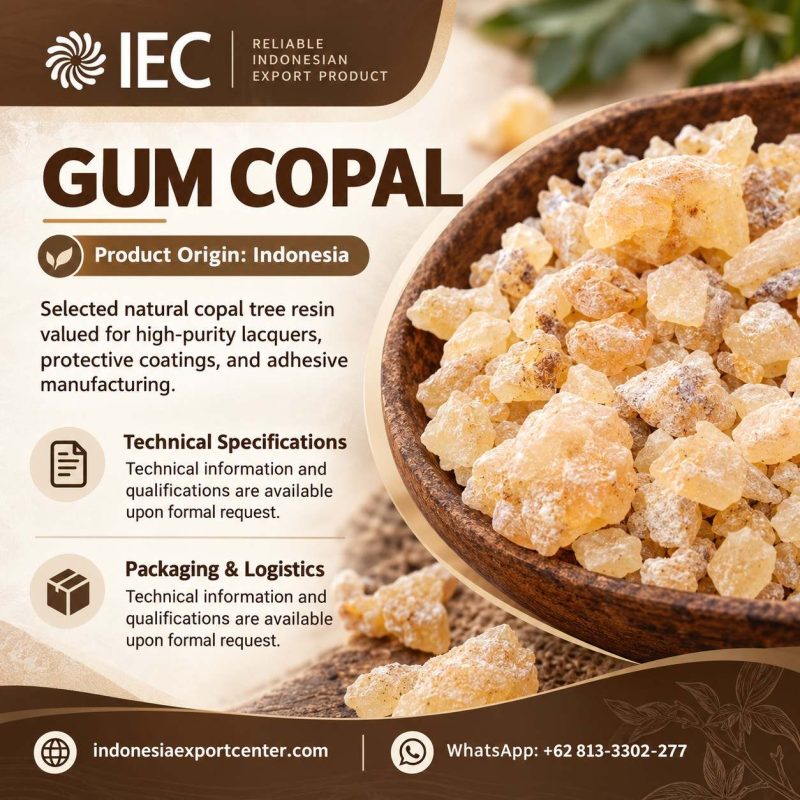
The IEC product brochure identifies natural Indonesian Gum Copal as a material associated with high-purity lacquer, protective coatings, and adhesive manufacturing. Technical specifications and qualifications are available upon formal request.
Understanding the Role of Resin in Varnish
A varnish is a coating system designed to form a film after application and curing or drying.
Resins can influence properties such as:
- Film formation.
- Appearance.
- Gloss.
- Hardness.
- Flexibility.
- Adhesion.
- Resistance characteristics.
- Processing behavior.
The actual contribution of Gum Copal depends on its chemistry, the complete formulation, and the curing or drying mechanism.
No universal performance benefit should be assumed.
Why Consider Natural Copal Resin?
Varnish formulators may investigate natural copal for:
- Traditional resin-based formulations.
- Specialty coating development.
- Comparison with alternative resin systems.
- Product research.
- Application-specific formulation modification.
The decision should be supported by testing.
Resin Identity and Grade Selection
The first stage is confirming the material being offered.
Buyers should request:
- Commercial resin identity.
- Botanical source, where available.
- Country of origin.
- Grade description.
- Physical form.
- Colour.
- Foreign matter information.
- Available processing data.
Different materials sold as copal may not behave identically.
Physical Properties Relevant to Varnish Manufacturing
Colour
Resin colour may influence the appearance of the finished varnish.
A controlled comparison is preferable to relying only on photographs.
Cleanliness
Foreign matter may affect processing and finished-product appearance.
Moisture
Moisture may be relevant to certain processing operations.
Solubility
Solubility depends on the actual resin and the selected solvent system, temperature, concentration, and processing conditions.
It must be tested.
Thermal Behavior
Some formulations may involve thermal processing.
Appropriate temperatures and equipment should be determined through qualified technical evaluation.
Film Characteristics
Hardness, flexibility, gloss, and other film properties must be measured in the finished formulation.
Gum Copal Technical Qualification
| Parameter | Recommended Evaluation |
|---|---|
| Resin Identity | Verify |
| Appearance | Compare representative samples |
| Colour | Controlled measurement |
| Foreign Matter | Inspect or test |
| Moisture | Test if relevant |
| Solubility | Application-specific test |
| Thermal Behavior | Evaluate safely |
| Formulation Compatibility | Laboratory trial |
| Film Formation | Apply and assess |
| Gloss | Measure where required |
| Hardness | Test using suitable method |
| Adhesion | Evaluate on intended substrate |
| Durability | Application-specific testing |
Developing a Varnish Trial
A structured qualification program may involve the following stages.
Stage 1 – Raw Material Review
Check the supplier’s product description and available technical information.
Stage 2 – Sample Preparation
Prepare the sample using an appropriate laboratory procedure.
Stage 3 – Compatibility Testing
Evaluate the resin under the intended formulation conditions.
Stage 4 – Pilot Formulation
Develop a controlled test formulation.
Stage 5 – Application Testing
Apply the varnish to the intended substrate.
Stage 6 – Film Evaluation
Assess the required physical and appearance properties.
Stage 7 – Stability Assessment
Evaluate relevant storage and formulation stability.
Stage 8 – Production Review
Determine whether the material is suitable for scale-up.
Varnish Formulation Challenges
Inconsistent Resin Grade
Natural material variation can affect repeatability.
Unexpected Solubility
A resin may behave differently from the buyer’s assumptions.
Colour Variation
Colour differences may influence finished-product appearance.
Processing Limitations
Equipment, heating, or filtration requirements may differ.
Finished-Film Performance
Laboratory appearance alone does not establish durability or long-term performance.
These risks should be addressed through controlled testing.
Quality Requirements for Commercial Procurement
A varnish manufacturer should establish:
- Acceptable grade.
- Sample reference.
- Colour criteria.
- Foreign matter limits.
- Moisture requirements.
- Processing characteristics.
- Analytical methods.
- Batch acceptance procedure.
Supplier Questions for Varnish Manufacturers
- What Gum Copal grade is offered?
- What is the source of the resin?
- How is the material sorted?
- Is a representative sample available?
- What technical data are available?
- Can the supplier provide consistent grading?
- What packaging is offered?
- What quantities are available?
- What are the export arrangements?
- What quality claims procedure applies?
Gum Copal Varnish RFQ Template
Subject: Indonesian Gum Copal for Varnish Manufacturing
Company: [Name]
Country: [Country]
Application: Industrial Varnish Manufacturing
Product: Natural Gum Copal
Required Grade: [Details]
Formulation Type: [Details]
Required Physical Form: [Details]
Colour Requirement: [Details]
Solubility Test Requirements: [Details]
Other Technical Requirements: [Details]
Sample Quantity: [KG]
Commercial Quantity: [KG / MT]
Destination Port: [Port]
Preferred Incoterm: [Term]
Please provide potential supplier information and available technical documentation for formulation evaluation.
Frequently Asked Questions
Is Gum Copal used in varnish manufacturing?
Copal has historical relevance to varnish formulations, but each modern application requires technical qualification.
Can Gum Copal improve varnish hardness?
Its effect depends on the specific resin and complete formulation. Testing is required.
Is Gum Copal soluble in every varnish solvent?
No universal solvent compatibility can be assumed.
Can it be used in water-based varnish?
Suitability depends on the resin system and any necessary processing or modification. It must be evaluated.
Does IEC provide a standard varnish formulation?
No verified formulation is provided.
Can manufacturers request samples?
Yes, subject to supplier confirmation.
Request Gum Copal for Varnish Manufacturing
Evaluating natural Indonesian Gum Copal for a varnish formulation or industrial coating project?
Send IEC your technical requirements, application, sample needs, and purchasing quantity.
REQUEST GUM COPAL FOR VARNISH MANUFACTURING
IEC | INDONESIA EXPORT CENTER
Website: https://indonesiaexportcenter.com/
WhatsApp: +62 813-3302-277
Related Resources
Natural Copal Resin Supplier Indonesia
Gum Copal for Protective Coatings
